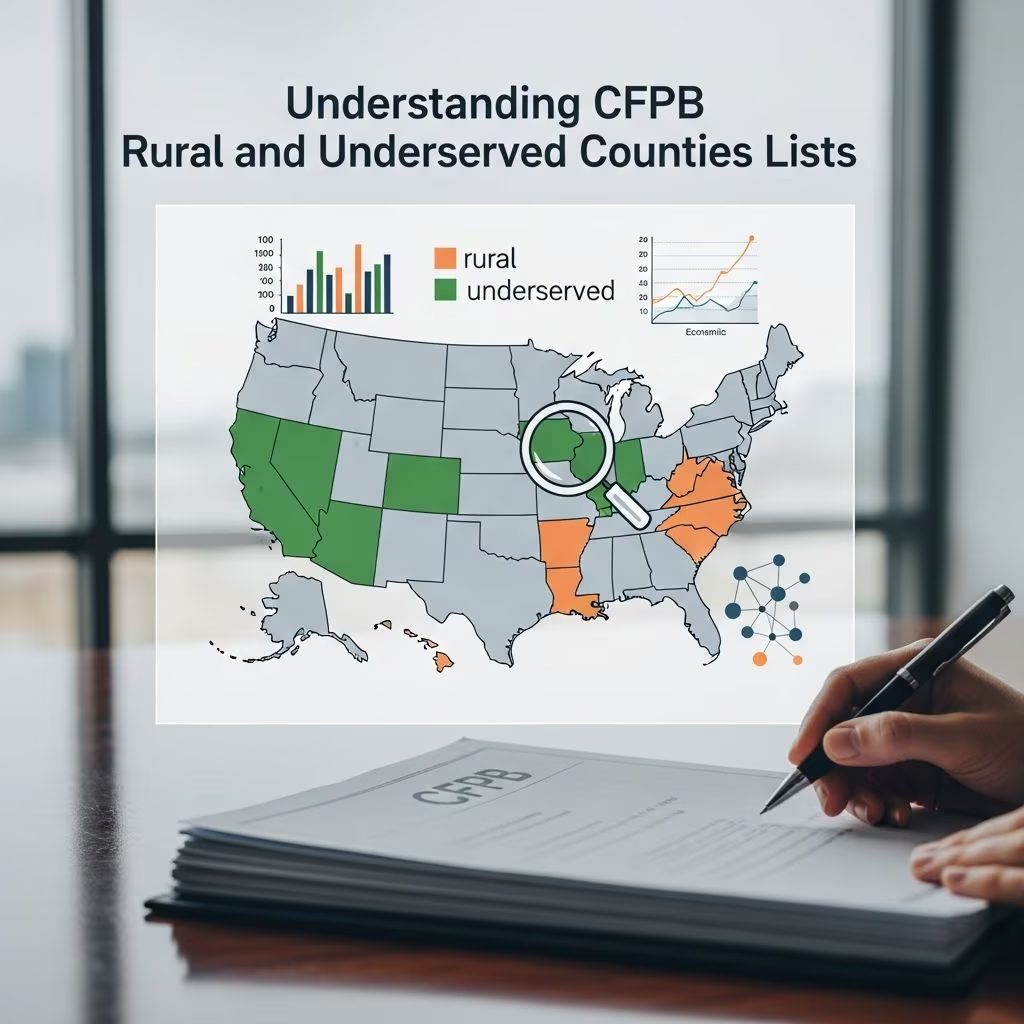
The Consumer Financial Protection Bureau (CFPB) publishes annual lists of rural and underserved counties to help mortgage creditors apply several targeted provisions of Regulation Z, which implements the Truth in Lending Act. These lists play a key role in determining when special compliance options and exemptions are available for certain mortgage products, especially in areas where consumers have fewer choices for credit.
1. Why Rural and Underserved Designations Matter
In many small or geographically isolated markets, traditional mortgage lending can be difficult and costly. To encourage responsible lending in these areas, Regulation Z provides tailored rules and regulatory relief to creditors that originate mortgages secured by properties located in designated rural or underserved counties.
These designations are important because they can affect:
- Escrow account requirements for higher-priced mortgage loans (HPMLs)
- Eligibility to originate balloon-payment qualified mortgages
- Certain servicing and appraisal rules that recognize unique rural market conditions
- Access to credit for consumers in markets that lack competition or nearby lenders
By using a standardized list, the CFPB offers a clear and predictable way for creditors to know when these special provisions may apply.
2. Overview of the CFPB Rural and Underserved Counties Lists
The CFPB publishes two closely related lists each year:
- A list of rural counties
- A list of rural or underserved counties
Both lists support specific provisions in Regulation Z, but they are not identical in scope or use. The lists typically cover:
- All U.S. states and the District of Columbia
- Certain U.S. territories that are treated as fully rural for CFPB purposes
Counties and county-equivalent areas are included or excluded based on objective data and methodologies linked to other federal datasets and rules, such as the Home Mortgage Disclosure Act (HMDA) and geographic classifications used by federal statistical agencies.
3. How the CFPB Identifies Rural Counties
To identify rural counties, the CFPB relies on concepts that are also used by other federal agencies to define rural areas, such as metropolitan and micropolitan statistical areas and census tract data. These statistical delineations are overseen by the Office of Management and Budget (OMB) and used by agencies like the Federal Housing Finance Agency (FHFA) and the U.S. Department of Agriculture (USDA).
Common features that typically distinguish rural areas in federal frameworks include:
- Location outside metropolitan statistical areas (MSAs)
- Low population density and limited urban development
- Significant distance from urbanized areas and economic centers
- Patterns of commuting and economic activity that are centered on small towns or dispersed communities
Agencies such as the Health Resources and Services Administration (HRSA) use detailed measures like Rural-Urban Commuting Area (RUCA) codes and road ruggedness to capture these characteristics at the census-tract level. While the CFPB’s list is organized at the county level, it builds on a similar foundation of demographic and geographic data.
4. How the CFPB Defines Underserved Counties
The concept of an underserved county is meant to identify places where mortgage lending activity is limited, signaling that consumers may have fewer options for mortgage credit even if the area is not strictly rural.
Under a CFPB final rule adopted in 2020, a county is treated as underserved if it meets a specific test based on HMDA data. Legal and industry analysis describes the standard as focusing on how many creditors extended covered first-lien transactions in that county during a given year, with a threshold set so that counties with very few active mortgage creditors may qualify as underserved. The underlying data come from the Home Mortgage Disclosure Act, which requires certain lenders to report detailed information about mortgage applications and originations.
In parallel, other regulators apply similar concepts of “underserved” in different contexts:
- The National Credit Union Administration (NCUA) describes underserved areas for credit union field-of-membership purposes as communities with economic distress, unmet financial service needs, and limited access to depository institutions.
- Definitions of persistent poverty counties and high-needs rural regions used by FHFA focus on long-term poverty levels and geographic disadvantage.
These related federal approaches help frame why the CFPB focuses on counties with very low levels of mortgage lending when defining “underserved.”
5. Territories Treated as Fully Rural
The CFPB’s lists explicitly recognize several U.S. territories as rural in their entirety for Regulation Z purposes. These territories are treated as county-equivalent areas that:
- Are not part of any metropolitan statistical area
- Are not designated as micropolitan statistical areas adjacent to metropolitan areas
This approach is generally consistent with how some federal housing and rural development programs recognize the unique geographic and economic conditions in these territories, where population centers are smaller and more isolated than in most states.
6. Regulation Z Provisions Tied to the Lists
The CFPB’s rural and underserved counties lists are not stand-alone policy tools; they are embedded in multiple provisions of Regulation Z. According to CFPB rulemakings and industry guidance, the lists help determine when creditors may use specific flexibilities, including:
| Regulatory Feature | How Rural/Underserved Status Matters |
|---|---|
| Escrow accounts for HPMLs | Certain small creditors operating predominantly in rural or underserved counties may qualify for an exemption from mandatory escrow accounts for higher-priced mortgage loans. |
| Balloon-payment Qualified Mortgages | Designated rural or underserved status can allow eligible small creditors to originate balloon-payment qualified mortgages under specific conditions. |
| Servicing and appraisal flexibilities | Some servicing and valuation requirements recognize the unique constraints of rural markets and rely on these lists to define qualifying locations. |
These special provisions are intended to balance consumer protection with the realities of small, thinly served mortgage markets.
7. Annual Updates and Methodology
The CFPB updates its rural and underserved counties lists each year, using data from defined reference periods. The methodology is anchored in an interpretive rule that explains how HMDA data are used to identify underserved counties and how geographic designations are applied.
Key elements of the methodology include:
- Data sources: Primarily HMDA data for mortgage activity and federal geographic classifications for rural status.
- Annual reference period: The lists typically reflect county status during a defined prior calendar year.
- Objective thresholds: Counties are added or removed based on whether they meet quantitative criteria such as lending activity levels and geographic classification.
- Published lists: Updated lists are made available on the CFPB’s website so creditors, examiners, and the public can see which counties qualify in a given year.
Because the lists are refreshed annually, a county may move on or off the rural or underserved lists over time as lending patterns or statistical area designations change.
8. Using the CFPB Rural or Underserved Areas Tool
In addition to the downloadable lists, the CFPB provides a Rural or Underserved Areas Tool that allows creditors to input specific addresses and determine whether a property is in a qualifying area.
Key features include:
- Address-level lookup: Users can enter single addresses or upload multiple addresses in batch format.
- Safe harbor: The CFPB states that creditors may rely on the tool to obtain a safe harbor determination that a property is located in a rural or underserved area for applicable Regulation Z provisions.
- Clear categorization: Results are typically grouped into categories such as “Rural/Underserved,” “Not Rural/Underserved,” “Could Not Be Identified,” and “Duplicates.” Addresses that appear in the “Rural/Underserved” category count as located in qualifying areas.
This tool reduces the risk of misclassification and ensures a consistent approach across creditors and examiners.
9. Practical Steps for Mortgage Creditors
Mortgage creditors that operate in smaller markets should integrate the rural and underserved counties lists and the address tool into their compliance processes. Common steps include:
- Policy design
Define when your institution intends to rely on special provisions tied to rural or underserved status (for example, small-creditor exemptions or balloon-payment qualified mortgages). - Eligibility tracking
Monitor your own lending footprint and asset size to determine whether you meet the “small creditor” or similar criteria required to take advantage of certain flexibilities. - System integration
Incorporate the CFPB lists or the address tool’s output into loan origination systems so each new application is evaluated for property location status. - Documentation and audit trail
Keep clear records of determinations based on the lists or the tool, including copies of annual lists used and any relevant screenshots or reports generated. - Training
Educate compliance, underwriting, and loan officer staff on how rural and underserved designations affect product options, disclosures, and escrow requirements.
Financial institutions that wish to expand service to underserved communities may also interact with other federal programs. For example, credit unions seeking to serve underserved areas under NCUA guidance must demonstrate economic distress and unmet needs, and NCUA may rely on CFPB’s underserved county data as one factor.
10. Consumer Implications
For consumers, the CFPB’s rural and underserved frameworks help maintain access to mortgage credit in locations where:
- There are relatively few local mortgage lenders
- Distances to bank branches and service providers are longer
- Property values may be more volatile or unique, complicating appraisals
- Income and employment may depend on seasonal or agricultural activity
By giving small creditors targeted flexibility while preserving core consumer protections, Regulation Z seeks to avoid a situation where regulatory requirements unintentionally discourage lending in already fragile markets.
Broader federal initiatives that focus on rural and medically underserved populations—such as HRSA’s rural definitions and indices used in health policy—underscore that access gaps often cut across financial, health, and infrastructure services. In that broader ecosystem, mortgage access is one element of community stability and long-term economic development.
11. Frequently Asked Questions (FAQs)
Q1: How often are the rural and underserved counties lists updated?
The CFPB updates the lists annually, using HMDA and geographic data from a defined reference year and publishing refreshed lists for future regulatory use.
Q2: Do rural and underserved designations affect all mortgage rules?
No. The designations affect specific provisions of Regulation Z, such as certain escrow account requirements and the ability of qualifying small creditors to make balloon-payment qualified mortgages. Standard Truth in Lending requirements still apply in all areas.
Q3: Can a county be underserved without being rural?
Yes. The underserved concept focuses on limited mortgage lending activity in a county, regardless of whether it is rural or metropolitan. A county can therefore be designated underserved based on HMDA lending data even if it is not classified as rural.
Q4: How can I confirm whether a specific property is in a rural or underserved area?
Creditors and other users can consult the CFPB’s annual lists and use the Rural or Underserved Areas Tool to check specific addresses. The CFPB indicates that creditors may rely on the tool’s output as a safe harbor for applicable Regulation Z provisions.
Q5: Are the CFPB definitions the same as those used in health or housing programs?
Not exactly. Many federal agencies, including HRSA and FHFA, maintain their own rural and underserved definitions tailored to program goals, using related but not identical criteria. The CFPB’s lists are specifically designed for mortgage and consumer credit regulation under Regulation Z.
References
- Rural and Underserved Counties List — Consumer Financial Protection Bureau. 2024-03-28. https://www.consumerfinance.gov/compliance/compliance-resources/mortgage-resources/rural-and-underserved-counties-list/
- Expanding Service to Underserved Areas: Application Guidance — National Credit Union Administration. 2023-10-24. https://ncua.gov/support-services/credit-union-resources-expansion/field-membership-expansion/serving-underserved/expanding-service-underserved-areas-application
- Duty to Serve High-Needs Counties Map Instructions — Federal Housing Finance Agency. 2023-12-15. https://www.fhfa.gov/data/duty-to-serve/high-needs-counties-map-instructions
- CFPB Releases Rural and Underserved Counties List — King & Spalding LLP. 2022-03-29. https://www.kslawllp.com/financial-institutions-blog/cfpb-releases-rural-and-underserved-counties-list
- How We Define Rural — Health Resources and Services Administration, Federal Office of Rural Health Policy. 2025-02-10. https://www.hrsa.gov/rural-health/about-us/what-is-rural
- Rural and Underserved Areas Tool — Consumer Financial Protection Bureau. 2017-06-01 (last updated). https://www.consumerfinance.gov/rural-or-underserved-tool/
- Am I Rural? Tool — Rural Health Information Hub. 2024-05-21. https://www.ruralhealthinfo.org/am-i-rural