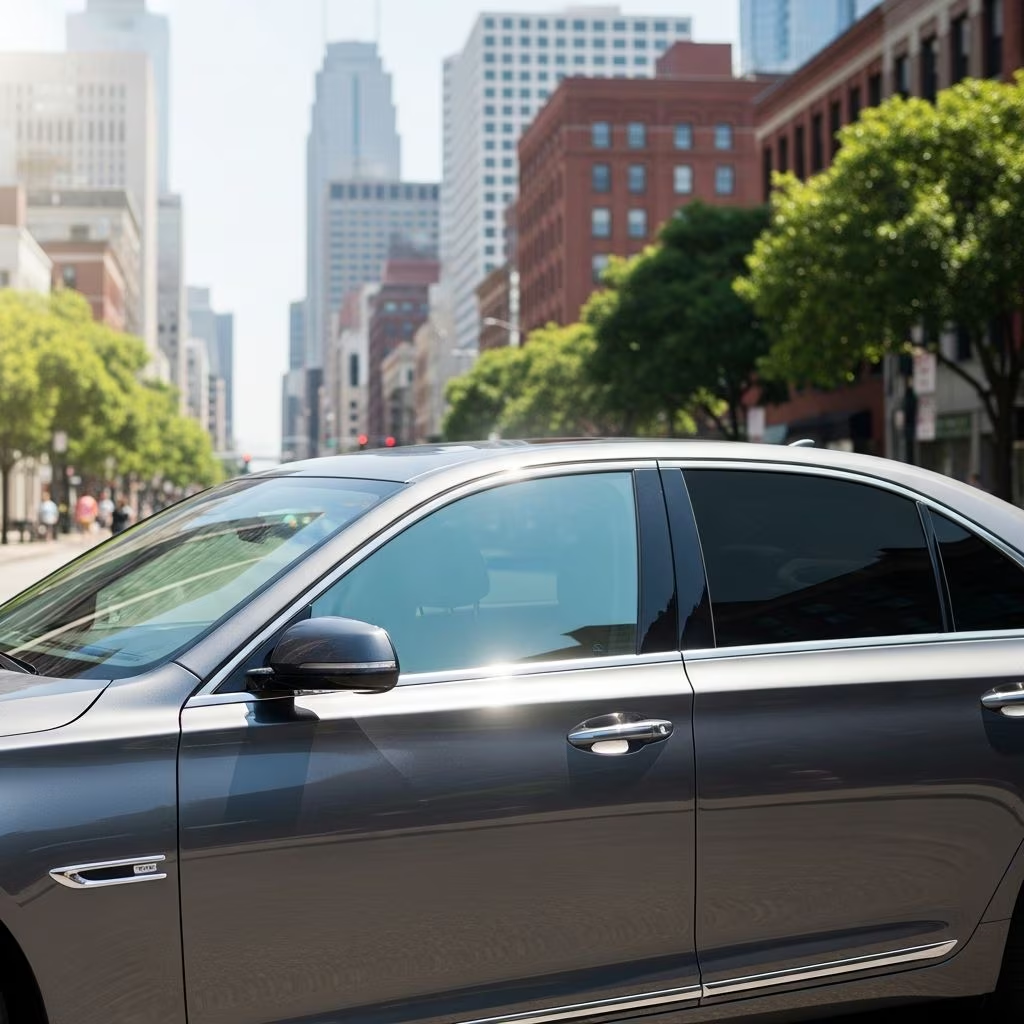
Darkened vehicle windows can make driving more comfortable and protect you from the sun, but every state limits how dark and reflective window tint can be to protect visibility and safety. Understanding these rules before you install tint helps you avoid tickets, inspection failures, and expensive re-tinting.
Why Window Tint Is Regulated
States and federal regulators impose limits on automotive tint to balance driver comfort with public safety.
- Driver visibility: Extremely dark windows can reduce a driver’s ability to see pedestrians, cyclists, and obstacles, especially at night or in bad weather.
- Law enforcement safety: Officers need to see inside a vehicle during traffic stops for their own safety and to assess what is happening inside.
- Accident safety standards: Federal glazing rules require a minimum level of light transmission in new passenger vehicles to ensure adequate outward visibility.
- Standardization: Basic limits on light transmission and reflectivity help keep vehicles reasonably similar across states, even though each state sets its own detailed rules.
Key Technical Terms You Must Know
Before comparing state laws, it helps to understand the technical language used in tint statutes and regulations.
Visible Light Transmission (VLT%)
Visible Light Transmission, often written as VLT%, is the percentage of visible light that passes through a window and any film applied to it.
- High VLT% (for example, 70%) = lighter tint and easier visibility.
- Low VLT% (for example, 20%) = darker tint and more privacy.
- Most laws measure combined VLT of both glass and film, not the film alone.
Reflectivity
Reflectivity measures how much light is reflected off the glass after tint is applied.
- Highly reflective films can look mirror-like and cause glare for other drivers.
- Many states limit reflectivity to around 20–35% to reduce glare and distracting mirror effects.
The Windshield “AS-1 Line”
Most states follow similar rules for windshields: you generally cannot cover the full windshield with dark tint.
- The AS-1 line is a mark on many windshields indicating how low a shade band may extend, usually about 4–6 inches from the top.
- Below that line, federal rules require relatively high light transmittance for passenger vehicles.
Typical Legal Rules by Window Location
Although each state writes its own statute, most follow a shared structure: windshields are most restricted, front side windows moderately restricted, and rear windows more permissive.
| Window Position | Common Legal Approach | Why It Matters |
|---|---|---|
| Windshield | Usually only a top band allowed (AS-1 line or 4–6 inches), often with limits on color and reflectivity. | Maintains clear forward visibility and prevents strong glare or color distortion. |
| Front side windows | Frequently must remain relatively light, such as 70% VLT or higher in some states, with reflectivity caps. | Allows drivers and law enforcement to see through the front doors where most interaction occurs. |
| Rear side windows | Often allowed to be darker (for example, 35% or lower), sometimes with conditions like dual side mirrors. | Provides privacy and heat reduction for passengers while preserving rear visibility with mirrors. |
| Rear window | Commonly allowed significant tint, but many states require two side mirrors if it is heavily darkened. | Drivers can see to the rear either directly or via mirrors; heavy tint may still be regulated for safety. |
Federal Rules vs. State Tint Laws
Vehicle tint law in the U.S. operates on two levels: federal safety standards for new vehicles and state rules for vehicles in use and aftermarket tint.
Federal Motor Vehicle Safety Standard No. 205
The National Highway Traffic Safety Administration (NHTSA) administers FMVSS No. 205, which regulates glazing materials in new vehicles.
- For most passenger cars, the glazing in windows required for driving visibility must transmit at least 70% of visible light when new.
- The standard applies to manufacturers and importers of vehicles and glass, not directly to individual vehicle owners modifying tint.
State-Level Tint Statutes
Aftermarket tint is mainly governed by state traffic laws, typically codified in the vehicle code or transportation code.
- States specify minimum VLT% for each window type, maximum reflectivity, and sometimes permitted colors.
- Some states require tint installers to provide a certificate or label showing compliance with state law.
- Violations may be treated as equipment infractions, fix-it tickets, or, if extreme, misdemeanors.
How State Laws Commonly Differ
There is no national uniform tint code, so a tint that is legal where you live may be illegal in a neighboring state.
Variation in Minimum VLT%
- Some states require relatively light tint on front windows (for example, around 70% VLT for front side windows in California).
- Others allow darker front window tint, such as 35% or even lower in certain jurisdictions.
- Rear windows are often allowed to be darker than the fronts, sometimes with no specific numerical limit for certain vehicle types, provided mirrors are present.
Differences in Reflectivity Limits
- Many states cap reflectivity at about 20–35% to avoid highly mirrored glass.
- Some explicitly prohibit holographic, prism, or colored mirror films on any vehicle window.
Separate Rules for Different Vehicle Types
- Passenger cars are sometimes held to higher light transmission standards than multipurpose vehicles, trucks, and vans.
- Sport-utility vehicles and vans may be allowed significantly darker tint on rear windows than sedans.
Enforcement and Penalties
How strictly tint laws are enforced can differ from one state or city to another, but the legal tools available to officers are similar across jurisdictions.
Traffic Stops and Inspections
- Officers may stop a vehicle if the tint appears darker or more reflective than allowed by law.
- Some agencies use portable light meters to measure VLT% during roadside checks.
- In states with mandatory safety inspections, unauthorized tint can result in a failed inspection until corrected.
Types of Penalties
- Fix-it tickets: Many jurisdictions issue a correctable citation that is dismissed once illegal tint is removed and proof is provided.
- Fines: Fines can increase for repeat violations and for very severe non-compliance.
- Criminal classification: In some states, applying or operating with severely illegal tint can be classified as a misdemeanor offense.
Medical and Other Exemptions
Because some people need extra sun protection for medical reasons, many states offer partial exemptions from standard tint limits.
- Qualifying conditions may include photosensitive skin disorders or other conditions made worse by light exposure.
- States may require documentation such as a physician’s letter, diagnosis, or a special permit card.
- Exemptions usually allow a lower VLT% than the normal limit, but rarely allow opaque or completely blacked-out windows.
- Drivers often must keep a copy of the exemption documentation in the vehicle to show during traffic stops.
Benefits of Legal Window Tint
Within legal limits, window tint can provide significant comfort and protection benefits, which is why it is popular in both sunny and cold regions.
- Reduced solar heat: Quality films can reduce the amount of solar energy entering the vehicle, decreasing interior temperatures and air-conditioning use.
- UV protection: Many automotive films block a large portion of ultraviolet radiation, which is linked to skin damage and interior fading.
- Glare reduction: Tint can reduce glare from sunlight and headlights, enhancing driver comfort and potentially improving reaction time.
- Privacy and security: Darker legal tint on rear windows can make it harder to see valuables or personal items inside the car.
Common Legal Pitfalls to Avoid
Drivers often encounter tint trouble not because they intended to break the law, but because of misunderstandings about how the rules apply.
- Assuming factory tint is always legal with added film: Many vehicles come with lightly tinted rear glass from the factory; adding film can push total VLT below legal thresholds.
- Using film percentages instead of combined VLT: A film labeled 35% may result in a combined VLT lower than 35% when applied to glass that is already tinted.
- Ignoring reflectivity limits: Some films are legal in darkness but illegal because they exceed reflectivity caps or have metallic mirror finishes.
- Relying on out-of-state rules: A tint job that complied with the law in one state may violate another state’s statute when you move or travel.
Staying Compliant: Practical Tips
If you plan to tint your vehicle windows, a few careful steps can help ensure you stay within the law.
- Check official state resources: Review your state’s vehicle code or Department of Motor Vehicles guidance on window tint limits before installation.
- Use reputable installers: Professional tint shops often track local laws and can recommend films that keep you compliant.
- Ask for documentation: Where available, request a certificate, receipt notation, or label stating the VLT% and confirming intended compliance.
- Consider future moves or travel: If you frequently cross state lines, consider choosing a slightly lighter tint that is less likely to cause issues elsewhere.
Frequently Asked Questions (FAQs)
Q: Is window tint legal in every U.S. state?
Yes. Window tint is legal in every state, but each state sets its own limits for how dark and reflective the tint can be on each window.
Q: What does “limo tint” mean, and is it usually legal?
“Limo tint” is an informal term for very dark tint with a low VLT% (often around 5%). In many states this shade is not legal on front side windows and may only be allowed on rear windows, if at all.
Q: Can I tint my entire windshield?
No. Federal and state rules do not allow dark tint over the entire windshield. Most states allow only a non-reflective band at the top of the windshield, down to the AS-1 line or a similar measurement.
Q: How can police tell if my tint is too dark?
Officers may rely on visual assessment to justify a stop, and some departments use hand-held meters to measure how much light passes through your windows during a traffic stop.
Q: What should I do if I receive a tint ticket?
Read the citation carefully to see whether it is a correctable violation. If so, remove or replace the illegal tint, obtain proof of correction, and follow local procedures for dismissal or reduced penalties.
References
- Interpretation ID: NHT87-3.49 (FMVSS No. 205 Glazing Requirements) — National Highway Traffic Safety Administration (NHTSA). 1987-02-24. https://www.nhtsa.gov/interpretations/nht87-3.49
- Window Tint Laws By State: 2024 Legal Window Tint Percentages — Rayno Window Film. 2024-01-15. https://www.raynofilm.com/blog/automotive-window-tint-laws-by-state
- Vehicle Window Tint Laws By State [Updated 2025] — Tint Wiz. 2025-03-10. https://tintwiz.com/window-tint-laws-by-state
- 46.2-1052. Tinting Films, Signs, Decals, and Stickers on Motor Vehicle Windows — Code of Virginia. 2022-07-01. https://law.lis.virginia.gov/vacode/title46.2/chapter10/section46.2-1052/
- United States Tint Laws (State-by-State Overview) — All Florida Tinting Co. 2023-06-01. https://allfloridatinting.com/united-states-tint-laws
- In the Dark About Auto Tint Laws? — 3M Company. 2021-09-20. https://www.3m.com/3M/en_US/home-window-solutions-us/resources/window-film-blog/full-story/~/auto-window-tint-laws/