
Understanding At-Will Employment in Georgia
Learn how Georgia’s at-will employment rule works, its limits, and when firing or quitting may raise legal issues.
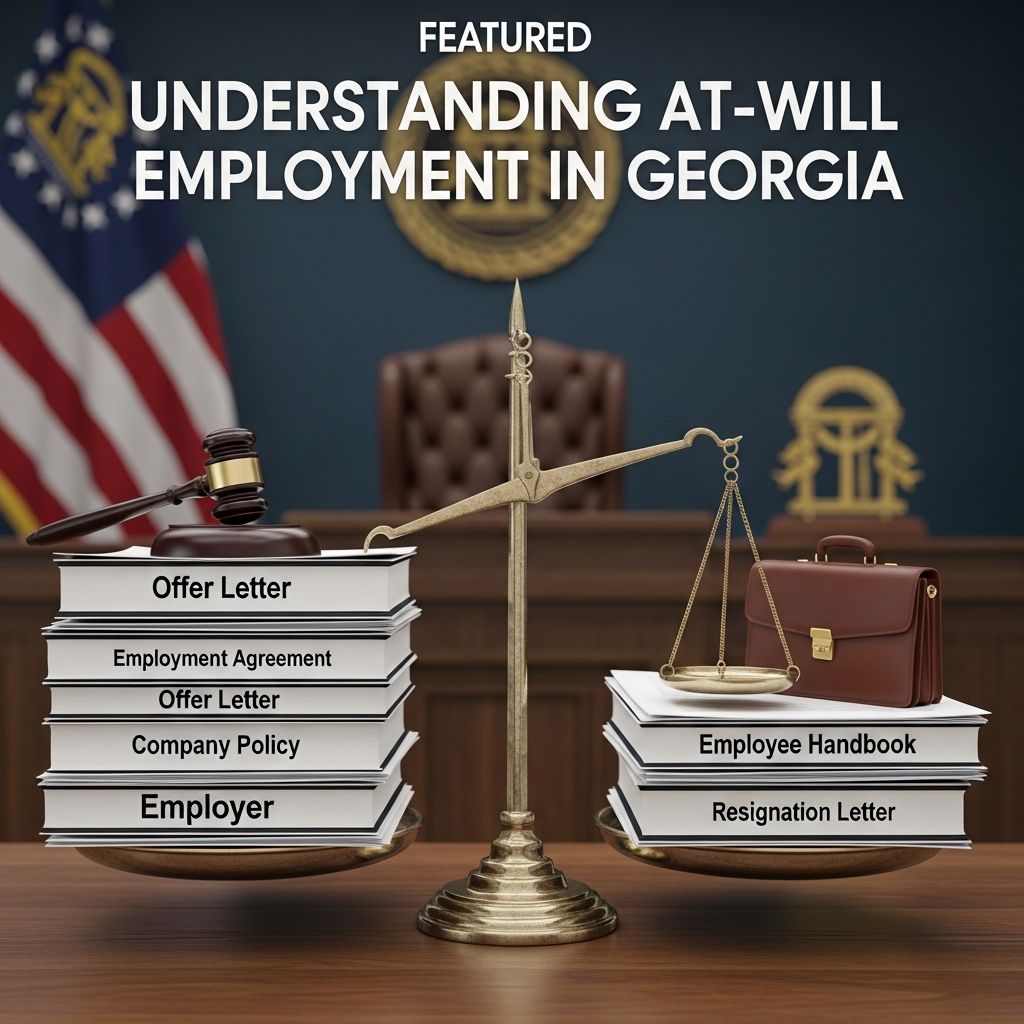
Georgia is widely known as an at-will employment state. For most workers, this means a job can end suddenly, often without advance notice, and sometimes without a clear explanation. But at-will employment does not give employers unlimited power, and it does not erase all employee rights. This guide explains what at-will employment means in Georgia, how the law works, and when a firing may still be unlawful.
1. What “At-Will Employment” Means in Georgia
Under Georgia law, if an employment relationship does not have a clearly defined duration, it is presumed to be at-will. The core rule is that either the employer or the employee may end the relationship at any time, for almost any reason, or for no stated reason at all.
- Employer rights: A business can terminate an at-will employee at any time, with or without cause, as long as the reason is not specifically prohibited by law.
- Employee rights: A worker may quit at any time, for any reason, and generally without legal penalty.
- Default rule: If a contract does not set a fixed end date, Georgia courts usually treat it as at-will employment.
This presumption of at-will employment is codified in Georgia’s employment statute, which provides that a hiring for an indefinite term may be ended at the will of either party.
2. How At-Will Employment Is Codified in Georgia Law
Georgia’s at-will doctrine is grounded in state statute and has been interpreted repeatedly by the courts.
- Statutory basis: Georgia Code section 34-7-1 states that if no specific term is agreed upon, employment is terminable at the will of either party.
- Judicial interpretation: Georgia courts have held that an at-will employee may be discharged “with or without cause, and regardless of motive,” meaning even unfair or arbitrary decisions generally do not create a contract claim.
- No broad common-law exceptions: Georgia appellate decisions emphasize that exceptions to the at-will rule must come from statute or contract; courts have been reluctant to create new judge-made exceptions.
As a result, many lawsuits based solely on allegations of unfair treatment fail unless the employee can point to a specific statute or contract provision that limits the employer’s discretion.
3. At-Will Employment vs. Contract Employment
Not every job in Georgia is at-will. Some workers are protected by agreements that promise employment for a particular duration or under specific conditions.
| Feature | At-Will Employment | Contract (Fixed-Term or For-Cause) Employment |
|---|---|---|
| Duration | Indefinite; no fixed end date by default. | Specific period (e.g., one year) or clear conditions for continuation. |
| Termination Standard | Either party may end employment at any time, for good reason, bad reason, or no reason, if not illegal. | Often requires “cause,” notice, or other contractually described grounds. |
| Legal Claims for Firing | Limited mainly to statutory claims (e.g., discrimination, retaliation). | May include breach of contract, wrongful termination in violation of contract, plus statutory claims. |
| Source of Protection | Primarily federal and state statutes. | Both contract terms and federal/state statutes. |
Even when a worker has a written agreement, only the period clearly defined in that contract falls outside the default at-will rule. Once a defined minimum term expires, any continued employment often reverts to at-will status unless a new agreement is made.
4. Limits on At-Will: When Firing Is Illegal
At-will employment in Georgia does not allow an employer to violate federal or state laws. A termination may be unlawful if it is based on a protected characteristic or if it punishes an employee for exercising certain legal rights.
4.1 Discrimination Based on Protected Characteristics
Several federal laws prohibit firing workers because they belong to specific protected groups:
- Title VII of the Civil Rights Act: Bars discrimination based on race, color, religion, sex (including pregnancy, sexual orientation, and gender identity), and national origin.
- Age Discrimination in Employment Act (ADEA): Protects workers age 40 and older from age-based employment decisions.
- Americans with Disabilities Act (ADA): Prohibits discrimination based on disability and requires reasonable accommodations for qualified employees.
Employers in Georgia cannot justify illegal discrimination by pointing to the at-will rule. If a termination is motivated by a protected characteristic, the worker may have a federal discrimination claim even though the job was at-will.
4.2 Retaliation for Exercising Legal Rights
Many employment statutes include anti-retaliation provisions that protect employees who assert their rights. A firing may be unlawful if it occurs because an employee:
- Filed a discrimination complaint, participated in an investigation, or opposed discriminatory practices under federal civil rights laws.
- Reported unsafe working conditions or exercised rights under federal workplace safety rules overseen by OSHA.
- Requested or took approved leave under the Family and Medical Leave Act (FMLA) for a qualifying reason.
- Complained about unpaid overtime or minimum wage violations under federal wage-and-hour law.
In these circumstances, an employee may still be considered at-will, but the employer cannot lawfully use termination as punishment for asserting protected rights.
4.3 Public Sector and Civil Service Rules
Some state and local government employees in Georgia are covered by civil service systems or specific statutes that require cause or due process for termination. Courts have recognized that, where no such protections apply, public employees are also at-will and lack a property interest in continued employment. Workers in the public sector should carefully review applicable regulations, handbooks, and contracts to understand whether they are truly at-will.
5. What Does Not Usually Change At-Will Status
Many employees assume that certain employer actions convert an at-will job into a guaranteed position. In Georgia, courts often reject those arguments.
- Employee handbooks and policies: General personnel policies, manuals, or disciplinary procedures rarely create a binding promise of continued employment if they do not expressly change the at-will relationship.
- Oral assurances: Verbal statements such as “you will always have a job here” or “we only fire for cause” are typically not enforced as contracts that override the statute.
- Long service or good performance: Lengthy tenure, positive reviews, or promotions do not, by themselves, alter the at-will status or create a right to ongoing employment.
Because of this, it is difficult in Georgia to argue that at-will status has been modified unless there is a clear, written, and enforceable agreement specifying terms inconsistent with at-will employment.
6. Common Misunderstandings About Firing in Georgia
The at-will doctrine often leads to confusion about what is and is not allowed. The following clarifications may help:
- “No reason” can be legal: An employer is not required to give a reason for terminating an at-will employee, and the reason does not have to be wise, fair, or objectively reasonable, as long as it is not unlawful discrimination or retaliation.
- Unfair is not the same as illegal: A firing that seems harsh, inconsistent, or based on personality conflicts is generally not actionable unless it violates a specific law.
- “Wrongful termination” is limited: Georgia does not recognize a broad common-law claim for wrongful termination; employees usually must base claims on statutes such as anti-discrimination or wage-and-hour laws.
Workers sometimes discover that they have no legal claim even though they feel deeply wronged. Conversely, some employees assume they have no recourse in an at-will state when, in fact, federal statutes protect them against specific kinds of terminations.
7. Practical Steps After Losing a Job
If you are fired in Georgia, there are practical actions you can take to understand your rights and prepare for next steps.
- Ask (politely) for the reason: Employers do not always have to share their rationale, but documenting what is said can help evaluate whether the termination may have been unlawful.
- Gather records: Retain offer letters, contracts, handbooks, performance reviews, emails, and any disciplinary notices that might be relevant.
- Note timing and context: Write down events leading up to the termination, especially if you recently made a complaint, requested leave, or engaged in other legally protected activity.
- Consider benefits and final pay: Review eligibility for unemployment benefits through the Georgia Department of Labor and clarify issues such as final paycheck, unused vacation or PTO according to company policy, and continuation of health coverage.
- Seek legal guidance if needed: In complex situations, consultation with an employment attorney can help determine whether the firing was lawful and what deadlines apply to potential claims.
Even when no legal violation occurred, understanding the basis for your termination can be valuable for future job searches and professional development.
8. How At-Will Affects Day-to-Day Workplace Decisions
Because employment can be ended quickly, at-will status influences both employer and employee behavior.
- For employers: The doctrine provides flexibility in staffing, allowing rapid changes in response to business needs, performance issues, or restructuring.
- For employees: Workers have the freedom to pursue better opportunities without worrying about breach-of-contract claims for leaving early, but also face less security.
- For workplace culture: In some settings, heavy reliance on at-will termination can affect trust, communication, and willingness to report problems, especially if employees fear retaliation.
Employers may choose, as a matter of policy, to give warnings, performance improvement plans, or severance even when not legally required, in order to promote fairness and reduce conflict.
9. Frequently Asked Questions (FAQs)
Q1: Can my Georgia employer fire me without giving a reason?
Yes, if you are an at-will employee, your employer may terminate you without giving a reason, as long as the decision is not based on a legally prohibited ground such as discrimination or retaliation.
Q2: Does my employee handbook guarantee that I cannot be fired?
Generally no. In Georgia, handbooks and policy manuals are usually not treated as binding contracts that override the at-will rule, unless they contain very clear contractual language that the employer intends to be binding.
Q3: Is every termination in Georgia considered “wrongful termination”?
No. Georgia does not recognize a broad claim for wrongful termination. Instead, employees usually must show that a specific statute—such as a discrimination, retaliation, or wage-and-hour law—or a contract was violated.
Q4: If I quit my job, can my employer sue me for leaving too soon?
In an at-will relationship, employees are generally free to resign at any time without legal penalty, though professional norms may favor giving notice. If you are under a fixed-term contract, different rules may apply, and you should review the agreement.
Q5: How do I know if my firing was illegal?
You must typically show that the termination was connected to a protected characteristic (such as race, age, or disability), a protected activity (such as filing a complaint or requesting qualifying medical leave), or violated a clear contract. Consulting with a qualified employment attorney or legal aid organization can help you evaluate your situation in light of Georgia’s at-will doctrine and applicable federal laws.
References
- Quick and Easy Guide to Labor & Employment Law: Georgia — Baker, Donelson, Bearman, Caldwell & Berkowitz, PC. 2025-10-01. https://www.bakerdonelson.com/easy-guide-georgia
- Georgia’s At-Will Employment Doctrine — Barrett & Farahany, LLP. 2022-06-15. https://www.justiceatwork.com/georgias-at-will-employment-doctrine/
- Georgia Code § 34-7-1 (Determination of Term of Employment) — State of Georgia / Justia. 2020-01-01. https://law.justia.com/codes/georgia/2020/title-34/chapter-7/article-1/part-1/section-34-7-1/
- Wrongful Termination — Moeller Barbaree LLP. 2023-03-10. https://www.moellerbarbaree.com/employment-law/wrongful-termination/
- At-Will Employment — State Accounting Office, State of Georgia. 2021-09-01. https://sao.georgia.gov/will-employment
- Do At-Will Employees Have Legal Rights for Wrongful Termination? — Radford & Scott, LLP. 2023-05-05. https://radfordscott.com/will-employees-legal-rights-wrongful-termination/
- If You Lose Your Job — GeorgiaLegalAid.org. 2022-11-20. https://www.georgialegalaid.org/resource/if-you-lose-your-job
Similar Articles








Read full bio of medha deb




