
Understanding Alabama Gambling and Lottery Laws
A clear, practical guide to how Alabama regulates gambling, lotteries, bingo, casinos, and online wagering.
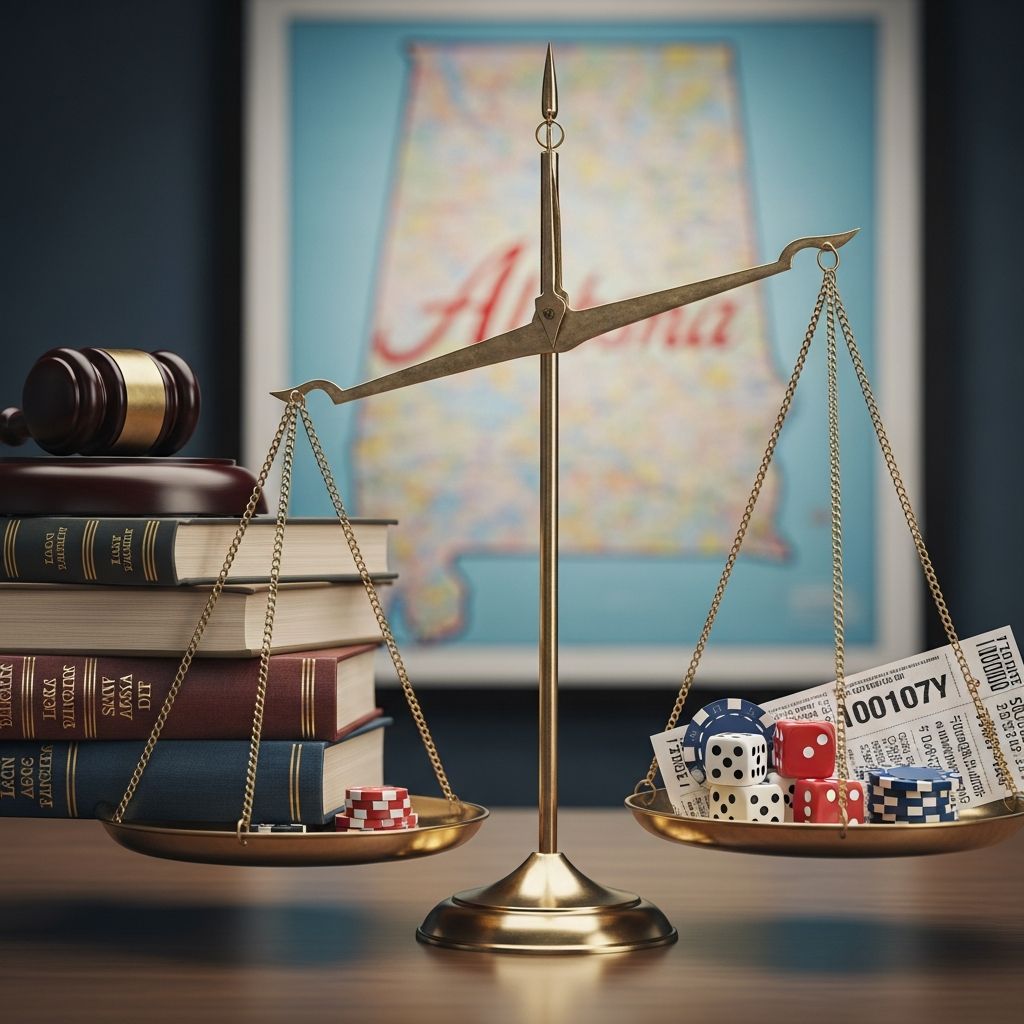
Alabama is one of the more restrictive states in the United States when it comes to gambling. While residents may see electronic bingo halls, tribal casinos, and church raffles, many traditional forms of commercial gambling remain illegal, and violations can carry serious criminal penalties. This guide explains the major rules, exceptions, and gray areas so you can understand what is allowed and what is not under Alabama law.
1. Why Gambling Law in Alabama Is Different
Unlike many states that permit commercial casinos and state lotteries, Alabama’s constitution historically prohibited most forms of gambling and still does not authorize a state-run lottery. Lawmakers have debated gambling expansion for decades, including proposals for casinos, sports betting, and a lottery, but recent efforts have failed to win final approval.
Three big features shape the state’s approach:
- Constitutional limits on lotteries and many forms of gambling.
- Criminal statutes that make operating or advancing illegal gambling a crime, with potential felony charges for large-scale or repeated operations.
- Local and tribal exceptions for charity bingo and gaming on federal tribal lands.
2. What Counts as Gambling Under Alabama Law?
Alabama law generally treats an activity as illegal gambling when it has three core elements:
- Players stake money or valuable items (consideration).
- The outcome depends largely on chance rather than skill.
- There is an opportunity to win something of value (prize).
When these elements appear together and the activity is not specifically authorized by law (such as certain charity bingo games or tribal casino gaming), it is typically prohibited.
3. Criminal Offenses and Penalties for Illegal Gambling
Alabama targets both the people who run gambling operations and, in some cases, those who participate. A recent bill supported by the Alabama Attorney General highlights the state’s focus on cracking down on illegal operations and elevating serious gambling conduct to felony status.
3.1 Common Gambling-Related Crimes
Key types of gambling offenses under Alabama law include:
- Simple gambling offenses – participating in unlawful games of chance for money.
- Promoting or advancing gambling – running, financing, or managing an illegal gambling operation or “gambling place.”
- Possessing gambling records or devices – holding ledgers, slips, machines, or equipment used for illegal betting.
- Operating illegal slot machines or electronic games – using devices that simulate casino-style games without legal authorization.
3.2 Misdemeanor vs. Felony Conduct
Smaller, one-time betting among individuals may be treated as a misdemeanor. By contrast, large or organized operations—especially those using machines or serving many customers—can be charged as felonies. This is consistent with the Attorney General’s stated priority of “fighting illegal gambling” through stronger felony penalties and enforcement tools.
| Type of conduct | Typical treatment | Key factors |
|---|---|---|
| Individual placing an illegal bet | Often misdemeanor | Small stakes, no business operation |
| Running an underground casino or sports book | Often felony | Scale of operation, profit motive, repeated activity |
| Owning illegal slot machines or electronic bingo devices | Misdemeanor or felony | Number of machines, prior offenses, revenue |
Because exact charges depend on how prosecutors apply specific code sections and any new legislation, anyone facing investigation or charges should consult a licensed Alabama attorney for case-specific advice.
4. Is There a State Lottery in Alabama?
Alabama currently has no state lottery. Proposals to amend the state constitution and create a lottery—often combined with casino or sports betting measures—have repeatedly stalled in the Legislature or failed to become law.
Recent plans that gained attention would have:
- Created a state lottery corporation to oversee ticket sales.
- Authorized lottery games similar to those offered in neighboring states.
- Dedicated lottery revenue to state programs through special trust funds.
However, none of these plans have taken effect, so buying traditional state lottery tickets within Alabama remains unavailable. Many residents travel to nearby states like Georgia or Florida, where lotteries are legal and regulated by those states’ laws.
5. Tribal Casinos and Class II Gaming
While Alabama prohibits commercial casinos owned by private companies, federal law allows certain forms of gambling on tribal lands under the Indian Gaming Regulatory Act (IGRA). In Alabama, the federally recognized Poarch Band of Creek Indians operates casino facilities that primarily offer Class II gaming, such as electronic bingo machines.
5.1 What Is Class II Gaming?
Under IGRA, Class II games include bingo and some card games that are explicitly allowed by federal rules, but not traditional house-banked casino games like roulette or standard slot machines. Electronic bingo games may look similar to slots, but they are legally tied to bingo play structures.
5.2 Compacts and State Regulation
States can enter into tribal-state compacts authorizing broader forms of gaming (Class III, including standard slots and table games), but Alabama has historically not implemented a comprehensive compact covering full casino gambling. Recent legislative proposals would require negotiation of such a compact and would establish an Alabama gaming commission to oversee non-tribal gaming if voters approved a constitutional amendment.
6. Charity Bingo, Raffles, and Local Amendments
Alabama’s constitution allows for local constitutional amendments that can legalize charity bingo and other limited games in specific counties. Over time, several counties have adopted such amendments, creating a patchwork of rules across the state.
6.1 Requirements for Legal Charity Games
Local provisions for bingo or raffles typically limit the activity to:
- Nonprofit or charitable organizations registered under applicable laws.
- Fundraising purposes, such as supporting churches, civic groups, or community projects.
- Licensing or permitting requirements imposed by the county or municipality.
Many proposals under consideration in recent years would have maintained or slightly expanded charity bingo while explicitly banning certain high-speed electronic games that resemble slot machines.
6.2 The Electronic Bingo Controversy
Electronic bingo machines have been a long-running source of litigation and enforcement actions in Alabama. State officials argue that some devices marketed as “bingo” are actually illegal slot machines, while operators claim that local constitutional amendments allow their use. Law enforcement actions, task forces, and court rulings have repeatedly targeted facilities alleged to be operating outside the scope of authorized charity bingo.
7. Sports Betting and Online Gambling
Sports betting is not currently legal in Alabama, either in-person or online. While many states have moved to legalize and regulate sports wagering following the U.S. Supreme Court’s decision in Murphy v. NCAA (2018), Alabama has not adopted a permanent sports betting framework.
7.1 Recent Legislative Efforts on Sports Betting
In recent legislative sessions, lawmakers introduced bills that would have:
- Authorized online sports betting through licensed platforms.
- Allowed limited retail sportsbooks at racetracks or casino sites.
- Created a state gaming commission to regulate sports betting, casinos, and a lottery.
These measures advanced at times but ultimately failed, leaving Alabama without legal sportsbooks.
7.2 Online Casino and Internet Gambling
There is no Alabama statute that explicitly authorizes online casinos or internet poker offered to state residents. In general, participating in online games of chance for money, when those games would be illegal if run within the state, risks violating state gambling laws. The Alabama Policy Institute and other groups have specifically warned about the dangers of online gambling expansion, including potential addiction and social harms.
7.3 Daily Fantasy Sports (DFS)
Alabama initially treated daily fantasy sports contests as illegal gambling, but the Legislature later carved out a framework that allows licensed DFS operators to offer contests in the state under specific regulations. Major platforms such as DraftKings and FanDuel are now able to operate DFS under these rules, while agreeing to modify certain pick’em style offerings after discussions with the Attorney General’s office.
8. Policy Debate: Expansion vs. Restriction
Gambling in Alabama is not only a legal topic but also a significant policy and political issue. Proponents and opponents present sharply contrasting views on whether the state should authorize more forms of gambling.
8.1 Arguments for Expansion
- Revenue: Supporters argue a lottery, casinos, and sports betting would generate substantial tax and licensing revenue without raising traditional taxes.
- Regulation of existing activity: Many Alabamians already travel to nearby states to gamble or use unregulated online sites, so advocates say legalization would bring this activity under state oversight.
- Economic development: Expanded gambling could create jobs at facilities such as racetracks and entertainment complexes.
8.2 Arguments for Limiting or Opposing Gambling
- Social costs: Opponents point to gambling addiction, bankruptcy, and family disruption as reasons to avoid further expansion.
- Regressive impact: Policy groups argue that lotteries and casino-style games fall disproportionately on lower-income residents, effectively acting as a regressive revenue source.
- Law-enforcement concerns: Some leaders favor stricter enforcement of existing laws instead of legalization, contending that making illegal operations legal will not solve underlying problems.
9. Practical Tips for Alabama Residents
If you live in or visit Alabama and are unsure whether a particular game or venue is legal, consider the following guidelines:
- Check the type of game: Traditional bingo at a church in a county with a local amendment is different from a high-speed electronic game at an unlicensed venue.
- Look for nonprofit sponsors: True charity games should list the benefiting nonprofit organization and comply with local licensing rules.
- Be cautious with online sites: Offshore casinos or sports books that claim to accept Alabama players are not licensed or regulated by Alabama authorities.
- Understand travel limitations: Buying lottery tickets in another state is subject to that state’s rules, but Alabama law may still apply to related conduct once you are back in-state.
- Seek legal advice if in doubt: Because Alabama’s gambling framework is complex and evolving, a local attorney is the best source for individualized guidance.
10. Frequently Asked Questions about Alabama Gambling Laws
Q1: Is any form of casino gambling legal in Alabama?
Commercial, privately owned casinos are not legal under Alabama law. However, federally recognized tribal casinos operated by the Poarch Band of Creek Indians offer Class II gaming such as electronic bingo under federal law and tribal authority.
Q2: Can I legally bet on sports in Alabama?
No. Alabama has not authorized legal sports betting, either in-person or online. Recent bills that would have allowed sports wagering failed to become law.
Q3: Are home poker games legal?
Small, purely social games where no one takes a fee or house cut are generally treated differently from for-profit operations, but Alabama law can still apply if chance predominates and money changes hands. Because the line can be blurry, anyone running regular games for money should speak with an attorney.
Q4: Is daily fantasy sports (DFS) allowed in Alabama?
Yes, daily fantasy sports contests are permitted under specific state legislation, and major DFS operators may legally offer contests in Alabama if they follow regulatory requirements.
Q5: Can my nonprofit hold a raffle or bingo night?
Possibly. Many counties allow charity bingo or raffles through local constitutional amendments, often with licensing and operational rules. Your organization must confirm that your county authorizes such games and comply with all applicable regulations to avoid illegal gambling charges.
Q6: What should I do if I think I’m involved in illegal gambling without realizing it?
Stop participating, gather any documentation you have, and consult a licensed Alabama attorney. Given the potential for misdemeanor or felony charges, it is important to get legal advice tailored to your situation.
References
- AG Announces Senate Committee Approves Felony Gambling Bill — Alabama Attorney General’s Office. 2024-04-17. https://www.alabamaag.gov/ag-announces-senate-committee-approves-felony-gambling-bill/
- Alabama Sports Betting: Legal AL Sportsbooks & Legislation Updates — Legal Sports Report. 2024-06-01 (updated). https://www.legalsportsreport.com/sports-betting-states/alabama/
- Gambling — Alabama Policy Institute. 2024-05-28. https://alabamapolicy.org/gambling/
- Albritton has gambling bill, working to shore up support in second half of session — Alabama Daily News. 2025-02-06. https://aldailynews.com/albritton-has-gambling-bill-working-to-shore-up-support-in-second-half-of-session/
- Alabama determined to stay in the past when it comes to gambling — Alabama Political Reporter. 2025-09-24. https://www.alreporter.com/2025/09/24/opinion-alabama-determined-to-stay-in-the-past-when-it-comes-to-gambling/
Similar Articles








Read full bio of Sneha Tete


