
Understanding Admissible Evidence in Criminal Cases
Learn how courts decide what evidence juries can hear, and why some proof never reaches the courtroom in criminal trials.
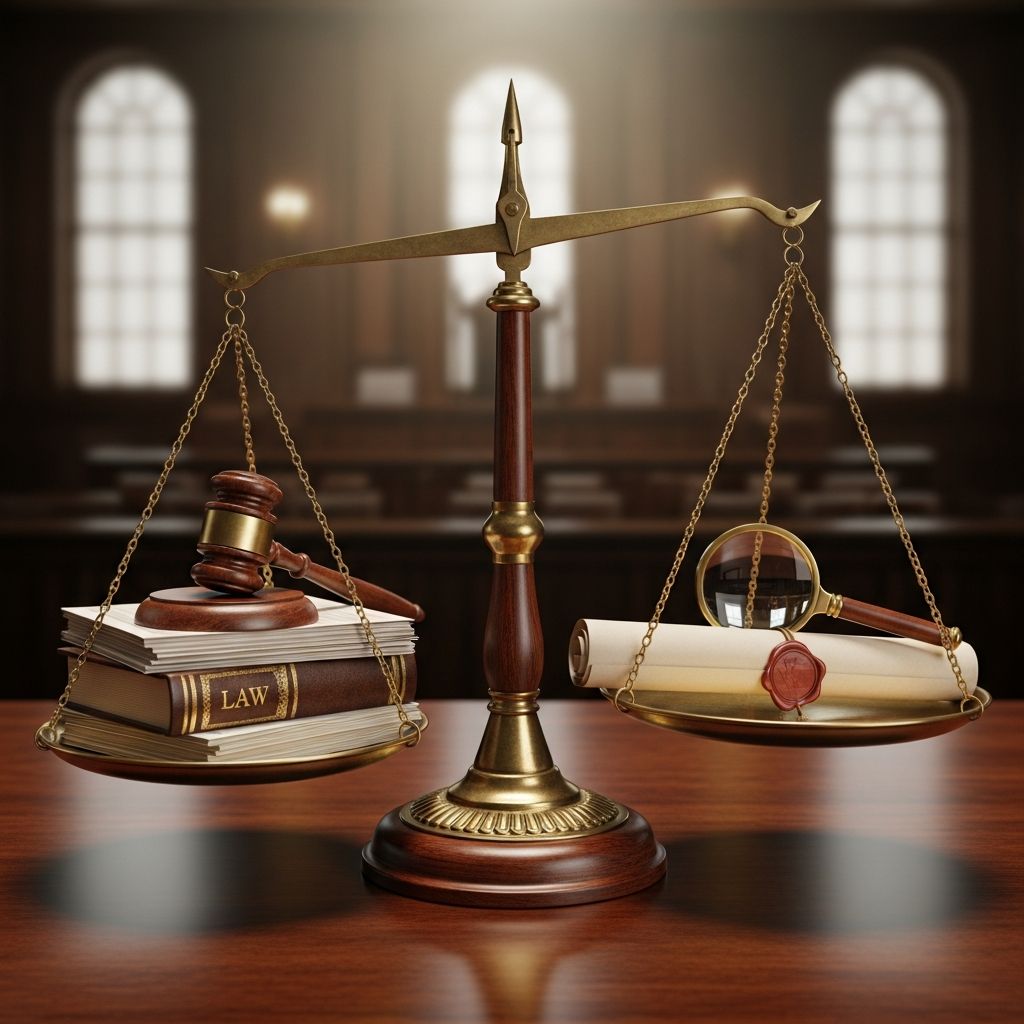
In every criminal trial, the outcome depends not only on what happened in real life, but also on what the judge allows the jury to hear and see in court. The law of admissible evidence decides which pieces of proof are allowed into the record and which are kept out.
This guide explains the core ideas behind admissibility in criminal cases, drawing on common principles found in the Federal Rules of Evidence and similar state rules. It is designed for readers who want a clear, practical understanding of how courts filter evidence before it reaches the factfinder.
1. What Does “Admissible Evidence” Mean?
Admissible evidence is any testimony, document, or physical item that a judge permits the jury (or judge in a bench trial) to consider when deciding the facts of the case. If the judge rules that a particular piece of proof does not satisfy the legal standards, it is inadmissible and cannot be used to prove a fact at trial.
1.1 Core requirements for admissibility
Across U.S. jurisdictions, evidence generally must satisfy at least three basic requirements:
- Relevance – It must make a disputed fact more or less likely than it would be without the evidence.
- Compliance with evidence rules – It must not be barred by special rules (for example, hearsay, privileges, or character evidence limits).
- Constitutional and statutory legality – It must be obtained and used in a way that respects constitutional rights and governing statutes.
These ideas are implemented through detailed rules that judges apply before and during trial.
2. Types of Evidence Commonly Used in Criminal Cases
“Evidence” is a broad category that covers many different forms of proof used to show what happened, who was involved, and how the law applies.
2.1 Typical forms of evidence
- Witness testimony (eyewitnesses, victims, police officers, expert witnesses)
- Documents and records (contracts, letters, medical records, phone logs)
- Audio and video (surveillance footage, recorded calls, body-cam recordings)
- Physical objects (weapons, clothing, fingerprints, drugs, tools)
- Digital data (emails, text messages, social media posts, metadata)
- Scientific and forensic results (DNA testing, ballistics, toxicology)
- Demonstrative aids (diagrams, charts, models that help explain other evidence)
Not every item that exists is automatically admissible. Each type must still satisfy relevance, reliability, and the specific rules that apply to its form.
3. Relevance: The Starting Point for Every Evidence Question
Relevance is the gateway requirement for admissibility. If evidence does not help prove or disprove a fact that matters in the case, it is generally excluded.
3.1 Definition of relevance
Under rules similar to Federal Rule of Evidence 401, evidence is relevant if it tends to make the existence of a material fact more or less probable than it would be without that evidence. A material fact is one that affects the outcome of the case, such as an element of the crime or a defense.
| Concept | What it Means | Role in Admissibility |
|---|---|---|
| Relevance | Evidence changes the probability of a fact in dispute. | Irrelevant evidence is excluded outright. |
| Materiality | The fact the evidence concerns must matter to the legal issues. | Evidence about side issues may be excluded as immaterial. |
| Probative value | How strongly the evidence tends to prove the fact. | Balanced against prejudice, confusion, or waste of time. |
3.2 Balancing probative value against unfair prejudice
Even if evidence is relevant, judges may exclude it when its value is substantially outweighed by certain risks, such as:
- Unfair prejudice – Likely to provoke an emotional response or bias the jury for an improper reason.
- Confusing the issues – Tends to distract the jury from the main questions.
- Misleading the jury – May cause jurors to give it inappropriate weight.
- Undue delay or waste of time – Consumes time out of proportion to its importance.
This balancing is a central part of judicial discretion. The same piece of evidence might be admitted in one case and excluded in another, depending on context.
4. Reliability, Authenticity, and Expert Evidence
Courts also consider whether evidence is sufficiently trustworthy and genuinely what it claims to be.
4.1 Authenticating evidence
Before a document, photograph, or physical object is admitted, the party offering it must provide a basis for concluding that the item is authentic. Common methods include:
- Testimony from a witness with knowledge (for example, “I took this photo”).
- Chain-of-custody evidence for physical and forensic items.
- Metadata, system logs, or records custodians for digital and business records.
Authentication does not require absolute certainty; it requires enough proof for a reasonable juror to find that the item is what it purports to be.
4.2 Expert testimony and scientific reliability
When evidence depends on specialized knowledge—such as DNA analysis, accident reconstruction, or complex medical opinions—courts rely on the standards for expert testimony. In federal court and many states, judges act as “gatekeepers” under cases such as Daubert v. Merrell Dow Pharmaceuticals and Kumho Tire v. Carmichael, examining factors like testability, peer review, error rates, and general acceptance. The goal is to ensure that only sufficiently reliable science or expertise reaches the jury.
5. Key Rules That Exclude Otherwise Relevant Evidence
Evidence can be highly relevant and still be inadmissible because of specific exclusionary rules designed to protect fairness, privacy, or constitutional values.
5.1 Hearsay and its many exceptions
Hearsay generally means an out-of-court statement offered to prove the truth of what it asserts. The default rule is exclusion, because the person who made the statement is not in court to be observed and cross-examined. However, the law recognizes numerous exceptions when circumstances suggest reliability, such as:
- Excited utterances and present sense impressions
- Business records and public records kept in the regular course of activity
- Statements for medical diagnosis or treatment
- Former testimony given under oath with an opportunity for cross-examination
Hearsay rules are often complex, but the underlying concern is reliability and the defendant’s right to confrontation in criminal cases.
5.2 Character evidence and prior bad acts
Courts are cautious about evidence of a person’s general character or past wrongs. Rules modeled on Federal Rule 404 generally bar using prior crimes or acts only to show that a person has a bad character and therefore likely acted in line with that character on the charged occasion. Exceptions allow limited use of such evidence for specific purposes, such as proving motive, intent, identity, or absence of mistake, but judges still weigh its prejudicial effect carefully.
5.3 Privileged communications
Certain relationships are protected by evidentiary privileges. These rules allow someone to refuse to disclose, or to prevent others from disclosing, confidential communications. Common privileges include:
- Attorney–client
- Spousal (marital communications)
- Psychotherapist–patient
- Clergy–penitent
These privileges reflect policy judgments that preserving candor in key relationships is more important than obtaining every possible piece of evidence.
6. Constitutional Limits: The Exclusionary Rule
Even when evidence is highly probative and consistent with ordinary evidentiary rules, it may be excluded if it was obtained in violation of constitutional rights. This is the domain of the exclusionary rule.
6.1 Evidence obtained through unconstitutional searches or seizures
In the United States, the Fourth Amendment protects against unreasonable searches and seizures. If police obtain evidence through an unconstitutional search (for example, without a required warrant or a valid exception), courts may suppress that evidence in a criminal case. The same analysis may apply to derivative evidence—the so-called “fruit of the poisonous tree”—unless an exception applies (such as independent source, inevitable discovery, or attenuation).
6.2 Other constitutional protections
Additional rights that can affect admissibility include:
- Fifth Amendment – Bars compelled self-incrimination and may exclude coerced confessions.
- Sixth Amendment – Guarantees the right to counsel in certain interrogations and the right to confront adverse witnesses at trial.
- Due process – Can exclude evidence obtained through methods that “shock the conscience” or fundamentally undermine fairness.
Suppression motions are the usual tool defense lawyers use to enforce these rights and keep unlawfully obtained evidence away from the jury.
7. The Judge’s Gatekeeping Role and Objection Practice
Judges are responsible for applying the rules of evidence. Lawyers play an important part by raising objections and making offers of proof, but the final decision belongs to the court.
7.1 Pretrial motions to suppress or exclude
Many evidence disputes are addressed before trial, often through written motions and evidentiary hearings. Common pretrial issues include:
- Challenging the legality of searches, arrests, or interrogations
- Requesting exclusion of prior convictions or bad-act evidence
- Attacking the reliability of expert methods or forensic testing
- Seeking protective orders related to privileged or sensitive material
Resolving these questions early promotes efficiency and helps each side plan its trial strategy.
7.2 Objections during trial
During trial, lawyers must object promptly when they believe a question, answer, or exhibit violates the rules of evidence. Typical objection grounds include:
- Relevance or undue prejudice
- Hearsay without an applicable exception
- Lack of foundation or failure to authenticate
- Violation of privilege
- Speculation, leading questions, or improper opinion
If an objection is sustained, the evidence is excluded or the jury is told to disregard it. If overruled, the evidence becomes part of the record for the jury to consider.
8. How Admissibility Shapes Trial Strategy
The rules of admissibility profoundly influence how attorneys investigate, negotiate, and present criminal cases.
8.1 For prosecutors
- Ensuring that key evidence was lawfully obtained and documented.
- Preparing witnesses to testify clearly and within evidentiary bounds.
- Anticipating defense motions to suppress and gathering supporting facts for admissibility.
- Selecting the most probative, least prejudicial evidence to avoid reversal on appeal.
8.2 For defense counsel
- Analyzing police conduct for potential constitutional violations.
- Challenging the reliability of eyewitnesses, experts, and forensic methods.
- Invoking privileges and privacy protections on behalf of the accused and third parties.
- Using cross-examination and objections to highlight weaknesses in the prosecution’s proof.
Because the prosecution bears the burden of proving guilt beyond a reasonable doubt, exclusions of important government evidence can be outcome-determinative.
9. Frequently Asked Questions About Admissible Evidence
Q1: Is all relevant evidence automatically admissible?
No. Relevance is only the first step. Relevant evidence can still be excluded if it is unfairly prejudicial, confusing, cumulative, hearsay without an exception, privileged, or obtained in violation of constitutional rights.
Q2: Can illegally obtained evidence ever be used in a criminal trial?
Sometimes. The exclusionary rule generally bars evidence obtained through constitutional violations, but courts recognize exceptions, such as when police would have discovered the same evidence lawfully anyway (inevitable discovery) or when the connection between wrongdoing and the evidence is too remote (attenuation).
Q3: Why is hearsay usually excluded?
Hearsay is excluded because the original speaker is not present in court to be observed and cross-examined, which undermines the factfinder’s ability to judge credibility. Exceptions exist when circumstances provide adequate guarantees of trustworthiness, such as business records kept routinely or prior sworn testimony with an opportunity for cross-examination.
Q4: How do judges decide whether expert evidence is reliable?
Judges consider factors such as whether the expert’s method can be tested, has been peer-reviewed, has known error rates, and is generally accepted in the relevant field. These criteria, associated with federal “Daubert” standards, help ensure that scientific and technical testimony rests on a sound foundation.
Q5: Does the jury know when evidence has been excluded?
Usually not. Most evidentiary disputes are handled outside the jury’s presence, either in pretrial hearings or at sidebars. Jurors see only the evidence that the judge has ruled admissible and are instructed not to speculate about what they did not hear.
References
- Admissibility of Evidence in Criminal Law Cases — Justia. 2024-01-15. https://www.justia.com/criminal/procedure/admissibility-evidence/
- NRS Chapter 48 – Admissibility Generally — Nevada Legislature. 2023-07-01. https://www.leg.state.nv.us/nrs/nrs-048.html
- What Are the 5 Rules of Evidence Admissibility? — Aaron Meyer Law. 2023-06-10. https://www.aaronmeyerlaw.com/what-are-the-5-rules-of-evidence-admissibility/
- Admissibility of Evidence — Intro to Law and Legal Process, Fiveable. 2022-09-01. https://fiveable.me/key-terms/introduction-law-legal-process/admissibility-of-evidence
- Admissible Evidence — Wikipedia (summary used, primary rule sources cross-checked). 2024-03-05. https://en.wikipedia.org/wiki/Admissible_evidence
Similar Articles








Read full bio of medha deb




