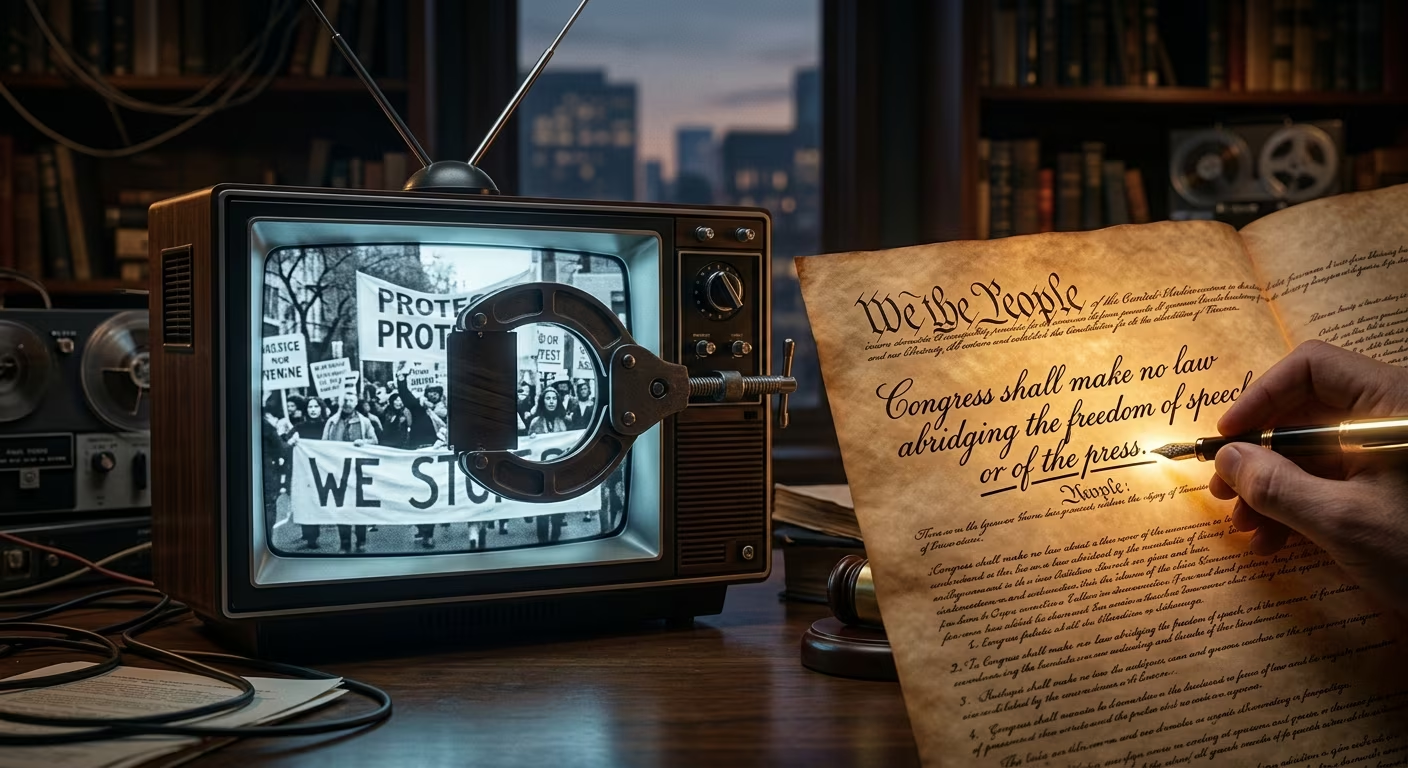
The Enduring Conflict: Free Speech vs. Public Airwaves
Since the inception of broadcast television, a persistent and deeply complicated tension has existed between the fundamental rights protected by the First Amendment and the regulatory authority of the Federal Communications Commission (FCC). The public airwaves, legally considered the property of the American people, are leased to broadcasters under the explicit stipulation that they serve the “public interest, convenience, and necessity.” Historically, this broad regulatory mandate has been interpreted by the federal government as a directive to shield audiences—particularly children and families—from indecent, obscene, or profane content. However, determining the exact boundaries of what constitutes acceptable broadcasting has sparked decades of fierce cultural debates, massive legal showdowns, and aggressive legislative maneuvering.
At the very heart of this ongoing conflict lies a critical constitutional question: how far can the government go in censoring broadcast television before it unconstitutionally infringes upon the foundational right to free speech? The answer remains a complex tapestry of Supreme Court rulings, fluctuating FCC enforcement policies, and a rapidly evolving digital media landscape. Understanding this dynamic requires a deep dive into the landmark cases and controversial moments that have defined the boundaries of American television.
The Catalyst: A Super Bowl Halftime Show That Changed Television
To truly understand the modern era of television censorship, one must look back to a single, explosive moment in pop culture history. During the 2004 Super Bowl halftime show, a high-energy performance by Janet Jackson and Justin Timberlake concluded with what Timberlake famously dubbed a “wardrobe malfunction.” Jackson’s right breast was briefly exposed to an estimated audience of over 140 million viewers. The fallout was immediate, widespread, and highly politically charged, fundamentally shifting the regulatory environment for live broadcasting in the United States.
Almost overnight, the FCC found itself inundated with over half a million viewer complaints. In response to the public outcry and mounting political pressure from lawmakers, the regulatory agency cracked down on broadcasters with unprecedented severity. CBS, the network that aired the championship game, was slapped with a massive $550,000 fine for broadcasting indecent material. Although this crippling financial penalty was eventually overturned in a lower federal court following years of exhaustive litigation, the chilling effect on the entertainment industry was profound and immediate. Broadcasters, terrified of incurring similar financial ruin or risking their operating licenses, immediately implemented extensive tape delays for live television, from awards shows to local sporting events. The 2004 Super Bowl incident became the ultimate cultural flashpoint, proving that a fraction of a second of television could trigger federal scrutiny and spark a sweeping reevaluation of what Americans were permitted to see and hear in their own living rooms.
Fleeting Expletives: The Supreme Court and the Bounds of Profanity
The aggressive posture adopted by the FCC in the mid-2000s extended well beyond momentary visual nudity, eventually targeting spoken language through a highly controversial crackdown on what became known as “fleeting expletives.” Historically, the FCC had exercised a degree of leniency regarding unscripted, isolated uses of profanity during live broadcasts. However, following controversial, unscripted remarks made by celebrities like Cher and Nicole Richie during live broadcasts of the Billboard Music Awards, the regulatory body abruptly reversed its historical stance. The FCC controversially declared that even a single, fleeting use of an expletive could be deemed actionable and subject to heavy financial penalties.
This sudden policy shift set the stage for one of the most significant First Amendment legal battles of the modern era: FCC v. Fox Television Stations. Fox Network, backed by a coalition of other major broadcasters, challenged the massive fines, arguing that the new rules were arbitrary, capricious, and a direct violation of their free speech rights under the Constitution. The legal saga dragged on for years, ultimately reaching the United States Supreme Court twice. In a landmark 2012 decision, the Supreme Court ruled in favor of the broadcasters, concluding that the FCC’s sudden enforcement standards were unconstitutionally vague. The Court heavily noted that the government had failed to provide proper, advance notice to the networks that “fleeting expletives” would be so severely penalized.
However, while the Supreme Court’s decision successfully vacated the specific fines levied against Fox and other television networks, it crucially dodged the broader constitutional question. The Court explicitly declined to strike down the FCC’s underlying indecency policy entirely, thereby leaving the government’s foundational authority to regulate broadcast speech intact and maintaining a persistent cloud of uncertainty over the television and radio industries.
Collateral Damage: Artistic Integrity and Public Broadcasting
The consequences of ambiguous and aggressive federal censorship policies inevitably extend far beyond reality television and celebrity award shows; they frequently inflict collateral damage on artistic integrity, historical truth, and serious journalism. A glaring example of this chilling effect occurred surrounding the highly anticipated release of acclaimed filmmaker Ken Burns’s monumental World War II documentary series, The War. Despite its profound educational value, deep historical significance, and universal critical acclaim, several PBS stations across the country strongly considered pulling the 14-and-a-half-hour documentary from their broadcast schedules entirely. Their apprehension stemmed entirely from a paralyzing fear of FCC retribution.
The documentary featured intimate, unvarnished interviews with combat veterans who occasionally used profanity to accurately describe the horrific, traumatizing realities of global warfare. Furthermore, the documentary’s narrator utilized specific expletives to explain the etymology of famous military acronyms like “SNAFU.” Under the strict, unforgiving indecency framework established by the FCC, these historical and artistic uses of language technically violated federal regulations. The fact that educational stations felt compelled to consider censoring the authentic, lived experiences of war veterans highlighted the fundamental absurdity of the FCC’s blanket approach to indecency. It powerfully demonstrated how paternalistic regulations, ostensibly designed to protect the general public, can ultimately deprive audiences of vital historical context and serious journalistic inquiry. When the looming threat of devastating fines hangs over independent broadcasters, the safest route is almost always self-censorship, silencing important national narratives before they ever reach the airwaves.
Legislative Overreach and the Role of Parents
While the FCC enforced the indecency rules currently on the books, certain factions within the United States Congress frequently attempted to codify and significantly expand this censorship through direct legislative action. Various bills have been introduced over the years with titles intentionally designed to make political opposition toxic. These legislative efforts generally sought to broaden the legal definitions of profanity and drastically increase the financial penalties for broadcasters who stepped out of line. The underlying philosophy of such legislation is deeply paternalistic, operating on the core assumption that the federal government must act as a surrogate parent for the entire nation, curating content to ensure it is uniformly safe for children.
Critics of these congressional crackdowns argue that such laws are a direct affront to First Amendment liberties and personal responsibility. The core counter-argument is that in a free and democratic society, the responsibility for curating media consumption should reside exclusively with parents and guardians, not federal bureaucrats in Washington. Modern televisions and broadcasting tools offer multiple avenues for parental control:
- The V-Chip: Technology embedded in modern televisions allowing parents to block programming based on specific age ratings.
- Digital Parental Controls: PIN-protected safeguards provided by local cable boxes and digital antennas to lock specific channels or time blocks.
- Content Ratings: The widely adopted TV Parental Guidelines (e.g., TV-MA, TV-14) designed to give audiences clear, advance notice of a program’s themes.
By attempting to legally sanitize the entire public broadcasting spectrum to a level strictly suitable for young children, lawmakers risk reducing all televised discourse to its most sterile and rudimentary form, effectively punishing adult audiences for the viewing habits and vulnerabilities of minors.
The Digital Era: An Inconsistent Regulatory Landscape
Adding another layer of profound complexity to the debate over television censorship is the glaring inconsistency of the modern regulatory media landscape. The FCC’s indecency and profanity rules apply strictly to traditional broadcast television and radio—networks that transmit their signals freely over the public airwaves. However, these same stringent federal rules do not apply to subscription-based services, such as premium cable networks or internet streaming platforms.
| Feature | Broadcast TV (ABC, CBS, NBC) | Cable & Streaming (HBO, Netflix) |
|---|---|---|
| Transmission Method | Free over public airwaves | Paid subscription or private network |
| FCC Indecency Rules Apply? | Yes (strictly enforced 6 AM – 10 PM) | No (exempt from indecency/profanity rules) |
| First Amendment Protections | Limited (subject to public interest mandates) | High (viewed as fully protected speech) |
| Audience Expectation | Accessible to all, requiring high safety standards | Active opt-in, assuming mature content risk |
This legal distinction has created a bizarre and increasingly outdated double standard. A viewer casually clicking through channels on a smart television may seamlessly transition from a heavily censored, network-broadcast sitcom to a completely unregulated, graphic streaming drama in a matter of seconds. As traditional broadcast viewership rapidly declines and audiences migrate heavily toward streaming, the FCC’s mandate to police the public airwaves feels increasingly antiquated. The technological reality of the 21st century has vastly outpaced the regulatory framework drafted in the 20th century, leaving traditional broadcast networks at a distinct competitive disadvantage. They are forced to aggressively compete for ratings and cultural relevance while operating with one hand tied behind their backs by government censors, while their streaming counterparts enjoy vast creative freedom to explore mature themes, complex narratives, and unfiltered, realistic dialogue.
Conclusion
The extensive history of television censorship in the United States is a testament to the enduring, often messy friction between community standards and constitutional liberties. From the massive, industry-shifting fallout of a Super Bowl halftime show to the Supreme Court’s cautious, narrow rulings on fleeting expletives, the federal government has continually struggled to define and enforce television indecency without aggressively trampling upon the First Amendment. While protecting children from genuinely harmful material is a widely shared and noble societal goal, the blunt mechanisms used by the FCC and Congress have frequently resulted in regulatory overreach, chilling artistic expression, and silencing historical realities. As the global media landscape continues its rapid, unstoppable shift toward digital and subscription-based streaming, the traditional arguments for heavy-handed broadcast censorship continue to lose their practical and legal potency. Ultimately, the preservation of free speech in broadcasting demands a regulatory environment that respects the intelligence of the audience and recognizes that the most effective, constitutional censor is not the federal government, but the remote control held firmly in the hands of the viewer.
Frequently Asked Questions
What is the difference between obscenity, indecency, and profanity according to the FCC?
The FCC categorizes objectionable content into three distinct tiers. Obscenity refers to content that lacks any serious literary, artistic, political, or scientific value and appeals to prurient interests; it is never protected by the First Amendment and is banned at all times. Indecency involves material that portrays sexual or excretory organs or activities in a patently offensive manner, which is legally restricted from broadcast between 6 a.m. and 10 p.m. Profanity encompasses grossly offensive language considered a public nuisance, which is similarly restricted during daytime viewing hours to protect children.
Why does the FCC only censor broadcast television and not cable or streaming platforms?
The legal justification stems from the method of transmission. Broadcast television uses the “public airwaves,” which are considered a scarce public resource heavily regulated by the government for the public good. In contrast, cable and internet streaming platforms are subscription-based. Because consumers must actively choose to pay for these services and intentionally “invite” them into their private homes, the courts have ruled they waive the expectation of a heavily sanitized, family-friendly broadcast environment, exempting them from standard indecency rules.
What was the primary issue in the FCC v. Fox Television Stations Supreme Court case?
The case focused heavily on the FCC’s aggressive enforcement against “fleeting expletives”—isolated, unscripted instances of profanity during live broadcasts. The core constitutional question was whether the FCC could levy massive fines against broadcasters without providing proper, prior notice that such isolated words would be heavily penalized. The Supreme Court ultimately ruled that the lack of adequate notice violated the broadcasters’ due process rights, though it stopped short of striking down the indecency policy itself.
Does the First Amendment protect all forms of speech on television?
No. While the First Amendment broadly protects political speech, journalism, and artistic expression, the Supreme Court has consistently ruled that “obscenity” is entirely devoid of First Amendment protections. Additionally, while indecency and profanity are protected forms of speech, the government is legally permitted to restrict when they can be broadcast on public airwaves to protect minors.
References
- FCC v. Fox Television Stations — Oyez. 2012-01-10. https://www.oyez.org/cases/2011/10-1293
- How Super Bowl halftime moments became flashpoints — AP News. 2026-02-05. https://apnews.com/article/super-bowl-halftime-show-controversies-bad-bunny-b2de04d16853229b4b45501dc225f68b
- Obscene, Indecent and Profane Broadcasts — Federal Communications Commission. 2021-01-13. https://www.fcc.gov/consumers/guides/obscene-indecent-and-profane-broadcasts