
Truck Bed Passenger Safety and Legal Requirements
Navigate state laws and safety concerns about riding in pickup truck beds across America.
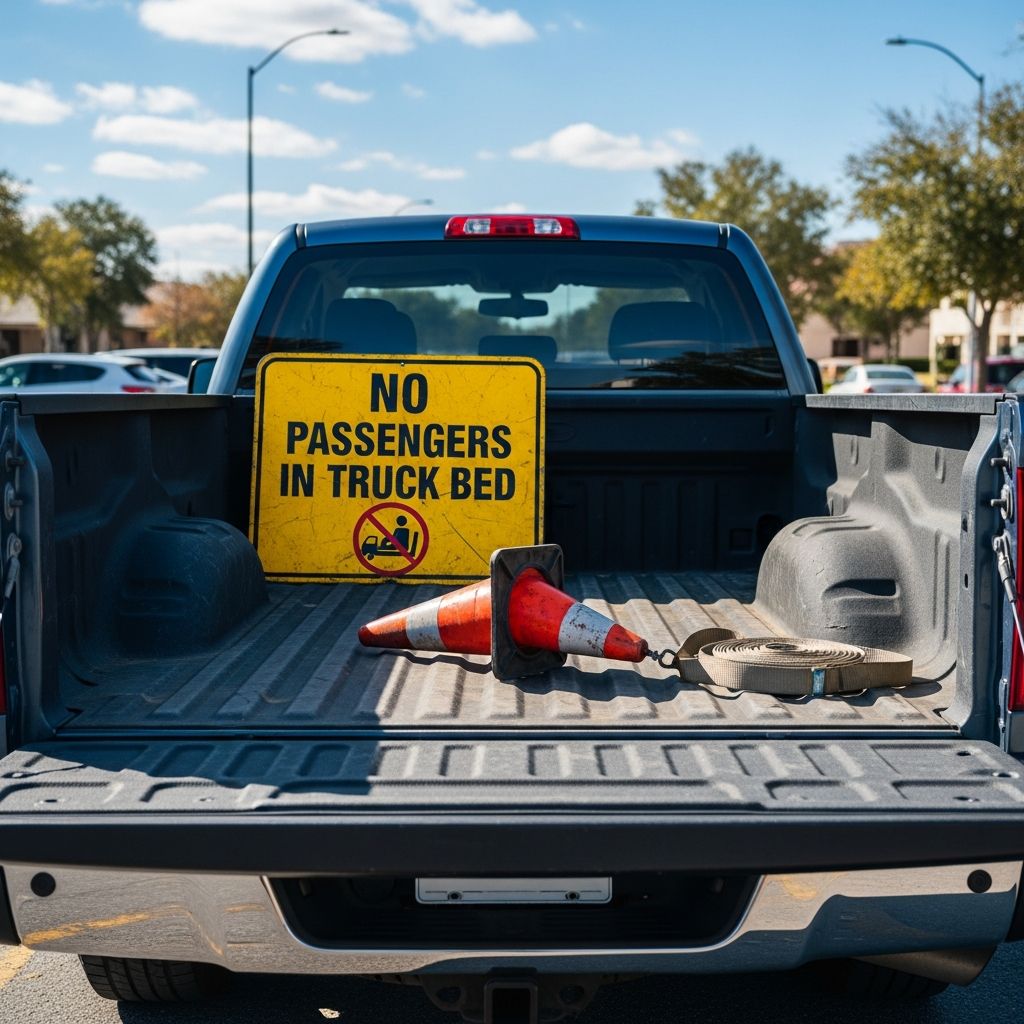
Understanding Truck Bed Transportation Laws Across America
When it comes to transporting passengers in the cargo area of a pickup truck, the legal landscape varies dramatically depending on where you live. Unlike federal seatbelt regulations that apply uniformly across the nation, there is no comprehensive federal law governing who may ride in truck beds and under what circumstances. This absence of unified legislation means that individuals must familiarize themselves with their specific state’s regulations to avoid costly violations and potential safety hazards. The practice of riding in pickup truck beds remains surprisingly common, yet it continues to generate significant legal and safety concerns across jurisdictions.
The fundamental issue surrounding truck bed passengers centers on vehicle design and crash protection. Pickup truck beds are fundamentally cargo containers, not passenger seating areas, and manufacturers design them without the safety features found in vehicle cabins. This structural reality forms the basis for many state regulations that restrict or severely limit truck bed passenger transportation.
The Spectrum of State Regulations
State approaches to truck bed passenger transportation fall into several distinct categories. Some states enforce complete bans with minimal exceptions, others permit the practice under specific conditions, and a significant portion maintains no explicit restrictions whatsoever. Understanding your state’s particular stance is essential before allowing anyone to ride in your truck’s cargo area.
Strict Prohibition States
Three states have adopted particularly stringent positions on this practice. New York, New Jersey, and Arkansas effectively prohibit passengers from riding in truck beds with very limited exceptions. These states recognize the substantial safety risks and have chosen to restrict the practice almost entirely. Arkansas law specifically prohibits anyone from riding in any portion of a vehicle not designed for passenger use. New York’s Vehicle and Traffic Law also maintains extremely limited exceptions to its general prohibition, while New Jersey similarly restricts the practice with only narrow carve-outs for specific circumstances.
Conditional Permission States
The majority of states occupy a middle ground, allowing truck bed passengers under defined conditions. These conditions typically involve age requirements, seating specifications, vehicle speed limitations, or the presence of approved safety restraints. The complexity of these requirements necessitates careful review before transporting passengers.
Age Requirements and Passenger Restrictions
A common regulatory approach across numerous states involves establishing minimum age thresholds for truck bed passengers. These age-based restrictions reflect legislative judgments about passenger maturity and susceptibility to injury.
| Age Threshold | States | Additional Conditions |
|---|---|---|
| 18 years and older | Colorado, Connecticut, Florida, Georgia, Michigan, Missouri, Nebraska, New Mexico, Oregon, Pennsylvania, Texas | May include speed limits or seating requirements |
| 16 years and older | North Carolina, Ohio, Virginia, Wisconsin | Overhead restraints or seatbelts may be required |
| 12 years and older | Hawaii | Passengers must sit flat on bed floor; all tailgates closed |
| Under 16 prohibited | Connecticut, Louisiana, North Carolina, Rhode Island, South Carolina | May allow exceptions with proper restraints |
Pennsylvania exemplifies how states combine age restrictions with speed limitations. Passengers under 18 cannot ride in truck beds, and even adults face restrictions if the vehicle exceeds 35 mph. Similarly, Ohio prohibits passengers under 16 from riding in truck beds when vehicle speeds exceed 25 mph, though compliant seatbelts and emergency circumstances may create exceptions.
Restraint Systems and Safety Equipment
Several states require or recommend federally approved restraint systems for truck bed passengers. California exemplifies this approach, permitting passengers only when the truck is equipped with federally approved safety restraints and the vehicle operates off highways. Connecticut imposes similar requirements for passengers under 16, mandating federally compliant seatbelts or restraint systems.
The requirement for restraint systems reflects recognition that truck beds offer zero crash protection compared to vehicle cabins. These systems attempt to mitigate injury risk, though safety experts remain concerned about their fundamental inadequacy compared to interior seating positions.
Vehicle Speed Limitations
Recognizing that high-speed collisions pose exponentially greater injury risks, several states impose speed restrictions on vehicles carrying truck bed passengers. These limitations recognize that at lower speeds, passengers face reduced injury potential compared to highway speeds.
- Ohio: 25 mph maximum for passengers under 16 (exceptions for life-threatening emergencies)
- Pennsylvania: 35 mph maximum for adult passengers in truck beds
- California parade passengers: 8 mph maximum
Special Circumstance Exceptions
Most states that regulate truck bed transportation include exceptions for specific situations. These carve-outs recognize that certain activities or emergencies justify otherwise prohibited conduct.
Agricultural and Rural Use
Agricultural operations frequently involve transporting workers in truck beds between different farm locations. Recognizing this practical necessity, several states exempt farm-owned vehicles when operating on farmland. Nevada allows passengers age 18 and older in truck beds on farms or ranches. California permits farm vehicles that do not leave farmland except to traverse a single one-mile highway segment connecting different property portions.
Parade Participation
Parades often feature slow-moving vehicles carrying passengers, including truck beds. Recognizing this tradition, several states carved out parade exceptions. Nebraska permits otherwise-prohibited passengers when participating in parades. California allows parade participants to ride in truck beds at speeds not exceeding 8 mph.
Emergency Situations
When life-threatening emergencies demand immediate transportation, some states allow truck bed passenger transportation despite general prohibitions. Ohio’s regulations explicitly recognize emergency situations that threaten driver or passenger life. California similarly permits truck bed riding during emergency circumstances requiring immediate transport.
States Without Explicit Restrictions
Approximately half of all states maintain no explicit laws prohibiting or regulating truck bed passengers. This absence of legislation does not necessarily indicate that riding in truck beds is safer in these jurisdictions; rather, it reflects legislative decisions not to restrict the practice through law. Residents in these states should recognize that while legal restrictions may not exist, safety risks remain identical to restricted states.
Penalties and Legal Consequences
States that prohibit or restrict truck bed passenger transportation typically impose financial penalties for violations. Specific penalty structures vary by jurisdiction, with California exemplifying graduated fine structures.
In California, first offense violations result in $100 fines, second offenses increase to $200, and subsequent violations escalate to $250 each. Some states impose higher penalties, particularly when accidents occur while passengers occupy truck beds. Beyond financial penalties, law enforcement may cite drivers for additional violations depending on the circumstances and applicable statutes.
The Safety Imperative Behind Regulations
Vehicle safety research consistently demonstrates that occupants in pickup truck beds face substantially greater injury and fatality risks compared to cabin passengers. Truck beds provide no structural protection, no restraint systems comparable to interior seating, and no cushioning or impact absorption. In collision events, unrestrained or inadequately restrained passengers in truck beds sustain injuries far exceeding those experienced by cabin occupants.
Additionally, open truck beds expose passengers to environmental hazards including wind force, debris, and sudden stops. Loss of balance or unexpected acceleration can throw passengers from vehicles moving at moderate speeds, resulting in traumatic injuries. These physical realities form the scientific foundation for restrictive regulations in states prioritizing passenger safety.
Practical Considerations for Truck Owners and Passengers
Before transporting anyone in a pickup truck bed, owners should verify their specific state’s requirements. This verification process should include checking:
- Age requirements for passengers in your state
- Mandatory safety restraint specifications
- Speed limitations applicable to truck bed passengers
- Any special circumstance exceptions that might apply
- Specific penalty amounts for violations in your jurisdiction
Even where legal, truck bed transportation carries inherent risks that should not be minimized. Passengers should understand that they occupy an extremely unsafe location compared to vehicle interiors and should exercise extreme caution when doing so.
Regional Variations and Compliance Challenges
The patchwork of state regulations creates compliance challenges for individuals who frequently cross state lines. A practice that is legal in one state may constitute a violation in an adjacent state. Long-distance travelers transporting passengers in truck beds should plan routes through states where the practice is permitted and understand how regulations change at state borders.
This regulatory fragmentation also creates confusion for casual users who may not understand the applicable rules in their current location. Rental truck operators, temporary residents, and travelers frequently encounter uncertainty about applicable restrictions, and law enforcement must contend with variations in enforceability and penalties.
Frequently Asked Questions About Truck Bed Passenger Transportation
Q: Is there a federal law regarding truck bed passengers?
A: No federal law governs truck bed passenger transportation. Each state establishes its own regulations, creating a complex patchwork of different rules across jurisdictions.
Q: What state permits the most passenger flexibility in truck beds?
A: Approximately half of states maintain no explicit restrictions on truck bed passengers, though this does not mean the practice is safer in those jurisdictions.
Q: Can young children ever legally ride in truck beds?
A: Some states permit children to ride in truck beds under specific conditions, such as Hawaii’s requirement that passengers be at least 12 years old with proper restraint systems and a fully enclosed bed.
Q: What should I do if unsure about my state’s truck bed passenger laws?
A: Contact your state’s department of transportation or review your state vehicle code online. Local law enforcement can also clarify specific regulations applicable in your jurisdiction.
Q: Do agricultural exceptions apply to all farm vehicles?
A: Agricultural exceptions typically apply only to farm-owned vehicles operating on farmland or connecting different farm properties. Commercial agricultural services may face different restrictions.
Q: Are there any circumstances where riding in a truck bed is completely prohibited everywhere?
A: No universal prohibition exists, but certain circumstances like transporting very young children in unrestrained truck beds violates regulations in most states with established restrictions.
References
- Is It Illegal to Ride in the Bed of a Truck in California? — West Coast Trial Lawyers. https://westcoasttriallawyers.com/is-it-illegal-to-ride-in-the-bed-of-a-truck
- Is it Illegal to Ride in the Bed of a Truck? — RealTruck. https://realtruck.com/blog/illegal-ride-bed-truck/
- Is It Legal to Ride in the Bed of a Pickup Truck? A Complete 50 State Guide — MAA Firm. https://maafirm.com/blog/is-it-legal-to-ride-in-the-bed-of-a-pickup-truck-a-complete-50-state-guide/
- Restrictions on riding in pickup beds — Insurance Institute for Highway Safety (IIHS). https://www.iihs.org/research-areas/seat-belts/cargo-area-restrictions-laws
- Is It Legal to Ride in a Truck Bed in California? — Eric Ratinoff Law Offices. https://www.ericratinoff.com/is-it-legal-to-ride-in-the-back-of-a-truck-in-california-and-what-are-the-risks/
- Can You Ride in a Truck Bed? What the Law Says — Chad Gmann. https://chadgmann.com/2025/11/04/can-you-ride-in-bed/
Similar Articles








Read full bio of Sneha Tete


