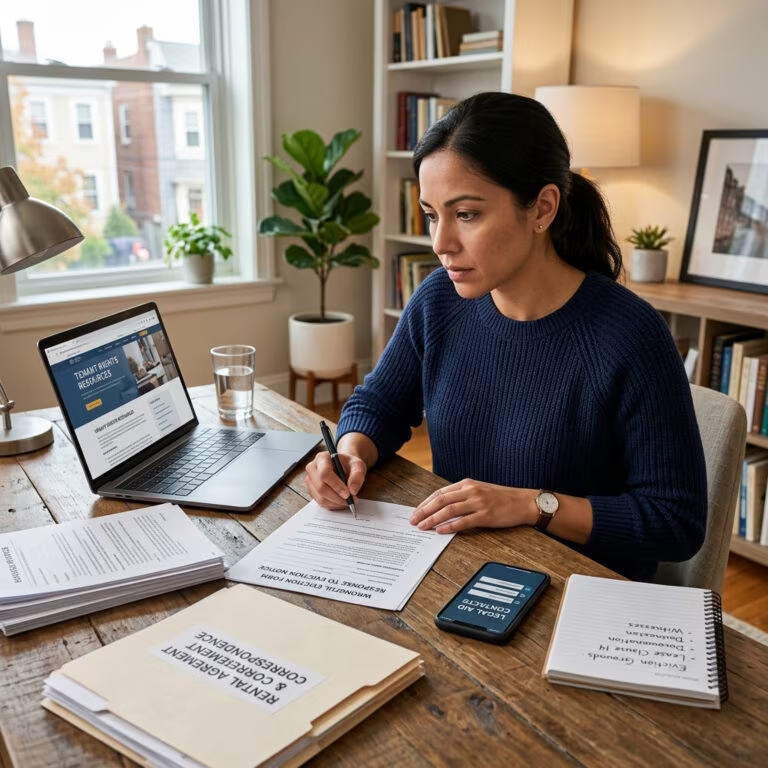
TransUnion SmartMove is a rental-screening service that provides landlords with tenant background information, including credit-based insights, estimated income, and rental risk assessments, to help them make leasing decisions. At the same time, the information it uses is a consumer report, which means renters have important rights to see, understand, and dispute that information under federal law.
1. What TransUnion SmartMove Is and Who Uses It
TransUnion SmartMove is operated by TransUnion Rental Screening Solutions, Inc., a consumer reporting company that focuses on rental housing decisions. It draws on TransUnion’s nationwide credit database and other data sources to compile reports about rental applicants for independent landlords, property managers, and small rental businesses.
- Primary purpose: Help landlords evaluate whether an applicant is likely to pay rent on time and comply with a lease.
- Type of company: A specialized consumer reporting agency (CRA) under the Fair Credit Reporting Act (FCRA).
- Users: Individual landlords, small property owners, and some property managers that do not maintain large in-house screening systems.
- Coverage: Available to rental owners and applicants across the United States.
Because SmartMove provides information used to approve or deny a rental application, it is regulated like other consumer reporting agencies, such as the nationwide credit bureaus.
2. What Information a TransUnion SmartMove Report Can Contain
A TransUnion SmartMove report is designed to give landlords a snapshot of your financial reliability and potential rental risk. Depending on the package a landlord selects, the report may include several categories of information.
2.1 Typical Components of a SmartMove Tenant Report
- Credit-based information
- Details such as payment history, credit utilization, and major derogatory events (for example, serious delinquencies, collections, or bankruptcies).
- Resident risk score
- A score built from credit and rental-relevant data that predicts the likelihood of serious payment problems or eviction, often branded as a ResidentScore.
- Helps landlords compare applicants using a numerical scale, similar to how credit scores are used for lending.
- Income-related insights
- An estimate of whether stated income appears consistent with credit data, sometimes called income insights.
- Flagging of applicants who may warrant additional income documentation, such as pay stubs or tax returns.
- Criminal background checks
- Searches of multiple criminal databases and registries, including national sources and certain watch lists.
- May include felony and misdemeanor records where legally reportable.
- Eviction and rental history checks
- Searches of eviction databases for judgments related to possession or unpaid rent, subject to FCRA rules.
- Indicators of prior serious rental issues such as unpaid balances or court-ordered removals.
The exact contents of a specific report depend on the package chosen by the landlord and on what information exists in public records and TransUnion’s databases.
2.2 How a SmartMove Report Differs from a Traditional Credit Report
| Feature | Traditional Credit Report | SmartMove Tenant Report |
|---|---|---|
| Primary use | Lending decisions (loans, credit cards, mortgages) | Rental housing decisions for landlords |
| Score type | Generic or industry-specific credit scores | Resident-focused risk score tailored to rental outcomes |
| Report access | Consumers via annual reports or directly from bureaus | Landlords via SmartMove portal; consumers can request a copy from the company. |
| Content emphasis | Broad credit performance across all types of credit | Credit behavior most predictive of rental payment and default, plus criminal and eviction data. |
3. How the Rental Screening Process Works
SmartMove is designed to keep sensitive data within TransUnion’s systems while still allowing landlords to evaluate applicants.
3.1 Steps in a Typical SmartMove Screening
- Landlord initiates a request
The landlord enters the applicant’s name and email address into the SmartMove system and selects the type of report they want. - Applicant receives an invitation
SmartMove sends a secure link asking the applicant to provide personal information and consent for the background check. - Applicant verifies identity and authorizes access
The renter confirms their identity using questions or verification tools and formally authorizes the screening, as required by the FCRA. - TransUnion compiles the report
After consent and identity verification, SmartMove pulls data from its credit database and other sources to generate the requested report. - Landlord reviews the report
The landlord logs in to view summary results, risk scores, and detailed findings, often within minutes of the applicant completing their part.
Throughout this process, sensitive identifiers such as full Social Security numbers are not displayed to the landlord, which helps reduce the risk of misuse or data loss.
4. Your Rights as a Renter When SmartMove Is Used
Because SmartMove is a consumer reporting company, it is subject to the federal Fair Credit Reporting Act (FCRA) and related state laws. These laws give you specific rights whenever a landlord uses a tenant screening report to make a decision about you.
4.1 Right to Consent and Privacy
- Written permission: In most situations, a landlord must obtain your consent before ordering a tenant screening report.
- Permissible purpose: Reports can only be obtained for a legally recognized purpose, such as evaluating you for a rental lease.
- Protection of identifiers: SmartMove is designed so that landlords do not directly handle full Social Security numbers or complete credit account numbers.
4.2 Right to a Copy of Your Tenant Screening Report
You have the right to see the consumer report that was used about you. The Consumer Financial Protection Bureau (CFPB) notes that many consumer reporting companies, including tenant screening firms, must provide a copy once a year upon request, or when adverse action is taken based on a report.
- You can contact TransUnion Rental Screening Solutions, Inc. (TransUnion SmartMove) directly to request the tenant and income reports that were provided to landlords, if you previously authorized them.
- Requesting your own report is considered a consumer disclosure and does not affect your credit scores.
- For companies covered by the CFPB’s annual disclosure requirement, a free copy must generally be provided within a set time frame after receiving your request.
4.3 Right to Dispute Errors
If you believe information in a SmartMove report is inaccurate or incomplete, you have the right to dispute it with the company.
- No cost to dispute: Filing a dispute with a consumer reporting agency is free.
- Investigation requirement: The company must investigate disputes, usually within 30 days in most cases, and correct or delete inaccurate information when appropriate.
- Notice to users: If a landlord based an adverse action on a report with incorrect information, you can provide updated documentation or an updated report for reconsideration.
These protections mirror the rights you have with nationwide credit bureaus and apply to rental screening reports used for eligibility decisions.
5. How to Request Your TransUnion SmartMove Report
The CFPB maintains a public list of consumer reporting companies, including TransUnion Rental Screening Solutions, Inc., and describes how consumers can contact each company for copies of their reports. While specific request procedures may change over time, the general steps are similar.
5.1 Typical Request Methods
- By mail: Complete the company’s disclosure request form, attach any required identification documents, and mail it to the address listed for consumer disclosures.
- By phone: Call the consumer assistance number provided by the company to request your tenant screening report, following their identity verification process.
- Online: Some companies offer secure web portals where you can submit a request and verify your identity electronically.
5.2 Information You May Need to Provide
- Full name (including middle initial and any suffix)
- Current mailing address, and previous address if you moved within the last two years
- Date of birth
- Last four digits of your Social Security number or other identifying information, as instructed
- Optional: The approximate date and location where a landlord used SmartMove to screen you, if known
The company will use this information solely to locate your file and confirm your identity before sending the report.
6. Interpreting Your Tenant Screening Report
When you receive a copy of your SmartMove report, you will see information similar to what landlords view when evaluating your application. Understanding how to read this report can help you spot errors and prepare for future rentals.
6.1 Key Sections to Review Closely
- Personal identifiers: Verify your name, addresses, and other identifying details are correct and do not include someone else’s information.
- Credit summaries: Look for unfamiliar accounts, incorrect balances, or payment histories that do not match your records.
- Resident or risk scores: Note the score range, any risk category labels, and the main negative factors listed alongside them.
- Criminal records: Confirm that any criminal history is accurate, belongs to you, and is not outdated beyond what the law allows.
- Eviction and rental records: Check dates, case numbers, and outcomes against court documents or landlord correspondence.
6.2 When to Consider a Dispute or Follow-Up
You may want to dispute information or provide additional documentation when:
- An account or public record clearly belongs to another person.
- A previously resolved debt, judgment, or eviction still appears as open or unpaid.
- A criminal or eviction record is reported with the wrong disposition (for example, dismissed rather than convicted, or vice versa).
- Information is older than the time limits typically allowed by the FCRA for negative items.
In addition to disputing with the screening company, you can share supporting documentation directly with a landlord to provide context during the application process.
7. Best Practices for Renters and Small Landlords
Although SmartMove is primarily a tool for landlords, both parties benefit when tenant screening is used responsibly and transparently.
7.1 Tips for Renters
- Review your credit reports from the nationwide bureaus at least once a year through the official portal for free annual credit reports.
- Ask a prospective landlord which screening service they use and whether you will receive a copy of any report they obtain.
- Prepare documents such as pay stubs, bank statements, or letters from previous landlords to explain any issues in your history.
- Keep written records of any disputes you file with consumer reporting companies.
7.2 Tips for Small Landlords
- Use written rental criteria that focus on objective factors such as payment history, income, and serious criminal or eviction records, and apply them consistently.
- Provide applicants with the required adverse action notices whenever you deny, require a co-signer, or impose additional terms based on a screening report.
- Recognize that tenant screening reports may contain errors and be open to reviewing corrected or updated information if an applicant raises concerns.
8. Frequently Asked Questions (FAQs)
Q1: Is TransUnion SmartMove the same as a regular TransUnion credit report?
No. SmartMove is a tenant screening product provided by TransUnion Rental Screening Solutions, Inc., which uses data from TransUnion’s credit files and other sources to create rental-specific reports and risk scores. It is related to, but not identical with, your standard TransUnion credit report.
Q2: Does a SmartMove check hurt my credit score?
SmartMove reports typically use a “soft” credit inquiry for screening, which does not impact your credit scores. Requesting a copy of your own report from a consumer reporting company also does not affect your scores.
Q3: Can I get a free copy of my SmartMove report?
You can contact TransUnion Rental Screening Solutions, Inc. to request the tenant and income reports you authorized for landlords. Many consumer reporting companies must provide one free copy annually upon request, and you are also entitled to a copy if a landlord takes adverse action based on a report.
Q4: What should I do if my SmartMove report contains errors?
You can file a dispute directly with TransUnion Rental Screening Solutions, Inc., explaining what is wrong and providing supporting documents. Under the FCRA, the company generally must investigate and correct inaccurate information within a reasonable time, typically 30 days.
Q5: Can a landlord deny my application based solely on a SmartMove report?
Yes, landlords often rely on tenant screening reports in rental decisions. However, if they deny your application, require a co-signer, or impose worse terms because of information in a report, they must give you an adverse action notice that explains your rights and tells you how to obtain a copy of the report.
References
- TransUnion Rental Screening Solutions, Inc. (TransUnion SmartMove) — Consumer Financial Protection Bureau. 2024-01-01 (page updated date, if shown). https://www.consumerfinance.gov/consumer-tools/credit-reports-and-scores/consumer-reporting-companies/companies-list/trans-union-smart-move/
- What Does A TransUnion SmartMove Report Show? — Landlord Studio. 2023-08-10 (approx. article date or last updated). https://www.landlordstudio.com/blog/transunion-smartmove-report
- TransUnion SmartMove Provides Renters and Landlords With a Speedy and Secure Rental Screening Process — TransUnion Newsroom. 2009-07-21. https://newsroom.transunion.com/transunion-smartmove-provides-renters-and-landlords-with-a-speedy-and-secure-rental-screening-process/
- TransUnion SmartMove: Tenant Screening Service & Tenant Background Checks — TransUnion SmartMove (MySmartMove). 2023-12-01 (ID 6096376.1.1223). https://www.mysmartmove.com
- List of consumer reporting companies — Consumer Financial Protection Bureau. 2023-01-01. https://www.consumerfinance.gov/consumer-tools/credit-reports-and-scores/consumer-reporting-companies/