
Transforming Educational Conduct: The Imperative for School Discipline Overhaul
Why shifting from punitive measures to restorative justice in educational systems is essential for achieving true equity.
The Urgent Need to Rethink Educational Environments
Education is universally acknowledged as the fundamental bedrock of personal development, upward mobility, and societal advancement. In an ideal framework, the classroom operates as a nurturing sanctuary for intellectual exploration, emotional maturation, and robust community building. However, for a deeply concerning demographic of youth in the United States, the modern educational system functions less as a supportive environment and more as a punitive gauntlet. Over the past several decades, a systematic reliance on exclusionary discipline has fundamentally altered the life trajectories of millions of students. Transforming these deeply entrenched disciplinary frameworks is no longer merely a matter of administrative preference or pedagogical debate; it has emerged as a profound civil rights issue that demands immediate, comprehensive, and sustained intervention. Overhauling how educational institutions address behavioral infractions is absolutely essential to dismantling systemic inequities and fostering environments where all students possess a genuine, unencumbered opportunity to thrive.
The roots of this modern disciplinary crisis can be traced back to the widespread adoption of “zero-tolerance” policies in the late twentieth century. Originally conceived as a rigid strategy to combat severe infractions involving narcotics and deadly weapons, these policies quickly underwent massive scope creep. Before long, the zero-tolerance philosophy expanded to encompass a bewilderingly broad spectrum of minor, non-violent, and developmentally normal behaviors. The direct result was a dramatic escalation in suspensions, expulsions, and school-based arrests for incidents that previous generations of educators would have easily handled through a trip to the principal’s office or a brief after-school detention. This aggressive ideological shift transformed the educational landscape across the country, equating standard adolescent misbehavior with criminality and systematically prioritizing exclusion over education, understanding, and rehabilitation.
The Mechanics and Failures of Exclusionary Discipline
Exclusionary discipline acts as an umbrella term referring to any punitive measure that physically or socially removes a student from their standard instructional setting. This category encompasses out-of-school suspensions, expulsions, disciplinary transfers to alternative and often underfunded programs, and persistent in-school suspensions that actively isolate students from their peers and primary educators. Proponents of these harsh methods frequently argue that removing disruptive individuals is a necessary evil to maintain a safe, orderly, and focused learning environment for the compliant majority. However, extensive educational and sociological research soundly contradicts this assertion, revealing a much darker reality.
The Cascade Effect of Lost Instructional Time
Stripping students of their instructional time does not miraculously address the underlying causes of their disruptive behavior; rather, it exponentially exacerbates their academic and social struggles. When a student is removed from the classroom environment, they inevitably fall behind on critical coursework. This academic deficit often leads to profound feelings of frustration, embarrassment, and disengagement upon their eventual return. Consequently, a vicious cycle is born. Academic alienation frequently manifests as further behavioral issues, acting as a defense mechanism, which in turn leads to additional suspensions. Ultimately, this self-perpetuating cycle significantly increases the statistical likelihood of a student dropping out of school entirely, drastically reducing their lifetime earning potential and civic engagement.
The Psychological Toll of Ostracization
Furthermore, exclusionary practices fundamentally fail to teach conflict resolution, emotional regulation, or accountability—skills that are critically necessary for healthy adolescent brain development. Instead of correcting behavior, out-of-school suspensions often serve as an unstructured, state-sanctioned vacation for already disengaged youth, inadvertently rewarding the very conduct the school administration seeks to eliminate. The psychological toll of being labeled a “problem child” or a “bad kid” is immense. Youth internalize these negative labels, leading to diminished self-worth and a profound deterioration of trust in authority figures and societal institutions.
Systemic Inequities: The Disproportionate Burden
Perhaps the most alarming and indefensible aspect of current disciplinary frameworks is their wildly disproportionate application. Statistical data compiled by governmental oversight bodies and academic institutions consistently demonstrate that punitive measures are not applied evenly across the general student population. Demographic factors—specifically race, socioeconomic background, disability status, and sexual orientation—play a statistically significant and highly troubling role in determining who faces the harshest exclusions. Black, Indigenous, and Hispanic youth are suspended, expelled, and arrested at rates that far exceed their white counterparts, even when accounting for socioeconomic variables.
The Danger of Subjective Enforcement
It is vital to understand that this glaring disparity is not indicative of inherently higher rates of misbehavior among marginalized groups. Rather, it is a stark reflection of systemic biases, implicit prejudices, and structural inequalities deeply embedded within the educational apparatus. A critical driver of this disparity is the highly subjective nature of many disciplinary infractions. While objective offenses—such as possessing verifiable contraband or committing physical violence—are generally penalized with some level of consistency across demographics, subjective offenses leave considerable room for unconscious bias to influence administrative decision-making.
Infractions labeled as “insubordination,” “disrespect,” “disruptive conduct,” or “defiance” are largely defined by the observer’s perception. Educators and administrators, often subconsciously influenced by societal stereotypes, may interpret the identical behavior entirely differently depending on the student’s cultural or racial background. A passionate disagreement or questioning of authority from a white student might be viewed favorably as assertiveness or critical thinking. Tragically, the exact same behavior from a Black student is frequently penalized as aggressive defiance or inherent disrespect. This subjective enforcement effectively turns the school disciplinary system into a mechanism of racial marginalization.
Intersectionality and Vulnerable Populations
The crisis deepens when examining intersectional identities. Students with documented disabilities, particularly those requiring Individualized Education Programs (IEPs), are disproportionately targeted by exclusionary discipline. In many tragic instances, behaviors that are direct manifestations of a student’s disability—such as sensory overload, executive functioning deficits, or emotional dysregulation—are met with punitive suspensions rather than the legal and ethical accommodations they require. Similarly, LGBTQ+ youth face higher rates of discipline, often being penalized for defensive behaviors resulting from unaddressed bullying or harassment by their peers.
The Law Enforcement Creep and the School-to-Prison Pipeline
Compounding the disastrous effects of exclusionary discipline is the increasing and normalized integration of law enforcement within educational institutions. The physical presence of School Resource Officers (SROs) has surged dramatically over the last two decades. This surge was initially driven largely by understandable community fears of school violence and highly publicized mass casualty events. However, in countless districts across the nation, the functional role of the SRO has expanded far beyond emergency threat response. Armed police officers are now frequently called upon by overwhelmed educators to mediate routine classroom disruptions, effectively criminalizing normal adolescent behavior.
Escalating Minor Conflicts into Legal Crises
When law enforcement personnel are utilized to handle standard school discipline, minor infractions instantly escalate into severe legal crises. A standard teenage scuffle in the cafeteria is no longer resolved with mediation and detention; it becomes an assault and battery charge. Verbal disrespect toward a teacher is legally relabeled as disturbing the peace or disorderly conduct. This phenomenon is the literal engine of the heavily scrutinized school-to-prison pipeline.
By unnecessarily introducing students to the juvenile justice system for behaviors that are developmental and normative, schools irreparably alter their life trajectories. A juvenile criminal record creates almost insurmountable barriers to accessing higher education, securing safe housing, and finding sustainable future employment. It effectively locks young people out of the socioeconomic mainstream before they even reach adulthood, creating a permanent underclass and driving up systemic incarceration rates.
Reimagining Accountability: The Restorative Justice Paradigm
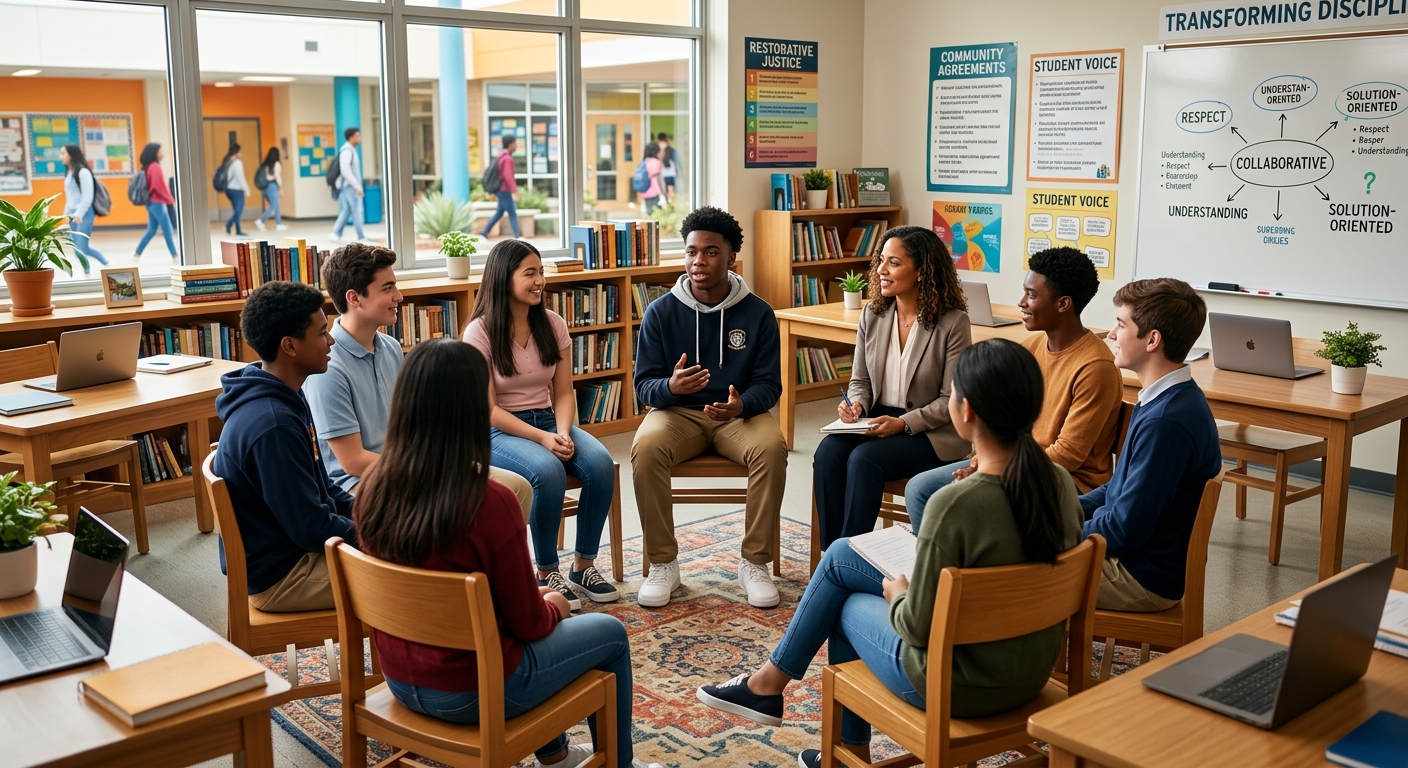
Reimagining school discipline requires a monumental paradigm shift away from a backward-looking punitive model toward a forward-looking restorative one. Restorative justice in education is not merely a program, but a comprehensive philosophy and a set of practical strategies aimed at proactively building relationships, maintaining community cohesion, and repairing harm when it occurs. Unlike traditional zero-tolerance policies that rigidly ask what rule was broken, who broke it, and what the punishment should be, restorative practices ask fundamentally different questions: Who was harmed? What are their needs? Whose obligation is it to address those needs and repair the breach in the community?
Practical Implementation of Restorative Models
Implementing restorative justice involves various structured tiers of intervention. At the foundational level, it involves proactive community-building exercises, such as daily peace circles, where students learn to communicate openly, develop empathy, and build trust with their peers and educators. When conflicts inevitably arise, the intervention shifts to intensive peer mediation, restorative conferences, and accountability circles. The primary goal is to hold students genuinely accountable for their actions by making them directly confront the tangible consequences of their behavior on others.
This approach requires the offender to actively participate in repairing the harm, whether through verbal apologies, community service, or behavioral contracts. This cultivates profound emotional intelligence, interpersonal skills, and genuine remorse—outcomes that a solitary suspension can never achieve. Extensive empirical evidence heavily suggests that schools that comprehensively and authentically adopt restorative frameworks experience significant, sustained reductions in suspension rates, dramatically improved academic outcomes, and a markedly more positive overall school climate.
| Aspect | Punitive Discipline Model | Restorative Justice Model |
|---|---|---|
| Primary Focus | Establishing guilt and assigning standardized punishment. | Identifying harm, understanding root causes, and repairing relationships. |
| Student Role | Passive recipient of top-down consequences. | Active participant in resolving conflict and making amends. |
| Long-Term Outcome | Alienation, increased dropout rates, potential legal system involvement. | Improved emotional intelligence, stronger community bonds, decreased recidivism. |
Navigating the Complexities of Policy and Resource Allocation
Realizing this vital transformation requires substantive, courageous changes in policy and resource allocation at both the state legislative level and the local school board level. Legislative bodies must enact strict, non-negotiable limitations on the use of out-of-school suspensions, particularly for highly subjective infractions and for young children in elementary grades, where exclusion is particularly psychologically damaging. However, simply banning suspensions without providing alternative frameworks will only lead to classroom chaos and extreme educator burnout.
Funding the Future, Not the Pipeline
More importantly, critical financial resources must be immediately redirected. The massive funds currently allocated to stationing armed police officers in school hallways and maintaining alternative disciplinary facilities would be far better spent on hiring licensed mental health professionals. The recommended national ratio of students to school counselors is 250 to 1, yet the current national average hovers disastrously far above that, with some marginalized school districts seeing ratios exceeding 700 to 1.
By heavily investing in school psychologists, clinical social workers, and behavioral counselors, educational institutions can finally address the complex root causes of behavioral issues. Issues such as community trauma, systemic poverty, food insecurity, and undiagnosed learning disabilities drive misbehavior. Punishing the symptoms while ignoring the disease is a fundamentally flawed educational strategy. Furthermore, educators must receive robust, heavily subsidized, and ongoing professional training in trauma-informed care, verbal de-escalation techniques, and recognizing their own implicit biases.
Conclusion
The stubborn persistence of outdated, highly punitive disciplinary practices represents a profound and unacceptable failure of the educational system’s sacred duty to its students. Continuing to rely blindly on exclusionary measures and law enforcement to manage standard adolescent behavior is not an unavoidable reality; it is a conscious policy choice to perpetuate historical inequality and continuously feed the school-to-prison pipeline. Overhauling school discipline is by no means a weak concession to misbehavior; rather, it is a demanding commitment to pedagogical excellence, societal equity, and fundamental civil rights. By boldly embracing restorative practices, actively dismantling biased enforcement mechanisms, and financially investing in the mental and emotional well-being of all youth, society can finally ensure that our schools truly serve as the foundational bedrock for an equitable, thriving future.
Frequently Asked Questions (FAQs)
What exactly is the “school-to-prison pipeline”?
The school-to-prison pipeline refers to a disturbing national trend wherein children are funneled out of public schools and into the juvenile and criminal justice systems. This pipeline is primarily driven by “zero-tolerance” disciplinary policies, the heavy presence of police in schools (SROs), and systemic biases that disproportionately target marginalized youth for minor infractions.
How do zero-tolerance policies affect long-term student outcomes?
Zero-tolerance policies mandate predetermined, harsh punishments (like suspension or expulsion) regardless of the context of the behavior. Research shows these policies do not make schools safer. Instead, they severely disrupt a student’s education, increase the likelihood of them dropping out, and significantly elevate the risk of future involvement with the criminal justice system.
What are effective alternatives to out-of-school suspensions?
Effective alternatives focus on addressing the root causes of misbehavior rather than just punishing it. These include restorative justice programs (like peer mediation and peace circles), trauma-informed counseling, targeted behavioral interventions, and providing support from school psychologists and social workers.
Do School Resource Officers (SROs) make schools safer?
While SROs are placed in schools with the intent of preventing mass violence, numerous studies indicate that their presence does not significantly reduce the occurrence of such rare events. Instead, their presence is strongly correlated with higher rates of arrests for minor behavioral issues, disproportionately affecting Black and Brown students, thereby increasing student anxiety and alienating vulnerable populations.
References
- K-12 Education: Discipline Disparities for Black Students, Boys, and Students with Disabilities — U.S. Government Accountability Office (GAO). 2018-03-22. https://www.gao.gov/products/gao-18-258
- Indicators of School Crime and Safety: 2022 — National Center for Education Statistics (NCES). 2023-02-15. https://nces.ed.gov/pubs2023/2023022.pdf
- Guiding Principles for Creating Safe, Inclusive, Supportive, and Fair School Climates — U.S. Department of Education. 2023-03-24. https://www2.ed.gov/policy/gen/guid/school-discipline/guiding-principles.pdf
Similar Articles








Read full bio of Sneha Tete


