
Thomas Paine’s Common Sense: Igniting Revolution
Discover how Thomas Paine's 1776 pamphlet Common Sense rallied Americans toward independence with bold arguments against monarchy.
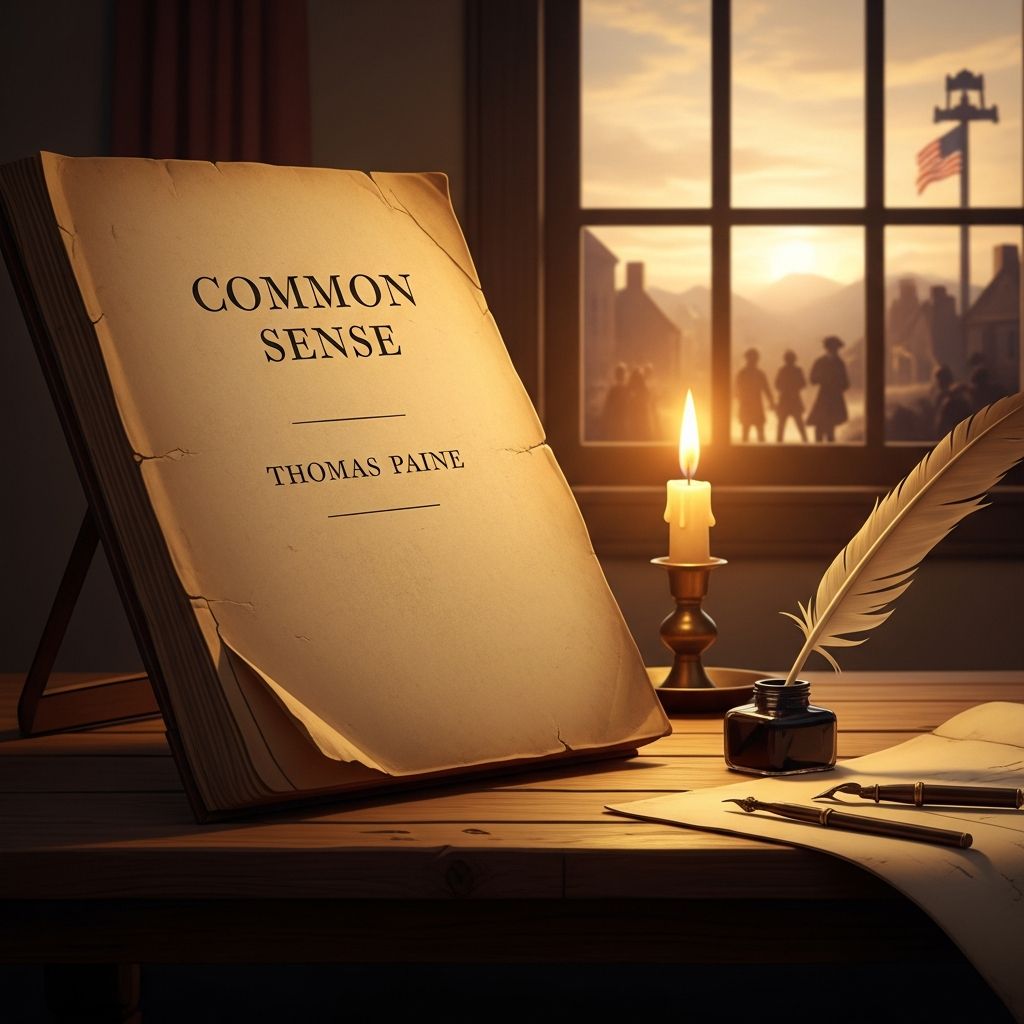
Thomas Paine’s Common Sense, published in January 1776, stands as a cornerstone of American revolutionary thought. This 47-page pamphlet presented straightforward arguments for independence from Great Britain, using simple language to persuade ordinary colonists.
The Origins and Rapid Rise of a Revolutionary Text
Paine, a recent immigrant from England, arrived in America in 1774 with a letter of introduction from Benjamin Franklin. Amid escalating tensions with Britain, he penned Common Sense in late 1775, publishing it anonymously on January 10, 1776. Its timing was impeccable, coinciding with growing colonial frustration over taxes, trade restrictions, and military occupation.
Sales exploded: an estimated 120,000 copies circulated within months, outpacing all prior American publications. Printers in Philadelphia, Boston, and New York rushed reprints, while individuals read aloud in taverns and town squares. This viral spread democratized political discourse, empowering farmers, artisans, and laborers to grasp complex ideas of governance and sovereignty.
Core Principles: Plain Facts and Logical Appeals
Paine opens with a direct challenge: “In the following pages I offer nothing more than simple facts, plain arguments, and common sense.” He urges readers to shed prejudices and let reason guide them, framing independence as a natural extension of human liberty.
- Society vs. Government: Paine distinguishes society—born of mutual benefit—as inherently good, while government, a necessary evil to restrain vices, should remain minimal.
- Natural Rights: He invokes prudence as the foundation for civil protections, arguing people surrender only enough property for security.
- Rejection of Dependency: Continued allegiance to Britain dooms America to perpetual subjugation, as reconciliation ignores past abuses like burned homes and destroyed property.
These ideas resonated because Paine avoided elitist rhetoric, speaking directly to the “common capacities of all people.”
Dismantling Monarchy: A Radical Biblical Critique
One of Paine’s boldest sections attacks hereditary monarchy as absurd and sinful. He traces kingship’s origins to Israel’s demand for a ruler despite divine warnings in 1 Samuel 8, portraying it as rebellion against God.
Paine mocks the system: a 21-year-old youth vetoing laws from millions wiser exemplifies its ridiculousness. He contrasts absolute monarchies, where “the King is law,” with free societies where “the law ought to be King.” In America, no earthly crown should rival divine law.
| Monarchy’s Flaws | Paine’s Counterpoint |
|---|---|
| Hereditary Succession | Places fools or tyrants on thrones by birthright, not merit. |
| Divine Right Myth | Scripture condemns kings as substitutes for God’s rule. |
| Practical Absurdity | One man’s veto overrides collective wisdom. |
This critique shattered loyalty to George III, recast as a “Royal Brute.”
Of Monarchy and Hereditary Succession in Depth
Paine dedicates significant space to monarchy’s historical failures. From Israel’s regrets to England’s civil wars, he catalogs how kings breed corruption. Hereditary rule fares worse, chaining nations to incompetent heirs. He quips that even animals avoid such folly, as no creature entrusts its young to strangers.
Extending to mixed governments like Britain’s, Paine exposes contradictions: Parliament checks the king via supplies, yet the king vetoes bills, assuming superior wisdom—a “mere absurdity.” Britain’s constitution, far from exemplary, enslaves America to distant flaws.
Strategic Case for Immediate Independence
Paine argues reconciliation is folly. Britain’s military might crumbles; reconciliation would invite future meddling. He poses rhetorical questions: Has your house burned? Property destroyed? Family suffered? These personalize tyranny.
Youth offers advantage: America can craft government from scratch, unlike nations receiving laws from conquerors. Paine prioritizes charter first, delegates second—”begin government at the right end.”
Militarily, delay favors Britain. A new world power could ally with France or Spain, securing liberty. Paine calculates reconciliation’s costs exceed war’s risks.
Vision for American Governance: A Continental Framework
Paine proposes a practical republic. Colonies elect representatives to a Continental Conference drafting a Charter securing freedom, property, and religion. This Congress, with 390+ delegates (30 per colony minimum), meets annually.
- Presidential Selection: Lottery rotates colonies; Congress elects from the chosen delegation by three-fifths vote.
- Lawmaking: Requires three-fifths approval for balance.
- Structure: Districts send delegates; assemblies and Congress contribute members.
He envisions proclaiming the Charter on a “divine law” foundation, crowning it symbolically before demolishing the crown—law reigns supreme.
Lasting Echoes in American Independence
Common Sense propelled the Revolution. By July 1776, it influenced the Declaration of Independence, echoing Paine’s logic. Public opinion swung: pre-pamphlet polls favored reconciliation; post-publication, independence surged.
Its legacy endures in democratic ideals—minimal government, rule of law, rejection of aristocracy. Paine’s words inspired abolitionists, suffragists, and reformers, proving ideas wield power.
Frequently Asked Questions
What was the main goal of Common Sense?
It aimed to convince colonists that independence from Britain was logical and necessary, using accessible arguments.
Why did Paine criticize monarchy so harshly?
He saw it as unbiblical, irrational, and prone to tyranny, unfit for enlightened societies.
How did Common Sense spread so quickly?
Printed in multiple cities, read publicly, and affordable, it reached over 120,000 copies rapidly.
What government did Paine propose?
A continental congress with elected delegates, lottery-selected presidency, and a charter prioritizing law.
Did Paine sign his name to the pamphlet?
No, it was published anonymously, enhancing its bold tone.
Modern Relevance of Paine’s Ideas
Today, Common Sense informs debates on governance. Its emphasis on reason over tradition critiques authoritarianism globally. In America, it underscores constitutional primacy—law as king.
Educators use excerpts to teach critical thinking; historians credit it with galvanizing the Revolution’s tipping point.
References
- Common Sense, 1776 — Gilder Lehrman Institute of American History. 1776. https://hamilton.gilderlehrman.org/supporting-document/common-sense-1776
- Common sense; addressed to the inhabitants of America — Library of Congress. 1776. https://www.loc.gov/item/2006681076/
- Primary Source: Thomas Paine, Common Sense (1776) — National Constitution Center. 1776. https://constitutioncenter.org/education/classroom-resource-library/classroom/primary-source-thomas-paine-common-sense
- Common Sense — Wikipedia (citing primary texts). 1776. https://en.wikipedia.org/wiki/Common_Sense
- Thomas Paine, Common Sense, 1776 — San Diego State University (PDF of original). 1776. https://loveman.sdsu.edu/docs/1776ThomasPaine.pdf
- Thomas Paine’s Common Sense — American Battlefield Trust. 1776. https://www.battlefields.org/learn/articles/common-sense
Similar Articles








Read full bio of medha deb


