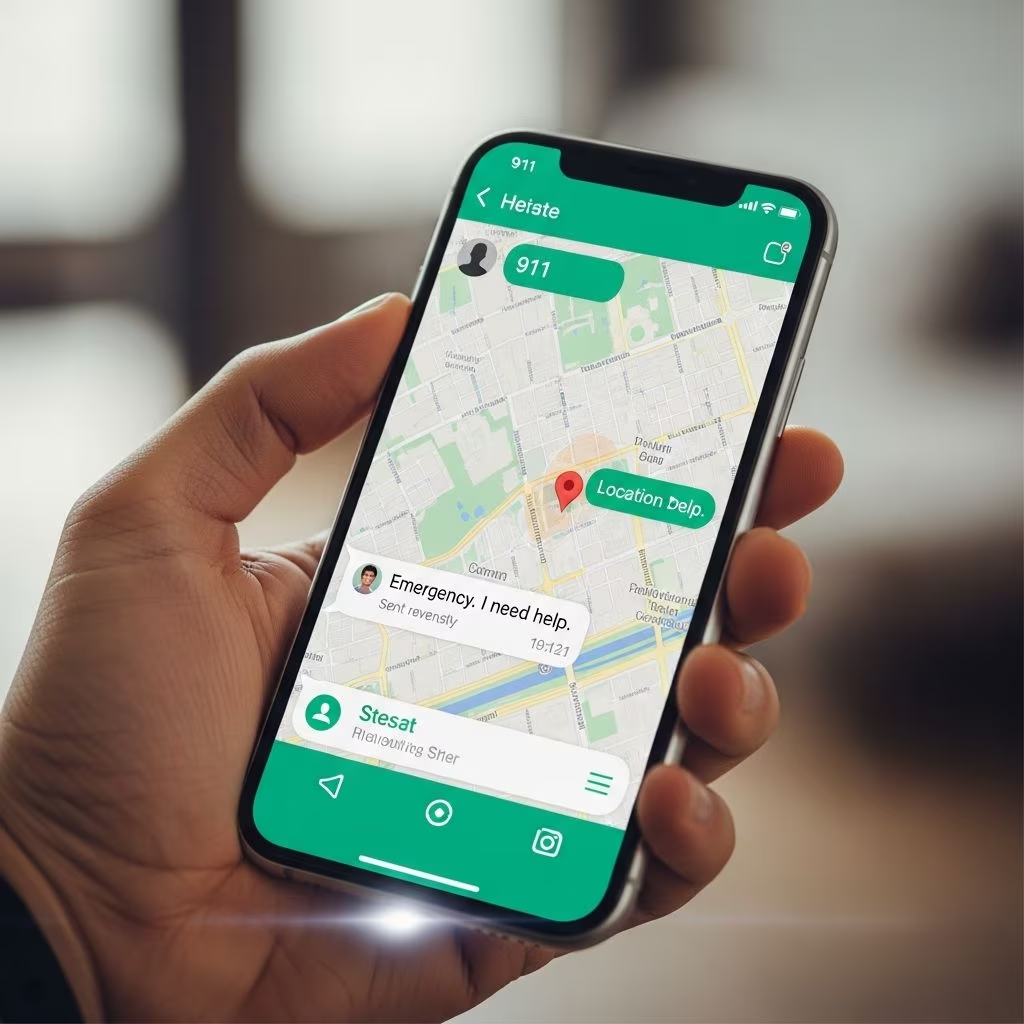
Texting 911 has emerged as a crucial alternative to traditional voice calls, particularly for individuals facing emergencies where speaking aloud poses risks or is impossible. This service allows users to send text messages to emergency dispatchers, enabling rapid response without verbal communication. Available in most U.S. states since its nationwide rollout, it supports SMS from mobile devices and is designed for true emergencies only.
Understanding the Rise of Text-to-911 Services
Emergency services have evolved with technology to accommodate diverse needs. Text-to-911, officially launched by the FCC in 2012 with full implementation by 2022, bridges gaps for those with hearing impairments, speech disabilities, or situations demanding silence. Unlike voice calls, texts transmit location data via Enhanced Location Accuracy (eLA), providing dispatchers with precise coordinates in supported areas.
This capability stems from federal mandates requiring wireless carriers to route texts to Public Safety Answering Points (PSAPs). As of 2025, over 98% of PSAPs support texting, though rural areas may lag. Users benefit from discreet reporting in active threats, but the service prioritizes brevity and clarity due to slower response times compared to calls.
Ideal Scenarios for Texting 911
Text 911 when voice calls are unsafe or impractical. Key situations include:
- Active shooter or domestic violence: Where noise could escalate danger, texting allows silent alerts with details like suspect descriptions.
- Mobility impairments or hearing loss: Essential for deaf or hard-of-hearing individuals unable to use voice services effectively.
- Speech difficulties: Conditions like autism, aphasia, or panic preventing speech benefit from typed messages.
- Remote or low-signal areas: Texts can sometimes transmit where calls drop, though both may fail entirely.
A table comparing use cases:
| Scenario | Why Text 911? | Voice Call Alternative? |
|---|---|---|
| Burglary in progress | Silent reporting without alerting intruder | Possible if safe to speak |
| Medical seizure | Provide symptoms while assisting victim | Preferred for real-time guidance |
| Child abduction | Discreet location sharing | Use if speaking won’t endanger |
| Fire in building | Quick alert if smoke inhalation hinders speech | Primary method |
Always prioritize texting only for imminent threats to life, health, or property, mirroring voice 911 guidelines.
Step-by-Step Guide to Texting 911 Effectively
To maximize success:
- Check local availability: Text ‘911’ or ‘text’ to 911; an automated reply confirms service or directs alternatives.
- Start with essentials: Include location (address, landmarks), emergency type (e.g., ‘heart attack’), and callback number.
- Be concise: Use short sentences; avoid emojis, links, or group texts, which may fail.
- Respond promptly:
- Switch to call if able: Texts delay response by 1-2 minutes; voice is faster for most cases.
Answer dispatcher queries; they may request photos or updates.
Example text sequence: ‘911: Fire at 123 Main St, Apt 4B, smoke everywhere, 2 people trapped. (555)123-4567.’
Dispatchers use structured protocols to triage texts, similar to calls, gathering TALK details: Type, Address, Location, Knowledge.
Regional Variations and Coverage Map Insights
While universal in theory, implementation varies. Coastal states like California and New York offer full support via major carriers (AT&T, Verizon, T-Mobile). Midwest and Southern PSAPs often integrate Rich Text (RTT) for real-time typing visibility.
| State/Region | Text-to-911 Status | Notes ||————-|——————-|——-|| California | Fully Supported | eLA-enabled PSAPs statewide || Texas | Partial (urban) | Rural gaps; check FCC map || Florida | Nationwide Leader | Supports MMS in select areas || Alaska | Limited | Voice preferred due to terrain || Hawaii | Full Coverage | Island-wide PSAP integration |
Consult the FCC’s Text-to-911 coverage map for precise PSAP status. International equivalents exist, like Canada’s Text with 9-1-1 for relay users.
Limitations and Common Pitfalls to Avoid
Texting isn’t a replacement for calls. Drawbacks include:
- Delayed responses: Texts queue behind voice calls; non-emergencies overload systems.
- No guaranteed delivery: Poor signal, iMessage misroutes, or carrier issues can fail texts.
- Limited data: No initial voice context; photos/MMS unsupported in many PSAPs.
- Misuse consequences: False texts tie up resources; accidental dials require staying on line.
In 2024, FCC data showed 10% of texts undelivered due to technical issues. Never text for non-emergencies like lost pets or traffic queries—use non-emergency lines.
Preparing Families and Vulnerable Groups
Educate children and seniors: Teach ‘Check, Call, Care’—assess scene, alert 911 (text or call), provide aid. For kids, emphasize address knowledge and staying on the line.
Vulnerable groups like the elderly or disabled should pre-save PSAP texts in contacts as ‘Text911’. Apps like RapidSOS enhance location sharing across platforms.
Legal Aspects and Responsibilities
Swatting—false emergency reports—is a federal crime with penalties up to 5 years. Knowingly misusing 911 incurs fines or jail time. Conversely, good-faith reports grant immunity.
Liability protections shield callers/texts acting reasonably. Document interactions if disputes arise.
Frequently Asked Questions About Texting 911
Can I text 911 from any phone?
Yes, from SMS-capable mobiles on major U.S. carriers; landlines and VoIP unsupported.
What if my text to 911 fails?
Try calling immediately; error messages guide to local non-emergency options.
Does texting 911 share my exact location?
Yes, via eLA in participating PSAPs, accurate to within 50 meters outdoors.
Is texting faster than calling?
No—calls connect in seconds; texts take longer but suit silent needs.
What about international emergencies?
Services vary; in Europe, use 112 with app-based alternatives.
Future Innovations in Emergency Texting
Next-gen 911 (NG911) promises video, data streaming, and AI triage. By 2030, expect seamless integration with smartwatches and vehicle telematics for automatic alerts.
In summary, texting 911 empowers safer crisis responses. Verify local support, use judiciously, and combine with preparedness for optimal outcomes. (Word count: 1687)
References
- When To Call 911 — E-Comm 9-1-1. 2023. https://www.ecomm911.ca/911-dispatch/when-to-call/
- When To Call 911 And When Not To Call 911 — California Governor’s Office of Emergency Services (Cal OES). 2022-05-12. https://www.news.caloes.ca.gov/when-to-call-911-and-when-not-to-call-911/
- When to Call 9-1-1 — Parker Police Department. 2024. https://www.parkerpolice.org/1892/When-to-Call-911
- Do’s and Don’ts of 911 — Frederick County Public Safety Communications. 2023. https://www.fcva.us/departments/public-safety-communications/do-s-and-don-ts-of-911
- Check, Call, Care: 3 Emergency Actions Steps — American Red Cross. 2024-08-15. https://www.redcross.org/take-a-class/resources/articles/the-three-cs-of-first-aid-check-call-care