
Text Messages in Court: Admissibility Guide
Unlock the rules for using text messages as court evidence: authentication, relevance, and legal hurdles explained for cases.
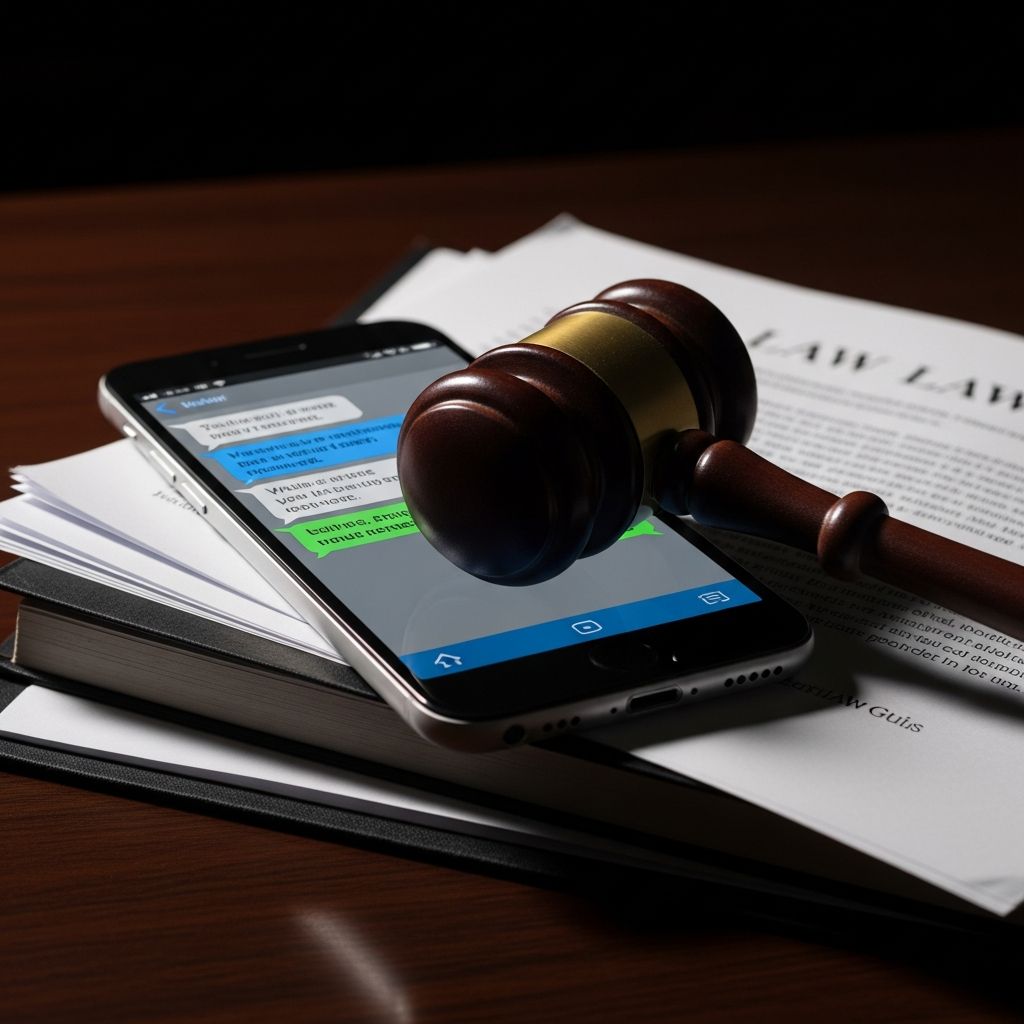
Text messages frequently serve as pivotal evidence in modern legal proceedings, bridging everyday digital communication with courtroom battles. Courts across jurisdictions recognize these electronic records as valid proof when they satisfy strict criteria, transforming casual chats into compelling testimony.
Foundational Requirements for Admissibility
Before any text message enters the trial record, it must clear multiple hurdles rooted in evidentiary rules. Judges evaluate submissions based on established standards to ensure fairness and reliability.
- Relevance to the Dispute: The content must directly connect to the case facts, such as demonstrating intent, agreements, or timelines.
- Authenticity Confirmation: Proponents must verify the message originates from the claimed sender without tampering.
- Proper Acquisition: Messages cannot stem from illegal searches or privacy breaches.
- Hearsay Compliance: Exceptions apply if statements fall under recognized categories like admissions or business records.
Failure in any area prompts exclusion, underscoring the need for meticulous preparation by legal teams.
Proving Authenticity: Key Strategies
Authenticating texts ranks as the primary challenge, demanding more than a mere sender label. Courts require evidence linking the device, account, and content to the individual involved.
Circumstantial indicators prove effective: recipient testimony confirming consistent communication patterns from a specific number, unique content referencing private details, or device metadata like timestamps and IP logs.
| Method | Description | Strengths | Potential Weaknesses |
|---|---|---|---|
| Screenshots/Printouts | Captures with phone number, name, and timestamps | Quick and visual | Susceptible to editing claims |
| Affidavits/Testimony | Sworn statements from sender/recipient | Direct personal knowledge | Requires witness availability |
| Device Forensics | Expert extraction of native data | Immutable records | Costly and technical |
| Carrier Records | Subpoenaed logs from providers | Official verification | Time delays in retrieval |
Under Federal Rules of Evidence 901, witnesses with knowledge can affirm the evidence’s genuineness, bolstering admissibility.
Legal Pathways to Obtain Texts
Accessing messages demands adherence to constitutional protections. Voluntary handover simplifies matters, but contested scenarios invoke formal processes.
- Subpoenas direct carriers or parties to produce records.
- Warrants authorize law enforcement searches post-probable cause.
- Court orders compel disclosure in civil disputes.
Illegally seized texts face suppression, protecting Fourth Amendment rights. Parties must document chains of custody to preempt challenges.
Navigating Hearsay Obstacles
Many texts qualify as out-of-court statements offered for truth, triggering hearsay scrutiny. Yet exceptions abound: party-opponent admissions bypass rules, while excited utterances or present-sense impressions gain entry.
Incoming messages from third parties demand contextual justification, often pairing with replies to establish relevance without standalone hearsay issues.
Preservation Techniques for Future Use
Proactive steps safeguard messages against deletion or device failure. Manual screenshots suffice initially, but forensic tools extract comprehensive threads, including metadata invisible in apps.
Services enabling exports to PDF maintain timestamps and headers intact. Litigants should timestamp preservations and secure multiples copies across devices.
Civil Applications: Contracts and Disputes
In contract law, texts memorialize agreements, negotiate terms, or confirm deliveries. Family courts scrutinize exchanges for custody insights or support calculations.
Personal injury claims leverage texts admitting fault or detailing incidents. Admissibility mirrors criminal standards, emphasizing chain integrity.
Criminal Contexts: Investigations and Trials
Prosecutors wield texts to prove conspiracies, threats, or alibis. Defenses counter by questioning context or coercion, arguing ambiguities.
Mental state inferences from tone and timing sway juries. Even deleted messages recover via provider archives, though age complicates efforts.
Overcoming Common Defense Tactics
Opponents attack texts via authenticity doubts, irrelevance claims, or illegal procurement allegations. Skilled advocates rebut with layered proofs: cross-examinations exposing inconsistencies or expert affidavits on edit impossibility.
Contextual arguments clarify sarcasm or jokes misconstrued as confessions. Weight, not mere admission, ultimately rests with fact-finders.
Frequently Asked Questions
Can screenshots alone authenticate texts in court?
No, screenshots require supporting evidence like testimony or metadata to confirm unaltered origin and authorship.
Are deleted texts retrievable for trials?
Yes, from recipient devices, carrier backups, or forensic recovery, though success diminishes with time elapsed.
Do state laws vary on text admissibility?
Yes, while federal standards guide, jurisdictions apply local evidence rules and privacy statutes.
What if texts violate privacy expectations?
Illegally obtained messages get excluded, regardless of probative value.
How do group chats factor into evidence?
Authentication demands isolating senders via handles, content, or replies; context clarifies multi-party dynamics.
Strategic Advice for Litigants
Consult attorneys early to map preservation and authentication plans. Avoid self-help recoveries risking spoliation claims. In high-stakes matters, digital forensics experts fortify positions.
Courts trend toward admitting reliable digital evidence, reflecting technology’s ubiquity. Mastery of these protocols tips scales decisively.
References
- Can My Text Messages Be Used Against Me in Court? — Hough Law. 2023-06-15. https://www.houghlaw.com/blog/can-my-text-messages-be-used-against-me-in-court/
- Is a Text Message Considered Written Notice — EZ Texting. 2024-02-10. https://www.eztexting.com/resources/sms-resources/is-a-text-message-considered-written-notice
- Text Messages as Evidence in Court — Malman Law. 2023-11-20. https://www.malmanlaw.com/malman-law-injury-blog/text-messages-as-evidence-in-court/
- Private vs Public Social Media: Can DMs and Texts Be Used in Court? — Magnals. 2024-01-05. https://magnals.com/private-vs-public-social-media-can-dms-and-texts-be-used-in-court/
- Text Messages as Evidence in Court — Lebedevitch Law Firm. 2023-09-12. https://www.leb-law.com/text-messages-as-evidence-in-court/
- Email & Text Message Evidence in Litigation — Stange Law Firm. 2023-05-18. https://www.stangelawfirm.com/articles/email-text-message-evidence-in-litigation/
- Text Messages Being Used in Court — RLMNJ Law. 2023-06-01. https://www.rlmnjlaw.com/blog/2023/june/text-messages-being-used-in-court/
Similar Articles








Read full bio of medha deb


