
Workplace Drug Testing Laws in Texas: Rights and Requirements
Navigate Texas drug testing policies: employer obligations, employee rights, and legal compliance.
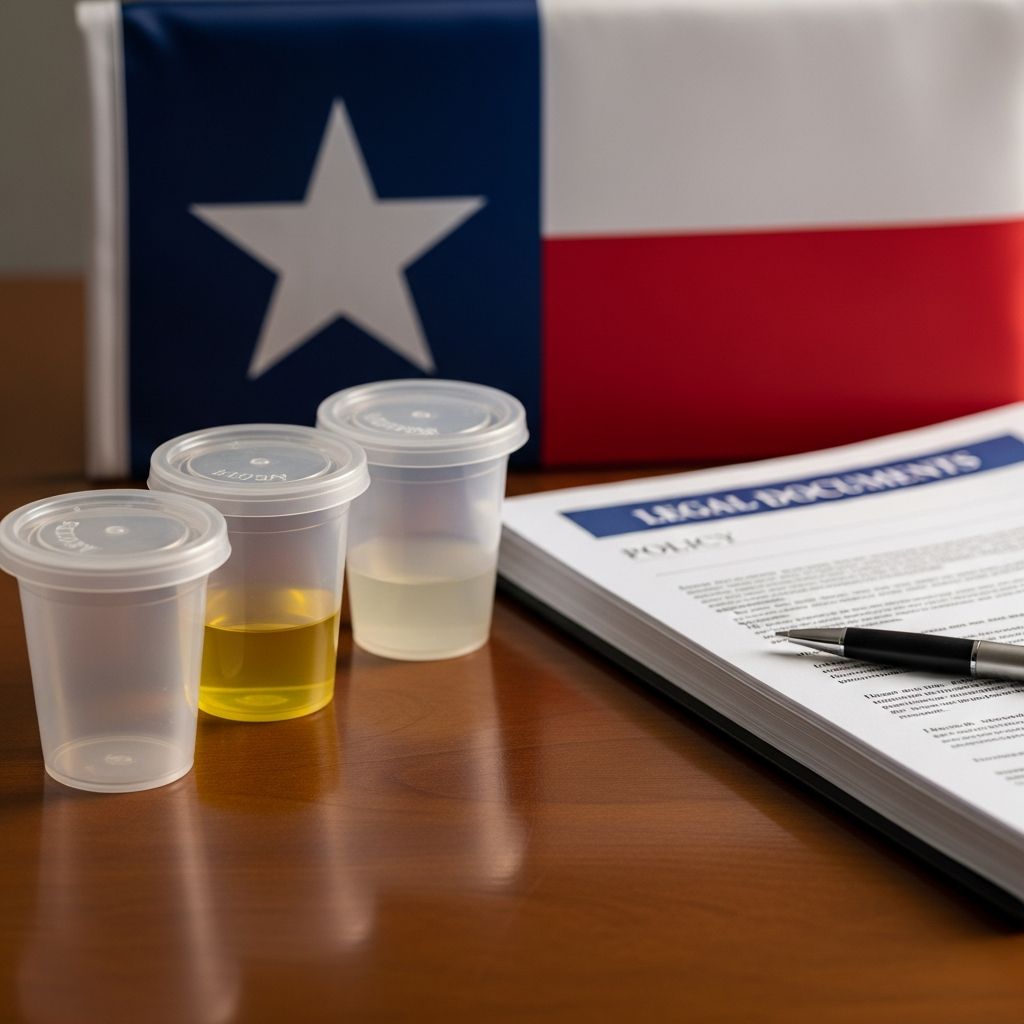
Understanding Texas Workplace Drug Testing Regulations
Drug testing remains a significant practice in Texas workplaces, balancing employer interests in maintaining safe work environments with employee privacy rights. The regulatory framework governing these practices differs substantially between private and public sector employers, with specific requirements that employers must follow to remain compliant with state law.
Texas law permits employers considerable flexibility in establishing drug testing programs, particularly within the private sector. However, this flexibility comes with specific procedural requirements and limitations designed to protect employee rights while allowing businesses to maintain drug-free workplace standards. Understanding these regulations is essential for both employers seeking to implement testing programs and employees who may be subject to such policies.
Foundational Requirements for Employer Drug Testing Policies
Texas employers must establish comprehensive drug testing policies that meet specific legal standards. These requirements ensure transparency and protect both employer and employee interests throughout the testing process.
Key elements that must be included in any drug testing policy include:
- Written notification of which employees or job categories will be subject to testing
- Clear identification of what substances will be tested for and the testing methodology employed
- Detailed explanation of disciplinary consequences for positive test results
- Procedures for handling test results and maintaining confidentiality
- Information about rehabilitation options, if the employer chooses to offer them
- The circumstances under which testing will occur, including pre-employment, random, or cause-based scenarios
For employers with 15 or more employees, documenting these policies in writing and distributing them to all staff members is not merely recommended but represents a critical legal obligation. This written documentation creates a clear record of employee acknowledgment and understanding, which becomes invaluable if disputes arise regarding termination decisions or unemployment claims.
Pre-Employment Versus Ongoing Workplace Testing
Texas employers can implement different testing approaches depending on their business needs and industry requirements. The timing and scope of testing decisions carry important legal implications.
Pre-employment drug testing, conducted before an individual begins work, represents one of the most common testing scenarios. Applicants who fail pre-employment screening can be disqualified from employment without facing the same legal complexities that arise when testing current employees. Employers have substantial discretion in this context, as individuals have not yet entered into an employment relationship with associated privacy protections.
For current employees, testing can occur through several mechanisms:
- Random testing: Unannounced tests administered to selected employees at regular intervals, such as twice yearly for a randomly chosen individual
- Cause-based testing: Tests triggered by reasonable suspicion of impairment, including observations of unsafe behavior, involvement in workplace accidents, or witness reports
- Routine testing: Periodic tests administered as part of regular health and safety protocols for specific job categories
The distinction between these testing types matters significantly for employee rights and legal defensibility. Cause-based testing must be grounded in objective observations or incidents, not arbitrary decisions or discrimination. Random testing, while more defensible than individualized suspicion-based testing, still must apply consistent criteria across all employees in the designated category.
Selective Applicability and Job-Based Distinctions
Texas law permits employers to apply drug testing requirements selectively, rather than implementing blanket policies that cover all workers. However, this selective application must follow logical business rationales related to job functions and safety considerations.
An employer could legitimately establish testing requirements for:
- All employees who operate machinery or vehicles
- Workers in positions classified as safety-sensitive or security-sensitive
- Staff members with access to controlled substances or security-restricted areas
- Personnel in management or supervisory roles overseeing safety operations
Conversely, employers can exclude from testing requirements administrative staff, clerical workers, or other positions where impairment poses minimal safety risks. The key legal principle requires that the testing policy apply consistently to all employees within designated job categories, preventing claims of selective enforcement or discriminatory application.
The Requirement for Employee Consent and Written Acknowledgment
A foundational principle of Texas drug testing law is the necessity of employee consent. Employers cannot lawfully administer drug tests without obtaining written permission from employees, creating a contractual acknowledgment of testing authority.
This consent requirement has practical implications that extend beyond mere formality. Employees retain the legal right to refuse consent to drug testing, though most employers can lawfully terminate employment for such refusal, provided the policy clearly states this consequence and the employee has been reminded of the policy before termination occurs.
Employers must also obtain consent specifically for the disclosure of test results. Employees should sign separate authorization forms permitting testing laboratories and employers to release results to relevant third parties, including the Texas Workforce Commission in the context of unemployment claims, courts, or other entities addressing disputes arising from the test. This multi-layered consent approach protects the employer’s ability to defend termination decisions against unemployment claims or legal challenges.
Testing Methodologies and Chain of Custody Requirements
The reliability of drug testing depends heavily on proper procedures for sample collection, handling, and analysis. Texas employers should implement testing protocols that meet or exceed industry standards to protect against unreliable results and associated legal challenges.
Initial screening tests typically detect amphetamines, cocaine, marijuana, opioids, and phencyclidine (PCP). However, initial positive results require confirmation through more rigorous testing methods. The Texas Workforce Commission expects employers to use gas chromatography/mass spectrometry (GC/MS) confirmation testing before taking adverse employment actions based on positive results. While GC/MS testing costs more than initial screening, this additional expense provides crucial legal protection by producing results that withstand scrutiny in unemployment hearings and legal proceedings.
Chain of custody documentation proves essential throughout the testing process. This documentation establishes that the employee’s sample was properly identified, handled, and tested without contamination or substitution. Employers should maintain detailed records showing:
- Sample collection date, time, and location
- Collector identification and methodology used
- Laboratory receipt and processing dates
- Testing methodology and results
- Storage conditions and security measures
This documentation becomes critical when defending unemployment claims, as the Texas Workforce Commission requires specific evidence that chain of custody was maintained as a prerequisite for disqualifying claimants based on positive drug tests.
Handling Positive Test Results and Disciplinary Responses
Employers possess substantial discretion in determining appropriate responses to positive drug test results, though policies must be clearly communicated and applied consistently. Texas law does not mandate any particular disciplinary response, permitting employers to establish their own standards.
Common approaches to positive results include:
- Immediate termination: Most employers notify employees that positive results will result in dismissal without opportunity for remediation
- Rehabilitation and return: Some employers offer employees the opportunity to participate in substance abuse treatment programs with conditional reinstatement
- Probationary return: Employers allowing workers to return after rehabilitation typically impose strict conditions, including monthly random testing, probationary periods of 12 months, and automatic termination for subsequent positive results
The critical requirement is that the employer’s policy must specify in advance what consequences will follow from positive results. Employees must receive written notification of these consequences before the testing occurs, ensuring they understand the stakes and cannot claim surprise at the outcome. This advance notice also strengthens the employer’s position in unemployment proceedings and wrongful termination litigation.
The Cannabis Testing Landscape: Recent Developments and Restrictions
A significant development affecting Texas employers involves new legal restrictions on testing for cannabis and cannabinoids. Recent legislative efforts have begun to limit employer authority in this specific area, creating important distinctions between cannabis and other controlled substances.
New restrictions, effective July 1, 2026, will prohibit employers with 15 or more employees from establishing drug testing policies that require employees to submit to tests screening for the presence of cannabinoids as a condition of employment. These restrictions also prevent employers from administering or requiring cannabinoid tests or establishing negative cannabinoid test results as employment conditions.
This represents a substantial limitation on traditional drug testing authority, reflecting evolving policy perspectives on cannabis use. Employers must therefore carefully review their current testing protocols and update policies to ensure compliance with these new restrictions on cannabinoid testing. This change does not eliminate testing for other controlled substances but creates a significant carve-out specifically for cannabis and its metabolites.
Distinctions Between Private and Public Sector Testing
While Texas law grants private employers considerable testing authority, public employees enjoy greater constitutional protections against drug testing. This distinction arises from Fourth Amendment principles requiring that government action not be unreasonably intrusive.
Public employers generally must demonstrate a compelling governmental interest that outweighs employee privacy rights before implementing testing programs. Courts have struck down overly broad testing initiatives for public employees that lack clear justification or particularized suspicion. Testing programs for public employees face heightened scrutiny, particularly when applied without individualized suspicion or clear safety-related justifications.
Private employers, by contrast, face fewer constitutional limitations, though they must still comply with state privacy laws, labor regulations, and employment contract provisions. The distinction reflects the greater authority employers possess over private business operations compared to governmental entities, which must answer to constitutional constraints.
Defenses Against False Results and Employee Appeal Rights
Employees who test positive retain limited but meaningful rights to challenge test results. Understanding these appeal mechanisms is important for both employees and employers.
Employees can request retesting of the original sample using different methodologies or laboratories. Many employers choose to implement policies allowing such retesting, though Texas law does not mandate this right. If an employer offers retesting, the policy should clearly specify who bears the cost, how quickly retesting occurs, and whether the employee’s employment status is suspended pending retest results.
In unemployment benefit disputes, employees can challenge the reliability of test evidence by questioning chain of custody procedures, testing methodology, laboratory qualifications, or the connection between positive results and actual impairment during work hours. The Texas Workforce Commission requires specific evidence meeting all five elements of the employer’s case before disqualifying claimants based on positive tests, creating meaningful opportunities for employees to contest adverse actions.
Protecting Employer Interests in Drug Testing Implementation
Employers implementing drug testing programs should take specific steps to protect their interests and ensure legal compliance:
- Develop written policies addressing all required elements before implementing any testing program
- Obtain employee written consent and acknowledgment of policies in advance
- Use qualified, certified testing laboratories with strong quality assurance records
- Implement confirmation testing for all positive results using GC/MS methodology
- Maintain meticulous documentation of chain of custody throughout the testing process
- Apply testing policies consistently across all covered employees within designated job categories
- Document the business rationale for job-based testing classifications
- Keep all test results confidential and limit disclosure to authorized parties
- Review and update policies regularly to maintain compliance with evolving legal requirements
Frequently Asked Questions
Q: Can Texas employers test all employees for drugs, or only certain positions?
A: Employers can apply testing selectively to specific job categories, such as positions operating machinery or involving safety-sensitive functions. However, testing must apply consistently to all employees within designated categories. Blanket testing of all employees is legally permissible but creates higher administrative costs.
Q: What happens if an employee refuses to submit to a drug test?
A: Employers can terminate employment for test refusal, provided the policy clearly states this consequence and the employee has been reminded of the policy and termination risk before dismissal occurs.
Q: Can employers test for marijuana under the new Texas law?
A: Beginning July 1, 2026, employers with 15 or more employees cannot establish testing policies requiring employees to submit to cannabinoid screening as a condition of employment. This restriction significantly limits marijuana testing authority for most employers.
Q: What testing methodology does Texas law require?
A: While initial screening tests are permissible, the Texas Workforce Commission expects confirmation testing using gas chromatography/mass spectrometry (GC/MS) methodology before adverse employment actions. This two-stage approach strengthens the employer’s legal position in disputes.
Q: Can employers force employees to undergo physical searches for drug testing?
A: No. Employers cannot physically force employees to submit to searches due to risks of civil and criminal liability for assault, battery, false imprisonment, and infliction of emotional distress. However, employers can terminate employment for refusal to consent to reasonable searches outlined in the policy.
Q: How long must employers retain drug test documentation?
A: While Texas law does not specify retention periods, employers should maintain records indefinitely for employees who have been terminated, as documentation may be needed for unemployment claims or litigation that could arise years after termination.
References
- Bill Text: TX HB1797 | 2025-2026 | 89th Legislature — Texas Legislature Online. 2025. https://legiscan.com/TX/text/HB1797/id/3045285
- What are Texas Laws Regarding Drug Testing? — Underwood Law Office. 2025. https://www.underwoodlawoffice.com/faqs/what-are-texas-laws-regarding-drug-testing/
- Drug Testing in the Workplace — Texas Workforce Commission, Education, Training & Employment Division. 2025. https://efte.twc.texas.gov/drug_testing_in_the_workplace.html
- Drug Testing in the Workplace: Private Employees versus Public Employees — Texas Employment Lawyer. 2025. https://www.texasemploymentlawyer.com/2025/11/drug-testing-in-the-workplace-private-employees-versus-public-employees/
- The Evolution of Workplace Drug Testing: What Employers Need to Know for 2026 — Ogletree Deakins. 2025. https://ogletree.com/insights-resources/blog-posts/the-evolution-of-workplace-drug-testing-what-employers-need-to-know-for-2026/
- Legal Considerations for a Drug-Testing Program — Fisher Phillips LLP. 2025. https://www.fisherphillips.com/en/news-insights/legal-considerations-for-a-drug-testing-program.html
Similar Articles








Read full bio of Sneha Tete




