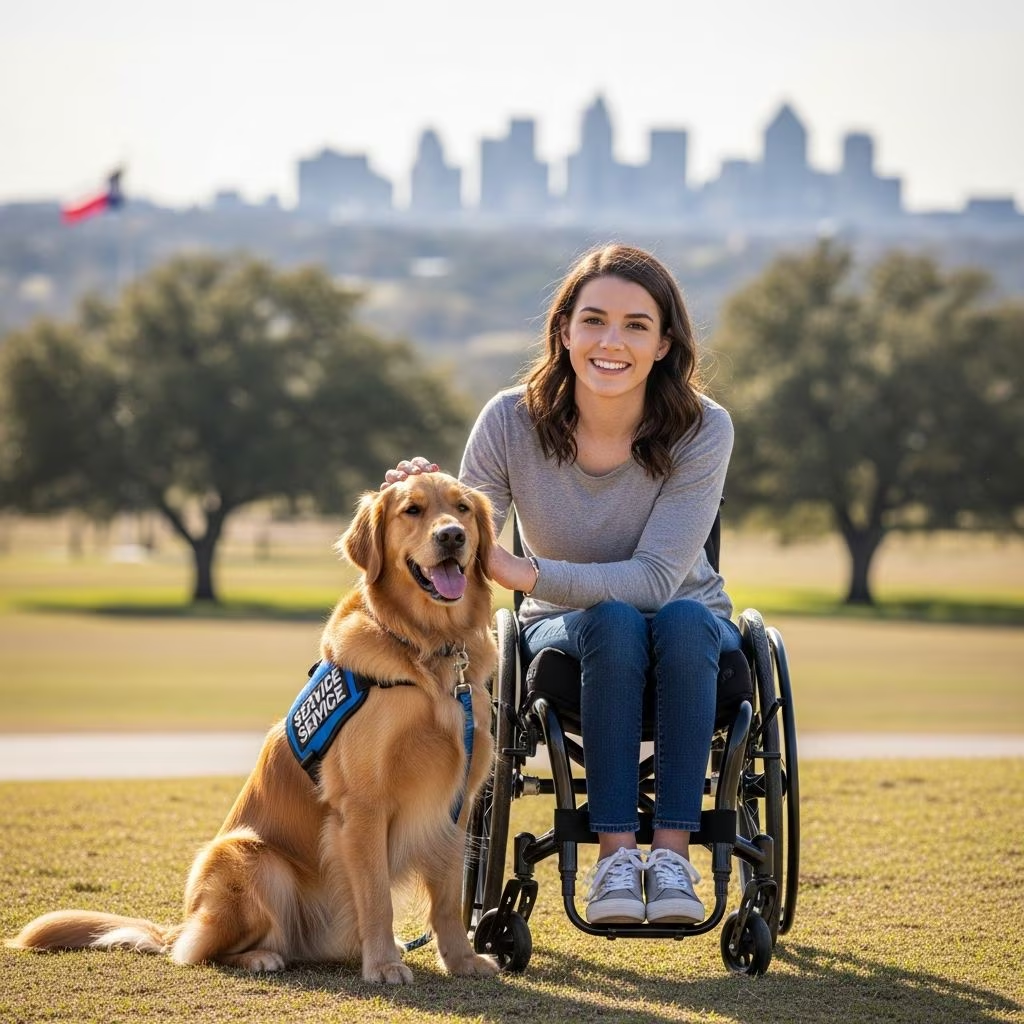
Texas provides robust legal protections for individuals with disabilities who rely on service dogs and other assistance animals to navigate daily life. These laws blend state statutes with federal regulations like the Americans with Disabilities Act (ADA), ensuring broad access to public spaces, housing, and transportation while distinguishing between trained service animals and emotional support animals (ESAs). This guide breaks down definitions, rights, responsibilities, and enforcement mechanisms to empower users and businesses alike.
Defining Assistance Animals Under Texas Law
Texas law, specifically the Texas Human Resources Code Section 121.002, defines an assistance animal or service animal as a canine specially trained or equipped to aid a person with a disability. This training focuses on tasks directly mitigating the effects of the disability, such as guiding the visually impaired, alerting to seizures, or retrieving items for mobility-limited individuals. Importantly, Texas emphasizes dogs, excluding other species unless specified otherwise in federal contexts.
Key distinctions arise between service animals and emotional support animals. Service animals must perform specific, trained tasks, whereas ESAs provide comfort or emotional aid without formal training requirements. State public access laws apply strictly to service animals, while ESAs gain protections primarily in housing under the Fair Housing Act (FHA).
- Service Animal Tasks: Examples include opening doors, detecting allergens, or interrupting harmful behaviors in psychiatric conditions like PTSD.
- Training Source: Animals can be owner-trained; no professional certification is mandated.
- Exclusions: Pets offering mere companionship do not qualify.
Public Access Rights for Service Animals
Individuals with disabilities accompanied by service animals enjoy near-universal access to public facilities in Texas. State law prohibits denial of entry to any public place, including restaurants, stores, schools, and transportation, when the animal is under control. Federal ADA Titles II and III reinforce this for state/local government (Title II) and private businesses (Title III), covering 12 categories like theaters, doctors’ offices, and recreation centers.
Businesses and staff may ask only two questions to verify: (1) Is the dog required due to a disability? (2) What tasks is it trained to perform? No proof, certification, or demonstration is required. If the disability is obvious (e.g., blindness), no questions are permitted.
| Scenario | Allowed Inquiry | Prohibited Actions |
|---|---|---|
| Visible Disability (e.g., wheelchair user) | None | Requesting ID, vest, or task demo |
| Non-Visible Disability | Two questions only | Demanding medical docs or certification |
| Food Prep Areas | Exclusion from sterile zones | Barring from customer areas |
Food establishments must allow service animals in customer areas but may exclude from food preparation zones per Texas Health and Safety Code Section 437.023.
Service Animals in Training: Texas Protections
Texas explicitly protects service animals in training, granting them the same public access rights when accompanied by an approved trainer or handler. This applies to public facilities and common carriers. The animal must be actively training for disability-related tasks, and disruptive behavior can lead to removal, mirroring rules for fully trained animals.
- Trainer Responsibilities: Maintain control and ensure the animal does not disrupt operations.
- University Policies: Institutions like UT Austin and UTSA align with state law, permitting in-training animals in buildings.
- Federal Note: ADA allows self-training but does not explicitly cover in-training status in all contexts.
Housing Accommodations for Assistance Animals
While Texas public access focuses on service dogs, housing follows the federal Fair Housing Act (FHA), mandating reasonable accommodations for assistance animals, including ESAs. Landlords cannot deny housing to qualified individuals with these animals, even in no-pet properties, without charging pet fees or deposits.
ESA eligibility requires documentation from a healthcare provider verifying the need for emotional support related to a disability. No training is needed, broadening inclusion to cats, rabbits, or other species. Texas law aligns but defers to FHA for multifamily housing.
- Verification Process: Letter confirming disability and animal’s therapeutic role.
- Exceptions: Undue burden (e.g., single-room occupancy) or direct threat.
- State Overlap: Service dogs qualify automatically as assistance animals.
Air Travel Regulations for Service Animals
Under the Air Carrier Access Act (ACAA), airlines treat service dogs as no-fee accompaniments but require DOT forms attesting to health, training, and behavior. ESAs lost federal cabin access in 2021; they travel as pets with fees. Texas residents benefit from state protections on ground transport but must comply with federal aviation rules.
Service animals in training lack ACAA guarantees; airlines set policies compliant with animal welfare laws.
Misrepresentation and Penalties
Texas imposes strict penalties for faking service animal status. Misusing a harness or leash to imply training constitutes a misdemeanor: fines up to $1,000, plus 30 hours community service for disability-serving organizations. Habitual neglect or abuse leads to animal seizure.
Harassment of legitimate service animals—impeding duties or endangering handlers—is prohibited, with criminal liability. A 2023 law update strengthened fake vest misuse penalties to $300 fines and service.
All animals must follow local laws: vaccinations, leashing, no excessive barking.
Responsibilities of Handlers and Businesses
Handler Duties
- Ensure control via voice, leash, or harness (except when task-interfering).
- Maintain hygiene; clean up waste immediately.
- Comply with vaccinations and health standards.
Business Obligations
- Admit qualified animals without discrimination.
- Remove only for threats, lack of control, or hygiene issues.
- Train staff on two-question rule.
Obtaining and Training a Service Dog in Texas
No registration or certification is required. Options include:
- Adopt from accredited programs (e.g., nonprofits pairing dogs with handlers).
- Hire professional trainers.
- Self-train a suitable pet dog, using online courses or resources.
Focus on reliability, temperament, and task-specific skills. Costs vary; some programs offer grants.
Frequently Asked Questions (FAQs)
Do service animals need vests or IDs in Texas?
No, neither ADA nor Texas law requires identifying gear, though some handlers use it voluntarily.
Can emotional support animals enter Texas restaurants?
No, ESAs lack public access rights; only trained service animals qualify.
Are miniature horses service animals in Texas?
Federal ADA allows them; Texas primarily references canines but defers to ADA in public settings.
What if a service dog is disruptive?
Businesses may request removal, but not based on breed, size, or shedding.
Do landlords need proof for ESAs?
Yes, a provider letter suffices; no further demands allowed under FHA.
Recent Developments and Enforcement
Texas continues refining laws, with 2023 enhancements targeting fraud. Contact the Texas Governor’s Office on Disabilities or local authorities for complaints. Businesses should consult ADA resources for compliance training.
References
- Texas Disability Law – Service Animals — Texas Governor’s Office. Accessed 2026. https://gov.texas.gov/organization/disabilities/assistance_animals
- Service Dog Laws In Texas — Texas Humane Legislation Network. 2023. https://www.thln.org/texas_service_dog_laws
- Service Dog Laws in Texas (2026): Rights & Training — Pettable. 2026. https://pettable.com/blog/how-to-get-a-service-dog-in-texas
- Service Animals in Training — University of Texas at Austin. Accessed 2026. https://compliance.utexas.edu/programs/iaa/animals/service-animals-training
- Service Animals — Texas A&M University. Accessed 2026. https://orec.tamu.edu/ada/service-animals/
- Service Animals and Their Access to Public Places — Texas Secretary of State. Accessed 2026. https://www.sos.state.tx.us/service-animals.shtml