
Texas LLCs: Shielding Owners from Personal Creditors
Discover how Texas LLCs provide robust protection for owners' assets against personal debts and creditors through exclusive charging order remedies.
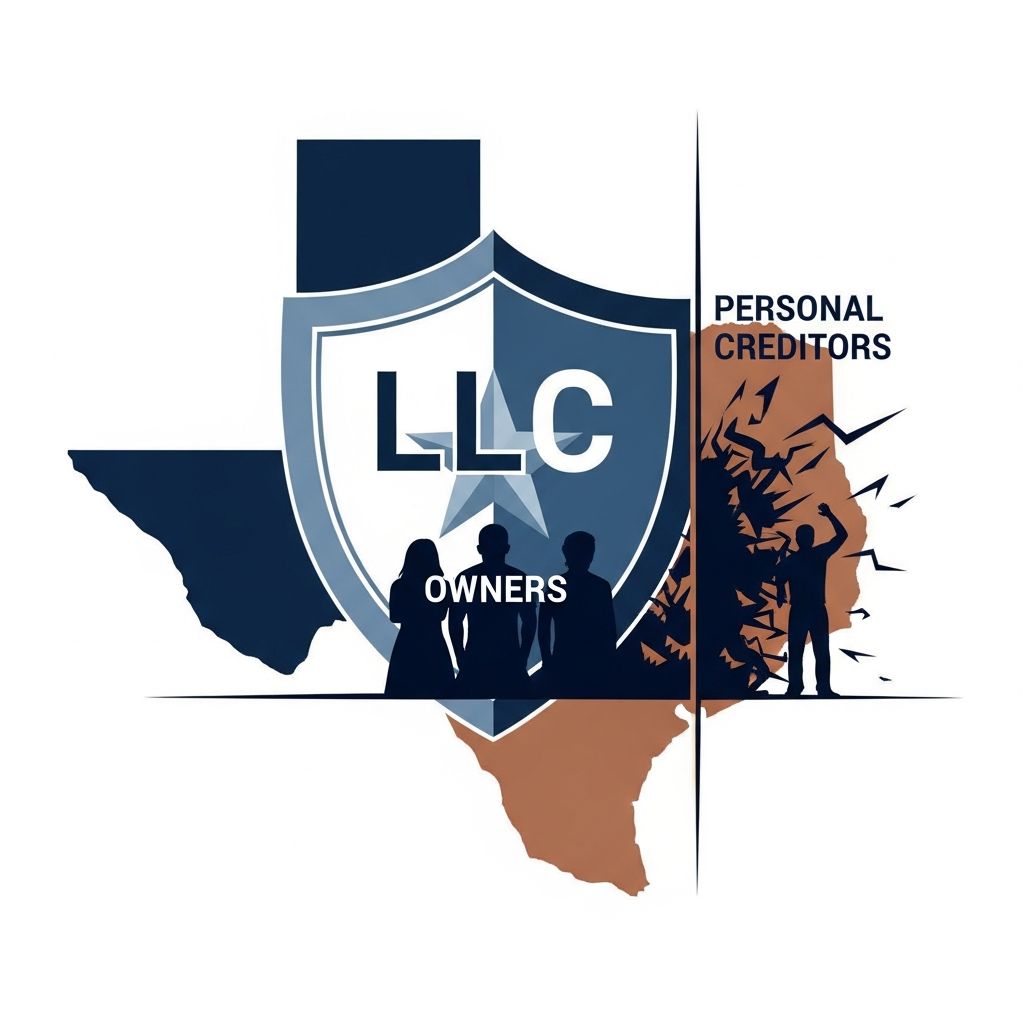
Forming a Limited Liability Company (LLC) in Texas creates a powerful barrier between business operations and personal finances, particularly when facing personal debts. Texas statutes provide some of the strongest protections in the nation, ensuring that creditors seeking to collect on an owner’s individual obligations cannot easily access LLC assets or force sales of ownership interests.
Understanding the Core Protection Mechanism
The foundation of this safeguard lies in treating the LLC as a distinct legal entity from its owners, known as members. Property titled in the LLC’s name, such as bank accounts or real estate, belongs solely to the company and remains insulated from members’ personal creditors. This separation prevents creditors from seizing LLC assets to satisfy personal judgments against individual members.
Texas law explicitly restricts creditors’ options. Under the Texas Business Organizations Code, a judgment creditor’s only recourse is obtaining a charging order against the debtor member’s financial interest in the LLC. A charging order grants the creditor rights to any distributions that would otherwise go to the member, but nothing more. Creditors gain no voting rights, management control, or ability to force asset liquidation.
Exclusive Remedy: Charging Orders in Detail
Texas statutes make charging orders the exclusive remedy for personal creditors, a provision updated in 2023 to eliminate ambiguities. This means creditors cannot pursue alternative actions such as foreclosing on the membership interest, demanding partnership-like dissociation, or compelling the LLC to redeem the interest.
- Creditors receive only economic benefits from distributions, if any are made.
- No interference with LLC operations or decision-making.
- Members retain full control over management and voting.
This structure deters creditors, as they often receive nothing if the LLC retains profits for reinvestment rather than distributing them. Texas’s debtor-friendly approach positions it as a prime jurisdiction for asset protection planning.
Protection Applies to All LLC Types
Historically, some states weakened protections for single-member LLCs (SMLLCs), allowing creditors broader remedies due to the absence of other members to protect. Texas explicitly rejects this distinction. Recent legislative clarifications confirm that charging order exclusivity applies equally to both multi-member LLCs and SMLLCs.
| LLC Type | Creditor Remedy | Key Texas Statute |
|---|---|---|
| Multi-Member LLC | Charging Order Only | Tex. Bus. Org. Code § 101.112 |
| Single-Member LLC | Charging Order Only | Tex. Bus. Org. Code § 101.112 (2024 update) |
This uniformity strengthens Texas LLCs for solo entrepreneurs and family businesses alike.
Business Debts vs. Personal Debts: Two-Way Shield
LLC formation primarily shields personal assets from business liabilities. If the LLC faces lawsuits from customers, employees, or vendors, only company assets are at risk—not members’ homes, vehicles, or savings—provided formalities are observed. Conversely, the reverse protection guards LLC assets from members’ personal creditors.
For instance, a slip-and-fall lawsuit targets LLC insurance and property, leaving personal holdings untouched. Personal credit card debt or medical bills cannot reach LLC bank accounts.
Maintaining the Liability Veil: Essential Practices
Robust statutory protections do not absolve owners of responsibilities. Courts may “pierce the veil” if the LLC is treated as a personal piggy bank, exposing members to liability. Texas applies corporate veil-piercing standards to LLCs, requiring proof of actual fraud for direct personal gain in contractual claims.
Key best practices include:
- Separate business and personal bank accounts; never commingle funds.
- Maintain accurate records, hold regular meetings, and file annual reports.
- Sign contracts as LLC representative, not individually.
- Adequate capitalization to cover foreseeable risks.
- Obtain necessary insurance policies.
Texas law reinforces this: Members are not liable for LLC debts absent fraud or specific company agreement provisions (Tex. Bus. Orgs. Code Ann. § 101.114). Personal tortious acts, however, remain individually actionable.
Potential Exceptions and Risks
Guaranteed loans or personal suretyships bypass protections, as do IRS liens or family court orders in some cases. Multi-state operations may invoke less protective laws if significant business occurs elsewhere. Fraudulent transfers prior to creditor actions can trigger unwind provisions.
Courts pierce veils rarely, but examples include using LLC funds for personal expenses or undercapitalization leading to insolvency. Environmental penalties or direct personal negligence also impose individual liability.
Strategic Planning for Maximum Protection
Layered strategies enhance safeguards:
- Form multi-member LLCs for added creditor deterrence.
- Use holding LLCs owning subsidiary operating LLCs.
- Combine with trusts for estate planning synergy.
- Regular legal audits to ensure compliance.
Texas’s framework, post-2011 amendments to the Business Organizations Code, provides clarity: Actual fraud is required to hold members liable on contracts, shifting burden to plaintiffs.
Frequently Asked Questions
Can personal creditors seize my Texas LLC’s assets?
No, Texas law prohibits this; LLC property is separate, and creditors are limited to charging orders against distributions.
Does protection differ for single-member LLCs?
No, 2023 updates confirm charging orders are exclusive for both single and multi-member LLCs.
What if I personally guarantee a business loan?
Your personal assets become reachable upon default, overriding LLC protections.
How do I avoid veil piercing?
Treat the LLC as truly separate: no commingling, proper records, and adequate funding.
Is Texas LLC protection better than other states?
Yes, its exclusive charging order rule and SMLLC parity make it highly favorable.
Conclusion: Empowering Texas Business Owners
Texas LLCs offer unparalleled asset protection from personal creditors, underpinned by clear statutes and judicial precedent. By forming and maintaining an LLC properly, owners secure their financial future against unforeseen personal debts while pursuing business growth.
References
- How LLC Formation Protects Personal Assets in Texas — White Meijas. 2024. https://whitemejias.com/how-llc-formation-protects-personal-assets-texas/
- LLC Protection for Members’ Personal Debt in Texas — Nolo. 2024. https://www.nolo.com/legal-encyclopedia/llc-protection-members-personal-debt-texas.html
- Shielding Your Assets: How Texas LLC Owners Can Protect Against Veil-Piercing Claims — HCH Lawyers. 2025-05. https://www.hchlawyers.com/blog/2025/may/shielding-your-assets-how-texas-llc-owners-can-p/
- When Liability Isn’t Limited: Avoiding Individual Liability as an Owner of a Corporation or LLC — West Mermis. N.D. https://www.westmermis.com/news/when-liability-isnt-limited-avoiding-individual-liability-as-an-owner-of-a-corporation-or-llc/
- Maintaining Your LLC’s Liability Protection: Best Practices and the Evolution of Texas Law — PKC Legal. N.D. https://www.pkclegal.com/blog/maintaining-your-llcs-liability-protection-best-practices-and-the-evolution-of-texas-law
Similar Articles








Read full bio of medha deb


