
Tenant vs Lodger: Legal Rights and Key Differences
Understand the legal distinctions between tenants and lodgers, including rights, eviction rules, and tax implications.
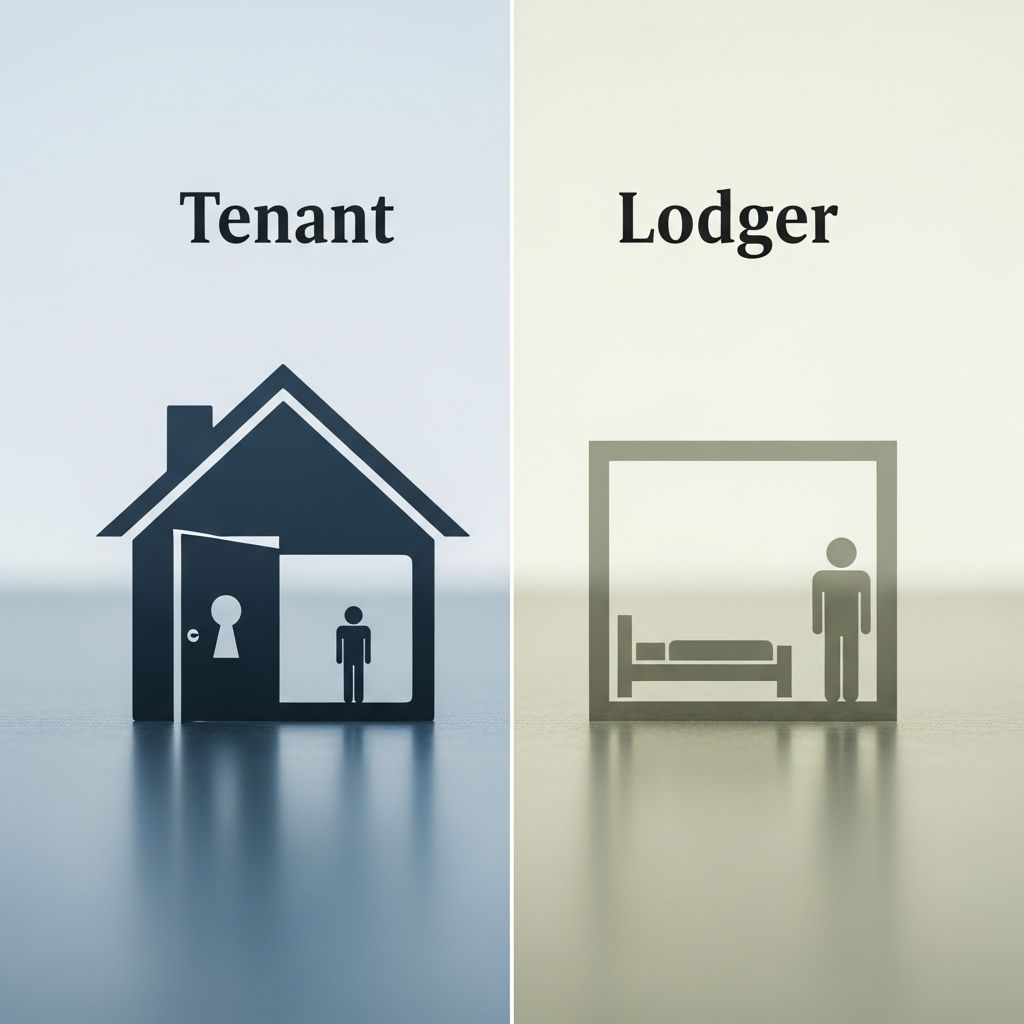
Understanding Occupancy: Who Is a Tenant and Who Is a Lodger?
When someone pays to live in a property, it’s easy to assume they’re all “tenants.” But in legal terms, not every paying occupant is a tenant. The distinction between a tenant and a lodger is more than just semantics—it shapes the rights, responsibilities, and protections each party has under the law.
A tenant is someone who rents a property or a defined part of it under a formal tenancy agreement, usually an Assured Shorthold Tenancy (AST) in many jurisdictions. A lodger, by contrast, is someone who rents a room in a home where the landlord also lives and shares common areas like the kitchen, bathroom, or living room. This simple difference in living arrangement triggers very different legal rules.
Core Legal Distinction: Exclusive Possession
The most important legal factor that separates a tenant from a lodger is the concept of exclusive possession. This refers to who controls access to the living space and whether the occupant can legally exclude others, including the landlord, from entering.
When a person has a tenancy, they generally have the right to exclusive possession of the property or their designated part of it. This means the landlord cannot enter without permission, except in emergencies or under specific conditions outlined in the tenancy agreement (for example, for repairs with proper notice). The tenant can lock their doors and decide who comes in, much like an owner would.
A lodger, however, does not have this level of control. Because the landlord lives in the same home and shares common areas, the landlord retains a degree of access throughout the property. The lodger may have a private room, but the landlord can reasonably enter shared spaces and, in many cases, the lodger’s room for cleaning, maintenance, or safety checks, provided it’s done respectfully and not abusively.
Living With the Landlord: The Lodger’s Reality
For someone to be classified as a lodger, the landlord must be living in the same property as their main or only home. This is a crucial requirement. If the landlord owns a flat and rents a room to someone but lives elsewhere, that occupant is not a lodger—they are a tenant, even if they only occupy one room.
This shared-living setup is what defines a lodger arrangement. The landlord is not just a distant property owner; they are a cohabitant. This changes the nature of the relationship from a purely commercial landlord–tenant dynamic to one that includes elements of shared domestic life. As a result, the legal protections for the occupant are significantly reduced compared to a standard tenant.
Types of Legal Agreements Involved
The type of agreement used reflects the legal status of the occupant and determines the level of protection they receive.
- Tenants typically sign a formal tenancy agreement, most commonly an Assured Shorthold Tenancy (AST). This is a legally binding contract that sets out the term, rent, responsibilities, and procedures for ending the tenancy.
- Lodgers usually operate under a licence to occupy, not a tenancy agreement. A licence is a more limited permission to live in the property, granted by the landlord who remains in control of the home.
Because a licence is not a tenancy, the occupant does not gain the same statutory rights. This is why the same person renting a room can be a tenant in one situation and a lodger in another, depending on whether the landlord lives there.
Security of Occupation and Eviction Rules
One of the most practical differences between tenants and lodgers is how difficult it is to end the arrangement and what legal steps are required.
Tenants: Formal Eviction Process
Tenants enjoy strong legal protection against eviction. A landlord cannot simply ask a tenant to leave at the end of a fixed term or during a periodic tenancy without following a strict legal process.
- The landlord must serve a valid notice (for example, a Section 21 or Section 8 notice in England and Wales).
- If the tenant does not leave, the landlord must apply to court for a possession order.
- Only after a court issues a warrant of possession can the landlord legally remove the tenant, often with the help of bailiffs.
This process can take several weeks or months, depending on the circumstances and court workload. It is designed to prevent unlawful eviction and protect tenants from being forced out without due process.
Lodgers: Simpler Termination
Lodgers, as excluded occupiers in many jurisdictions, do not have the same level of protection. Because they live in the landlord’s home under a licence, the landlord can usually end the arrangement more easily.
- The landlord must give reasonable notice, typically equivalent to the rent payment period (for example, one month if rent is paid monthly).
- If the lodger refuses to leave after reasonable notice, the landlord may be able to change the locks and return the lodger’s belongings, provided they do not use force or threaten the lodger.
- In most cases, the landlord does not need a court order to regain possession, though local laws may impose some procedural requirements.
This makes lodger arrangements more flexible for landlords but also less secure for the occupant, who can be asked to leave with relatively short notice.
Deposit Rules and Financial Protections
Another major difference lies in how deposits are treated and what protections exist for the occupant’s money.
| Aspect | Tenant | Lodger |
|---|---|---|
| Deposit required? | Commonly required | Optional, not always taken |
| Deposit protection | Legally required in a government-backed scheme | Not legally required |
| Return of deposit | Must follow scheme rules; disputes handled by the scheme | Agreed between parties; no statutory scheme |
For tenants, deposit protection is a legal requirement. If a landlord fails to protect a deposit in an approved scheme, they can face financial penalties and may be unable to serve a valid Section 21 notice to regain possession.
For lodgers, there is no legal obligation to protect a deposit. While many responsible landlords still hold deposits and return them fairly, there is no statutory framework to enforce this. Disputes over lodger deposits are treated more like private agreements and are harder to resolve through formal channels.
Landlord Responsibilities and Repairs
The legal duties a landlord owes also differ significantly between tenants and lodgers.
Obligations to Tenants
Landlords of tenants have extensive legal responsibilities, including:
- Ensuring the property is fit for human habitation (under the Homes (Fitness for Human Habitation) Act 2018 in England).
- Carrying out repairs to the structure, exterior, and essential services (heating, water, sanitation).
- Providing a gas safety certificate and ensuring electrical safety.
- Complying with energy performance and safety regulations.
These duties are statutory and cannot be avoided by agreement. A tenant can take legal action if the landlord fails to meet them.
Obligations to Lodgers
Landlords of lodgers still have some basic duties, but they are more limited:
- The property must be safe and in a reasonable state of repair, especially in shared areas.
- Health and safety standards (gas, electricity, fire safety) still apply, particularly in common areas.
- However, the landlord is not subject to the same detailed repair obligations as with a tenancy, and the lodger has fewer avenues to enforce them.
Because the landlord lives in the property, they have a direct interest in maintaining it, but the legal framework is less prescriptive than for tenancies.
Council Tax and Utility Responsibilities
Who pays council tax and utilities can also depend on whether the occupant is a tenant or a lodger.
- Tenants are usually responsible for paying council tax if they are the only adult in the property or part of a household that includes other tenants. The tenancy agreement often specifies this responsibility.
- Lodgers typically do not pay council tax separately. Because they live in the landlord’s main home and are not considered the primary occupant, the landlord usually remains liable for council tax, though they may include a contribution in the rent.
Utility bills are also handled differently. Tenants often pay their own utilities or a share as part of a joint tenancy. Lodgers may pay a flat rent that includes utilities, or they may contribute to shared bills, but they rarely have separate accounts in their own name.
Tax Implications for Landlords
The tax treatment of rental income differs depending on whether the occupant is a tenant or a lodger, especially in systems like the UK’s Rent a Room Scheme.
- Tenants: Rental income from letting a property or part of it to a tenant is fully taxable. Landlords must declare all rental income on their tax return and may be able to claim allowable expenses (mortgage interest, repairs, etc.).
- Lodgers: In some jurisdictions, landlords who rent a room in their main home to a lodger may qualify for a tax-free allowance under a Rent a Room type scheme. For example, in the UK, landlords can earn up to a certain annual amount tax-free from letting a furnished room in their only or main home, provided the occupant is a lodger, not a tenant.
This tax advantage only applies when the landlord lives in the property and the arrangement is genuinely a lodger licence, not a tenancy. Misclassifying a tenant as a lodger to claim tax benefits can lead to penalties if challenged by tax authorities.
Can a Tenant Take in a Lodger?
Yes, a tenant can usually take in a lodger in their rented property, but there are important conditions:
- The tenant must have the landlord’s permission, as most tenancy agreements require consent to sublet or have additional occupants.
- The person living there is a lodger of the tenant, not of the property owner. This means the tenant becomes the “landlord” in that relationship.
- The lodger has limited rights and can be asked to leave with reasonable notice, similar to how a main landlord can end a lodger arrangement.
- The tenant remains responsible for the tenancy and must ensure the lodger does not damage the property or breach the tenancy agreement.
If the tenant’s tenancy ends, the lodger must also leave, as their right to occupy depends on the tenant’s right to be there.
How to Avoid Misclassification
Mistaking a tenant for a lodger (or vice versa) can lead to serious legal and financial consequences. Here are some practical steps to ensure correct classification:
- Assess the living arrangement: Is the landlord living in the property as their main home? If not, the occupant is likely a tenant.
- Review the agreement: Is it a formal tenancy agreement or a simple licence to occupy? The document should match the actual situation.
- Consider access and control: Can the occupant lock their room and exclude the landlord? If yes, it points toward a tenancy.
- Seek legal advice: When in doubt, consult a solicitor or housing advisor to confirm the correct status and draft appropriate documentation.
Getting this right protects both parties: the occupant knows their rights, and the landlord understands their obligations and risks.
Frequently Asked Questions
Can a lodger become a tenant?
Yes, if the landlord moves out and the occupant continues to rent the room or property, the arrangement may change from a licence to a tenancy. The exact status depends on the facts, including whether the occupant now has exclusive possession.
What is reasonable notice for a lodger?
Reasonable notice is usually at least the length of the rent payment period (for example, one month for monthly rent). It should be clear, in writing, and give the lodger enough time to find alternative accommodation.
Do lodgers have any rights at all?
Yes, lodgers are not completely unprotected. They have the right to live in a safe and habitable environment, and landlords must not harass or illegally evict them. However, their rights are much more limited than those of tenants.
Can a landlord evict a lodger without notice?
No, even though the process is simpler, a landlord must still give reasonable notice before asking a lodger to leave. Immediate eviction without notice is likely to be considered harassment or unlawful eviction.
Does the Rent a Room Scheme apply to tenants?
No, the Rent a Room Scheme (or similar tax allowances) only applies when a landlord rents a furnished room in their main home to a lodger. It does not apply to standard tenancies where the landlord does not live in the property.
References
- Shelter: Tenant or lodger? — Shelter England. Accessed 2025. https://england.shelter.org.uk/professional_resources/news_and_updates/tenant_or_lodger
- GOV.UK: Rent a room — HM Revenue & Customs. Updated 2024. https://www.gov.uk/rent-a-room
- GOV.UK: Assured shorthold tenancy — UK Government. Updated 2024. https://www.gov.uk/assured-shorthold-tenancies
Similar Articles








Read full bio of Sneha Tete


