
Tenant Rights When Property Is Condemned in New York
Understand how New York condemnation affects leases, rent, relocation and compensation so you can protect your rights as a tenant.
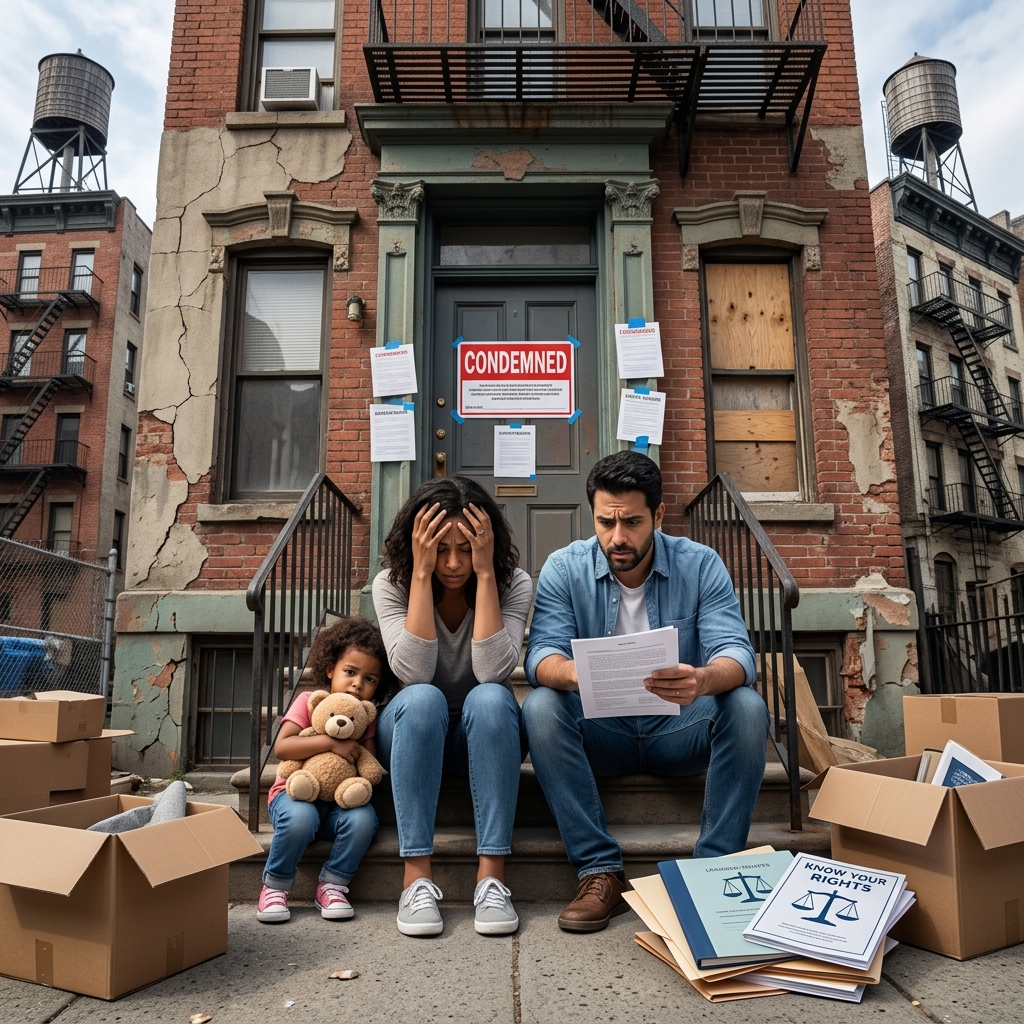
Condemnation of a building can upend a tenant’s life in a matter of days. In New York, however, tenants are protected by a mix of landlord–tenant law, habitability rules, and eminent domain procedures that determine what happens to leases, rent obligations, and possible compensation when a rental property is declared unsafe or taken for public use.
What Condemnation Means for Tenants
A property is usually considered condemned when a local government agency or code official formally determines that the building is not fit for human occupation, often due to serious health or safety violations. Once this occurs, tenants may be ordered to leave, and the building may not be lawfully occupied until the problems are corrected and authorities lift the condemnation order.
There are two broad situations that tenants encounter in New York:
- Safety-based condemnation – where housing or building officials declare the premises uninhabitable because of violations such as structural instability, fire hazards, lack of heat or water, or severe sanitation issues.
- Eminent domain condemnation – where government acquires the property for a public project (for example, a road or school), using the procedures set out in New York’s Eminent Domain Procedure Law (EDPL).
In both situations, tenants may face sudden relocation, uncertainty about their lease, and questions about whether they can recover money or damages.
Common Reasons a Building Is Condemned
Although every case is fact-specific, New York tenants often see condemnation arise from serious violations of building and housing codes. Local authorities can order a building vacated when conditions pose an immediate risk to occupants.
- Structural failure – major damage to the foundation, exterior walls, roof, or support systems that makes collapse or further damage likely.
- Fire safety issues – blocked exits, nonfunctional alarms or sprinklers, exposed wiring, or combustible materials that create a significant fire hazard.
- Lack of essential services – chronic absence of heat, electricity, potable water, or functioning plumbing, especially in winter months.
- Severe sanitation problems – persistent mold, infestation, raw sewage, or other conditions that endanger health.
- Physical disasters – damage from storms, falling trees, fires, or other sudden events that leave the building unsafe.
New York’s warranty of habitability requires landlords to keep rental units “fit for human habitation” and free from conditions dangerous or detrimental to life, health, or safety. Extreme violations of that warranty can lead authorities to declare a structure uninhabitable and trigger condemnation.
Condemnation vs. Ordinary Habitability Problems
Not every serious housing problem results in formal condemnation. New York tenants frequently rely on habitability rules and housing agencies to enforce repairs without vacating the property.
| Type of issue | Typical response | Impact on tenancy |
|---|---|---|
| Code violations that are serious but not immediately life-threatening | Tenant complaints, inspections, orders to repair, possible rent reductions or HP actions in Housing Court. | Lease usually continues; tenant may seek repairs, rent abatements, or damages for breach of habitability. |
| Conditions posing immediate danger (risk of collapse, severe fire hazard) | Emergency orders to vacate and condemnation until repairs are completed. | Tenants may have to leave at once; lease may be terminated if the unit is unfit for habitation. |
| Government taking by eminent domain | Formal condemnation process under EDPL; title transfers to government with a duty to pay just compensation. | Tenants must ultimately vacate; leases are affected, and tenants may have claims as interest holders in the property. |
Understanding whether a case involves habitability enforcement or full condemnation helps tenants predict how quickly they must move and what remedies might be available.
Effect of Condemnation on Leases
In New York, a written lease generally remains in force until it expires or is lawfully terminated. Condemnation interacts with that lease in specific ways.
During Condemnation Proceedings
When a government entity begins condemnation proceedings under eminent domain, the property is not considered fully taken until title formally vests in the condemning authority. Up to that date, landlords are typically entitled to collect rent, and tenants must continue to perform under their lease obligations, including paying rent, unless a separate habitability issue justifies withholding or abatement.
If the property is still legally habitable and the tenant remains in possession, the lease continues and rent is due under its terms.
After the Property Is Unfit for Habitation
When conditions become so severe that the premises are no longer fit to live in, New York courts recognize that the landlord has breached the warranty of habitability. In practice, this can mean:
- Automatic termination of the lease if condemnation or extreme uninhabitability makes continued occupancy impossible.
- Rent reduction or suspension for the period during which the tenant could not safely live in the unit.
- Relief from future rent obligations once the lease is effectively terminated because the premises are permanently uninhabitable.
Whether a lease is terminated outright or treated as breached with a rent abatement depends on the specific facts, including whether repairs are feasible and how long the building will remain unusable.
Transfers of Title and End of the Tenancy
Under condemnation law, any person with an interest in the property—including tenants with legitimate leasehold interests—may assert a claim in the compensation proceedings. When title passes to the condemning authority, landlords generally stop collecting rent, and tenants must vacate unless a short-term occupancy arrangement is specifically negotiated.
For tenants, the key questions are:
- On what date did the property legally transfer to the condemning authority?
- Did the lease contain a condemnation clause explaining what happens if the property is taken?
- Were they forced to leave before or after formal condemnation due to habitability problems?
These details affect whether tenants can seek reimbursement of prepaid rent, security deposits, or a share of any condemnation award.
Rent, Security Deposits, and Compensation
Financial questions are often the most urgent for tenants who suddenly face relocation because their home is condemned.
Ongoing Rent Obligations
As a general rule, tenants must pay rent while they remain in lawful possession and the premises are habitable. If the landlord breaches the warranty of habitability, however, tenants may have a right to a rent reduction or even a complete suspension of rent for the period of uninhabitability.
In New York, tenants can bring cases in Housing Court challenging the amount of rent owed where habitability is in dispute, and courts may adjust rent accordingly.
Prepaid Rent and Security Deposits
When a lease ends because a building is condemned or made permanently uninhabitable, prepaid rent and security deposits should be handled according to New York landlord–tenant law and the lease terms.
- Prepaid rent – Tenants may be able to claim a refund of rent covering periods when the unit could not be lawfully occupied due to condemnation, particularly if the lease is terminated and the landlord cannot provide habitable premises.
- Security deposit – New York law strictly regulates how deposits must be held and returned after tenants move out. If a tenant is forced to vacate due to condemnation and did not cause the damage leading to the order, the landlord generally cannot treat the security deposit as payment for defects attributable to their own failure to maintain habitability.
- Itemized deductions – When landlords claim deductions from a deposit, they must provide a timely, itemized list of damages; failure to do so can forfeit their right to keep any portion of the deposit.
Condemnation Awards and “Just Compensation”
In eminent domain cases, the condemning authority must pay just compensation for the property it takes, valued at its highest and best use. This compensation is primarily intended for the owner of the property, but tenants and other interest holders may assert claims if their lease affords them rights affected by the taking.
Important considerations for tenants include:
- Some leases contain condemnation clauses that either grant or waive the tenant’s right to share in any award.
- Compensation is typically limited to losses in real estate, fixtures, and equipment, not for lost business profits or “going concern” value.
- Any claim must be properly filed within the condemnation process, often with assistance from an attorney experienced in eminent domain law.
Relocation, Habitability, and Harassment
When a property is condemned, tenants often have little time to arrange alternative housing. New York law does not guarantee replacement housing in every case, but there are important protections surrounding how landlords and authorities must treat tenants.
Warranty of Habitability and Tenant Remedies
New York’s warranty of habitability applies to nearly all residential leases and cannot be waived. When landlords fail to maintain safe and habitable conditions, tenants may:
- Seek court orders compelling repairs or corrections of dangerous conditions (HP actions in Housing Court).
- Request rent abatements or other damages for periods when the unit was partially or wholly uninhabitable.
- In extreme cases, treat the lease as terminated and seek to recover deposits and prepaid rent.
Protection Against Harassment and Illegal Lockouts
New York City and state law prohibit landlords from using harassment or illegal self-help tactics to remove tenants, even when the building is in poor condition.
- Landlords may not lock tenants out, remove doors, shut off utilities, or intimidate tenants to force them to leave instead of following proper legal procedures.
- Evictions generally require a court process and the involvement of a Marshal, Sheriff, or Constable with a valid warrant.
- Tenants can bring actions against landlords who illegally lock them out or harass them because they reported hazardous conditions.
If an apartment is condemned but the landlord attempts to bypass lawful procedures, tenants should immediately contact local housing agencies, legal aid, or an attorney to enforce their rights.
Steps Tenants Should Take When Their Building Is Condemned
When you learn that your New York rental property has been condemned or is about to be, it is important to act quickly and methodically.
- Confirm the condemnation order – Obtain written notice from the local building or housing department describing the violations and stating whether the property must be vacated.
- Document conditions – Take photos, videos, and notes showing the unsafe or uninhabitable aspects of the unit. This can support habitability claims, rent abatements, or deposit refunds.
- Review your lease – Look for any clauses dealing with condemnation, eminent domain, or casualty damage and note what they say about rent, termination, or compensation.
- Keep records of payments – Maintain proof of rent payments, security deposits, and other charges, especially for periods near the condemnation date.
- Contact the landlord in writing – Notify the landlord of the condemnation and request information on relocation, deposit handling, and any proposed agreement regarding the lease.
- Seek legal guidance – Consult a tenant-rights organization, legal aid office, or private attorney, particularly if eminent domain is involved or substantial sums are at stake.
- Plan for relocation – Begin searching for alternative housing immediately, even while legal questions are being resolved, since condemnation orders often require rapid move-outs.
Frequently Asked Questions
Does condemnation automatically cancel my lease in New York?
Condemnation can lead to termination of a lease when the premises become unfit for habitation, but whether it is “automatic” depends on the facts and, in some cases, on the language of your lease. Courts treat severe uninhabitability and condemnation as a breach of the warranty of habitability that can justify ending the tenancy and relieving the tenant of future rent obligations.
Do I still have to pay rent after the building is condemned?
If you are ordered to vacate because the unit is unsafe, you typically do not owe rent for periods when you cannot legally or safely occupy the premises. Before formal condemnation, however, rent may remain due while you are in possession unless habitability is so compromised that a court grants a rent abatement or suspension.
Can I get my security deposit back if I have to move due to condemnation?
In many cases, yes. When a tenant is forced to leave due to conditions caused by the landlord’s failure to maintain the property, the landlord generally cannot keep the security deposit for damage attributable to that failure. New York law also requires timely return and itemized explanations for any deductions, and noncompliance can require the landlord to refund the entire deposit.
Am I entitled to part of the condemnation award?
Tenants may have a claim in eminent domain proceedings as interest holders in the property, but their rights often depend on the lease and the specific circumstances. Some leases reserve all condemnation proceeds for the owner, while others grant tenants specific rights. Any claim must be asserted in the formal condemnation process and is usually focused on losses tied to fixtures, equipment, or leasehold value, not lost profits.
What should I do if my landlord tries to force me out without legal process?
If your landlord locks you out, shuts off utilities, or threatens you to leave without a court order, you may be facing an illegal lockout or harassment. New York law prohibits self-help evictions; tenants can seek relief in Housing Court and may also contact local police or housing authorities to restore access and pursue remedies against the landlord.
References
- Tenant Rights and Responsibilities — New York City Department of Housing Preservation & Development. 2024-01-01. https://www.nyc.gov/site/hpd/services-and-information/tenants-rights-and-responsibilities.page
- Tenants Rights Upon Condemnation in New York — LegalMatch Law Library. 2023-06-01. https://www.legalmatch.com/law-library/article/tenants-rights-upon-condemnation-in-new-york.html
- Condemnation Brochure — Forchelli Deegan Terrana LLP. 2023-03-01. https://www.forchellilaw.com/wp-content/uploads/2023/03/Condemnation-Brochure.pdf
- ARTICLE 7: Landlord and Tenant — New York State Senate. 2023-01-01. https://www.nysenate.gov/legislation/laws/RPP/A7
- Residential Tenants’ Rights Guide — Office of the New York State Attorney General. 2022-11-01. https://ag.ny.gov/sites/default/files/tenants_rights.pdf
- LEGALease: Rights of Residential Owners and Tenants — New York State Bar Association. 2022-09-01. https://nysba.org/legalease-rights-of-residential-owners-and-tenants/
- Upstate NY Tenants Rights Guide — Ithaca Tenants Union. 2024-01-15. https://www.ithacatu.org/rights
Similar Articles








Read full bio of medha deb


