Grandparents in New York often step in when a child’s parents cannot provide safe, stable care. In some cases, informal caregiving is enough; in others, a formal grandparent adoption becomes necessary to protect the child and give the grandparent clear legal authority. This guide explains how grandparent adoption works in New York, who is eligible, the steps involved, and how adoption interacts with custody and visitation rights.
Understanding Adoption and Grandparent Roles in New York
Under New York law, adoption is a legal process through which an adult assumes full parental rights and responsibilities for a child. After finalization, the adoptive parent is treated as the child’s legal parent for all purposes, and the prior legal relationship with biological parents is usually terminated.
Grandparents can be involved with their grandchildren in several legal ways:
- Informal caregiving (no court orders, parents still retain legal rights).
- Custody or guardianship orders through family court, which give grandparents decision-making power but do not create a new parent–child relationship.
- Formal adoption, which makes the grandparent the legal parent and generally ends the birth parents’ rights.
Choosing between custody, guardianship, and adoption has long-term consequences for inheritance, decision-making, and contact with other relatives, so understanding the differences is critical.
Who May Adopt a Child in New York?
New York’s adoption statutes allow a broad set of adults to adopt, subject to court approval. Grandparents are not a special category; they qualify under the general rules:
- An unmarried adult may adopt a child.
- A married couple together may adopt.
- Two unmarried adult intimate partners may adopt jointly.
There is no separate statute that only governs grandparent adoptions. Instead, grandparents follow the same adoption procedure as other relatives, with some practical differences—particularly regarding investigations and the child’s existing relationship to the caregiver.
When Grandparent Adoption May Be Appropriate
Grandparent adoption typically arises in situations where parents cannot safely or consistently care for their children. Common scenarios include:
- Parents struggling with serious substance use disorders, untreated mental illness, or chronic instability.
- Cases of abuse or neglect leading to child protective investigations and removal from the parental home.
- Incarceration or long-term absence of one or both parents, leaving grandparents as primary caregivers.
- Death of one or both parents, where grandparents step in as the child’s main support.
In these circumstances, adoption may offer advantages over informal arrangements or temporary custody:
- Clear authority to make medical, educational, and legal decisions for the child.
- Stability and permanence for the child, especially when agency supervision ends after adoption is finalized.
- Predictable rights related to inheritance and benefits that mirror those of biological parent–child relationships.
Legal Requirements for Grandparent Adoption
To adopt a grandchild in New York, a grandparent must satisfy both general adoptive parent requirements and child-specific conditions.
Basic adoptive parent qualifications
- Be an adult legally allowed to adopt under New York law.
- Be able to provide a safe, stable home environment for the child.
- Complete any required home study or agency evaluation if the adoption is through an agency.
Courts will consider factors such as the grandparent’s health, financial stability, and capacity to care for the child long term. Even in relative adoptions, judges focus on the best interests of the child as the guiding principle.
Termination or consent of parental rights
Adoption cannot proceed unless the child’s current legal parents either:
- Consent to the adoption by signing legally valid consents, either out of court or before a judge, or
- Have their parental rights terminated by the court in a separate proceeding, usually when the parents are unfit or have abandoned the child.
In private placement situations, written consents generally become irrevocable after specific time periods, and courts may require waiting periods before finalizing the adoption.
The Grandparent Adoption Process Step by Step
While every case is unique, most grandparent adoptions in New York follow a recognizable sequence of legal steps.
1. Choosing the appropriate court and legal strategy
Adoption proceedings are typically filed in either the Family Court or the Surrogate’s Court in the county where the adoptive grandparent lives. Before filing, many grandparents consult a family law attorney to decide whether adoption, guardianship, or custody best fits the family situation.
2. Filing the adoption petition
The grandparent or their attorney prepares a formal petition requesting to adopt the child. The petition usually includes:
- Basic information about the child and grandparent.
- Details about the child’s parents and their consent or termination status.
- Facts explaining why adoption serves the child’s best interests.
In some private placements, New York law requires filing the petition within a short time after the grandparent takes physical custody of the child.
3. Certification and home study
For agency adoptions, prospective adoptive parents must be certified as qualified by a New York court and complete a home study through an authorized agency. A home study generally includes:
- Interviews with the grandparents and other household members.
- Review of the home environment and safety measures.
- Assessment of the family’s history, finances, and parenting approach.
- Training sessions about adoption and child needs.
Relative adoptions, including grandparent adoptions, may involve fewer investigations than unrelated adoptions, particularly when the grandparent has already been caring for the child. However, courts still must be satisfied that placement is appropriate.
4. Supervision period and agency involvement
In agency adoptions, New York law typically requires at least three months of post-placement supervision before adoption becomes legal. During this time:
- The agency monitors how the child is adjusting.
- Caseworkers may visit the home and offer support services.
- The agency ultimately decides whether to consent to the adoption petition.
If the grandparent has already been caring for the child as a foster parent or kinship caregiver, the supervision requirement may be more straightforward, but the agency still plays a central role in recommending finalization.
5. Court hearing and finalization
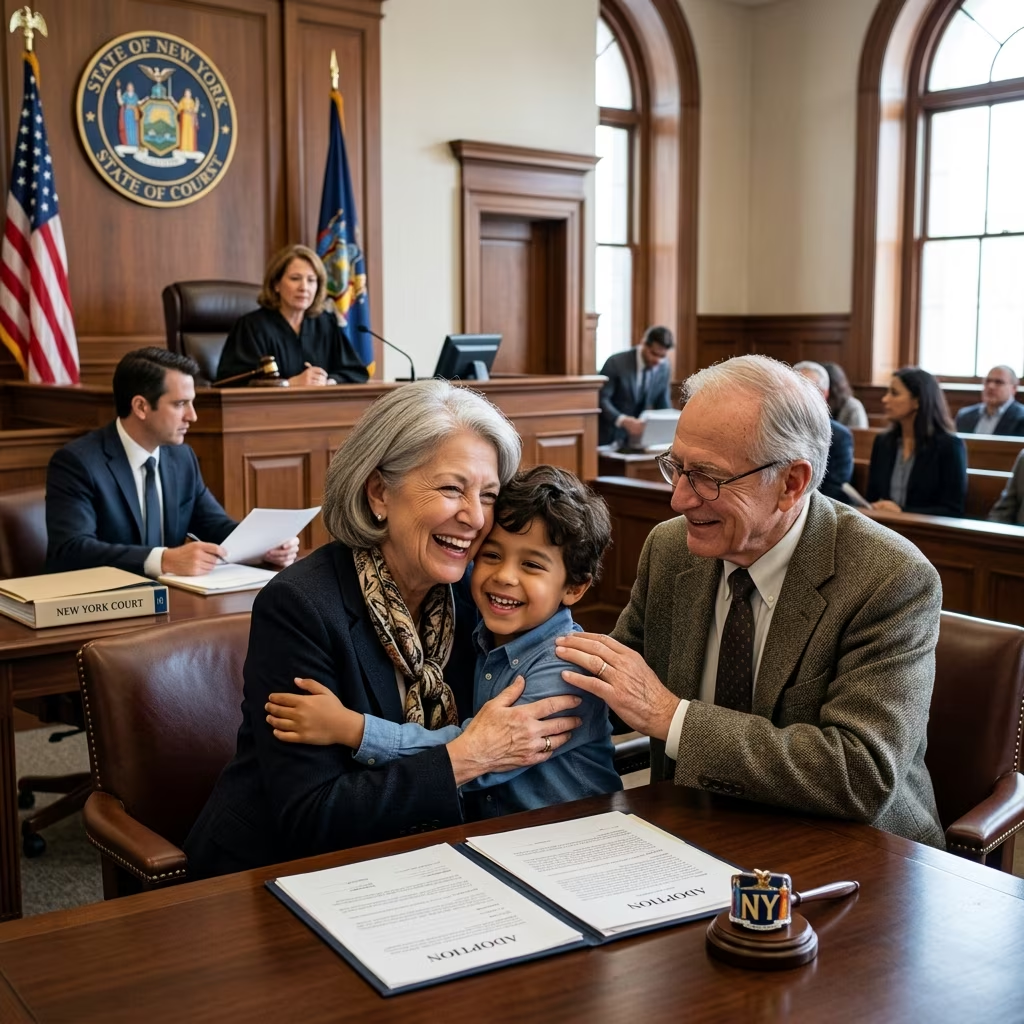
Once all documentation is complete and any required supervision period has passed, the court holds a hearing to decide whether to approve the adoption. If the judge is satisfied that all legal requirements are met and the adoption is in the child’s best interests, the court issues a final order of adoption.
After finalization:
- The grandparent becomes the child’s legal parent.
- The agency’s supervision ends, if it was an agency case.
- The child’s birth certificate may be amended to reflect the adoptive parent(s).
Legal Effects of Grandparent Adoption
Grandparent adoption significantly changes the child’s legal relationships.
| Legal Area | Effect of Grandparent Adoption |
|---|---|
| Parental rights | Birth parents’ rights are generally terminated; adoptive grandparent holds full parental authority. |
| Decision-making | Grandparent can consent to medical treatment, enroll the child in school, and make other major decisions. |
| Inheritance | Adopted grandchild typically gains the same inheritance rights as a biological child of the grandparent. |
| Other relatives | Legal ties to the child’s extended family may be altered, though the court can consider preserving important relationships. |
As a general rule, once an adoption is final, the adoptive parents are viewed as the child’s “absolute” parents, and courts are cautious about intruding on their rights except under narrow circumstances.
Grandparent Visitation Rights After Adoption
One of the most complex questions is what happens to grandparent visitation rights after a child is adopted by someone else. New York law does not automatically bar a biological grandparent from seeking visitation post-adoption.
Visitation petitions by grandparents
Grandparents can ask the court for visitation with a grandchild under specific circumstances.
- They may file a petition for visitation in Family Court or Supreme Court.
- They must show legal grounds for the request, such as death of one or both parents or equitable circumstances.
- They must prove that visitation is in the child’s best interests.
Equitable circumstances often include an existing strong relationship between grandparent and grandchild, or evidence that the parents have blocked reasonable attempts to build such a relationship.
Best interests of the child standard
Courts give substantial weight to the parents’ preferences but must also consider multiple factors when deciding whether visitation aligns with the child’s best interests.
- The age and maturity of the child and, when appropriate, the child’s wishes.
- The history and quality of the relationship between grandparent and grandchild.
- The health and well-being of all involved.
- Distance and logistics of visitation, including travel burdens.
- The level of communication and cooperation between grandparent and custodial parents.
New York courts have held that, under proper circumstances, natural grandparents may retain visitation rights even after adoption, as long as contact does not harm the child’s emotional or physical well-being.
Grandparent Visitation in Adoptive Families
When a child is adopted—whether by relatives or unrelated adults—the adoptive parents become the child’s legal parents and generally control decisions about contact with extended family. However, this power is not absolute.
Key points for grandparents seeking visitation with adopted grandchildren include:
- Adoption does not automatically extinguish all grandparent visitation claims. Courts may still consider petitions from biological grandparents in special circumstances.
- Judges apply the same best interests of the child standard as in other family cases.
- Evidence of animosity between grandparents and adoptive parents is relevant, but not enough on its own to deny visitation.
Some New York decisions suggest that preserving a loving relationship between grandparents and grandchildren is often viewed favorably when it serves the child’s welfare.
Post-Adoption Contact Agreements
New York recognizes Post-Adoption Contact Agreements, which can formally preserve contact between birth families and adopted children. These agreements typically address:
- Communication between birth parents and adoptive parents.
- Contact between the adopted child and biological siblings or half-siblings.
- In some situations, contact with grandparents or other relatives, if the court approves.
To be enforceable, such agreements must be reviewed and approved by the court that finalizes the adoption. Once approved, they can provide a structured framework for continued relationships while respecting the adoptive parents’ authority.
Special Considerations for Kinship and Relative Care
Many grandparent adoptions grow out of kinship care arrangements where grandparents have been informally caring for the child or serving as foster parents. In these cases:
- The child may already be bonded strongly to the grandparent.
- Agencies may view adoption as a way to provide permanence and end state supervision.
- Investigations and home studies can be streamlined compared with fully unrelated placements.
New York promotes permanent homes for children in foster care, and grandparent adoption can be one path to achieving that permanency while keeping the child within the extended family.
Frequently Asked Questions (FAQs)
Do grandparents need the parents’ consent to adopt a grandchild?
Yes, in most situations the child’s legal parents must either consent to the adoption or have their rights terminated by a court. Without consent or a termination order, a grandparent cannot complete an adoption.
Can a grandparent adopt if the child is already in foster care?
Often, yes. If the child is in foster care, the agency may support a grandparent adoption after a home study and supervision period, especially when the grandparent has been serving as a foster or kinship caregiver. The process still requires court approval and sometimes termination of parental rights.
Does adoption by another family end a biological grandparent’s visitation rights?
Not automatically. New York law allows biological grandparents to petition for visitation even after adoption, under limited circumstances. Courts decide based on legal grounds and the child’s best interests.
Are grandparent adoptions faster or simpler than other adoptions?
They can be somewhat simpler, particularly regarding investigations, because the grandparent is a known relative and may already be caring for the child. However, all core legal requirements—petitions, consents, hearings, and judicial review—still apply.
Where should a grandparent file an adoption or visitation case?
Adoption petitions are typically filed in the Family Court or Surrogate’s Court in the county where the grandparent lives. Visitation petitions may be brought in Family Court or Supreme Court, depending on the case. Consulting a New York family law attorney can help determine the appropriate venue.
References
- LEGALease: Adoption in New York — New York State Bar Association. 2020-01-01. https://nysba.org/legalease-adoption-in-new-york/
- The Adoption Process — New York State Office of Children and Family Services. 2022-05-01. https://ocfs.ny.gov/programs/adoption/process.php
- Post Adoption, Grandparents May Have Rights — New York State Kinship Navigator. 2015-06-01. https://www.nysnavigator.org/wp-content/uploads/Post-Adoption-Grandparents-May-Have-Rights-KN.pdf
- Grandparents Rights – Queens, NY — Donald Mastrodomenico, P.C. 2023-01-01. https://www.mastrodomenicolaw.com/family-law/grandparents-rights/
- Do Grandparents Have Visitation Rights in New York? — DivorceNet / Nolo. 2022-04-15. https://www.divorcenet.com/resources/do-grandparents-have-visitation-rights-new-york.html
- Grandparents’ Rights in New York State Family Law — Cole, Sorrentino, Hurley, Hewner & Gambino, P.C. 2021-09-01. https://www.colesorrentino.com/grandparents-rights-in-new-york-state-family-law/
- Adopting Grandchildren in NY: Legal Guide — JustAnswer Family Law (expert response). 2019-07-01. https://www.justanswer.com/family-law/r10h7-asked-represent-grandmother-wants.html