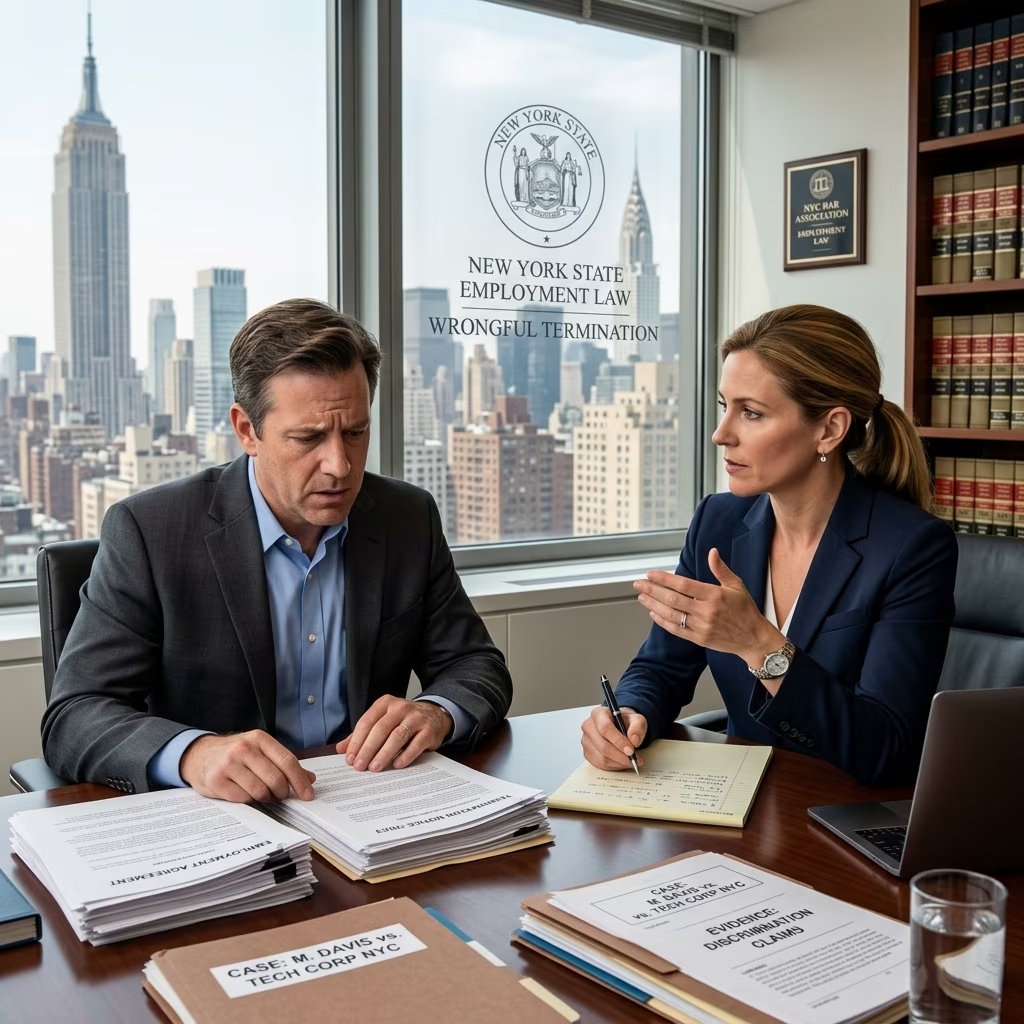
Being fired is disruptive and stressful, but under New York law not every unfair dismissal is wrongful termination. This guide explains when a firing becomes illegal, what legal protections exist under New York and federal law, and how you may be able to sue your employer if your rights were violated.
New York is an at-will employment state, which means most private-sector employers can end employment for any reason or no reason, as long as they do not rely on an unlawful motive or violate a specific legal protection. The key question is not whether your employer treated you fairly, but whether your termination broke a law or breached a binding agreement.
At-Will Employment in New York: The Starting Point
To understand wrongful termination, you must first understand how at-will employment works in New York.
- Most workers are at-will: Either the employer or the employee may end the employment relationship at any time, with or without notice.
- No general “good cause” requirement: In the private sector, employers usually do not need to show good cause or a valid business reason to fire someone.
- Key exceptions: Termination cannot be based on illegal reasons such as discrimination, retaliation, interference with statutory rights, or breach of contract.
There are limited exceptions where employees are protected by a just cause standard, such as many unionized workers under collective bargaining agreements and certain fast-food workers in New York City. In those cases, employers must show legitimate grounds for termination and follow agreed procedures.
Unfair vs. Illegal: Why the Difference Matters
Many employees feel their termination is unfair, but unfairness alone does not create a legal claim. To be legally wrongful, a firing must violate a specific statute, regulation, or contract.
| Unfair Firing | Wrongful (Illegal) Firing |
|---|---|
| Based on personality conflicts, favoritism, or inaccurate performance assessments. | Based on protected characteristics, retaliation, or breach of legal rights. |
| Employer may rely on poor judgment or bad management. | Employer violates anti-discrimination laws, whistleblower protections, or contracts. |
| Usually no legal remedy under at-will rules. | Employee may file agency complaints or sue for damages and other relief. |
Understanding this distinction helps focus your energy on whether there is a legal basis for a claim, rather than only a sense of unfair treatment.
When Can You Sue for Wrongful Termination in New York?
You may be able to sue your employer for wrongful termination if your firing falls into one or more legally protected categories. Below are the most common grounds.
Discriminatory Termination
Federal and New York laws prohibit employers from firing employees because of protected characteristics such as race, sex, age, disability, religion, national origin, and other defined traits. These protections arise under federal statutes like Title VII of the Civil Rights Act, the Americans with Disabilities Act (ADA), the Age Discrimination in Employment Act (ADEA), and parallel state and city human rights laws.
Termination may be discriminatory if:
- You were treated differently than similarly situated coworkers who do not share your protected characteristic.
- Comments, policies, or decisions suggest bias against a protected group.
- Adverse actions, such as discipline or firing, follow discriminatory remarks or practices.
Discriminatory firing can lead to claims for lost wages, lost benefits, emotional distress, and, in some cases, punitive damages.
Retaliation for Protected Activity
Employers also cannot fire workers in retaliation for asserting their legal rights or engaging in legally protected activities. Retaliation claims are common in New York employment disputes.
Examples of protected activities include:
- Reporting workplace discrimination or harassment internally or to a government agency.
- Filing or assisting with a complaint about unpaid wages or overtime.
- Requesting or taking protected leave, such as Family and Medical Leave Act (FMLA) leave.
- Filing a workers’ compensation claim or reporting a workplace injury.
- Whistleblowing about illegal activity or safety violations.
- Participating in union organizing or collective activity regarding working conditions.
If you complain about a legal violation and are then fired, demoted, or subject to other serious adverse action soon afterward, retaliation may be suspected. Retaliatory termination can support lawsuits under anti-discrimination laws, labor statutes, whistleblower laws, and other protections.
Breach of Employment Contract or Promises
Not all employment in New York is purely at-will. If you have a written employment contract specifying a fixed term or limiting the reasons for termination, firing you contrary to those terms may be wrongful.
Potential contractual bases include:
- A written agreement stating you may be terminated only for “cause” or after progressive discipline.
- Offer letters or policy documents that create clear, enforceable promises about job security.
- Collective bargaining agreements that require just cause and grievance procedures.
New York law generally allows up to six years to bring breach of contract claims related to employment termination. However, practical considerations and evidence issues often favor acting much sooner.
Public Policy and Statutory Protections
Certain statutes and public policy principles also limit at-will firing. For example, it is illegal to fire an employee for reporting workplace injuries, participating in protected labor activity, or exercising statutory rights such as sick leave under New York law.
Some notable protections include:
- Workers’ compensation anti-retaliation provisions for reporting injuries or filing claims.
- Labor protections for organizing, collective bargaining, or acting together about workplace issues.
- State and city earned sick leave laws that prohibit firing for taking or requesting lawful sick time.
- Specific local rules, such as just-cause protections for certain fast-food workers in New York City.
If your termination appears connected to one of these activities, it may be actionable even if there is no traditional employment contract.
Deadlines and Procedural Steps: Acting Before Time Runs Out
Wrongful termination claims are subject to strict deadlines, known as statutes of limitations and filing deadlines. Missing these can permanently bar your claim, so it is critical to act promptly.
Major Filing Deadlines Often Involved
- Federal discrimination and retaliation (Title VII, ADA, ADEA): In New York, you generally must file a charge with the Equal Employment Opportunity Commission (EEOC) within 300 days of the termination or other discriminatory act.
- New York State Division of Human Rights (NYSDHR): State law claims often have filing periods up to 3 years for certain discrimination matters.
- New York City Human Rights Law: Some claims must be filed with the city commission within 1 year, while lawsuits may have a 3-year limit.
- FMLA retaliation: Federal law typically provides a 2-year limitation period, extended to 3 years for willful violations.
- Breach of contract claims: Under New York law, many written contract claims have a 6-year statute of limitations.
These are general examples; the precise deadlines for any given situation can vary based on the specific statute, the nature of the claim, and whether administrative filing is mandatory before suing.
Do You Need to File with an Agency First?
For many federal discrimination and retaliation claims, employees must first file a charge with the EEOC and obtain a “right to sue” notice before bringing a lawsuit in federal court. For some state and local claims, employees may choose between administrative and court routes, and different rules apply.
Common agencies involved in wrongful termination matters include:
- Equal Employment Opportunity Commission (EEOC) – Handles federal discrimination and retaliation charges.
- New York State Division of Human Rights (NYSDHR) – Enforces state human rights laws.
- New York City Commission on Human Rights – Administers city-level anti-discrimination protections.
- New York State Department of Labor – Receives complaints regarding certain wage and leave rights.
- Workers’ Compensation Board – Handles retaliatory discharge complaints related to workplace injuries and claims.
Choosing the right forum and meeting the correct deadline is a strategic and legal decision that often benefits from legal advice.
Building a Strong Wrongful Termination Case
Even when your termination appears illegal, success depends on evidence and how clearly it supports a specific legal claim. The following practical steps are frequently recommended by employment practitioners.
Step 1: Document Events and Preserve Evidence
Because memories fade and electronic records can change, start documenting your experience as soon as possible.
- Keep copies of offer letters, contracts, handbooks, and written policies.
- Save emails, performance reviews, commendations, and disciplinary notices.
- Write a timeline of key events, including complaints you made, responses you received, and the date of termination.
- Retain pay stubs and benefits information to support claims for lost compensation.
- Record, in writing, any discriminatory remarks or retaliatory behavior you observed.
Step 2: Identify the Legal Theory
Successful cases are anchored in clearly articulated legal theories. Ask yourself:
- Was I fired after complaining about discrimination or harassment?
- Was the reason given for my firing inconsistent with my documented performance?
- Was I treated differently than coworkers who do not share my protected characteristic?
- Did the employer ignore or violate explicit contract promises about job security or discipline?
- Was the termination connected to my request for leave, a wage complaint, or a safety report?
Clarifying these questions helps determine whether the case is primarily about discrimination, retaliation, contract breach, or statutory rights.
Step 3: Consider Internal and External Remedies
Depending on your situation, you may have several paths:
- Internal HR complaints: Some employers investigate and address complaints internally, which may result in corrections or settlements.
- Union grievance procedures: Unionized employees often must use the contractual grievance process for discipline and termination disputes.
- Agency filings: EEOC, NYSDHR, and city or state agencies may investigate and attempt conciliation or enforcement.
- Civil litigation: Filing a lawsuit in state or federal court may be appropriate where damages are substantial or agency resolutions are inadequate.
Step 4: Evaluate Potential Remedies
Remedies in wrongful termination cases depend on the law involved, but they often include one or more of the following:
- Back pay: Wages and benefits lost from the termination date to judgment.
- Front pay: Future lost earnings when reinstatement is impractical.
- Reinstatement: Returning to your former position in appropriate cases.
- Compensatory damages: Payment for emotional distress, reputational harm, or other non-economic losses.
- Punitive damages: In some discrimination and retaliation cases, extra damages to punish egregious misconduct.
- Attorney’s fees and costs: Many employment statutes allow prevailing employees to recover legal fees.
You also have a duty to “mitigate” damages in many cases, meaning you must make reasonable efforts to seek new employment instead of simply accumulating avoidable losses.
Special Situations: Union, Fast-Food, and Public Employees
While this guide focuses on private-sector at-will employment, some New York workers are subject to different rules.
Unionized Employees
Union contracts typically include good-cause or just-cause provisions, along with grievance and arbitration procedures. Termination that violates these provisions is usually challenged through the union’s process, not immediate court action.
- Check your collective bargaining agreement for termination standards and deadlines.
- Notify your union representative promptly after discipline or firing.
- Follow required grievance steps, as failure to do so may limit your remedies.
Fast-Food Workers in New York City
New York City fast-food workers have special protections: employers generally cannot fire them or cut their hours significantly without just cause or a legitimate business reason. Complaints can be filed with the city’s Department of Consumer and Worker Protection.
Public Sector Employees
Public employees may have additional civil service protections, due process rights, or statutory procedures not addressed in detail here. Many cannot be terminated without formal charges and hearings, depending on their role and governing statutes.
Frequently Asked Questions About Wrongful Termination in New York
FAQ 1: Can I be fired for no reason in New York?
Yes, most private-sector employees can be fired for no stated reason because New York follows at-will employment rules. However, your employer cannot fire you for an illegal reason such as discrimination, retaliation, or violation of statutory rights.
FAQ 2: Is every unfair firing considered wrongful termination?
No. A firing may be harsh, unjust, or based on incomplete information yet still be legal. It becomes wrongful only when it violates a law or enforceable agreement—for example, firing someone because of race or for reporting harassment.
FAQ 3: How do I know if discrimination played a role in my firing?
Look for patterns: discriminatory remarks, different treatment compared to coworkers, sudden negative changes after you disclosed a disability or pregnancy, or inconsistent explanations for your termination. These signs, together with documentation, can help show discriminatory motive under federal and state human rights laws.
FAQ 4: Do I need a lawyer to file a wrongful termination claim?
It is possible to file agency complaints without a lawyer, but employment law is complex, and deadlines are strict. Consulting an employment attorney can help you identify claims, comply with procedural requirements, and evaluate settlement or litigation options, especially where significant wages or career impacts are at stake.
FAQ 5: What should I do immediately after being fired?
Collect relevant documents, request the reason for your termination in writing if appropriate, preserve emails and messages, avoid signing broad releases without understanding them, and seek legal advice promptly if you suspect discrimination, retaliation, or contract violations. Acting quickly helps ensure key deadlines are not missed.
References
- Termination — Office of the New York State Attorney General. 2023-05-10. https://ag.ny.gov/resources/individuals/workers-rights/job-termination
- New York City Wrongful Termination Lawyer — Schwartz Perry & Heller LLP. 2024-02-15. https://www.schwartzandperry.com/wrongful-termination/
- New York Wrongful Termination Lawyer — Horn Wright, LLP. 2024-03-20. https://www.hornwright.com/employment-law/wrongful-termination/
- Can I Sue for Wrongful Termination in New York? — Super Lawyers / Thomson Reuters. 2022-11-30. https://answers.superlawyers.com/employment-litigation/new-york/can-i-sue-for-wrongful-termination-in-new-york/5a862ca3-9cb6-11f0-a8f5-127149c488c1.html
- Wrongful Termination in New York City: What Employees Need to Know in 2026 — NewYorkCity-EmploymentLawyer.com. 2026-01-05. https://www.newyorkcity-employmentlawyer.com/wrongful-termination-in-new-york-city-what-employees-need-to-know-in-2026/