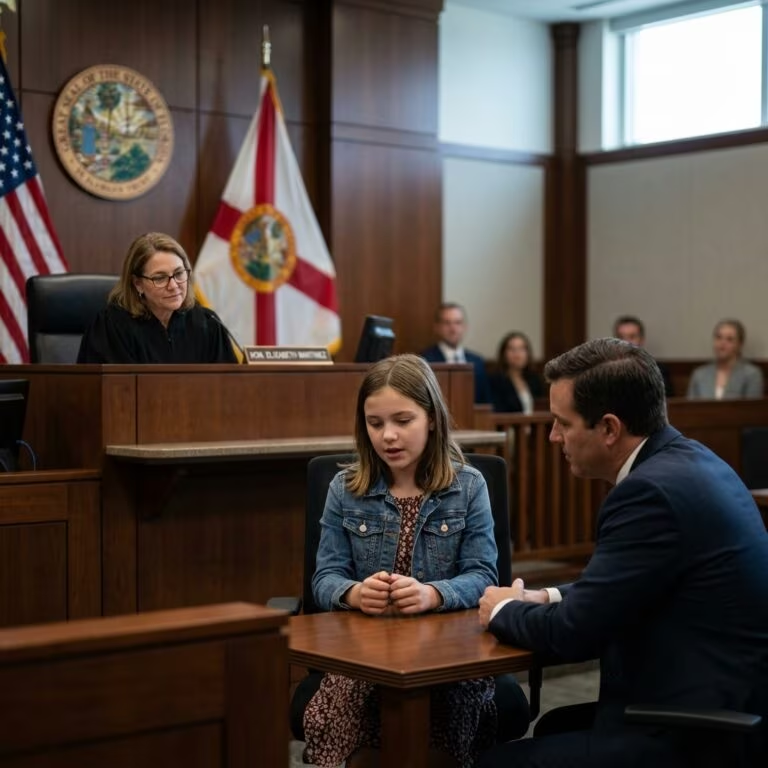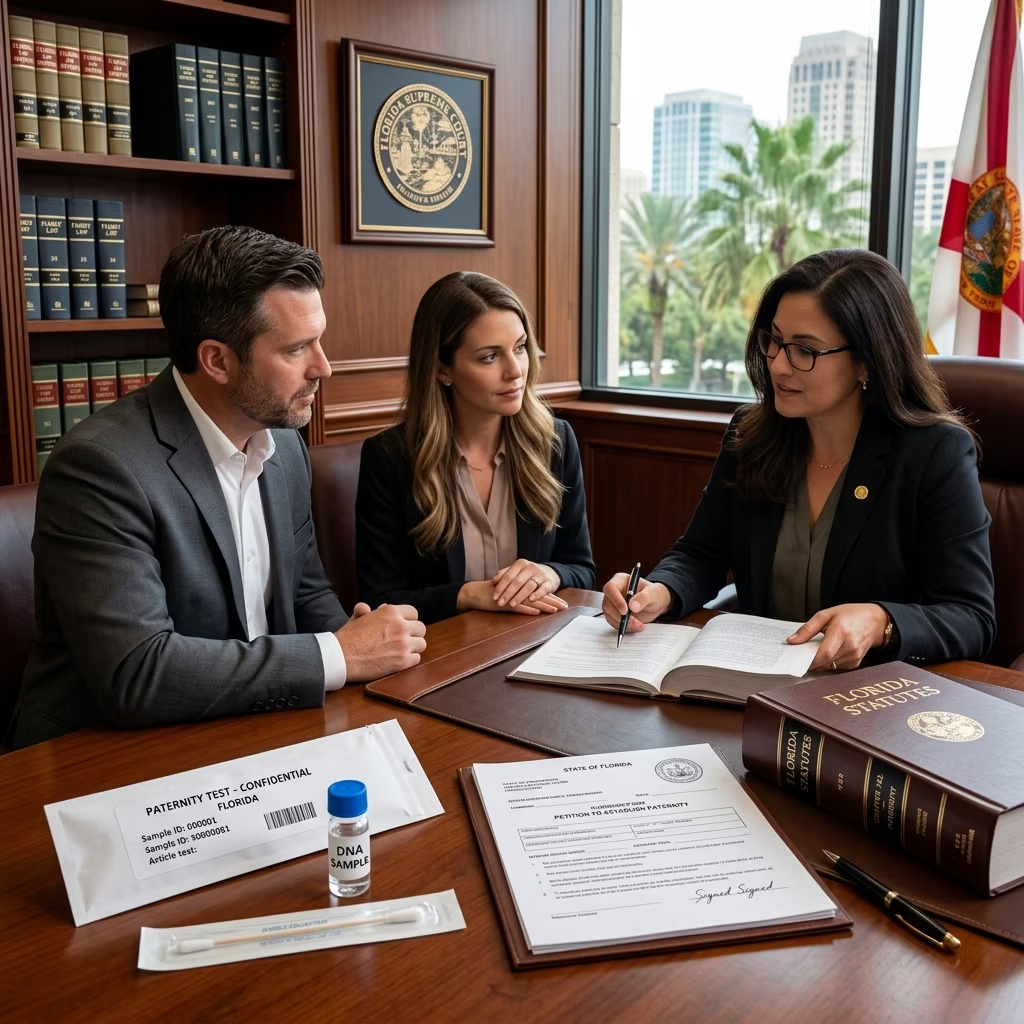
Paternity testing in Florida sits at the intersection of science, family relationships, and the law. It affects child support, custody, and the child’s rights to financial and emotional support from both parents. This guide explains how Florida handles paternity testing, who can request it, the legal impact of DNA results, and what options exist when paternity is disputed or needs to be undone.
Why Paternity Matters Under Florida Law
Florida law distinguishes between a child’s biological father and legal father, and paternity testing is often the tool that connects the two. Establishing legal paternity can:
- Secure child support and medical coverage for the child.
- Give the father rights to time-sharing (visitation) and decision-making authority.
- Provide the child access to inheritance, Social Security, veterans’ benefits, and other legal rights.
- Clarify parental responsibilities and reduce long-term disputes.
Florida presumes that a husband is the legal father of any child born during a marriage, so his name is automatically added to the birth certificate unless that presumption is later challenged.
Presumptions of Paternity: Married vs. Unmarried Parents
Florida law treats married and unmarried parents differently when a child is born.
Children Born to Married Mothers
When a mother is married at the time of birth:
- Her husband is presumed to be the child’s legal father.
- His name is placed on the birth certificate without further legal action.
- DNA testing is generally unnecessary unless someone later disputes that presumption.
Children Born to Unmarried Mothers
When the parents are not married, there is no automatic legal father listed on the birth certificate unless paternity is established. Florida Statute §742.10 provides that paternity for children of unmarried parents must be established either voluntarily or through legal proceedings.
Common ways to establish paternity for children of unmarried parents include:
- Marriage after the child’s birth (and completion of an affirmation form so the father can be added to the birth certificate).
- Voluntary acknowledgment of paternity, typically by completing a notarized form.
- Administrative order based on genetic testing requested through Florida’s Child Support Program.
- Court-ordered paternity action filed in circuit court, possibly including DNA testing.
Voluntary Acknowledgment of Paternity in Florida
Florida allows parents to establish paternity voluntarily, often without going to court. This process is commonly used when both parents agree who the father is and want to avoid litigation.
Hospital-Based Acknowledgment
If parents are unmarried but agree on paternity at birth, the father can sign a Paternity Acknowledgment form (DH-511) in the hospital. Both parents must sign in front of a notary, and once the form is processed, it has the same legal effect as a court order establishing paternity.
Post-Birth Acknowledgment
After leaving the hospital, parents can still voluntarily establish paternity any time before the child turns 18 by submitting an Acknowledgment of Paternity (Form DH-432) or related forms to the Florida Bureau of Vital Statistics. These forms must be properly witnessed or notarized.
Once accepted, voluntary acknowledgment:
- Identifies the legal father.
- Allows the father’s name to be added to the birth certificate.
- Can be used to support child support and custody orders later.
Under recent changes discussed by Florida practitioners, a voluntary acknowledgment filed with the Bureau of Vital Statistics is treated as legally equivalent to a court order once accepted.
Scientific and DNA Testing for Paternity
When paternity is disputed or uncertain, Florida courts and agencies rely on scientific testing—usually DNA tests—to determine biological relationships. Florida Statute §742.12 governs scientific testing to determine paternity.
When DNA Testing May Be Ordered
Under §742.12, in any court proceeding to establish paternity:
- The court can order scientific tests on its own initiative.
- Either party can ask for testing by filing a sworn statement alleging or denying paternity and describing facts that make their claim reasonably plausible.
- The child, mother, and alleged father may all be required to submit samples for testing.
Testing must be performed by a qualified laboratory using methods accepted within the scientific community. Results are admissible as evidence and weighed alongside other evidence of paternity.
Probability Thresholds and Legal Presumptions
Florida gives special weight to high-probability test results. Under §742.12:
- If the test shows a 95% or higher probability of paternity, it creates a rebuttable presumption that the tested man is the biological father.
- If the alleged father does not successfully rebut this presumption, the court may enter a summary judgment of paternity based on the test.
- If testing shows the alleged father cannot be the biological father, the case must be dismissed with prejudice as to that alleged father.
More recent commentary on changes to Florida law indicates that genetic tests showing a 99% probability may be sufficient on their own to establish legal fatherhood without a contested trial, reflecting the strong evidentiary value courts assign to DNA results.
Administrative Testing Through the Child Support Program
Florida’s Child Support Program (administered by the Department of Revenue) can arrange genetic testing when paternity needs to be established for support purposes.
- The mother, alleged father, and child provide genetic samples at designated testing locations.
- If the tests show the man is the biological father, the agency can issue an Administrative Order of Paternity and direct the Bureau of Vital Statistics to update the birth certificate.
- The program typically offers testing at no cost to the parties when done through the state’s child support process.
Can a Parent Refuse a Paternity Test?
Parents sometimes wonder whether they can avoid DNA testing altogether. Florida law draws a line between voluntary testing and testing ordered by a court or agency.[10]
Voluntary Refusal
A mother or alleged father may initially decline voluntary testing arranged informally or through an administrative process. However, refusal does not prevent paternity from being addressed through litigation, and it may prompt the other parent to seek a court order.[10]
Court-Ordered Testing
When a court orders testing under §742.12, neither parent can simply refuse without consequences.
- The court has authority to compel the mother, child, and alleged father to submit to testing.
- Refusing a court-ordered test can lead to sanctions, including being held in contempt of court.
- A judge may enter a default judgment establishing or denying paternity based on the evidence available, even without DNA results, if a party refuses to comply.
Similar principles apply if a man is alleged to be the father and is avoiding testing; courts may order him to participate, and refusal can be used against him in a paternity case.[10]
Starting a Court Case to Establish Paternity
When voluntary or administrative routes are not appropriate or fail, paternity can be established through a civil action in circuit court.
Who Can File
In Florida, various parties may file a paternity action, including:
- The child’s mother.
- An alleged biological father seeking to confirm paternity.
- The child (or a representative) in some circumstances.
- State agencies or the Department of Revenue seeking child support.[10]
Typical Court Process
While the specifics can vary, a common sequence in a court-based paternity case includes:
- Petition: The filing party submits a Petition to Establish Paternity in the circuit court where the child resides, often asking for determinations about custody, time-sharing, and child support.
- Service and response: The other party is served and has an opportunity to respond.
- DNA testing: Someone may request scientific testing under §742.12, or the court may order it on its own.
- Hearing or trial: The court reviews test results, testimony, and other evidence.
- Final order: If paternity is established, the court issues a judgment addressing legal fatherhood and often child support and parenting issues.
Approved Florida Supreme Court family law forms, such as Form 12.983(a), help individuals ask the court to order scientific testing to determine paternity and can be filed along with required financial and jurisdictional affidavits.
Disestablishing Paternity in Florida
Not all paternity issues involve establishing fatherhood; sometimes a man who has been legally recognized as a father later believes he is not the biological parent.
Florida Statute §742.18 permits a man to file a Petition to Disestablish Paternity and terminate a child support obligation when certain conditions are met, often including recent scientific test results showing he is not the biological father.
To succeed, the petitioner generally must:
- Provide acceptable genetic test results administered within a specified time frame showing he cannot be the father, or explain why testing could not be completed earlier.
- Meet procedural and timing requirements, such as filing in the correct court and providing notice to all relevant parties.
- Show that he did not voluntarily waive or ignore opportunities to contest paternity in the past under circumstances that would bar relief.
If the petition is granted, legal paternity and related support obligations can be terminated prospectively, but the court may leave prior support orders intact depending on the circumstances.
Effects of Paternity on Child Support and Parenting Rights
Once paternity is established—through testing, voluntary acknowledgment, administrative order, or court judgment—the man becomes the child’s legal father. This has several implications:
| Legal Area | Effect of Established Paternity |
|---|---|
| Child Support | The father can be ordered to pay support and provide health insurance as appropriate. |
| Custody & Time-Sharing | The father can request parental responsibility and a time-sharing schedule. |
| Decision-Making | The father may gain authority to participate in decisions about education, health care, and religion. |
| Birth Certificate | The father’s name is added, reflecting legal parentage. |
| Inheritance & Benefits | The child may gain rights to inheritance and government or employment-based benefits through the father. |
Practical Tips for Parents Considering Paternity Testing
Parents involved in paternity issues in Florida should consider both legal and practical factors.
- Clarify goals: Decide whether you are seeking child support, parenting rights, or simply clarity about biological relationships.
- Understand your options: Voluntary acknowledgment may be best when everyone agrees; court or administrative routes are useful when disagreement exists.
- Follow legal procedures: Use qualified laboratories and approved forms to ensure test results are accepted by courts and agencies.
- Consider timing: Early testing and acknowledgment can simplify future disputes, while delays can complicate disestablishment later.
- Seek legal advice: Because paternity affects long-term rights and obligations, consulting a Florida family law attorney or legal aid organization is often advisable.
Frequently Asked Questions About Florida Paternity Testing
Do I always need a DNA test to establish paternity in Florida?
No. DNA testing is common when paternity is disputed or uncertain, but it is not always required. If parents are married at birth, the husband is presumed to be the father. If unmarried parents agree, they can sign voluntary acknowledgment forms without testing.
Who pays for paternity testing?
Costs vary. Tests ordered through the Florida Child Support Program may be provided at no cost to the parents. In court cases, the judge may allocate testing costs between the parties or assign them to one party, and costs can sometimes be shifted based on the outcome.
Can the mother stop the alleged father from getting a paternity test?
She can refuse voluntary testing, but she cannot permanently block paternity from being established. If the alleged father files a petition, the court can order testing and enforce its order through sanctions or default judgments if she refuses.
What happens if DNA results show a high probability of paternity?
If the tested man’s probability of paternity is 95% or higher, Florida law creates a rebuttable presumption that he is the biological father. If he doesn’t successfully challenge this, the court can enter a summary judgment of paternity based on the results.
Can I undo paternity if I later learn I am not the biological father?
Possibly. Florida Statute §742.18 allows a man to petition to disestablish paternity and terminate support if scientific tests show he is not the father and statutory requirements are met. Strict procedural rules apply, so legal advice is important.
References
- Chapter 742, Florida Statutes — Florida Senate. 2023-01-01. https://www.flsenate.gov/Laws/Statutes/2023/Chapter742/All
- Scientific Testing to Determine Paternity, §742.12 — Florida Legislature (Online Sunshine). 2025-01-01. https://www.leg.state.fl.us/Statutes/index.cfm?App_mode=Display_Statute&URL=0700-0799/0742/0742.html
- Establish Paternity — Florida Department of Revenue, Child Support Program. 2024-06-01. https://floridarevenue.com/childsupport/Pages/paternity.aspx
- Paternity Testing in Florida: When Is It Required and Why It Matters — Lopes Law Offices. 2023-09-15. https://lopeslawoffices.com/paternity-testing-in-florida-when-is-it-required-and-why-it-matters/
- Can a Mother Refuse a Paternity Test in Florida? Legal Options for Alleged Fathers — Sinatra Legal. 2025-06-04. https://www.sinatralegal.com/blog/2025/06/04/can-a-mother-refuse-a-paternity-test-in-florida-legal-options-for-alleged-fathers/
- Florida Supreme Court Approved Family Law Form 12.983(a) — Florida Courts. 2023-01-01. https://www.flcourts.gov/content/download/686003/file_pdf/983a.pdf
- Changes in Florida Paternity Laws One Year Later — K. Joseph Law. 2024-07-01. https://www.kjosephlaw.com/blog/2024/july/1-yr-since-paternity-law-change-took-effect/