
Probation Violations in Texas: What Happens Next
Understand Texas probation violations, likely penalties, and the legal process after an alleged breach.
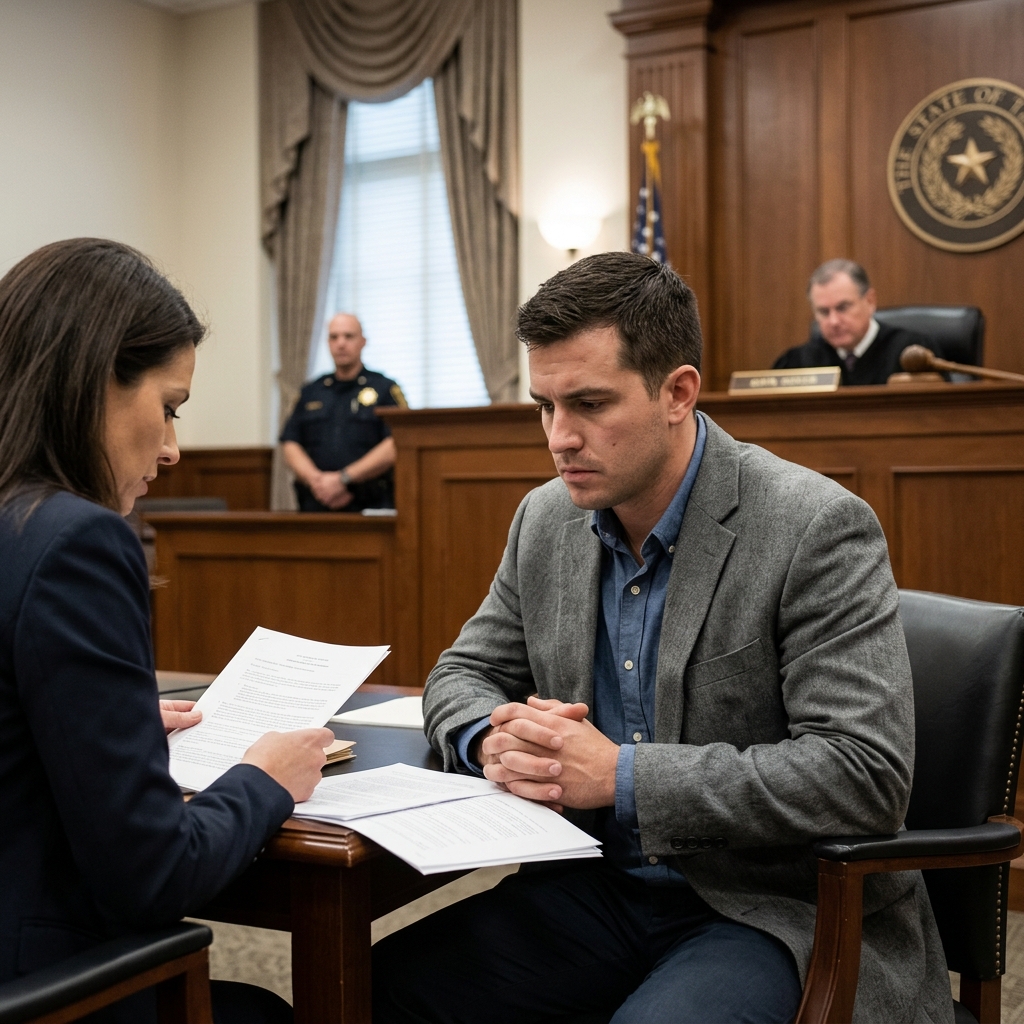
When a Probation Mistake Becomes a Legal Problem
Probation is often treated as a second chance, but it comes with strict rules. In Texas, failing to follow even one condition can trigger serious consequences, including arrest, a hearing, and possible jail or prison time. The outcome depends on the nature of the violation, the person’s record on supervision, and whether the court views the problem as a technical slip or a more serious breach.
Many probationers assume that only a new criminal charge will matter. In reality, missing meetings, failing drug tests, skipping classes, traveling without permission, or falling behind on required payments can all put a case at risk. Texas courts and probation officers have multiple ways to respond, and the response may become harsher if the conduct is repeated or deliberate.
What Counts as a Violation of Probation in Texas?
A probation violation happens when a person does not comply with one or more court-ordered conditions of community supervision. Those conditions vary from case to case, but they usually require the person to report regularly, stay out of trouble, pay required amounts, and complete any ordered programs.
- Missing a scheduled appointment with a probation officer
- Testing positive for drugs or alcohol when testing is required
- Failing to complete community service hours
- Not attending counseling, treatment, or educational classes
- Leaving the state or county without permission
- Contacting a protected person when contact is prohibited
- Getting arrested for a new offense
- Not paying fines, court costs, supervision fees, or restitution
Some violations are called technical violations because they involve breaking a probation rule without necessarily committing a new crime. Others are more serious because they involve new criminal conduct. Courts usually treat those two categories differently, but both can create risk.
How Texas Courts Usually Respond
Not every violation leads straight to revocation. In many cases, the probation officer may first respond with a warning, a corrective instruction, or an added requirement. If the issue is minor and isolated, the court may decide that supervision should continue with no major change. Repeated failures, however, can quickly escalate the case.
The court’s options generally become more severe as the problem grows. A judge may keep the person on probation but add conditions, extend the supervision period, impose a short jail stay, or revoke probation altogether. The available response often depends on whether the person is on straight probation or deferred adjudication, as well as the original offense level.
| Possible Court Response | What It Means |
|---|---|
| Warning or administrative response | The probation officer addresses the issue without immediate court action. |
| Modified supervision | The court adds new conditions such as more testing, counseling, or community service. |
| Extended probation | The supervision period lasts longer than originally ordered. |
| Short confinement | The person may be ordered to serve jail time as a sanction or condition. |
| Revocation | The court ends probation and imposes the remaining punishment allowed by law. |
Why a Violation Can Lead to Arrest
Once a violation is alleged, the court may issue a warrant or capias and the person can be arrested. In many cases, probation officers document the alleged failure and report it to the prosecutor or the court. That report may be enough to begin revocation proceedings. The person may then be held in custody while the case moves forward.
Arrest does not mean the person is automatically guilty of the violation. It does mean that the court treats the allegation seriously enough to require formal review. The next step is usually a hearing where the State must prove the violation.
The Standard of Proof Is Lower Than in a Criminal Trial
Probation revocation hearings are not the same as a full criminal trial. The State does not have to prove the violation beyond a reasonable doubt. Instead, the prosecution typically needs to show by a preponderance of the evidence that at least one condition was violated. That is a lower burden of proof than the standard used to convict someone of a new criminal offense.
That difference matters because even evidence that would not support a new conviction may still be enough to support a probation violation. A single proven violation can be enough for the court to act, even if other alleged violations are not established.
Possible Consequences After the Hearing
If the court finds that the violation occurred, the result can range from lenient to severe. The judge has discretion and may consider the seriousness of the conduct, the person’s criminal history, prior compliance, and whether the violation was accidental, negligent, or intentional.
- Reinstatement: The court may let probation continue under the original terms.
- Modified terms: The court may add conditions such as more frequent reporting or treatment.
- Added sanctions: The judge may impose fines, community service, or a short jail stay.
- Extended supervision: The probation period may be lengthened.
- Revocation: The court may end probation and impose the remaining authorized sentence.
For a misdemeanor, revocation can mean county jail exposure. For a felony, it can mean prison time. The exact result depends on the original case and the type of supervision ordered at sentencing.
Deferred Adjudication and Straight Probation Are Not the Same
Texas has different forms of supervision, and the consequences of a violation can vary depending on which type applies. With straight probation, the court has already entered a conviction and suspended some or all of the punishment. If the court revokes probation, the defendant may have to serve the remaining sentence tied to that conviction.
With deferred adjudication, the court places the case on supervision without entering a final finding of guilt. If the person violates the terms, the court may proceed to adjudicate guilt and then impose punishment within the legal range for the offense. That can make the stakes especially high.
Why Some Violations Are Treated More Harshly
Judges are usually more concerned when a violation suggests that supervision is not working. A missed appointment may be forgiven more easily than a new arrest. Likewise, a first-time failure to complete a class may be viewed differently from repeated dishonesty, refusal to report, or continued drug use. Courts also pay close attention to whether the violation places other people at risk.
Financial failures can also matter, especially when the court believes the person had the ability to pay. A missed payment due to real hardship may be treated differently from a refusal to pay without explanation. Documentation is often important in these cases because it helps show whether the failure was avoidable.
How to Reduce the Risk of a Worse Outcome
If a probation issue arises, early action is often more effective than waiting for the court to intervene. Contacting counsel quickly, gathering proof of compliance, and correcting the problem can all help. A defense lawyer may be able to explain the circumstances to the prosecutor or judge and argue for a less severe response.
- Keep records of payments, classes, drug tests, and reporting
- Show proof of employment, treatment, or family responsibilities when relevant
- Explain any missed appointment or deadline with supporting documentation
- Do not ignore court notices or probation communications
- Talk to a criminal defense lawyer before admitting a violation in court
In some cases, the best defense is showing that the alleged violation did not actually happen. In others, the goal is to prove that the failure was not willful or that a safer alternative to revocation is appropriate.
Common Defenses in a Texas Probation Case
There is no single defense that works in every case, but several arguments may be available depending on the facts. The strongest defense is often the one supported by documents, witnesses, or objective records.
- The alleged violation never occurred
- The probationer did not receive clear notice of the condition
- The failure was caused by circumstances beyond the probationer’s control
- The State lacks reliable evidence
- The probationer substantially complied with the order
- The payment failure was due to inability to pay rather than refusal
Even when a defense does not end the case, it may persuade the court to choose a less severe sanction. That is why preparation matters so much in supervision cases.
What to Expect from the Legal Process
Probation violation cases often move quickly, but they still follow a procedure. After the alleged breach is reported, the State may file a motion to revoke or adjudicate. The defendant then has an opportunity to appear in court, review the allegations, and contest the evidence. Some cases resolve through negotiation, while others proceed to a hearing before a judge.
Because the process can involve detention, bargaining, and deadlines, it is risky to handle the matter alone. A lawyer can review the original probation terms, evaluate the evidence, and seek an outcome that preserves as much freedom as possible.
Frequently Asked Questions
Can one missed appointment really matter?
Yes. A single missed report or appointment can trigger an allegation of violation, especially if the court believes the failure was avoidable or part of a pattern.
Will every violation result in jail?
No. Courts can choose warnings, modified conditions, added classes, or extended probation. Jail becomes more likely when the violation is repeated, serious, or tied to new criminal conduct.
Is a failed drug test the same as a new crime?
Not always. A failed test is often treated as a technical violation, but it can still lead to arrest, added sanctions, or revocation depending on the case.
Can probation be reinstated after a violation?
Yes. Courts sometimes continue probation after a violation, especially when the breach is minor, the person has otherwise complied, and there is a credible plan to fix the problem.
Why should someone get a lawyer for a probation issue?
Because the stakes can be high and the proof standard is lower than in a criminal trial. A lawyer may help challenge the allegation, negotiate a better result, or present mitigation that avoids revocation.
References
- Texas Code of Criminal Procedure, Article 42A.751 — Texas Legislature. 2025-09-01. https://statutes.capitol.texas.gov/Docs/CR/htm/CR.42A.htm
- Texas Code of Criminal Procedure, Article 42A.751 — Texas Legislature Online. 2025-09-01. https://statutes.capitol.texas.gov/Docs/CR/htm/CR.42A.htm#42A.751
- Texas Courts: Community Supervision and Corrections — Office of Court Administration, Texas Judiciary. 2024-11-15. https://www.txcourts.gov/media/1458167/community-supervision.pdf
- Probation and Community Supervision — Texas Department of Criminal Justice. 2024-08-20. https://www.tdcj.texas.gov/divisions/cid/probation.html
- Community Supervision Handbook — Texas Association of Counties. 2024-06-10. https://county.org/resources/community-supervision-handbook.pdf
Similar Articles








Read full bio of medha deb




