
The Civil Rights Imperative of Tenant Legal Representation
Why guaranteed legal aid in housing court is a civil rights imperative.
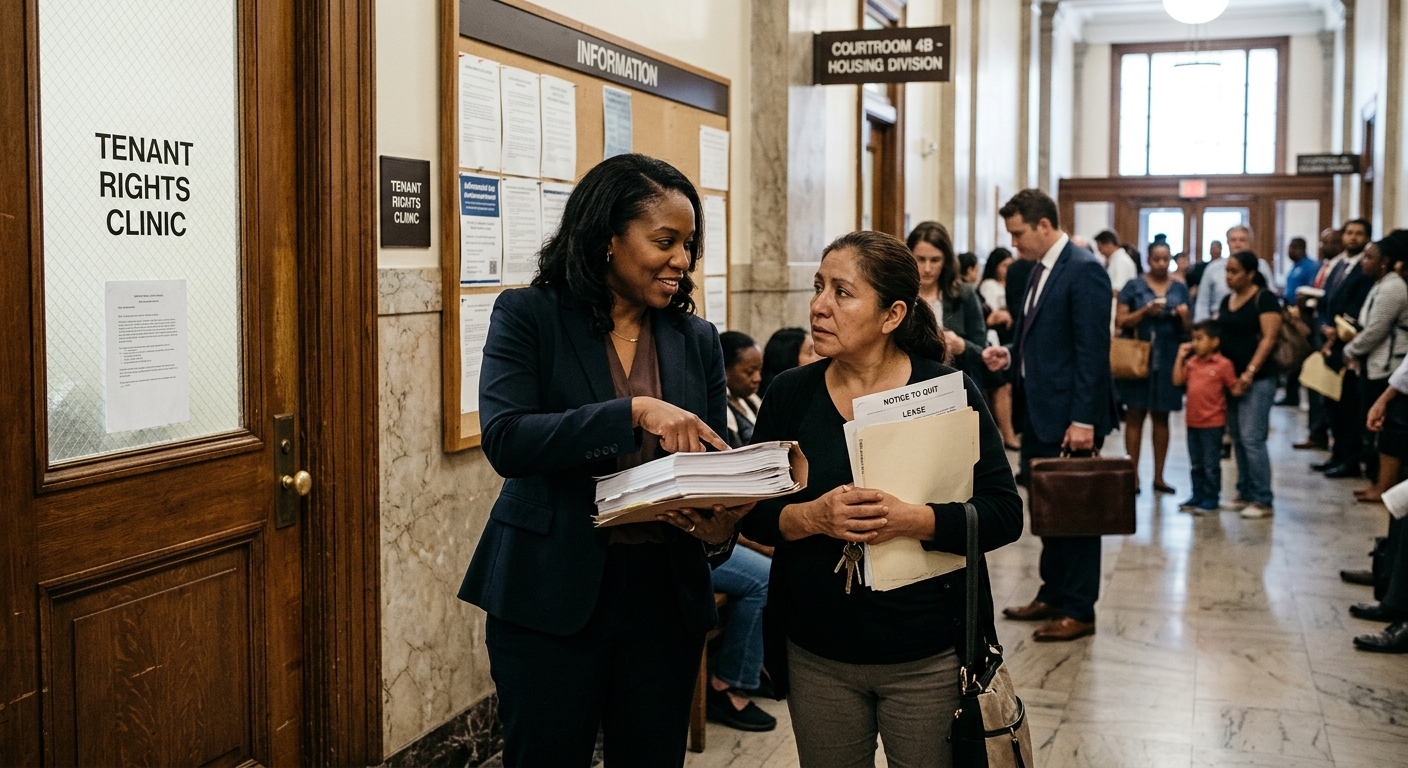
The foundation of a stable, thriving society begins with the security of a home. Yet, for millions of low-income renters across the United States, that foundation is perpetually at risk of collapsing. Every year, an invisible epidemic of displacement sweeps through American cities, uprooting families, devastating neighborhoods, and perpetuating cycles of intergenerational poverty. The eviction crisis is not merely a byproduct of economic hardship or a consequence of individual financial missteps; it is a symptom of a deeply unbalanced legal system that structurally advantages property owners while leaving vulnerable tenants to fend for themselves.
For decades, the standard procedure in housing court has favored speed and volume over fairness and due process. In the wake of global public health emergencies and mounting economic volatility, the systemic inequities embedded in the nation’s rental housing market have been laid completely bare. Recognizing that housing stability is a fundamental human right, advocates and legal professionals are championing a transformative policy solution: the civil right to counsel for tenants. By ensuring that no tenant faces the life-altering threat of eviction without qualified legal representation, municipalities can begin to dismantle systemic racial disparities, save public funds, and restore a semblance of justice to a fundamentally skewed system.
The Anatomy of America’s Eviction Machinery
To understand why legal representation is critical, one must examine the environment where eviction cases are processed. Housing courts are designed for brutal efficiency, handling dockets overflowing with hundreds of cases daily. Proceedings are notoriously fast-paced, with the average hearing lasting only a few minutes, leaving little room for nuance or a careful investigation of circumstances. The machinery of eviction rests on complex procedural rules and strict deadlines. A tenant receiving an eviction notice is thrust into a bureaucratic maze, expected to decipher legal summonses, file written responses, and present legally valid arguments. Without specialized knowledge, even a tenant with a highly defensible case is overwhelmingly likely to lose.
Unmasking the Demographics of Displacement
The eviction crisis does not fall evenly across the population; it overwhelmingly targets marginalized communities, acting as an engine of systemic inequality. Analysis of court records reveals stark demographic disparities unexplained by income alone . Black renters face a disproportionately high risk of displacement. Studies show that while Black residents comprise a smaller fraction of the adult renter population, they account for an outsized percentage of eviction filings nationwide .
The intersection of race and gender paints a disturbing picture. Black and Latina women, particularly those raising young children, are heavily impacted. Neighborhoods with higher concentrations of nonwhite residents consistently experience higher average eviction rates than predominantly white neighborhoods with similar poverty levels . These disparities stem from historical housing discrimination and redlining, making the modern eviction crisis a pressing civil rights emergency.
The David and Goliath Dynamic in the Courtroom
The structural imbalance of housing court is perhaps best illustrated by the stark asymmetry in legal representation. When landlords initiate eviction proceedings, they almost always do so with the backing of legal counsel. National estimates consistently indicate that upwards of 90 percent of landlords enter housing court represented by attorneys who specialize in real estate and eviction law. Conversely, the vast majority of tenants are forced to navigate the complexities of the courtroom entirely on their own .
This creates a classic David and Goliath dynamic, but in this scenario, David rarely possesses a slingshot. Unrepresented tenants are at a severe disadvantage during negotiations. Landlord attorneys frequently use high-pressure tactics in the hallways outside the courtroom, convincing unrepresented renters to sign heavily skewed settlement agreements or to voluntarily vacate the premises to avoid a formal judgment. Furthermore, tenants without lawyers typically do not know how to assert affirmative defenses. A tenant might be withholding rent because the landlord refused to fix a collapsed ceiling, which is a legally valid defense in many jurisdictions. Without an attorney to properly enter this defense into the court record, the tenant will almost certainly be evicted for nonpayment.
The “Scarlet E”: The Far-Reaching Consequences of an Eviction Record
The impact of an eviction extends far beyond the immediate physical loss of shelter. An eviction filing functions as a permanent black mark—a “Scarlet E”—that severely restricts a family’s future prospects. In today’s highly digitized rental market, tenant screening algorithms automatically scrape court records. Even if a tenant ultimately wins their case or the filing is dismissed, the mere existence of the record can result in automatic denials from future landlords. This forces displaced families into substandard housing or dangerous, overcrowded living situations.
The collateral damage of housing instability permeates every aspect of a person’s life, generating profound societal costs.
| Category of Impact | Specific Consequences of Eviction |
|---|---|
| Economic Damage | Job loss due to court appearances and the chaotic search for new housing; destruction of credit scores; loss of belongings placed on the street. |
| Health & Well-being | Spikes in severe depression, anxiety, and suicide rates; disruption of ongoing medical treatments; increased risk of infectious disease exposure in emergency shelters. |
| Child Development | Mid-year school transfers leading to significant academic regression; loss of peer networks and community support; increased likelihood of entering the foster care system. |
What Does a Civil “Right to Counsel” Actually Mean?
In the United States, the Sixth Amendment guarantees the right to legal representation for individuals facing criminal charges who cannot afford an attorney (a precedent solidified by the landmark Supreme Court case Gideon v. Wainwright). However, this constitutional guarantee does not extend to civil proceedings. Because eviction is classified as a civil matter, individuals facing the loss of their homes are not constitutionally entitled to a public defender.
The Right to Counsel (RTC) movement seeks to bridge this gap by enacting local and state-level legislation that guarantees free, high-quality legal representation for eligible tenants facing eviction. Unlike traditional legal aid, which relies on chronically underfunded grants and is forced to turn away thousands of desperate applicants each year, an established RTC creates a statutory mandate. It ensures that any tenant meeting specific income thresholds has a lawyer standing beside them, transforming legal assistance from a scarce charity into a guaranteed right.
The Economic Case: Why Legal Aid Pays for Itself
Skeptics of Right to Counsel legislation often express concern over the upfront costs of funding housing attorneys. However, fiscal research proves that guaranteed legal representation is a highly sound public investment. Comprehensive cost-benefit analyses demonstrate that preventing evictions saves municipal governments tens of millions of dollars annually . When families are evicted, the government bears the downstream costs: funding emergency homeless shelters, subsidizing transitional housing, paying for increased Medicaid expenditures linked to displacement, and absorbing massive foster care costs when families are forcibly separated.
Independent analyses routinely calculate significant returns on investment for RTC programs. For example, a 2026 study evaluating Nashville’s Eviction Right to Counsel initiative found a return of $2.32 in direct government savings for every dollar invested . Similarly, cost-benefit evaluations in Los Angeles County indicate that every dollar invested in tenant representation can yield upwards of $4.53 in societal cost savings . In short, it is far cheaper to pay a lawyer to keep a family housed than to pay for the catastrophic consequences of displacement.
Grassroots Momentum and Legislative Breakthroughs
The shift toward viewing legal representation as an essential right gained unprecedented traction in 2017 when New York City passed the nation’s first Right to Counsel law for tenants . The results were undeniable. By providing attorneys to low-income New Yorkers, the city saw a dramatic decrease in default judgments. According to reports from the NYC Comptroller’s Office, an astounding 89% of households represented by an RTC attorney in 2024 were able to remain stably housed .
This pioneering victory catalyzed a nationwide grassroots movement. Tenant organizers and legal professionals used New York’s success as a blueprint. Today, several states and over two dozen cities have enacted versions of Right to Counsel legislation. While challenges remain—such as managing attorney burnout and securing permanent funding—the fundamental premise is effective. Providing lawyers to tenants changes the behavior of landlords, who are less likely to file frivolous evictions when facing a trained legal adversary.
Reimagining Housing Stability Beyond Crisis Management
While guaranteeing legal representation in housing court is a monumentally important step, it is ultimately a defensive strategy—a mechanism for leveling the playing field within a flawed system. True housing justice requires looking beyond the courtroom doors. An attorney can stop an illegal eviction, but they cannot magically lower exorbitant rents or conjure affordable housing units out of thin air.
The Right to Counsel must be viewed as one crucial pillar within a broader approach to housing equity. To genuinely advance racial justice and protect marginalized communities, policymakers must simultaneously invest in deep rental assistance, expand affordable housing stock, and strengthen tenant protections. Only by combining robust legal defenses with proactive policies can we shift the paradigm from crisis management to long-term stability.
Frequently Asked Questions (FAQs)
What is the difference between criminal and civil right to counsel?
In the U.S., the Constitution guarantees legal representation (a public defender) to anyone facing criminal charges that could result in incarceration. Civil cases—which include high-stakes issues like eviction, child custody, and debt collection—do not carry this constitutional guarantee. The Right to Counsel in housing court is a legislative effort to provide lawyers in these critical civil matters.
Who is most disproportionately affected by evictions?
Data consistently shows that Black and Latinx renters, particularly women, face the highest rates of eviction filings. These disparities are deeply tied to systemic racism, historic redlining, and ongoing inequities in the housing and labor markets, making eviction a profound racial justice issue.
Why do landlords win the majority of eviction cases?
Landlords win the vast majority of cases primarily because of the extreme imbalance in legal representation. Over 90% of landlords have legal counsel, while over 90% of tenants do not. Unrepresented tenants frequently do not understand complex housing laws and fail to raise valid legal defenses, resulting in default judgments.
Does Right to Counsel save taxpayers money?
Yes. Multiple independent cost-benefit analyses have proven that RTC programs save governments money. The cost of providing an attorney is significantly lower than the public costs associated with homelessness, such as emergency shelter operations, healthcare interventions, and foster care placements.
References
- A comprehensive demographic profile of the US evicted population — Proceedings of the National Academy of Sciences (PNAS). 2023-10-02. https://doi.org/10.1073/pnas.2305860120
- Evictions Up, Representation Down — Office of the New York City Comptroller Mark Levine. 2025-05-02. https://comptroller.nyc.gov/reports/evictions-up-representation-down/
- Nashville’s Eviction Right to Counsel program paid off, study finds — Legal Aid Society of Middle Tennessee. 2026-04-13. https://las.org/
- Cost-Benefit Analysis of Providing a Right to Counsel to Tenants in Eviction Proceedings. [California]. — Stout Risius Ross, LLC / Child Welfare Library. https://www.stout.com/
- How Eviction Disproportionately Affects Communities of Color — Connecticut Fair Housing Center. 2026-03-17. https://www.ctfairhousing.org/
Similar Articles








Read full bio of medha deb


