
Teaching Banking Basics With an Interactive Card Game
Use a fast-paced banking card game to help students understand real-world financial products, services, and everyday money choices.
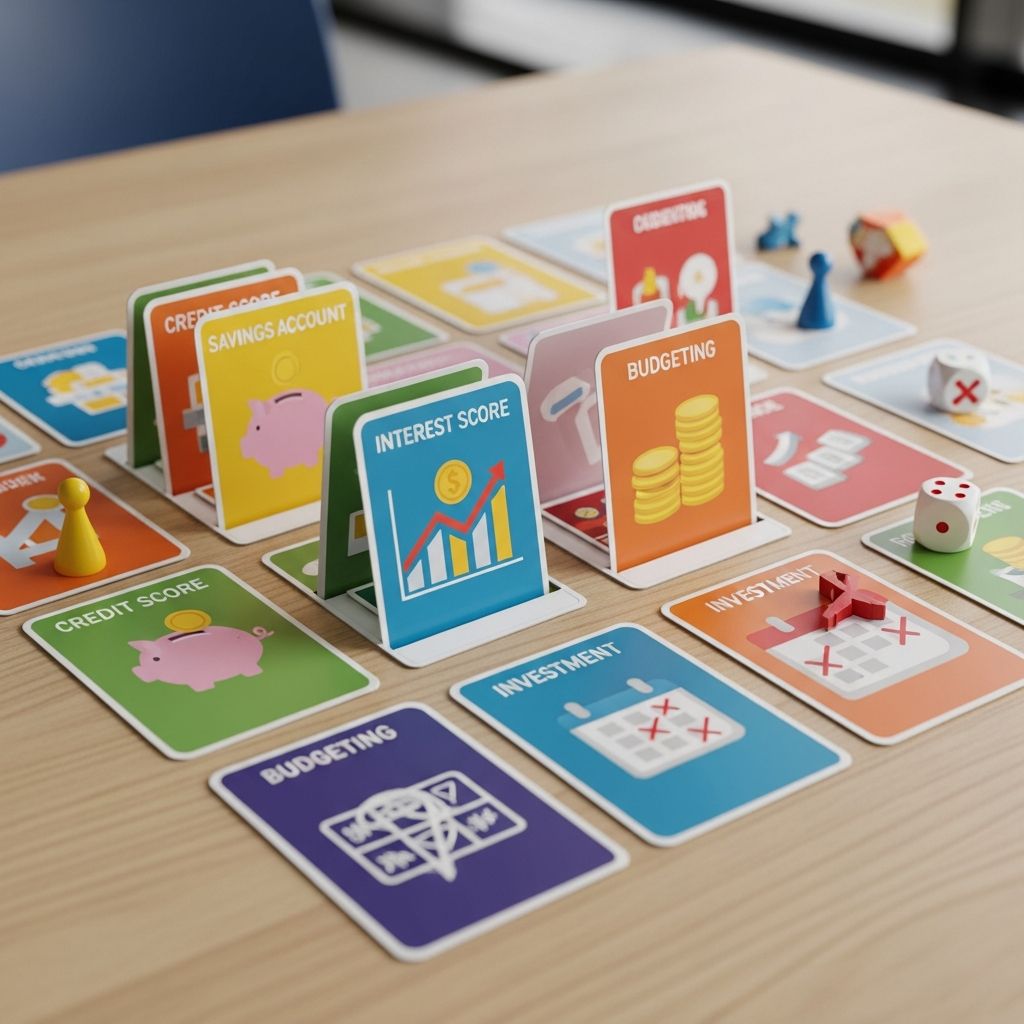
Helping young people understand banks, credit unions, and common financial products can be challenging if learning stays abstract. A structured card game transforms those ideas into concrete, memorable experiences that prepare students to use real-world banking services with confidence.
Why Banking Basics Matter for Young People
Banking skills are a foundation of financial well-being. Knowing how to choose an account, read a statement, or use a debit card safely can influence how prepared young people feel to manage their money over time. Research shows that financial education in adolescence is linked to better credit outcomes and lower default rates in adulthood, particularly when state-level personal finance requirements are in place. High school financial education has also been associated with higher rates of account ownership and more effective use of mainstream banking services instead of costly alternatives like check cashers.
A classroom card game can make these concepts easier to explore by:
- Introducing key products and services in plain language
- Letting students practice comparing options in a low-stakes setting
- Encouraging teamwork, discussion, and critical thinking
- Connecting game scenarios to real decisions they will face
Core Ideas Behind the Banking Basics Card Game
The banking basics card game is built around three core teaching ideas:
- Products and services vocabulary — Students encounter terms like checking account, savings account, ATM card, online banking, and direct deposit, and begin to use them correctly.
- Matching needs to tools — Students consider everyday money situations and think about which banking tools could help them most.
- Present and future thinking — Students decide what might fit their lives now as youth and later as adults, building a long-term mindset about financial choices.
This structure aligns with broader financial literacy goals, such as understanding how to choose and use banking products and how financial institutions support savings and payments.
Key Banking Products and Services Featured in the Game
The specific cards you include will depend on your students’ age and experience, but most versions of the game emphasize core tools young people are likely to encounter. These align with common explanations from central banks and federal agencies.
| Banking Tool | What It Typically Does | Why It Matters for Students |
|---|---|---|
| Checking account | Holds money for frequent spending and bill paying; often accessed with debit cards, checks, or electronic transfers. | Helps students manage everyday purchases and learn to track inflows and outflows. |
| Savings account | Stores money for future needs while earning interest; may limit frequent withdrawals. | Introduces saving goals and the idea of interest as a reward for saving. |
| Debit card | Lets the account holder pay directly from a checking account at stores or online and withdraw cash from ATMs. | Connects plastic or digital payments to real account balances and responsible tracking. |
| ATM and branch services | Provide ways to deposit, withdraw, and check balances in person or at machines. | Shows students how to access their money and the importance of secure PIN use. |
| Online and mobile banking | Offer digital access for viewing balances, paying bills, and moving money. | Reflects how many people manage accounts today and raises security and privacy topics. |
| Direct deposit | Automatically routes paychecks or benefits into an account. | Demonstrates a fast, safe method of getting paid without cashing paper checks. |
| Credit products (optional for older students) | Include credit cards, personal loans, or lines of credit with repayment over time and interest charges. | Helps teens begin to understand borrowing costs, credit history, and responsible use. |
Designing the Card Game for Your Classroom
The game can be adapted to different grade levels and subject areas, from math and social studies to advisory periods. At its core, the activity includes two interconnected decks:
- Product and service cards — Each card names a bank product, service, or feature and gives a short description or example.
- Scenario cards — Each card describes a situation, goal, or challenge that involves money management.
Students work individually or in small groups to match scenarios to appropriate products or services, justify their choices, and discuss alternatives.
Suggested Card Types
- Core accounts (checking, savings, youth accounts, joint accounts)
- Access tools (debit cards, ATMs, mobile apps, online statements)
- Safety and protection (FDIC or NCUA deposit insurance, passwords, fraud alerts)
- Payment services (bill pay, transfers, peer-to-peer payments)
- Income-related features (direct deposit, payroll cards, cashing checks)
- Credit and borrowing (secured credit card, student loan, overdraft, personal loan) for advanced groups
Scenario Ideas to Encourage Critical Thinking
Scenarios should be realistic, age-appropriate, and open-ended enough to allow for more than one reasonable answer. For example, you might include situations like:
- Trying to save for a specific future purchase
- Receiving a first paycheck and deciding what to do with it
- Wanting to shop safely online
- Sharing expenses with a friend or family member
- Needing a safe place to keep money instead of at home
- Dealing with an unexpected fee or account problem
Each scenario encourages students to consider which banking products could help and which trade-offs to weigh, similar to how financial literacy curricula ask students to compare the costs and benefits of banking tools.
Step-by-Step Game Instructions
Below is a general sequence you can customize. The focus is on learning, not competition, though light competition can increase engagement.
1. Introduce Basic Concepts
Begin with a short discussion or mini-lesson on what banks and credit unions do. Central bank and consumer education materials emphasize that these institutions:
- Accept deposits and keep money safe
- Offer ways to pay for goods and services
- Provide loans and other credit products
- Support saving and future planning
Clarify any key vocabulary students will see on the cards, such as interest, balance, or overdraft.
2. Explain the Objective
Tell students that their goal is to:
- Learn what different banking products and services do
- Decide which ones could help in specific situations
- Share their thinking and listen to others’ reasoning
3. Form Small Groups
Divide the class into groups of two to four students. Smaller groups help everyone practice using the vocabulary and develop confidence discussing money topics.
4. Distribute and Review Cards
- Give each group a full set of product and service cards.
- Optionally, provide each group with a subset of scenario cards to work through.
- Have groups quickly read through their product cards so each student becomes familiar with the range of options.
5. Play: Match Scenarios to Products and Services
For each round:
- A group draws or is assigned a scenario card.
- Students discuss which products or services would best address the situation.
- They select one or more matching product cards and place them next to the scenario.
- One student explains the group’s reasoning aloud.
You can award points for clear explanations, creative solutions, or identification of multiple workable tools. Alternatively, keep it non-competitive and focus on discussion.
6. Facilitate Whole-Class Reflection
After several rounds, bring the class together to compare answers:
- Ask different groups which products they chose for the same scenario.
- Highlight where different choices are all reasonable but have different pros and cons.
- Connect student ideas to how real banks operate and to concepts like fees, accessibility, and security.
7. Extend With Debrief Questions
Wrap up with reflective questions such as:
- Which product or service do you think you might use first in your own life?
- Which product seemed most confusing, and what would help you understand it better?
- What questions would you ask a bank or credit union before opening an account?
- How can online and mobile tools make managing money easier, and what risks should you watch for?
Differentiating the Game for Different Ages
The same basic card game can be tuned for elementary students, middle schoolers, or high school learners by adjusting the complexity of terms and scenarios.
For Younger Students
- Use simpler language and fewer cards in each deck.
- Focus on the idea of keeping money safe, saving for goals, and not confusing debit with “free money.”
- Emphasize that banks and credit unions are places where adults help you manage money.
For Middle School Students
- Introduce basic checking and savings accounts and simple fees.
- Highlight real-world examples like saving for a phone or managing allowance money.
- Begin to talk about online banking, passwords, and safe PIN behavior.
For High School Students
- Add more advanced terms, such as overdraft, direct deposit, mobile check deposit, or basic credit tools.
- Include scenarios about part-time jobs, direct deposits, and choosing between financial institutions.
- Connect the game to topics like credit reports, fees, and long-term financial planning.
Connecting the Game to Real-World Banking Choices
To help the activity translate into real skills, link each part of the game to real actions students may take as they approach adulthood:
- Opening accounts — Discuss what information is usually needed to open a checking or savings account and why identification rules exist.
- Comparing institutions — Highlight the difference between banks and credit unions, including ownership structure and typical fee structures.
- Understanding fees and interest — Use product cards to point out that some accounts pay interest on deposits, while others may charge monthly fees or overdraft fees.
- Using digital tools safely — Reinforce good practices like using strong passwords, not sharing PINs, and monitoring accounts regularly for unauthorized charges.
These conversations mirror the practical topics in many banking fundamentals and financial literacy programs used with teens and young adults.
Tips for Effective Classroom Implementation
To make the most of the banking basics card game, consider the following instructional approaches:
- Co-create norms — Because money can feel personal, set expectations for respectful discussion and remind students not to share private financial details.
- Use think-alouds — Model your own reasoning when you match a product card to a scenario, making your decision-making visible.
- Encourage multiple answers — Banking decisions rarely have a single correct answer. Welcome different viewpoints if they are supported with sound reasoning.
- Connect with families — Invite students to take a brief summary of terms home and ask a parent or caregiver which products they use and why.
- Revisit the game — Reuse the cards in later lessons to practice budgeting, comparing fees, or exploring credit, reinforcing learning over time.
Sample Learning Outcomes
By the end of the card game activity and follow-up discussion, students should be able to:
- Identify at least several common banking products and services by name
- Explain in simple terms what those products are used for
- Match everyday money situations with helpful banking tools
- Describe at least one product or service they might want to use now and one they might consider in the future
- Ask informed questions about fees, access, and safety when considering banking options
Frequently Asked Questions (FAQs)
Q: Do students need to have their own bank accounts to play the game?
No. The game is designed to introduce concepts and vocabulary whether or not students already use banking services. Many programs that teach banking basics to youth assume little to no prior experience.[10]
Q: How long does a typical card game session take?
Most educators can complete a brief introduction, small-group play, and a whole-class debrief in one standard class period. For deeper discussion or extension activities, you can easily stretch the game to two or more sessions.
Q: Can this activity work in non-math classes?
Yes. Because it focuses on decision-making, vocabulary, and reasoning, the game fits naturally into social studies, economics, advisory, or career readiness courses, as well as math classes.
Q: How do I adapt the game for online or hybrid learning?
You can convert product and scenario cards into digital slides or an online quiz format, then have students discuss matches in breakout rooms or whole-class discussion. The key is preserving the matching and explanation steps, even if students are not manipulating physical cards.
Q: Should I include credit cards and loans in a basic banking game?
For younger or less experienced groups, it may be better to focus first on savings, checking, and basic services. For older students, including credit cards and loans can support broader financial literacy standards and help them understand how borrowing and credit scores work.
References
- EVERFI Financial Literacy Curriculum Guide — EVERFI. 2024-01-01. https://everfi.com/wp-content/uploads/2024/01/EVERFI-Financial-Literacy-Curriculum-Guide.pdf
- Banking basics for students — Regions Bank. 2023-05-10. https://www.regions.com/next-step/seminars/banking-basics-for-students
- Banking Basics — Federal Reserve Education. 2022-09-15. https://www.federalreserveeducation.org/teaching-resources/personal-finance/saving/banking-basics
- Banking Basics Guide — Reaching Financial Independence — Bank of America. 2023-08-01. https://info.bankofamerica.com/en/student-banking/banking-basics
- Banking BASICS Leader’s Guide — Consumer Action. 2012-01-01. https://www.consumer-action.org/downloads/english/Banking_Basics_LG_2012.pdf
- Educator Resources — Hands on Banking — Wells Fargo. 2023-04-20. https://youth.handsonbanking.org/educators/
Similar Articles








Read full bio of medha deb


