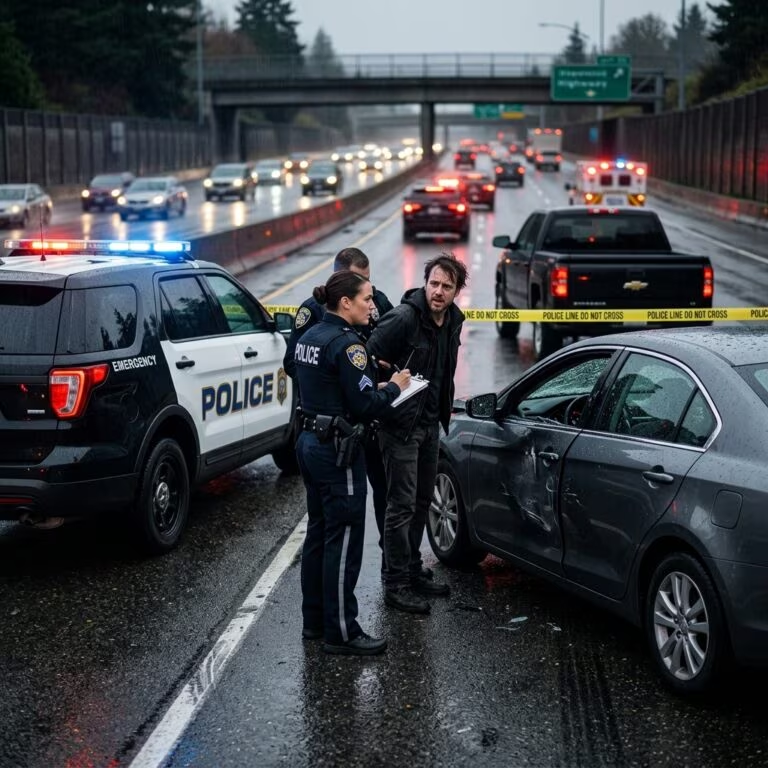
The pursuit of justice in the United States is anchored in the foundational democratic belief that no individual, regardless of their status or badge, is above the law. However, when the very individuals tasked with enforcing the law are accused of violating it, the scales of justice often appear heavily imbalanced. Over the past decade, high-profile incidents of fatal police encounters have sparked nationwide protests and forced a profound public reckoning regarding police accountability. Yet, despite the intense public scrutiny and the increasing prevalence of body-worn camera footage that often accompanies these cases, criminal convictions of law enforcement officers remain a distinct statistical anomaly.
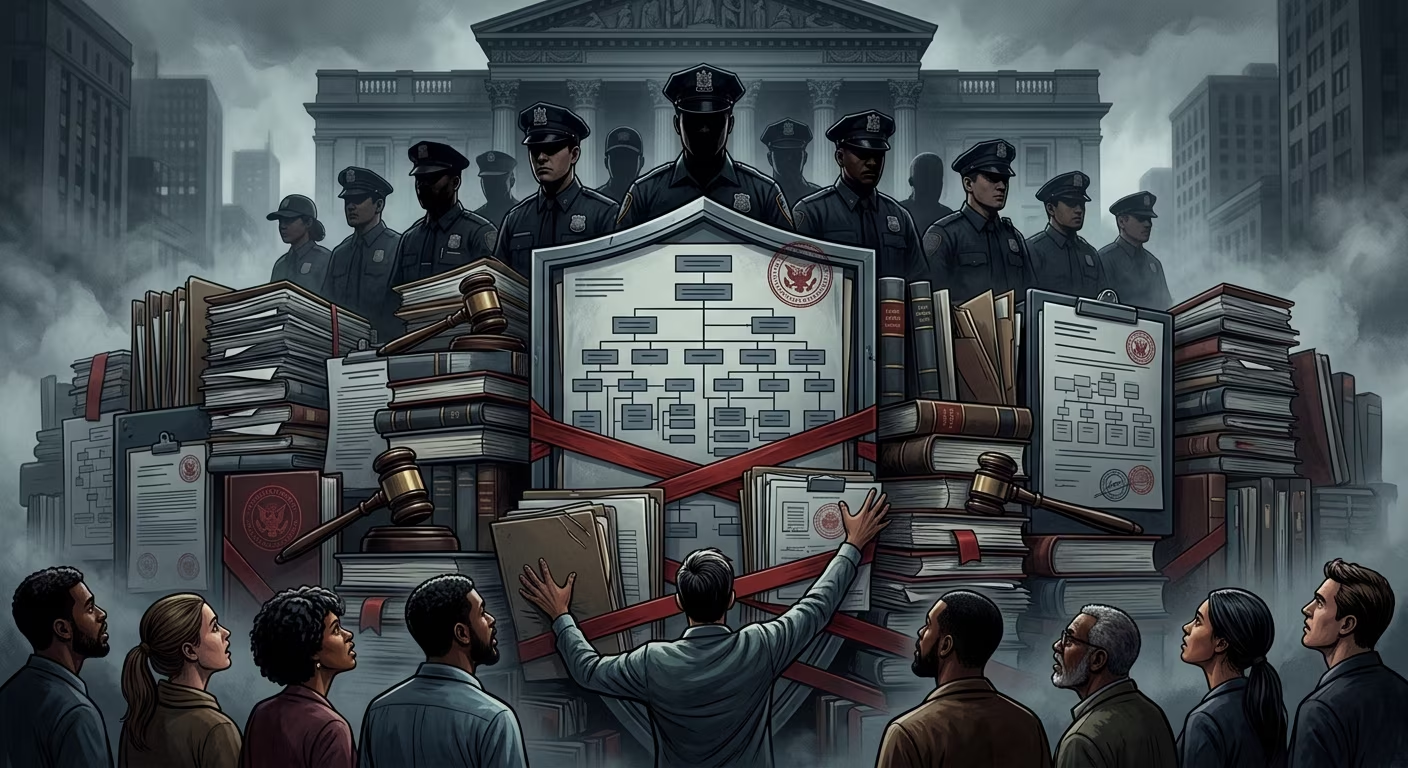
This stark reality leads to a critical and uncomfortable question: why does the criminal justice system so frequently fail to hold officers accountable for excessive use of force or fatal shootings? The answer does not lie in a single, easily rectifiable failing. Rather, it exists within a complex, interwoven ecosystem of legal standards, political pressures, and inherent structural conflicts of interest. Together, these elements collectively function as a nearly impenetrable shield against prosecution, making the courtroom an incredibly difficult arena for addressing police misconduct.
The Engine of Prosecution: A Built-In Conflict of Interest
The American criminal justice system relies heavily on the symbiotic, day-to-day relationship between local law enforcement agencies and county District Attorneys (DAs). In standard criminal proceedings, prosecutors and police officers are fundamentally on the same team; they work in tandem daily to build cases, gather forensic evidence, and secure convictions against civilian defendants. Police officers serve as the primary witnesses for the prosecution. They conduct the initial interviews, process the crime scenes, sign affidavits, and testify on the stand. Without the active and willing cooperation of the local police department, a DA’s ability to effectively prosecute everyday crime grinds to an absolute halt.
This deep reliance creates a profound and inescapable conflict of interest when an officer from that very department is accused of a crime. When a controversial police shooting occurs, the local prosecutor is suddenly expected to pivot from being a close collaborator to becoming an impartial investigator and adversary. The prosecutor must evaluate the legal conduct of individuals they may have relied on just days prior for crucial testimony in a separate felony trial.
Furthermore, prosecutors are acutely aware that aggressively pursuing charges against an officer can irrevocably damage their working relationship with the broader police department. If rank-and-file officers feel betrayed or targeted by the DA’s office, they might become less cooperative, perform less thorough investigations, or experience a drop in morale, all of which directly impact the prosecutor’s overall conviction rate in civilian cases. This structural paradox means that the investigators and the investigated are intricately linked, making true prosecutorial impartiality nearly impossible at the local county level.
The Evidentiary and Legal Hurdles
Even if a local prosecutor is willing to brave the institutional backlash and bring criminal charges against a law enforcement officer, they face an uphill battle against deeply entrenched legal frameworks explicitly designed to give police the benefit of the doubt. The cornerstone of use-of-force law in the United States stems from the landmark Supreme Court decision in Graham v. Connor . This ruling established the “objective reasonableness” standard, which dictates that an officer’s use of force must be evaluated from the perspective of a reasonable officer on the scene, rather than with the 20/20 vision of hindsight.
This legal standard explicitly accounts for the fact that police officers are frequently forced to make split-second decisions in circumstances that are tense, rapidly evolving, and highly uncertain. Consequently, when evaluating whether a fatal shooting was legally justified, juries are instructed not to ask whether the deadly force was ultimately necessary in retrospect, but whether a “reasonable” officer in that exact moment might have perceived a deadly threat. This creates an incredibly high bar for prosecutors to clear. They must prove beyond a reasonable doubt that the officer’s actions were entirely unreasonable to any other trained professional in their shoes.
Furthermore, proving criminal intent, or mens rea, in these cases is notoriously difficult. Unlike civilian homicides, where premeditation, malice, or sudden passion is often a focal point, police shootings typically occur during the chaotic execution of official duties. This context makes it significantly harder to prove to a jury that the officer acted with criminal malice rather than fear, panic, or a tragic misjudgment of the threat level.
By the Numbers: The Rarity of Criminal Charges
To fully understand the magnitude of this legal and structural shield, one must look at the empirical data surrounding police prosecutions. The statistics reveal a stark contrast between the number of fatal police encounters and the number of criminal charges actually filed. Data compiled by the Police Integrity Research Group at Bowling Green State University—one of the nation’s leading academic institutions tracking police crime—demonstrates just how exceptionally rare it is for officers to face the inside of a courtroom as criminal defendants .
According to their extensive tracking of cases across the United States, out of the thousands of fatal police shootings that occur over a given decade, only a minute fraction of officers are ever arrested for murder or manslaughter. Even among the very small subset of officers who are formally charged, the conviction rate is significantly lower than that of the general public facing similar homicide charges. This is partially because juries are culturally conditioned to view police officers as community protectors, which inherently biases them toward accepting an officer’s claim of self-defense. This historical data highlights a systemic bottleneck where prosecutorial discretion, legal hurdles, and jury bias converge to protect law enforcement personnel from the consequences of fatal actions.
The Political Clout of Law Enforcement Unions
Beyond the confines of the courtroom and the DA’s office, the broader political landscape plays a massive role in shaping prosecutorial decisions. District Attorneys are, in the vast majority of U.S. jurisdictions, elected officials. This means their continued employment relies on winning local elections and maintaining public favor. In the realm of local politics, few entities wield as much concentrated power as police unions and fraternal orders of police.
These organizations are exceptionally well-funded, highly organized, and politically aggressive. Police unions routinely endorse DA candidates, provide substantial financial contributions to their campaigns, and mobilize their extensive memberships to vote as a powerful bloc. Conversely, if a prosecutor demonstrates a willingness to aggressively investigate and charge law enforcement officers, unions are quick to launch formidable opposition campaigns. They often frame reform-minded prosecutors as “soft on crime” or “anti-police,” effectively weaponizing public fear of crime to unseat them.
The threat of political retaliation is a powerful deterrent. A District Attorney who chooses to indict a popular or well-connected police officer risks not only losing the daily cooperation of the police force but also facing a well-funded, union-backed challenger in the next primary election. This dynamic ensures that political self-preservation often outweighs the pursuit of strict accountability, further insulating officers from legal scrutiny.
Federal Intervention: The Role of Pattern-or-Practice Investigations
When local prosecutorial systems fail entirely due to these entrenched conflicts of interest, the federal government sometimes steps in as a mechanism of last resort. The U.S. Department of Justice (DOJ), specifically through its Civil Rights Division, possesses the authority to conduct “pattern-or-practice” investigations into state and local law enforcement agencies . These investigations represent a fundamentally different approach; they do not target individual officers for isolated criminal acts, but rather focus on systemic, agency-wide constitutional violations.
Authorized under federal law, these probes allow the DOJ to investigate local police departments for widespread issues such as routine excessive use of force, racially biased policing, or unconstitutional stops and searches. If the DOJ finds a pattern of misconduct, it can compel the local jurisdiction to enter into a federal consent decree. A consent decree is a legally binding performance plan overseen by a federal judge, mandating specific reforms, training updates, and transparency measures.
While pattern-or-practice investigations are a crucial tool for implementing structural reforms and forcing departmental modernization, they are not a substitute for individual criminal prosecution. They seek to fix the institution rather than punish the specific individual, leaving a gap in justice for specific victims of police violence. Furthermore, the frequency and aggressiveness of these federal investigations are highly volatile, often fluctuating significantly depending on the political priorities of the current presidential administration.
Reimagining Accountability: Structural Solutions
Breaking the cycle of prosecutorial hesitancy requires fundamentally dismantling the structural barriers that currently define police investigations. Legal scholars, civil rights advocates, and progressive policymakers have proposed several systemic reforms designed to introduce genuine impartiality into the investigative process.
One of the most prominent proposals is the mandatory use of independent special prosecutors for all cases involving police use of deadly force. By removing the case from the jurisdiction of the local District Attorney, the inherent conflict of interest is instantly mitigated. Some states have already passed legislation requiring the State Attorney General’s office to automatically take over investigations when an unarmed civilian is killed by law enforcement, ensuring the investigators do not rely on the accused department for their daily caseloads.
Additionally, reforms targeting grand jury transparency are gaining traction. Historically, DAs have used the secretive grand jury process to secure “no-bill” decisions (a refusal to indict) without having to publicly explain the evidence or their legal reasoning. Opening these proceedings or bypassing them entirely in favor of preliminary public hearings can dramatically increase public trust.
Comparing Prosecution Models
| Feature | Local District Attorney Model | Independent Special Prosecutor Model |
|---|---|---|
| Conflict of Interest | High. Relies on local police for daily casework and trial success. | Low. Operates externally and does not depend on local police cooperation. |
| Political Pressure | High. Vulnerable to local police union endorsements and local elections. | Low to Moderate. Usually appointed at the state level, insulating them from local union retaliation. |
| Public Trust | Often low in high-profile cases due to perceived bias and secrecy. | Generally higher, as the process is viewed as structurally impartial. |
Frequently Asked Questions (FAQs)
Why is it so difficult to convict a police officer of murder?
Convicting a police officer is difficult due to a combination of high legal standards (like proving the force was “objectively unreasonable”), the difficulty of proving criminal malice in the line of duty, inherent jury biases that favor law enforcement, and the structural reliance that prosecutors have on police departments to do their jobs.
What does “objective reasonableness” mean?
Established by the Supreme Court in Graham v. Connor, “objective reasonableness” is the legal standard used to evaluate police use of force. It requires juries to judge an officer’s actions based on what a reasonable officer would have done in that exact, split-second moment, without the benefit of hindsight.
How do police unions influence the justice system?
Police unions influence the justice system by utilizing their substantial financial resources and political organization to endorse, fund, or oppose District Attorneys in local elections. This political clout can pressure prosecutors to avoid charging officers out of fear of losing their elected positions.
Conclusion
The failure to consistently hold law enforcement officers accountable for misconduct is not simply a matter of individual prosecutorial failure; it is the predictable outcome of a justice system functioning exactly as it was structurally designed. The intertwined relationship between police and prosecutors, the formidable legal standards protecting officers, and the immense political power of police unions create an environment where accountability is the exception rather than the rule. Until systemic reforms—such as the widespread implementation of independent prosecutors and the reevaluation of legal use-of-force standards—are adopted, the courtroom will remain a formidable shield for those who wear the badge, leaving communities searching for alternative avenues of justice.
References
- Graham v. Connor, 490 U.S. 386 — Supreme Court of the United States. 1989-05-15. (Although established in 1989, this ruling remains the active, foundational legal standard currently used by all U.S. courts to evaluate police use of force). https://supreme.justia.com/cases/federal/us/490/386/
- Police Integrity Research Group — Bowling Green State University. 2024-03-14. https://www.bgsu.edu/health-and-human-services/programs/department-of-human-services/criminal-justice/police-integrity-research-group.html
- Civil Rights Division | Conduct of Law Enforcement Agencies — U.S. Department of Justice. 2025-02-25. https://www.justice.gov/crt/conduct-law-enforcement-agencies