Introduction: The Paradox of Modern Cannabis Policy
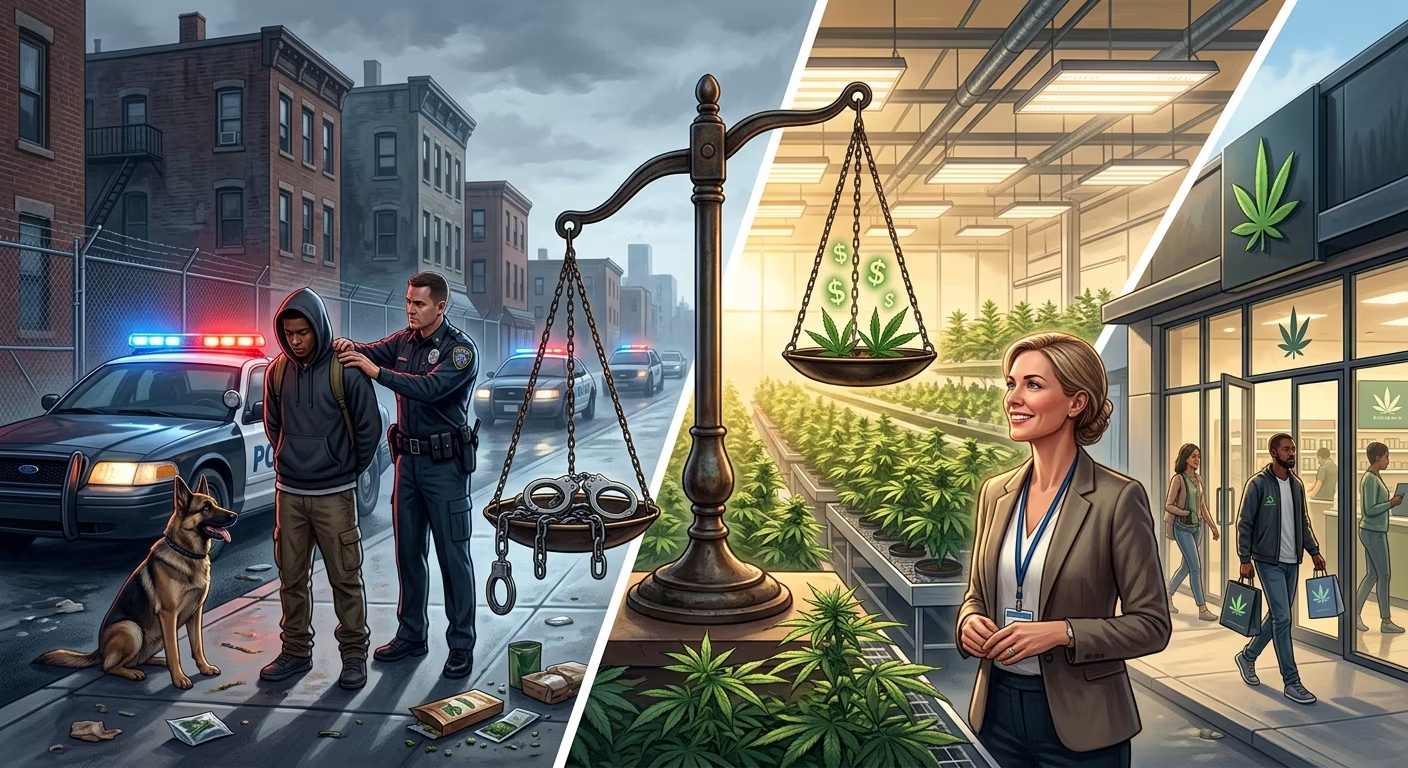
The United States is currently experiencing a profound shift in its cultural and legal relationship with cannabis. In bustling metropolitan centers and quiet suburban neighborhoods alike, sleek dispensaries operate with the same regulatory legitimacy as local coffee shops. Tax revenues from legal cannabis sales are funding schools, public infrastructure, and community enrichment programs. Yet, beneath this veneer of progressive reform lies a deeply entrenched paradox: while the legal market mints new millionaires, the criminal justice system continues to aggressively penalize marginalized communities for the very same plant.
This stark contradiction highlights the illusion of equitable drug policy. Despite the rapid spread of decriminalization and legalization across the nation, the enforcement of cannabis laws remains fiercely disproportionate. The persistence of racial bias in drug arrests reveals that changing the legal status of a substance does not automatically dismantle the systemic inequities woven into the fabric of law enforcement. To understand the true state of cannabis policy today, one must look past the booming green economy and examine the glaring statistical realities of who is still being handcuffed, processed, and burdened with a lifelong criminal record.
The Statistical Reality: Usage Parity Versus Enforcement Disparity
A fundamental premise of fair law enforcement is that policing should reflect the actual occurrence of infractions across different demographics. However, in the realm of drug enforcement, this principle is routinely shattered. Extensive public health and sociological research consistently demonstrates that Black and white Americans consume and distribute cannabis at nearly identical rates. The parity in usage, however, vanishes entirely when analyzing arrest data.
The Arrest Gap
Comprehensive analyses of national crime statistics paint a troubling picture. On a national scale, a Black person is approximately 3.6 times more likely to be arrested for cannabis possession than a white person. This staggering disparity is not an isolated phenomenon confined to specific regions with notoriously strict drug laws; it is a pervasive reality across the United States. In some counties, the racial disparity in arrest rates skyrockets even further, with Black individuals facing arrest rates up to eight or ten times higher than their white counterparts for identical behaviors.
Does Legalization Erase the Gap?
A common assumption is that legalizing or decriminalizing cannabis inherently solves the problem of racially biased policing. The data tells a more complicated story. While states that have enacted sweeping reforms have indeed seen a precipitous decline in the absolute number of cannabis-related arrests, the racial disparity within the remaining arrests often persists—and in some jurisdictions, it actually worsens. For instance, even after legalization, minor infractions such as public consumption or possession over the legal limit are predominantly enforced against people of color. The total pie of arrests shrinks, but the slice representing marginalized communities remains disproportionately large.
The Historical Context: Echoes of the War on Drugs
To comprehend why these disparities endure, it is essential to trace the roots of modern drug policing back to the “War on Drugs.” Initiated in the late 20th century, this political and legislative campaign explicitly targeted specific communities under the guise of restoring public order. The architecture of the War on Drugs relied heavily on aggressive street-level enforcement, mandatory minimum sentencing, and the militarization of local police forces.
The cultural narratives propagated during this era deeply influenced law enforcement paradigms. Policies such as “broken windows” policing—which posits that cracking down on minor offenses prevents major crimes—disproportionately directed police resources into low-income neighborhoods and communities of color. Decades of these practices created a self-fulfilling prophecy: heavy police presence in specific neighborhoods led to higher arrest rates, which in turn were used to justify continued over-policing of those exact populations.
Even as societal attitudes toward cannabis have softened considerably, the institutional inertia of the War on Drugs remains. The tactical approaches, deployment strategies, and implicit biases ingrained in law enforcement agencies over the past fifty years cannot be erased overnight by a simple change in state statutes. The legacy of these policies continues to dictate whose neighborhoods are surveilled, whose cars are pulled over, and whose pockets are searched on a daily basis.
Mechanisms Behind the Bias: How Disparity Happens
The disparity in arrest rates is not merely a statistical anomaly; it is the direct result of specific mechanisms within the criminal justice system. These mechanisms operate at both the broad institutional level and the localized individual level.
Neighborhood Surveillance and Targeted Patrols
The geographical deployment of police officers is a primary driver of racial disparities in arrests. Law enforcement agencies frequently concentrate their patrols in urban areas and neighborhoods with higher populations of people of color. When police are disproportionately stationed in specific areas, the residents of those areas are subjected to a hyper-vigilant level of scrutiny. A white individual consuming cannabis in a private suburban backyard is unlikely to encounter an officer, whereas a Black individual in a heavily patrolled urban environment faces a much higher risk of interaction and subsequent arrest.
The Role of Discretion in Law Enforcement
Another critical mechanism is the immense discretion afforded to police officers during routine interactions, such as traffic stops and pedestrian checks. When an officer pulls a driver over for a minor traffic violation, they possess significant leeway in deciding whether to escalate the encounter by searching the vehicle for contraband. Studies on traffic stops routinely show that Black drivers are pulled over more frequently and are subjected to discretionary searches at higher rates than white drivers. Because cannabis possesses a distinct odor, it is frequently cited as the probable cause for a search, transforming a broken taillight into a life-altering drug arrest.
The Lifelong Echoes: Collateral Consequences of a Conviction
The true cost of a cannabis arrest extends far beyond the immediate trauma of being handcuffed, interrogated, or spending a night in a holding cell. The criminal justice system attaches a host of “collateral consequences” to drug convictions—invisible punishments that systematically dismantle an individual’s ability to participate fully in society. These consequences can be devastating, effectively enforcing a permanent second-class citizenship for those ensnared by the system.
| Domain | Impact of Conviction | Long-term Effect |
|---|---|---|
| Employment | Routine background checks lead to immediate disqualification from both public and private sector jobs. Professional licensing boards often deny certifications. | Chronic unemployment, reduced lifetime earning potential, and forced reliance on informal or illegal economies. |
| Housing | Denial of federal housing assistance (Section 8) and routine rejection by private landlords conducting standard background screenings. | Increased risk of homelessness, housing instability, and forced relocation to under-resourced or unsafe neighborhoods. |
| Education | Potential loss of eligibility for federal student financial aid. Many universities also require applicants to disclose criminal records. | Inability to pursue higher education, stalling intergenerational social mobility and career advancement. |
| Family & Immigration | Convictions can be used against individuals in child custody disputes and can trigger immediate deportation proceedings for non-citizens. | Permanent family separation, loss of parental rights, and forced removal from the country regardless of long-term residency. |
When these collateral consequences are combined with the disproportionate arrest rates detailed earlier, the result is a systemic economic and social suppression of communities of color. A minor possession charge can literally mean the difference between securing a stable career and falling into an inescapable cycle of poverty and marginalization.
The Path Forward: Enacting True Equity in Policy
Addressing the glaring inequities in drug policing requires far more than simply removing the prohibition on cannabis. True equity demands comprehensive legislative frameworks that actively dismantle the structural harms caused by decades of discriminatory enforcement.
The Necessity of Retrospective Justice
If society acknowledges that the prohibition of cannabis was inherently flawed and unevenly enforced, it is morally imperative to provide retrospective justice to those burdened with past convictions. Automatic expungement is a critical step in this process. While some states have introduced petition-based expungement systems, these processes are often expensive, legally complex, and entirely inaccessible to the average person. Automatic, state-initiated expungement removes the bureaucratic barriers, clearing records en masse and immediately restoring civil rights and employment opportunities to thousands of affected individuals.
Community Reinvestment and Economic Inclusion
Furthermore, the astronomical revenues generated by the legal cannabis industry must be leveraged to repair the communities most devastated by the War on Drugs. Comprehensive equity policies should mandate that a significant portion of cannabis tax revenue be reinvested into community initiatives, such as job training programs, substance abuse treatment, and educational funding in disproportionately impacted areas.
Additionally, the burgeoning legal market must be accessible to those who bore the brunt of criminalization. Licensing frameworks must include social equity programs that provide initial capital, technical assistance, and priority licensing to individuals from marginalized communities, ensuring they are not locked out of the lucrative industry they paradoxically helped build during the era of prohibition.
Frequently Asked Questions
Why do racial disparities in arrests persist even after cannabis is legalized?
Legalization significantly reduces the total absolute number of arrests, but it does not alter the underlying policing strategies that focus heavily on marginalized communities. Disparities persist in the enforcement of remaining restrictions, such as public consumption, driving under the influence, or possessing amounts slightly over the legal limit. Institutional biases and targeted neighborhood patrol allocations continue to subject people of color to higher rates of police scrutiny.
What exactly does “automatic expungement” mean?
Automatic expungement refers to a legal process where the state government proactively identifies and clears eligible criminal records from its databases without requiring the individual to file a formal petition, hire an attorney, or pay expensive court fees. This removes the severe administrative and financial burdens that prevent many people from successfully clearing their records under traditional legal systems.
How does a simple cannabis conviction impact housing options?
A drug-related criminal record can result in immediate disqualification from federally subsidized housing programs. Furthermore, private landlords frequently run background checks and routinely deny rental applications from individuals with any criminal history. This practice severely limits safe housing options and drastically increases the risk of housing instability and homelessness for individuals with past convictions.
Are cannabis usage rates genuinely the same across different racial groups?
Yes. Decades of comprehensive data from federal public health surveys, including the National Survey on Drug Use and Health, consistently show that Black and white populations consume and sell cannabis at nearly identical rates. The massive gap in arrest statistics is entirely driven by systemic disparities in law enforcement and surveillance, not by fundamental differences in citizen behavior.
How can individuals advocate for fairer cannabis policies in their communities?
Advocacy begins with understanding local and state-level legislation. Citizens can support grassroots organizations focused on criminal justice reform, demand transparency in local police data regarding traffic stops and arrests, and vote for policymakers who prioritize automatic expungement and community reinvestment over mere market commercialization. Engaging in community oversight boards and deliberately supporting social equity businesses also play a vital role in shifting the landscape.
References
- A Tale of Two Countries: Racially Targeted Arrests in the Era of Marijuana Reform — American Civil Liberties Union. 2020-04-20. https://www.aclu.org/report/tale-two-countries-racially-targeted-arrests-era-marijuana-reform
- Cannabis Decriminalization Reduces Racial Disparity in Arrests of Adults — Social Science & Medicine / High Times. 2022-01-03. https://hightimes.com/news/cannabis-decriminalization-reduces-racial-disparity-in-arrests-of-adults/
- Clemency For Marijuana Offenders Serving Federal Prison Sentences — Academy for Justice / Arizona State University Sandra Day O’Connor College of Law. 2022-10-07. https://academyforjustice.org/
- National Survey on Drug Use and Health (NSDUH) — Substance Abuse and Mental Health Services Administration (SAMHSA). 2023. https://www.samhsa.gov/data/data-we-collect/nsduh-national-survey-drug-use-and-health