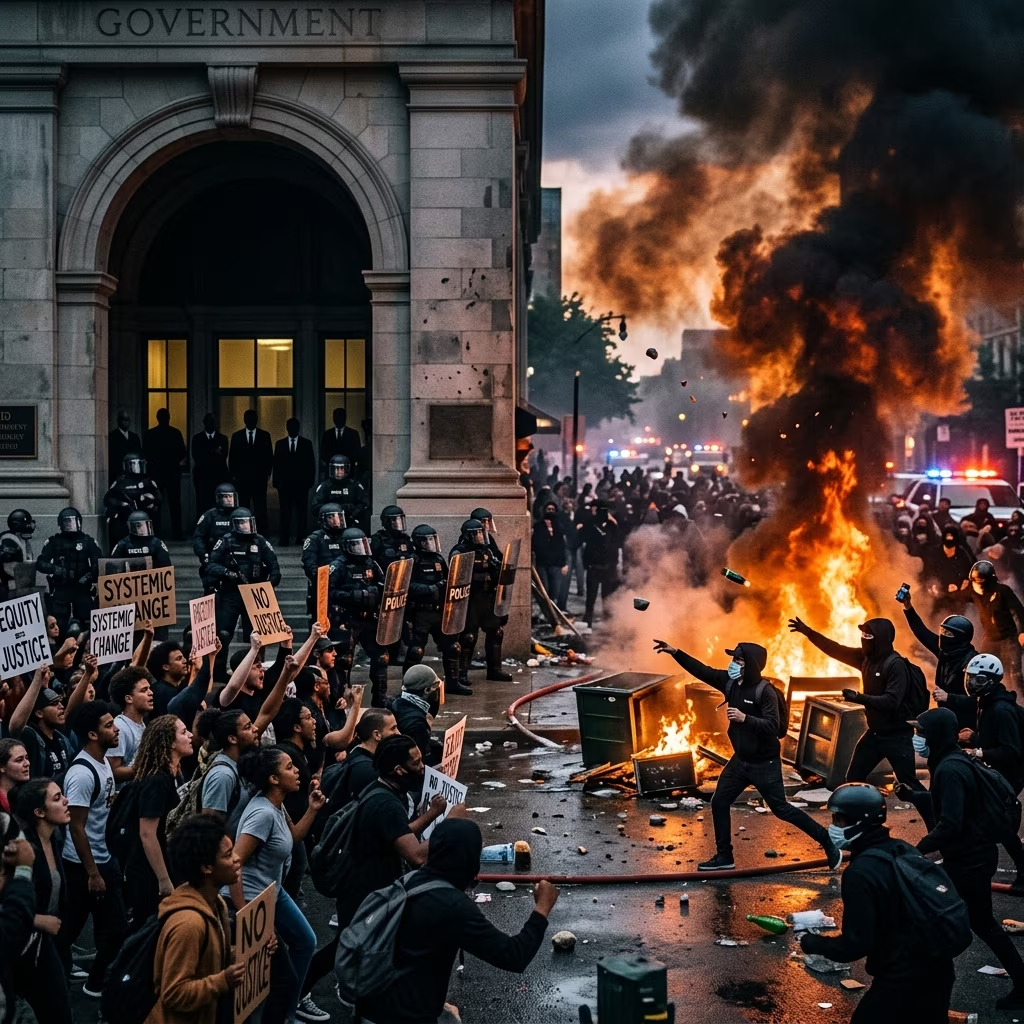
The right to peaceably assemble is a cornerstone of democratic societies, enshrined as a critical mechanism for citizens to voice grievances and advocate for systemic reform. However, the intersection of public demonstrations and law enforcement response often becomes a volatile nexus, particularly when deep systemic inequities are at play. The summer of 2020 served as a profound inflection point in the United States, highlighting the immense fractures between marginalized communities and the agencies tasked with protecting them. By analyzing critical case studies, particularly the widespread unrest following high-profile police use-of-force incidents, we can observe a troubling, repeated pattern: law enforcement tactics designed to maintain public order frequently achieve the exact opposite. The dynamics of escalation are multifaceted and deeply rooted in institutional culture. They involve the aggressive militarization of policing, the unequal enforcement of emergency decrees, the chilling of constitutionally protected rights, and the alarming, tacit tolerance of armed civilian vigilantes. Examining the failures of traditional crowd control is essential for driving comprehensive reform, protecting human lives, and preserving democratic expression.
The Catalyst of Civil Discontent: Unchecked Use of Force
Civil unrest rarely materializes out of thin air; it is typically the culmination of decades of systemic neglect and discriminatory practices. The immediate spark is often a visible, undeniable incident of law enforcement employing disproportionate or lethal force against marginalized individuals. When aggrieved citizens take to the streets to demand transparency and legal accountability, their assemblies are inherently expressions of collective trauma and political disenfranchisement.
Unfortunately, municipal authorities and police departments frequently respond to these outcries not with empathetic community engagement, but with defensive, adversarial posturing. The systemic failure to address the underlying root causes—such as persistent implicit bias, lack of internal accountability, and the disproportionate over-policing of minority neighborhoods—creates a highly combustible environment. Instead of facilitating peaceful expression, law enforcement often prioritizes rapid, overwhelming suppression. The U.S. Department of Justice has emphasized that the mishandling of public protests and incidents of officer misconduct not only lead to severe civil liability but fundamentally devastate public trust in local government. This foundational standard underscores that the social and financial costs of aggressive protest management are entirely unsustainable. By treating grieving communities as hostile combatants, agencies establish a self-fulfilling prophecy of conflict, paving the way for inevitable escalation.
Militarization and the Misuse of Less-Lethal Weapons
Perhaps the most visible and consequential contributor to the escalation of protest violence is the extensive militarization of the law enforcement response. The visual transformation of peace officers into an occupying force—complete with armored personnel carriers, camouflage riot gear, and heavy weaponry—fundamentally alters the psychology of a protest. This phenomenon is known sociologically as the “weapons effect.” The mere presence of highly aggressive visual stimuli increases the likelihood of hostile behavior from all parties involved, heightening anxiety and defensive aggression.
Furthermore, the operational reliance on “less-lethal” munitions—such as tear gas, rubber bullets, bean bag rounds, and flashbang grenades—frequently results in severe bodily harm and widespread chaos. The nomenclature of “less-lethal” is inherently misleading, as these tools have repeatedly caused permanent disabilities, loss of vision, and even death when deployed indiscriminately into dense crowds. The United Nations anti-torture mechanisms have issued explicit, dire warnings regarding the global misuse of these weapons. International human rights experts emphasize that heavy-handed protest policing violates the absolute prohibition against cruel, inhuman, or degrading treatment.
During acute periods of civil unrest, it has become alarmingly common for law enforcement agencies to deploy chemical irritants into peaceful assemblies long before valid dispersal orders are communicated, or without providing viable exit routes for the crowd. This tactic directly violates the core policing principles of proportionality and necessity. Instead of establishing order, it incites panic, leading to dangerous stampedes and immense collateral damage. Relying on these tactics demonstrates a systemic inability to manage crowds through de-escalation and crowd-psychology principles.
The Perils of Armed Vigilantism in Protest Zones
Adding an entirely new layer of extreme danger to modern protest environments is the rising phenomenon of armed vigilantism. During the 2020 unrest, the infiltration of heavily armed civilian militias into active protest zones became a national crisis. Coordinated largely through social media networks, these individuals often arrive under the self-appointed guise of protecting private property, businesses, or assisting overwhelmed law enforcement. However, interjecting untrained, unaccountable civilians carrying assault-style rifles into highly charged, chaotic demonstrations inevitably invites catastrophe.
Reports document that armed white men patrolling protest areas frequently organized their deployments on platforms like Facebook, viewing themselves as a necessary, militant bulwark against perceived anarchy. When law enforcement agencies tolerate, ignore, or actively fraternize with these armed factions, it establishes a deeply dangerous double standard. Widespread video evidence from various municipalities has shown uniformed officers offering water, gratitude, and tactical leeway to armed vigilantes, while simultaneously deploying violent riot-control tactics against unarmed racial justice advocates.
This disparate treatment sends a chilling, undeniable message to the public: the state apparatus is willing to protect and enable paramilitaries who align with the status quo, while aggressively suppressing citizens demanding civil rights. The tragic, foreseeable culmination of this dynamic is the loss of human life. When inexperienced individuals, operating outside of any legal chain of command or use-of-force continuum, clash with agitated protestors, the results are deadly. The failure of law enforcement to enforce the law uniformly, and their refusal to disarm or disperse unauthorized civilian militias, represents a catastrophic dereliction of duty that directly fuels the exact violence they are sworn to mitigate.
Disparate Enforcement and the Chilling of First Amendment Rights
The implementation of emergency curfews is a ubiquitous tactic utilized by city governments to quickly clear the streets and reestablish control. On paper, curfews are neutral administrative tools. In practice, however, their enforcement is rarely equitable. The selective enforcement of these curfew violations places a spotlight on the profound systemic biases operating within the criminal justice system.
While racial justice protestors are aggressively targeted, tackled, arrested, and subjected to prolonged detention, armed counter-protestors and militia members are frequently allowed to move freely through the streets long after curfew hours have passed. This unequal application of the law creates a severe chilling effect on First Amendment rights. Citizens become rightfully fearful of exercising their constitutional right to assembly, knowing they may face arbitrary militarized violence or selective prosecution. When a democratic state weaponizes public safety orders against specific ideological groups while turning a blind eye to vigilantism, it fundamentally destabilizes the rule of law and deepens the societal fissures that sparked the unrest.
Accountability and A Path Forward for Public Safety
To break this destructive cycle of violence and begin restoring fractured community trust, municipalities must commit to a radical reimagining of protest policing paradigms. This transformation must be anchored in strict, transparent accountability mechanisms for officers who violate constitutional rights. Eliminating or severely restricting qualified immunity—a legal doctrine that frequently shields law enforcement personnel from civil liability even when rights are violated—is a crucial first step.
Law enforcement agencies must immediately pivot away from militarization and invest their resources into rigorous de-escalation training, crowd psychology education, and continuous implicit bias mitigation. Policies governing the deployment of less-lethal weapons must be overhauled to align with stringent international human rights standards, strictly prohibiting their indiscriminate use against non-violent crowds. Furthermore, cities must establish clear, unyielding protocols for managing armed civilians. Anti-militia laws must be aggressively enforced, and any coordination between police and vigilante groups must be strictly criminalized. Ultimately, transitioning toward community-led public safety models, which empower civilian mediators and unarmed violence interrupters, offers a much more sustainable and humane alternative to traditional, force-centric policing.
Reforming Protest Policing Tactics
To understand the necessary shift in methodology, consider the following comparison between traditional, militarized responses and reformed, community-focused policing strategies:
| Traditional Militarized Policing | Reformed De-escalation Strategies |
|---|---|
| Deployment of armored vehicles and riot gear as an immediate first response to demonstrations. | Officers in standard uniforms focusing on transparent communication, visibility, and approachability. |
| Indiscriminate use of tear gas, rubber bullets, and flashbangs on dense crowds. | Strict prohibitions on wide-area chemical agents; utilizing targeted arrests only when absolutely necessary. |
| Tolerance, fraternization, or active encouragement of armed civilian militias in protest zones. | Strict enforcement of anti-militia laws, establishment of weapon-free zones, and immediate disarmament of vigilantes. |
| Selective enforcement of curfews intended to legally target and detain specific ideological protestors. | Equitable application of emergency laws; explicit protection exemptions for journalists and legal observers. |
Frequently Asked Questions (FAQs)
What is the “weapons effect” in the context of protest policing?
The weapons effect is a recognized psychological phenomenon where the mere presence of weapons or aggressive militarized gear (such as riot shields, assault rifles, and armored vehicles) inherently increases aggressive thoughts and behaviors in both law enforcement and the crowd. Rather than projecting safety, it escalates tensions and makes violent confrontations more likely.
Why are “less-lethal” weapons considered highly dangerous during protests?
While specifically designed not to be inherently fatal, weapons like tear gas, rubber bullets, and flashbang grenades can cause severe injuries, permanent disability, or death, especially when fired indiscriminately into dense crowds or at close range. They also induce immediate, widespread panic, which can lead to deadly stampedes and severe collateral damage to innocent bystanders.
How does the presence of armed vigilantes affect active civil unrest?
Armed vigilantes introduce lethal weapons into chaotic, highly emotional environments without the de-escalation training or legal accountability required of official peace officers. Their presence drastically increases the likelihood of fatal confrontations, emboldens aggressive counter-protesting, and often distracts law enforcement from safely and neutrally managing the broader demonstration.
What actionable steps can municipalities take to improve protest policing?
Municipalities can mandate strict de-escalation and crowd psychology training, drastically limit the deployment of militarized vehicles and gear, enforce completely equitable curfew applications, ban the use of indiscriminate chemical agents, and establish robust, independent civilian oversight boards to ensure strict accountability for any police misconduct.
References
- Protecting protests: UN anti-torture mechanisms call for responsible and accountable policing of assemblies — Office of the United Nations High Commissioner for Human Rights (OHCHR). 2023-06-26. https://www.ohchr.org/en/press-releases/2023/06/protecting-protests-un-anti-torture-mechanisms-call-responsible-and
- Risk Management in Law Enforcement: Discussions on Identifying and Mitigating Risk — U.S. Department of Justice, Office of Community Oriented Policing Services. 2016-10-05. https://cops.usdoj.gov/RIC/Publications/cops-w0830-pub.pdf
- Armed white men patrolling Kenosha protests organized on Facebook — The Guardian. 2020-08-27. https://www.theguardian.com/us-news/2020/aug/26/kenosha-militia-protest-shooting-facebook