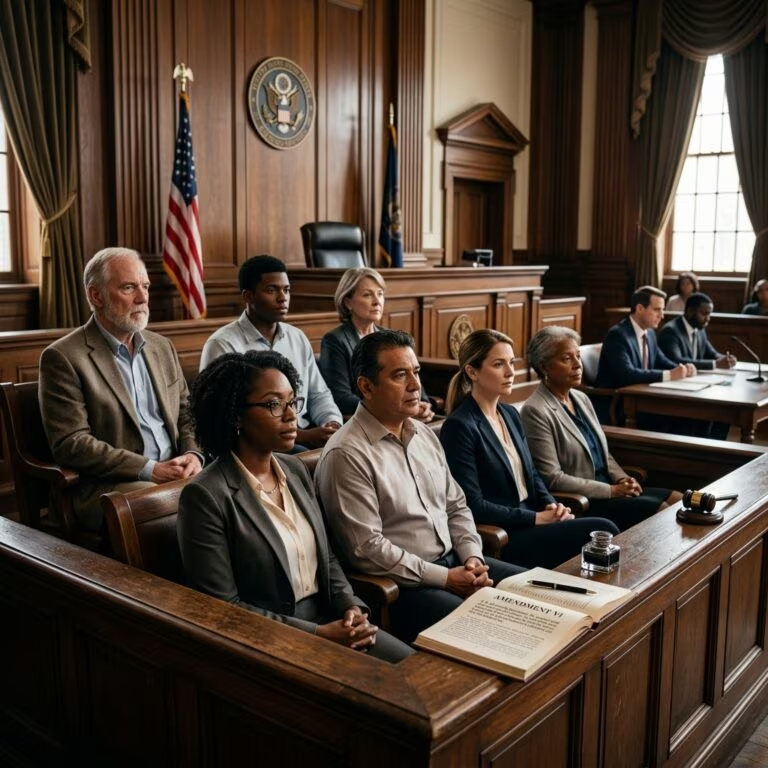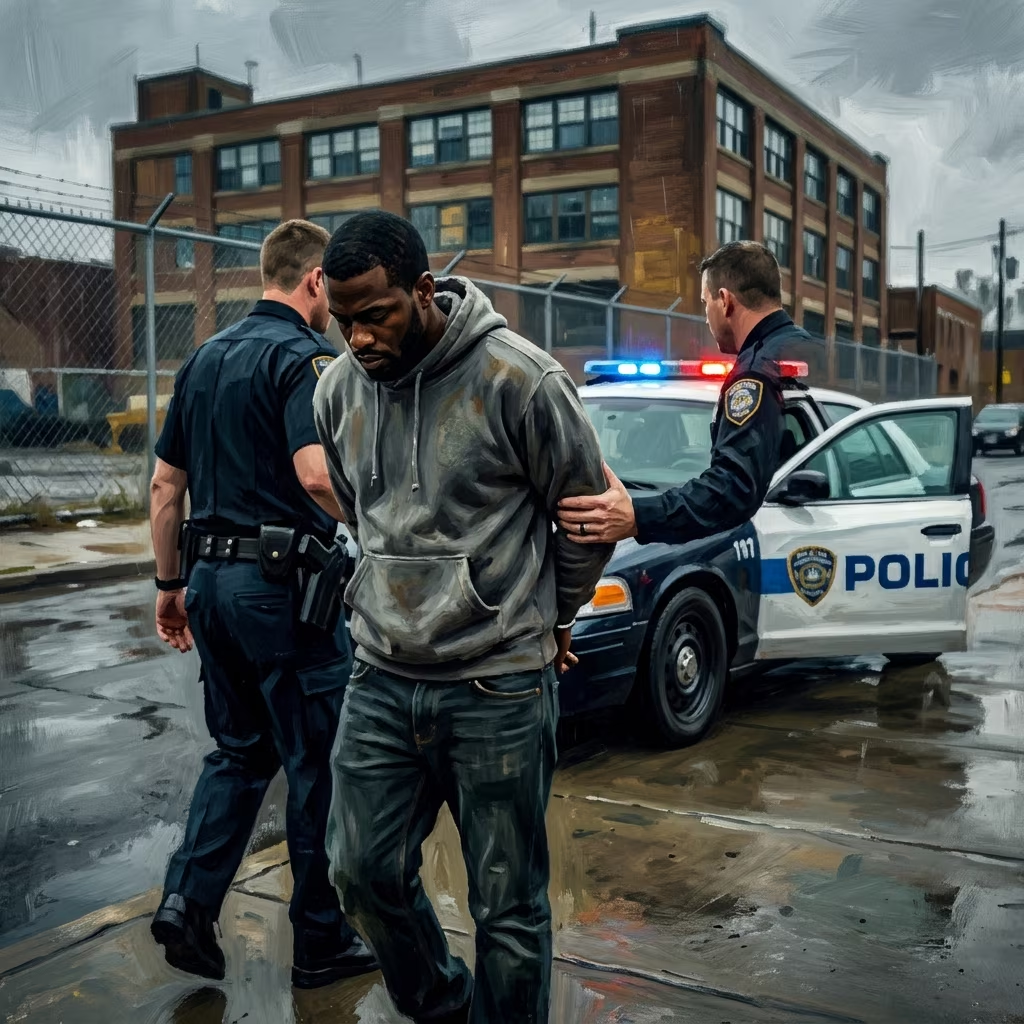
The concept of the “War on Drugs” has dominated American criminal justice and political rhetoric for several decades, dramatically shaping law enforcement priorities across the nation. Despite recent progressive policy shifts, evolving public attitudes toward illicit substances, and a growing emphasis on harm reduction, a deeply troubling constant remains firmly entrenched within the system: staggering racial disparities in drug arrests. While the legislative landscape transforms in many regions, the day-to-day enforcement reality for Black and Brown communities often mirrors the most stringent and punitive eras of past decades.
This deep-rooted issue is not merely a historical footnote or a relic of the 1980s and 1990s. Even in an era increasingly characterized by the decriminalization and outright legalization of substances like cannabis in various state jurisdictions, the scales of justice remain conspicuously unbalanced. The persistence of these unequal outcomes forces us to critically examine not just the laws themselves, but the foundational ways in which they are enforced. It requires a closer look at discretionary policing, neighborhood surveillance, and systemic biases that continue to funnel marginalized populations into the criminal justice system at alarmingly disproportionate rates.
A Historical Perspective on Narcotics Policing
To fully grasp the magnitude and persistence of unequal drug enforcement, one must look back at the historical framework that established modern policing practices. The aggressive law enforcement tactics born out of the late 20th-century drug war were not distributed evenly across the American landscape. Instead, they were disproportionately deployed in low-income, predominantly minority neighborhoods. Policymakers and police departments favored highly visible, aggressive street-level enforcement in these areas, arguing that such tactics were necessary to combat urban crime waves.
This spatial concentration of police resources meant that Black and Hispanic individuals were placed under constant, heavy surveillance. A teenager smoking cannabis in a heavily policed urban neighborhood was significantly more likely to be intercepted by a patrol officer than a peer engaging in the exact same behavior in a quieter, less-patrolled affluent suburb. Over time, these tactical decisions created a self-fulfilling statistical loop: because police looked for drugs primarily in minority communities, they found them there, which in turn justified further resource allocation to those same neighborhoods.
Furthermore, the establishment of mandatory minimum sentencing laws during this period exacerbated the impact of these arrests. Minor possession charges were suddenly carrying draconian penalties, locking a generation of young Black men behind bars for non-violent offenses. While many of these specific sentencing laws have since been challenged or repealed, the cultural policing habits and operational frameworks they helped build remain active today.
The Disconnect Between Usage and Enforcement Data
One of the most glaring contradictions in contemporary drug policy is the stark disconnect between those who consume illicit substances and those who are criminalized for it. A common misconception used to justify higher arrest rates in minority neighborhoods is the assumption that these communities use or sell illicit drugs at vastly higher rates. However, decades of public health data consistently debunk this narrative, revealing that drug consumption is a universal phenomenon spread relatively evenly across racial and ethnic lines.
According to comprehensive public health surveys, such as the National Survey on Drug Use and Health (NSDUH) conducted by the Substance Abuse and Mental Health Services Administration (SAMHSA), rates of illicit substance use do not drastically differ by race. In fact, for certain substances, white populations frequently report higher rates of lifetime or past-month use . For instance, survey data regularly demonstrates that white adults consume cannabis and misuse prescription narcotics at rates identical to or exceeding those of Black adults.
Despite these clear usage statistics, law enforcement data reveals a vastly different picture of consequence. Black individuals remain exponentially more likely to be arrested, charged, and convicted for drug-related offenses. This profound paradox highlights a fundamental, systemic flaw in the criminal justice apparatus: drug arrests are not a pure, objective metric of where crime is occurring. Rather, they are a reflection of where police officers are deployed, who they are instructed to scrutinize, and who they ultimately choose to arrest.
The Paradox of Cannabis Legalization
Over the past decade, a major shift in public opinion has led numerous states to decriminalize or fully legalize recreational cannabis. Advocates for criminal justice reform championed these legislative milestones not just as a victory for personal liberty, but as a critical mechanism to alleviate the disproportionate targeting of minority groups. The prevailing logic was straightforward: if the substance responsible for the vast majority of low-level drug arrests is no longer illegal, the associated racial disparities should theoretically vanish.
However, empirical research presents a much more complex and sobering reality. Studies tracking arrest data before and after legalization have found that while the overall volume of cannabis-related arrests drops significantly for everyone, the underlying racial disparities stubbornly persist. A comprehensive evaluation funded by the National Institute of Justice examined arrest trends following state-level cannabis legalization and concluded that substantial racial disparities remained intact, particularly concerning enforcement of remaining regulations, such as public consumption or possession over the legal limit .
In jurisdictions where cannabis was legalized, Black individuals still faced higher arrest rates for residual cannabis offenses and other drug infractions compared to their white counterparts. This finding is critical because it indicates that the root of the disparity lies not in the legal status of a specific plant, but in the ingrained, discretionary practices of law enforcement. Legalization acts as a volume dial, turning down the total number of arrests, but it fails to address the disproportionate targeting that defines the system.
Systemic Mechanisms Driving Unequal Arrests
If usage rates are comparable and sweeping legislative changes like legalization do not fully resolve the issue, what exactly is driving this enduring divide? The answer lies in the daily mechanics of discretionary policing and the systemic biases embedded within the justice system.
First is the widespread practice of targeted patrols and “hot-spot” policing. When law enforcement agencies concentrate their resources, patrol units, and specialized task forces in specific neighborhoods—almost exclusively low-income communities of color—the probability of detecting low-level drug offenses naturally skyrockets. This over-policing creates an environment where residents cannot escape scrutiny.
Second, the use of pretextual traffic stops plays a massive role in generating drug arrests. Officers frequently use minor civil infractions—such as a broken taillight, tinted windows, or an alleged improper lane change—as a legal pretext to pull a vehicle over and fish for contraband. Studies have repeatedly shown that Black and Hispanic drivers are subjected to vehicular searches at much higher rates than white drivers, despite being statistically less likely to be found carrying illicit drugs or weapons.
| Enforcement Strategy | Stated Objective | Community Impact & Disparity Result |
|---|---|---|
| Hot-Spot Policing | Reduce visible crime in historically high-incident areas. | Disproportionately targets minority neighborhoods, leading to higher arrest rates for minor, non-violent offenses due to hyper-surveillance. |
| Pretextual Traffic Stops | Uncover hidden contraband (drugs, unregistered weapons). | Increases friction and search rates for Black and Brown drivers, yielding a higher rate of minor drug arrests despite similar overall contraband hit rates. |
| Zero-Tolerance Enforcement | Deter drug use and local distribution through strict penalties. | Funnels non-violent offenders into the penal system, stripping communities of economic stability and reinforcing generational poverty. |
These discretionary decisions by individual officers, compounded over thousands of interactions daily, create a structural funnel that disproportionately channels minorities into the justice system. Implicit bias—unconscious associations that link certain racial groups to criminality—further exacerbates the likelihood that an officer will view a Black civilian with suspicion, leading to an escalation of the encounter.
The Devastating Ripple Effects of a Drug Conviction
When discussing drug arrest statistics in the abstract, it is easy to become detached from the severe human cost. However, the consequences of a drug arrest extend far beyond a night in a holding cell or a court-mandated fine. A drug conviction triggers a brutal cascade of collateral consequences that can permanently derail an individual’s life, perpetuating a relentless cycle of poverty and disenfranchisement.
Individuals burdened with a criminal record often face insurmountable barriers when attempting to reintegrate into society. Finding stable, gainful employment becomes exceptionally difficult, as many employers utilize background checks to automatically disqualify applicants with a history of drug offenses. Similarly, access to safe, affordable housing is severely restricted; private landlords routinely reject applicants with records, and federal guidelines allow public housing authorities to evict or bar individuals with drug convictions.
Furthermore, a drug conviction can result in the loss of federal financial aid for higher education, the suspension of driver’s licenses, and, in many states, the revocation of voting rights. These collateral consequences ensure that the punishment continues indefinitely, long after the formal sentence has been served. Because drug arrests are racially skewed, these lifelong economic and social penalties disproportionately impact Black and Brown communities, directly compounding generational wealth gaps and systemic inequality.
Charting a Path Toward Meaningful Reform
Dismantling these deeply entrenched disparities requires a fundamental reimagining of how society conceptualizes and addresses substance use. Altering the legal status of specific substances is a necessary step, but as data shows, it is insufficient on its own. True reform demands a paradigm shift from a punitive, criminal justice-centric approach to a comprehensive public health model.
This means actively reallocating public funding away from aggressive drug enforcement task forces and reinvesting those resources into community-based support structures. Expanding access to voluntary addiction treatment, mental health services, affordable housing, and economic development programs addresses the root causes of substance misuse without relying on handcuffs and jail cells. Treating drug use as a medical issue rather than a moral or legal failing is essential for creating equitable outcomes.
Additionally, state and local jurisdictions must implement stringent policies that enforce transparency and accountability in policing practices. This includes legally curtailing the use of pretextual traffic stops, ending quota-based policing metrics, and requiring detailed, public demographic reporting on all police stops and searches. Only through deliberate, comprehensive, and systemic change can society hope to sever the historical link between race and drug enforcement, ensuring that justice is truly blind.
Frequently Asked Questions (FAQs)
Why do drug arrest disparities exist if usage rates are similar across different races?
Disparities persist because arrest rates are driven by policing strategies rather than actual usage rates. Law enforcement agencies historically concentrate their patrols and surveillance in low-income, minority neighborhoods. Consequently, individuals in these communities are much more likely to be caught and arrested for minor drug offenses than individuals using drugs in less policed, wealthier, and predominantly white neighborhoods.
Has the legalization of marijuana solved the problem of unequal drug arrests?
No, it has not. While the legalization of recreational cannabis has led to a significant overall reduction in the total number of cannabis-related arrests, research demonstrates that racial disparities still remain. Black individuals continue to be arrested at disproportionately higher rates for remaining drug offenses, such as public consumption, carrying amounts over the legal limit, or possessing other illicit substances.
What does a “public health approach” to drug policy mean?
A public health approach treats drug use and addiction primarily as a medical and social issue rather than a criminal one. It focuses on harm reduction, offering support, medical treatment, counseling, and rehabilitation services instead of utilizing arrests, incarceration, and lifelong criminal records to address substance misuse.
How does implicit bias affect drug enforcement?
Implicit bias refers to the unconscious attitudes and stereotypes that affect human understanding, actions, and decisions. In law enforcement, implicit bias can cause officers to unconsciously associate Black and Brown individuals with criminality. This leads to higher rates of suspicion, more frequent stops, and a greater likelihood of officers initiating searches during routine encounters, which inevitably yields more drug arrests among minority populations.
References
- 2023 National Survey on Drug Use and Health (NSDUH) Releases — Substance Abuse and Mental Health Services Administration (SAMHSA). 2024-07-30. https://www.samhsa.gov/data/release/2023-national-survey-drug-use-and-health-nsduh-releases
- Racial Disparities in the Wake of Cannabis Legalization: Documenting Persistence and Change — National Institute of Justice. 2022-01-01. https://nij.ojp.gov/library/publications/racial-disparities-wake-cannabis-legalization-documenting-persistence-and