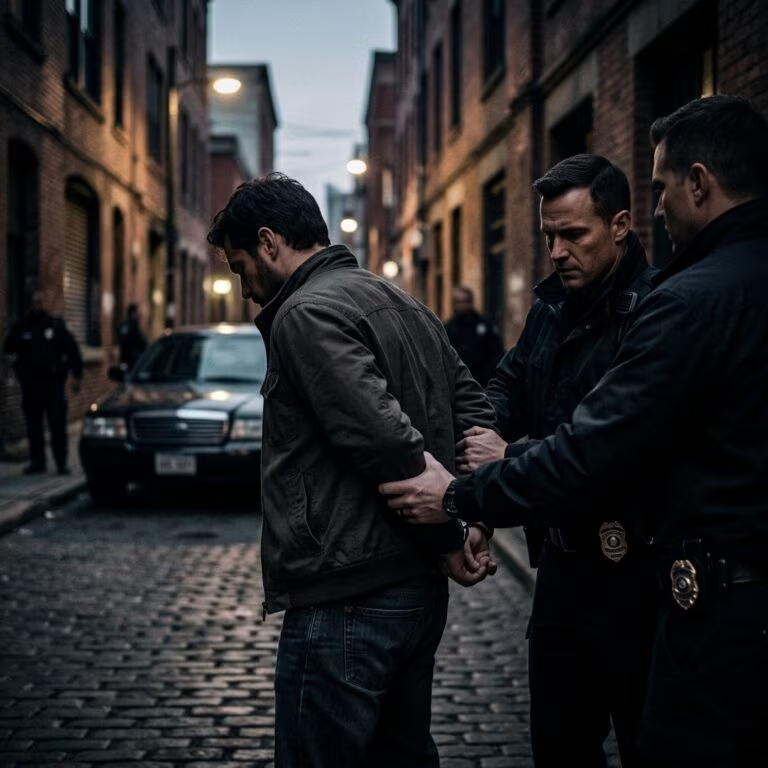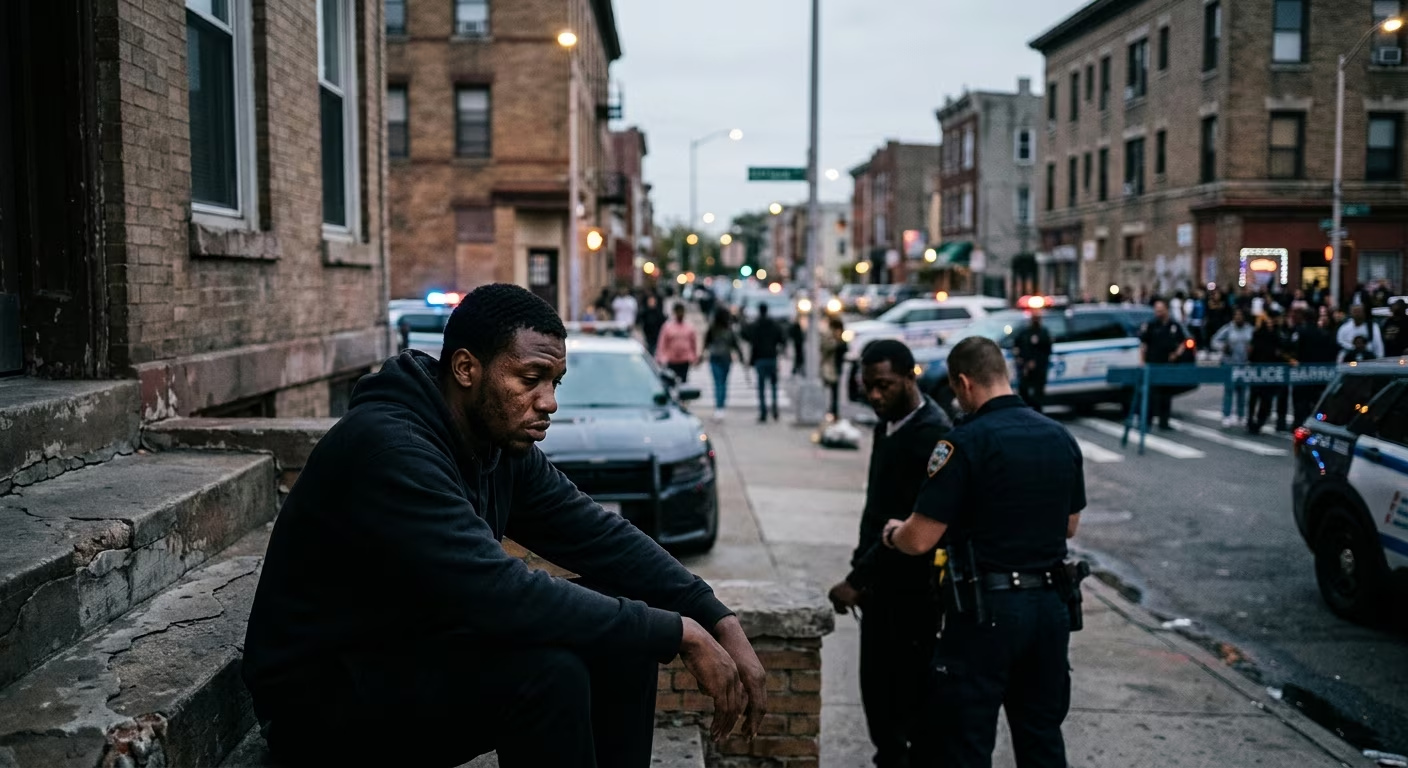
The guarantee of equal protection under the law serves as the philosophical and legal cornerstone of democratic jurisprudence in the United States. However, the pervasive and deeply entrenched practice of discriminatory policing—commonly referred to within public discourse as racial profiling—casts a long, dark shadow over this constitutional promise. Racial profiling occurs when law enforcement authorities utilize an individual’s race, ethnicity, religion, or national origin as a primary justification for suspecting them of criminal activity. Rather than relying on specific, actionable intelligence or individualized behavioral cues, biased policing leans heavily on unfounded societal stereotypes. This practice not only fundamentally violates the civil liberties of millions of Americans but also systematically fractures the delicate relationship between communities and the officers who are sworn to protect them.
Across national highways, suburban city sidewalks, border crossings, and public transit hubs, people of color are disproportionately subjected to unwarranted scrutiny, interrogations, and searches. The U.S. Department of Justice has historically acknowledged that ensuring enforcement operations are free from racial bias is essential to maintaining the moral authority and fundamental integrity of the criminal justice system . When individuals are judged, detained, or searched based solely on their appearance rather than their actions, the core tenets of fairness and justice are deeply compromised. In this comprehensive analysis, we will explore the underlying mechanisms of discriminatory policing, the profound toll it exacts on marginalized communities, the empirical evidence debunking its operational effectiveness, and the actionable structural reforms required to build a genuinely equitable legal system.
Decoding the Mechanisms of Bias in Law Enforcement
To fully grasp the widespread nature of racial profiling, one must critically examine the routine mechanisms and daily protocols through which law enforcement agencies operate. The most frequent interaction between civilians and the police in the United States takes place on the road. According to the Stanford Open Policing Project, which amassed and standardized over 200 million records of traffic stops across the nation, police officers pull over tens of millions of motorists every single year . These stops, ostensibly initiated for minor traffic infractions, frequently serve as legal pretexts for investigatory fishing expeditions.
Discretionary policing empowers individual officers to make highly subjective determinations about who looks “suspicious” or who seems “out of place” in a given neighborhood. This expansive subjectivity is precisely where implicit and explicit biases seamlessly integrate into law enforcement tactics. The mechanisms of systemic bias include, but are not necessarily limited to:
- Pretextual Traffic Stops: Officers frequently use minor, non-moving infractions—such as a broken taillight, slightly obscured license plates, or items hanging from a rearview mirror—as a legal justification to stop a driver. Once stopped, officers may use the opportunity to initiate a line of questioning or a vehicle search for contraband, disproportionately targeting drivers of color.
- Pedestrian Stop-and-Frisk Tactics: In densely populated urban environments, pedestrians belonging to minority groups are frequently detained and searched for weapons or narcotics based on vague, legally ambiguous suspicions rather than objective probable cause.
- Surveillance and Predictive Policing: Modern algorithmic tools and historical neighborhood deployment strategies often result in the heavy over-policing of predominantly Black and Hispanic neighborhoods. This heavy presence creates a self-fulfilling statistical prophecy: more police presence leads to higher arrest rates in these areas, which algorithms then use to justify even more surveillance.
Such disparities are not merely anecdotal; they are meticulously documented across varying jurisdictions. Researchers often employ the “veil of darkness” test, which demonstrates that racial disparities in traffic stops decrease after sunset, when it becomes significantly more difficult for officers to ascertain the race of a driver before initiating the stop . The systemic application of these subjective methods results in a stark, divided reality where the burden of routine law enforcement falls overwhelmingly on communities of color.
The Far-Reaching Impact on Targeted Communities
The societal consequences of bias-based policing extend far beyond the immediate inconvenience of a traffic stop, a citation, or a pat-down. For the individuals relentlessly targeted by these tactics, these encounters often constitute traumatic, humiliating, and physically dangerous experiences that accumulate over a lifetime, shaping their fundamental understanding of civic belonging.
The Erosion of Public Trust and Safety
When community members cannot trust local police departments to treat them with baseline dignity, respect, and fairness, public safety as a whole is severely undermined. Effective law enforcement inherently relies on the active cooperation of the community to report criminal activity, act as reliable witnesses, and assist in ongoing investigations. However, pervasive racial disparities in policing breed deep-seated resentment, anxiety, and fear . An individual or a family that has been repeatedly harassed, questioned without cause, or unlawfully detained is understandably hesitant to call the authorities during an actual emergency. This severe communication breakdown leaves vulnerable communities less protected and creates geographic environments where violent crime can flourish without adequate intervention. The debate regarding a “Guardian-versus-Warrior” mentality in policing is central here: when police are viewed by the community as a hostile occupying force rather than protective guardians, the foundational social contract completely dissolves.
Legal, Constitutional, and Human Rights Infringements
From a rigorous legal and constitutional standpoint, racial profiling strikes directly at the heart of the Fourth Amendment, which guarantees the right of the people to be secure against unreasonable searches and seizures. It also egregiously violates the Fourteenth Amendment’s Equal Protection Clause. Relying on an individual’s demographic profile to establish reasonable suspicion or probable cause is legally indefensible. The international community has also raised severe, formalized alarms regarding the American justice system. Independent rights experts appointed by the United Nations have explicitly stated that the United States must urgently eradicate systemic racism within its policing and criminal justice sectors . The UN mechanism noted that discriminatory policing in the U.S. represents a profound human rights crisis rooted in historical injustices, pointing directly to the vastly disproportionate rates at which Black Americans are searched, incarcerated, and subjected to lethal law enforcement force.
Evaluating the Fallacy of Predictive Prejudice
Proponents of aggressive, highly discretionary policing tactics have historically attempted to defend racial profiling by claiming it is an efficient, statistically justified method for seizing illegal weapons, narcotics, and apprehending fugitives. This argument posits that if specific demographic groups are statistically overrepresented in historical crime data, then profiling those groups is merely a pragmatic, necessary allocation of limited law enforcement resources. However, rigorous empirical analysis decisively dismantles this “predictive prejudice” and exposes it as a deeply flawed law enforcement strategy.
Comprehensive research examining the operational outcomes of police stops reveals that searches conducted on individuals of color are consistently less productive than searches conducted on white individuals. An empirical analysis of California’s largest law enforcement agencies highlighted that while Black and Hispanic civilians were stopped and searched at significantly higher rates, these specific searches yielded markedly less contraband or evidence of criminal activity compared to identical searches of their white counterparts . This undeniable statistical reality—frequently referred to in criminological research as the “hit rate” disparity—demonstrates that racial profiling is not only unconstitutional and morally reprehensible, but it is also objectively ineffective as a public safety tool.
When officers rely on racial proxies rather than genuine, individualized behavioral indicators, they cast far too wide a net. They waste valuable public tax dollars and administrative resources harassing innocent civilians while actual, sophisticated criminal behavior goes entirely undetected. By misallocating time, energy, and attention toward low-level, high-discretion stops heavily driven by implicit bias, law enforcement agencies actively detract from their ability to solve violent crimes, investigate complex offenses, and address genuine, localized threats to public safety.
Systemic Interventions: Charting a Path Forward
Eradicating the systemic burden of discriminatory policing requires far more than performative diversity training seminars, cosmetic policy tweaks, or vague commitments to community engagement. It demands sweeping structural, legislative, and cultural transformations within the very institutions of law enforcement.
Restructuring Policy and Establishing Accountability
First and foremost, police departments nationwide must severely curtail or completely eliminate high-discretion stops for minor equipment violations. Recent sociological studies clearly show that formally restricting officers from pulling over drivers for non-moving violations—such as tinted windows or expired registration tags—significantly reduces the racial disparities in traffic stops and substantially improves community perceptions of police fairness . Departmental policies should prioritize stops strictly for situations where there is a clear, imminent threat to public safety, such as reckless driving or driving under the influence, rather than utilizing obscure traffic codes as a convenient pretext for investigatory fishing expeditions. Furthermore, comprehensive bans on racial, religious, and ethnic profiling must be aggressively codified at the federal, state, and local levels. These legislative bans must be accompanied by strong private rights of action, effectively allowing victims of discrimination to sue for injunctive relief and damages without being universally blocked by the doctrine of qualified immunity.
Rigorous Data Collection and Algorithmic Oversight
Transparency is the mandatory precursor to institutional accountability. Law enforcement agencies must be federally mandated to collect, analyze, and publicly report detailed demographic data on all civilian encounters, encompassing stops, searches, arrests, and any uses of force. The U.S. Department of Justice has long emphasized the absolute necessity of robust data collection systems to properly assess the appropriate application of police discretion and authority . By regularly auditing this data, independent oversight boards can identify problematic officers or racially skewed departmental trends before they escalate into tragedies. Additionally, as modern police departments increasingly rely on facial recognition technology and predictive algorithms, stringent independent oversight must exist to audit these digital tools, ensuring they do not hardcode historical prejudices into the future of automated policing.
Frequently Asked Questions (FAQ)
What exactly constitutes racial profiling in law enforcement?
Racial profiling occurs when law enforcement officers use an individual’s race, ethnicity, national origin, or religion as a determining factor in deciding whom to stop, search, interrogate, or detain, rather than relying on specific, individualized evidence of criminal activity. It represents the improper substitution of broad demographic stereotypes for legitimate, legally sound probable cause or reasonable suspicion.
Why are routine traffic stops considered a major focal point of racial disparities?
Traffic stops represent the single most common form of interaction between everyday civilians and the police. Because state traffic codes are incredibly expansive and detailed, officers possess remarkably broad discretion to pull over almost any vehicle for minor infractions (e.g., a license plate light being burned out). This exceedingly wide discretion leaves ample room for implicit biases to dictate exactly who is stopped and who is subsequently subjected to a vehicle search .
Does racial profiling actually lower community crime rates?
No. Extensive empirical data and criminological studies indicate that searches based primarily on racial profiling consistently yield much lower rates of contraband discovery than searches based on genuine suspicious behavior . It is an inefficient, highly counterproductive tactic that wastes municipal resources and severely damages the essential foundation of trust between local communities and law enforcement agencies.
What legal protections currently exist against discriminatory policing practices?
The Fourth Amendment broadly protects citizens against unreasonable searches and seizures, while the Fourteenth Amendment’s Equal Protection Clause explicitly prohibits discrimination on the basis of race. However, overcoming the complex procedural legal hurdles to decisively prove systemic bias or individual intent in court remains exceptionally difficult. This operational difficulty is why civil rights advocates continuously push for comprehensive legislative reforms, the elimination of qualified immunity, and the establishment of independent civilian oversight boards.
References
- A Resource Guide on Racial Profiling Data Collection Systems — U.S. Department of Justice. 2000-11-01. https://www.ojp.gov/pdffiles1/bja/184768.pdf
- Findings — The Stanford Open Policing Project. 2024-01-01. https://openpolicing.stanford.edu/findings/
- Empirical Analysis of Racial Disparities in Policing — Santa Clara Law Digital Commons. 2022-01-01. https://digitalcommons.law.scu.edu/
- UN rights experts slam ‘systemic racism’ in US police and courts — UN News. 2023-09-28. https://news.un.org/en/story/2023/09/1141652
- Solving racial disparities in policing — Harvard Gazette. 2021-02-23. https://news.harvard.edu/gazette/story/2021/02/solving-racial-disparities-in-policing/
- Racial Disparities in the Discretionary Context of Traffic Stops — Stanford SPARQ. 2025-07-29. https://sparq.stanford.edu/