
Beyond the Ink: How Suspicionless Fingerprinting Threatens Constitutional Rights
Exploring the legal battles surrounding law enforcement's collection of biometric data during routine street stops.
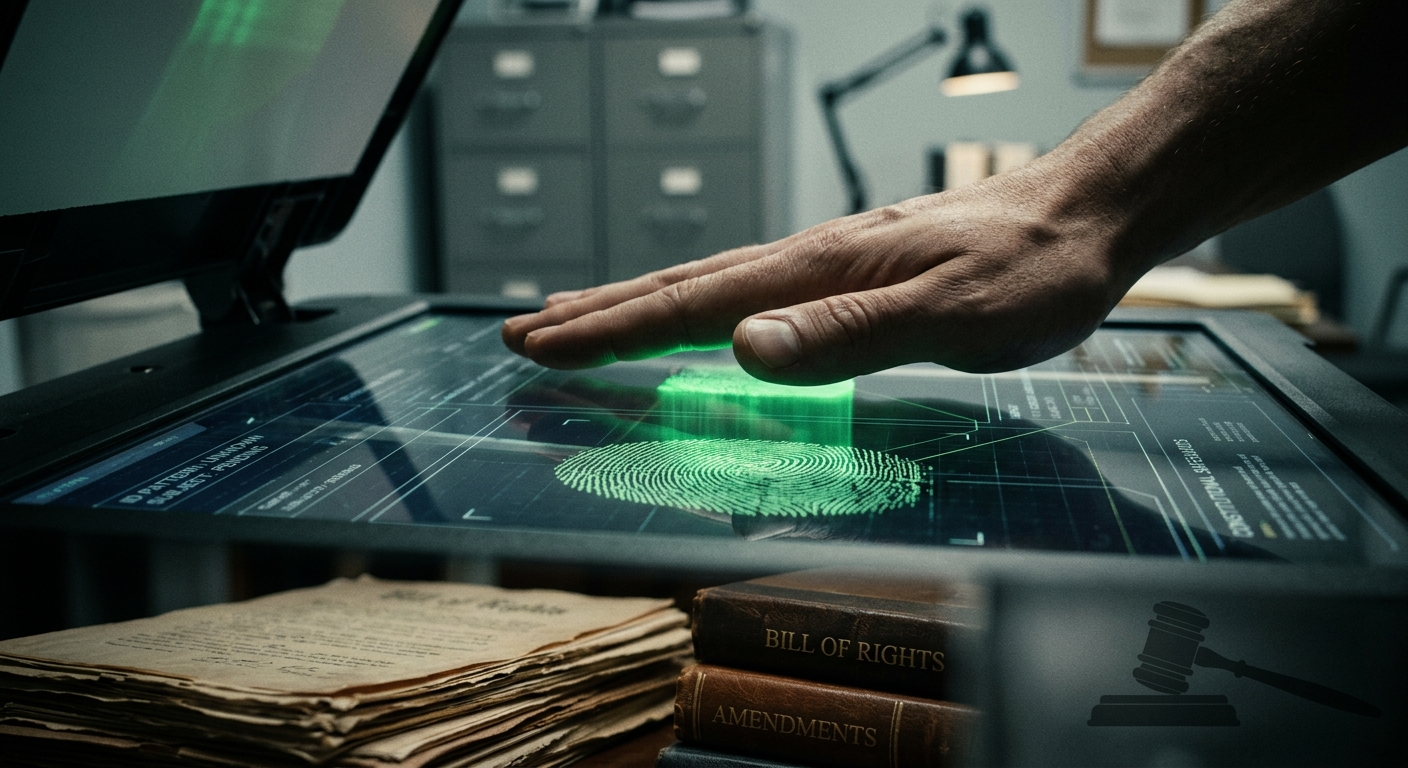
The Intersection of Biometrics, Law Enforcement, and Constitutional Rights
For decades, law enforcement officers have utilized field interrogations as a primary tool for investigating suspicious activities and maintaining public order. Traditionally, these encounters involved officers asking a few questions, requesting identification, and briefly assessing the situation before allowing the individual to go on their way. However, the rapid advancement of technology has fundamentally transformed the nature of these routine street stops. Today, a simple conversation on a sidewalk can quickly escalate into a comprehensive data collection event, where biological identifiers are harvested and permanently stored in government databases.
The introduction of mobile biometric technology, such as portable fingerprint scanners and facial recognition software, has empowered officers to collect highly sensitive personal data without ever transporting an individual to a police station. While proponents argue that these tools are essential for modernizing police work and rapidly identifying individuals who may have outstanding warrants, civil rights advocates warn of a mounting constitutional crisis. When police officers routinely extract biometric data from citizens who are merely going about their daily lives—without obtaining a warrant, securing informed consent, or establishing probable cause—they cross a dangerous legal threshold. The compulsory collection of fingerprints during suspicionless stops threatens to erode the fundamental privacy rights guaranteed to all citizens, reshaping the relationship between the state and the public.
Probable Cause vs. Reasonable Suspicion in Field Stops
To understand the legal friction surrounding roadside fingerprinting, it is necessary to examine the nuanced framework of the Fourth Amendment of the United States Constitution, which protects citizens against unreasonable searches and seizures. The legality of police interactions generally hinges on two distinct evidentiary standards: “reasonable suspicion” and “probable cause.”
Under the precedent established by the landmark Supreme Court case Terry v. Ohio (1968), police officers are permitted to conduct brief, investigatory stops—commonly known as Terry stops—if they have a reasonable, articulable suspicion that a person is involved in criminal activity. During a Terry stop, an officer may ask questions to dispel their suspicions and perform a limited pat-down of the suspect’s outer clothing to ensure they are not armed. However, reasonable suspicion is a relatively low legal bar. It relies on the officer’s immediate observations and inferences rather than concrete evidence of a crime.
In contrast, “probable cause” is a higher standard required to make an arrest, obtain a warrant, or conduct a full search of a person and their belongings. Probable cause requires a reasonable basis for believing that a crime may have been committed, or when evidence of the crime is present in the place to be searched.
The critical legal controversy arises when officers attempt to collect fingerprints during a standard Terry stop. The United States Supreme Court has historically signaled that fingerprinting is an intrusive procedure that requires more than mere suspicion. In the 1985 case Hayes v. Florida, the Supreme Court ruled that transporting a suspect to a police station for fingerprinting without probable cause, a warrant, or consent violates the Fourth Amendment. The ruling emphasized that investigative detentions must remain strictly limited in scope and duration. Forcing an unarrested individual to submit to biometric data collection fundamentally alters the nature of the stop, transforming a brief inquiry into a full-blown search and seizure without the requisite legal justification.
The Anatomy of a Suspicionless Biometric Dragnet
Despite historical Supreme Court rulings regarding station-house fingerprinting, the advent of mobile technology has enabled some local police departments to deploy biometric dragnets directly on the streets. In various municipalities across the nation, law enforcement agencies have instituted highly controversial policies that authorize officers to photograph and fingerprint individuals during routine field interrogations, even when those individuals are never charged with a crime.
These policies essentially function as a localized dragnet. Imagine a scenario where a young adult is walking home from a convenience store. An officer, acting on a vague description of a suspect in the area, initiates a Terry stop. Finding no weapons and making no arrest, the officer nonetheless demands that the young adult place their thumb on a mobile scanner and poses them for a photograph before letting them go.
This practice is often justified by police departments as an administrative measure to thoroughly document the encounter. However, civil liberties experts argue that this is a blatant circumvention of constitutional protections. By extracting biometric data on the spot, officers are treating ordinary, legally innocent citizens as active criminal suspects. A policy that allows for the systemic collection of fingerprints without probable cause strips away the presumption of innocence. It leverages the inherent power imbalance between an armed police officer and a civilian, creating an environment where “consent” to be fingerprinted is largely illusory. When an officer demands a fingerprint, few citizens feel they have the right—or the physical safety—to refuse compliance.
Turning Citizens into Perpetual Suspects
The constitutional violations of suspicionless fingerprinting do not end when the individual is released from the street stop. The most enduring harm stems from what happens to the biometric data after the encounter concludes. When a police department collects a fingerprint or a photograph during a field interrogation, that information is uploaded into comprehensive local, state, or federal law enforcement databases.
Unlike physical evidence tied to a specific closed case, biometric data is stored indefinitely. Innocent individuals who were merely stopped and released find their biological signatures permanently cataloged alongside convicted felons. This creates a phenomenon that privacy scholars refer to as the “perpetual lineup.”
In a traditional criminal investigation, a police lineup is a controlled procedure involving a specific group of individuals to identify a suspect for a specific crime. In the digital age, a perpetual lineup means that every time a new crime occurs and an unknown fingerprint or image is run through the system, the innocent citizen’s biometric data is automatically searched and evaluated by algorithms. They become a permanent, passive suspect in every future criminal investigation indefinitely.
This endless cycle of suspicion carries profound psychological and practical consequences. Algorithms and fingerprint analyses are not infallible; false matches occur, especially when dealing with partial prints recovered from crime scenes. By needlessly expanding biometric databases with the data of innocent people, law enforcement agencies exponentially increase the risk of wrongful arrests, algorithmic misidentification, and catastrophic disruptions to the lives of everyday citizens who have done nothing wrong.
Disproportionate Impact on Communities of Color
The constitutional and privacy concerns surrounding suspicionless biometric collection are deeply intertwined with systemic racial biases in policing. It is a well-documented reality that discretionary police stops are not distributed evenly across all demographics. Marginalized communities, particularly Black and Hispanic individuals, bear the brunt of aggressive field interrogation tactics.
Extensive research, such as the comprehensive data collected by the Stanford Open Policing Project, has consistently demonstrated significant racial disparities in law enforcement interactions. The project, which analyzed tens of millions of police stops across the United States, found that Black and Hispanic drivers are disproportionately stopped, searched, and subjected to force compared to their white counterparts, even after controlling for various contextual factors.
When a police department implements a policy of collecting fingerprints during Terry stops, these existing biases are codified into the biometric database. Because officers have wide discretion in determining who looks “suspicious” enough to be stopped and fingerprinted, the resulting database becomes a digitally distorted reflection of systemic racism. Minorities are vastly overrepresented in these perpetual lineups, meaning they are disproportionately subjected to ongoing, automated surveillance long after their initial, unjustified police encounter.
This compounding effect transforms a singular violation of constitutional rights into a multigenerational tool of racial profiling. It reinforces a policing paradigm where communities of color are persistently monitored, treated as inherently suspicious, and stripped of the anonymity and privacy that wealthier, whiter communities take for granted.
State Supreme Courts as Privacy Defenders
While the United States Supreme Court establishes the baseline for constitutional rights, state supreme courts frequently serve as the ultimate defenders of privacy, offering broader protections under their own state constitutions. As federal jurisprudence struggles to keep pace with the rapid evolution of digital and biometric surveillance, state courts have increasingly stepped in to dismantle unconstitutional policing policies.
A prominent example of this dynamic occurred in Michigan, where the state’s highest court confronted the legality of a local police department’s “photograph and print” policy. For years, officers in a major Michigan municipality routinely fingerprinted individuals during stops without establishing probable cause. In the landmark case Johnson v. VanderKooi, the Michigan Supreme Court unanimously ruled that this practice was unconstitutional.
The court definitively declared that taking a person’s fingerprints during a Terry stop without consent or a warrant constitutes an unreasonable search. The ruling emphasized a fundamental trespass theory of the Fourth Amendment: by physically intruding on a person’s body to extract biological information, the police executed a search that required the rigorous justification of probable cause.
Decisions like Johnson v. VanderKooi serve as critical legal milestones. They send a powerful message to law enforcement agencies nationwide that the convenience of modern technology cannot override fundamental civil liberties. By striking down suspicionless biometric dragnets, state courts are reinforcing the principle that the human body is constitutionally protected territory, immune from unwarranted governmental extraction regardless of the technological tools at an officer’s disposal.
Frequently Asked Questions (FAQs)
What constitutes an unreasonable search and seizure under the Fourth Amendment?
An unreasonable search and seizure occurs when law enforcement inspects or confiscates a person’s property, or intrudes upon their physical body, without adequate legal justification, such as a valid warrant issued by a judge or “probable cause” to believe a crime has been committed. The Fourth Amendment protects individuals’ reasonable expectations of privacy from government overreach.
Can law enforcement collect my fingerprints without arresting me?
Generally, no. The U.S. Supreme Court and various state supreme courts have established that compelling an individual to provide fingerprints without their voluntary consent or without probable cause violates constitutional protections. Routine street stops based merely on “reasonable suspicion” do not authorize officers to forcibly extract your biometric data.
What is the difference between reasonable suspicion and probable cause?
“Reasonable suspicion” is a lower legal standard that allows police to briefly stop and question an individual (a Terry stop) if they have a justifiable reason to believe criminal activity is afoot. “Probable cause” is a much stricter standard, requiring concrete facts and evidence that would lead a reasonable person to believe a specific crime has been or is being committed, which is required for making arrests and conducting full searches.
What is the “perpetual lineup” effect?
The “perpetual lineup” refers to the practice of storing the biometric data (like fingerprints and photos) of innocent, uncharged individuals in law enforcement databases permanently. This means their data is continuously and automatically cross-referenced against evidence in all future criminal investigations, effectively treating them as permanent, passive suspects without their consent.
How do biometric police stops affect minority communities?
Because discretionary police stops historically and statistically disproportionately target Black, Hispanic, and other minority communities, policies that allow for suspicionless biometric data collection result in these same communities being vastly overrepresented in police databases. This exacerbates systemic bias and increases the likelihood of false algorithmic matches and wrongful arrests within these marginalized populations.
References
- Hayes v. Florida | 470 U.S. 811 (1985) — Justia Supreme Court Center. 1985-03-20. https://supreme.justia.com/cases/federal/us/470/811/
- Findings – The Stanford Open Policing Project — Stanford University. 2020. https://openpolicing.stanford.edu/findings/
- MSC 160958 DENISHIO JOHNSON V CURTIS VANDERKOOI Opinion — Michigan Courts. 2022-07-22. https://www.courts.michigan.gov/
Similar Articles








Read full bio of medha deb


