
Susan B. Anthony’s Defiant Stand for Women’s Suffrage
Discover Susan B. Anthony's bold speech and trial that challenged voting laws and ignited the women's suffrage movement.
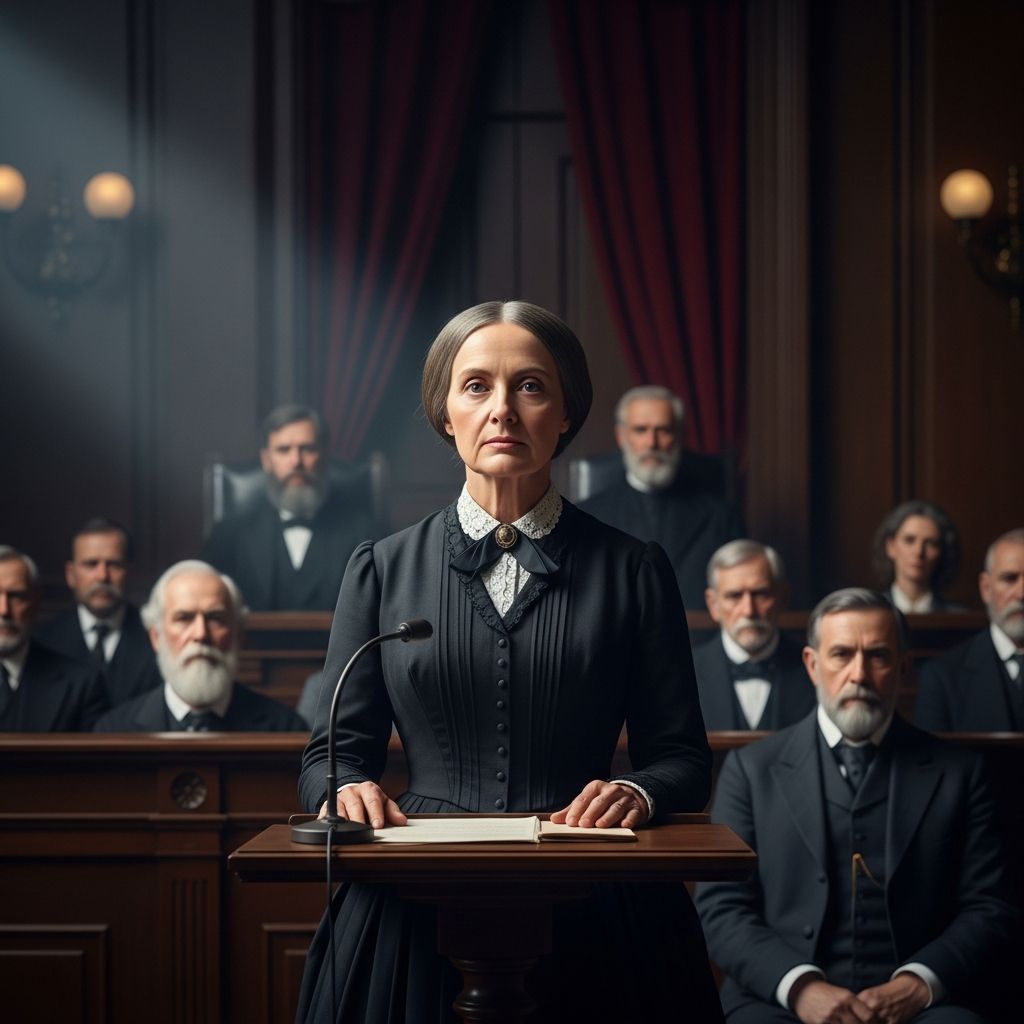
Susan B. Anthony’s act of voting in the 1872 presidential election and her subsequent speech titled “Is It a Crime for a U.S. Citizen to Vote?” marked a turning point in the struggle for women’s voting rights in America. Facing indictment, she boldly asserted her constitutional privileges as a citizen, sparking nationwide debate on gender equality in democracy.
The Audacious Act That Shook the Nation
In November 1872, Susan B. Anthony, a prominent abolitionist and women’s rights advocate, cast a ballot in Rochester, New York, during the presidential election pitting Ulysses S. Grant against Horace Greeley. At 52 years old, she knowingly defied state laws restricting suffrage to men, registering four women to vote alongside herself. This deliberate civil disobedience stemmed from her conviction that the U.S. Constitution granted all citizens—regardless of sex—the right to participate in elections.
Anthony’s motivation was rooted in years of activism. Having co-founded the National Woman Suffrage Association (NWSA) with Elizabeth Cady Stanton in 1869, she viewed voting as essential to citizenship. The post-Civil War Reconstruction Amendments, particularly the 14th and 15th, fueled her argument that women, as citizens, deserved equal electoral access. Her arrest shortly after voting thrust her into the spotlight, transforming a local infraction into a national symbol of resistance.
Unpacking the Core of Her Revolutionary Speech
Delivered in January 1873 across Monroe County, New York, Anthony’s speech was a meticulously crafted legal and philosophical defense. She began by framing her indictment not as criminality but as the rightful exercise of citizen duties. “I stand before you to-night, under indictment for the alleged crime of having voted… It shall be my work this evening to prove… that in thus voting, I not only committed no crime, but… simply exercised my citizen’s right,” she proclaimed.
Anthony dissected foundational documents to bolster her case. She invoked the Declaration of Independence’s assertion of “unalienable rights” to life, liberty, and the pursuit of happiness, extending “all men” to encompass women. The phrase “consent of the governed” implied universal suffrage, as taxation without representation—echoing colonial grievances—denied women self-governance.
- Declaration of Independence: Anthony highlighted its inclusive language, arguing it pronounced the right of “all men, and consequently… all women” to a voice in government.
- Constitution’s Preamble: “We the People” signified collective sovereignty, excluding no gender from participatory rights.
- Privileges and Immunities Clause (14th Amendment): This protected citizens’ rights against state infringement, positioning voting as a core privilege.
She critiqued state constitutions, like New York’s, for imposing sex-based disqualifications unsupported by federal law. Anthony contended that no constitutional provision authorized states to disenfranchise half their population.
Constitutional Pillars of Anthony’s Argument
Anthony’s rhetoric pivoted to the Reconstruction Amendments, interpreting them as expansive shields for suffrage. The 14th Amendment’s citizenship clause declared, “All persons born or naturalized in the United States… are citizens,” granting women equal status. Its Privileges or Immunities Clause forbade states from abridging these rights, which Anthony equated with voting.
The 15th Amendment, prohibiting denial of voting rights based on “race, color, or previous condition of servitude,” was a double-edged sword. Critics used it to exclude sex; Anthony countered that women fit “previous condition of servitude” due to historical legal subjugation—married women lost property rights, echoing slavery’s denial of autonomy.
| Amendment | Key Text | Anthony’s Interpretation |
|---|---|---|
| 14th | “No State shall make or enforce any law which shall abridge the privileges or immunities of citizens” | Voting is a fundamental privilege states cannot deny based on sex. |
| 15th | “The right… shall not be denied… on account of race, color, or previous condition of servitude” | Women’s societal bondage qualifies as servitude; amendment implies broader protections. |
| Article IV, Section 2 | “The Citizens of each State shall be entitled to all Privileges and Immunities of Citizens in the several States” | Uniform national citizenship rights override state gender restrictions. |
She lambasted enforcement laws like the 1870 statute, noting their masculine pronouns (“his”) betrayed intent to target ex-Confederates, not women. This linguistic loophole underscored discriminatory application.
The High-Stakes Trial: Justice on Trial
Anthony’s trial commenced in June 1873 in federal court in Canandaigua, New York, before Justice Ward Hunt. Refusing to plead, she conducted her own defense, reiterating speech arguments. Her attorney, Henry Selden, posited voting as inherent to citizenship, unaltered by Reconstruction Amendments.
Prosecutors argued state law defined voters as males, and Anthony’s awareness constituted “knowing” violation. Hunt, presiding without a jury in a bench trial, rejected good-faith defenses, directing a guilty verdict. Fined $100—unpaid—Anthony declared, “I shall never pay a dollar of your unjust penalty.” The decision affirmed state suffrage control, dismissing federal overrides.
Critical Moments in the Proceedings
- Anthony’s self-defense: Turned courtroom into suffrage platform.
- Selden’s appeal: Voting essential to citizenship, lacking corrupt intent.
- Hunt’s ruling: 14th Amendment irrelevant; states set qualifications.
- No imprisonment: Fine only, symbolizing partial victory.
Wider Ripples: From Courtroom to Constitutional Change
The trial garnered massive publicity, with Anthony touring to deliver her speech 75 times. It exposed suffrage inconsistencies, pressuring lawmakers. Though immediate winless, it galvanized NWSA, contributing to Wyoming’s 1869 female enfranchisement and western territories’ reforms.
Anthony’s efforts culminated in the 19th Amendment (1920), affirming women’s vote. Her strategy—civil disobedience plus constitutionalism—influenced figures like Alice Paul. Modern scholars credit her with framing suffrage as citizenship right, not gift.
Critiques and Contemporary Perspectives
Anthony faced racism charges for prioritizing suffrage over Black male voting post-15th Amendment split with Frederick Douglass. Yet, her intersectional alliances persisted. Today, her legacy endures in debates on voting access, echoing barriers for marginalized groups.
Legal scholars revisit Hunt’s bias—his pre-trial opinion doomed fairness. The case highlighted federalism tensions: states’ rights versus national citizenship.
Frequently Asked Questions
Why did Susan B. Anthony vote illegally?
She believed the 14th Amendment’s citizenship clause guaranteed women voting rights, overriding state male-only laws.
What was the outcome of her trial?
Convicted and fined $100, which she refused to pay; no jail time followed.
How did her speech influence the suffrage movement?
It popularized constitutional arguments, mobilizing support and leading to the 19th Amendment.
Did Anthony support Black suffrage?
Initially yes, but prioritized women’s rights, causing tensions with allies like Douglass.
Is Anthony’s argument valid today?
It shaped modern equal protection jurisprudence, informing Voting Rights Act cases.
Legacy in Modern Democracy
Anthony’s defiance underscores democracy’s evolution. Her speech, preserved in archives, inspires activists combating disenfranchisement. Statues and currency honors affirm her role, yet challenges persist—voter suppression echoes 19th-century exclusions.
Reflecting on her words: Democratic government rests on every member’s voice. Anthony’s stand ensures that principle’s expansion.
References
- Anthony, “Is It a Crime…,” Textual Authentication — Voices of Democracy, University of Maryland. 2023. https://voicesofdemocracy.umd.edu/anthony-is-it-a-crime-textual-authentication/
- Susan B. Anthony: Women’s Right to Vote — National Archives (prologue.blogs.archives.gov). 2019-11-05. https://prologue.blogs.archives.gov/2019/11/05/susan-b-anthony-womens-right-to-vote/
- Susan B. Anthony Speech: Is it a Crime for a Citizen — University of Missouri-Kansas City School of Law. N/A. http://law2.umkc.edu/faculty/projects/ftrials/anthony/anthonyaddress.html
- The Trial of Susan B. Anthony — Federal Judicial Center. N/A. https://www.fjc.gov/sites/default/files/trials/susanbanthony.pdf
- Susan B. Anthony – Gifts of Speech — Gifts of Speech, Sweet Briar College. N/A. http://gos.sbc.edu/a/anthony.html
- IS IT A CRIME FOR A U.S. CITIZEN TO VOTE? — Teaching American History. N/A. https://teachingamericanhistory.org/document/is-it-a-crime-for-a-u-s-citizen-to-vote/
Similar Articles








Read full bio of Sneha Tete


