
The Supreme Court and the Future of American Voting Rights
How recent Supreme Court rulings shape US election integrity and voting rights.
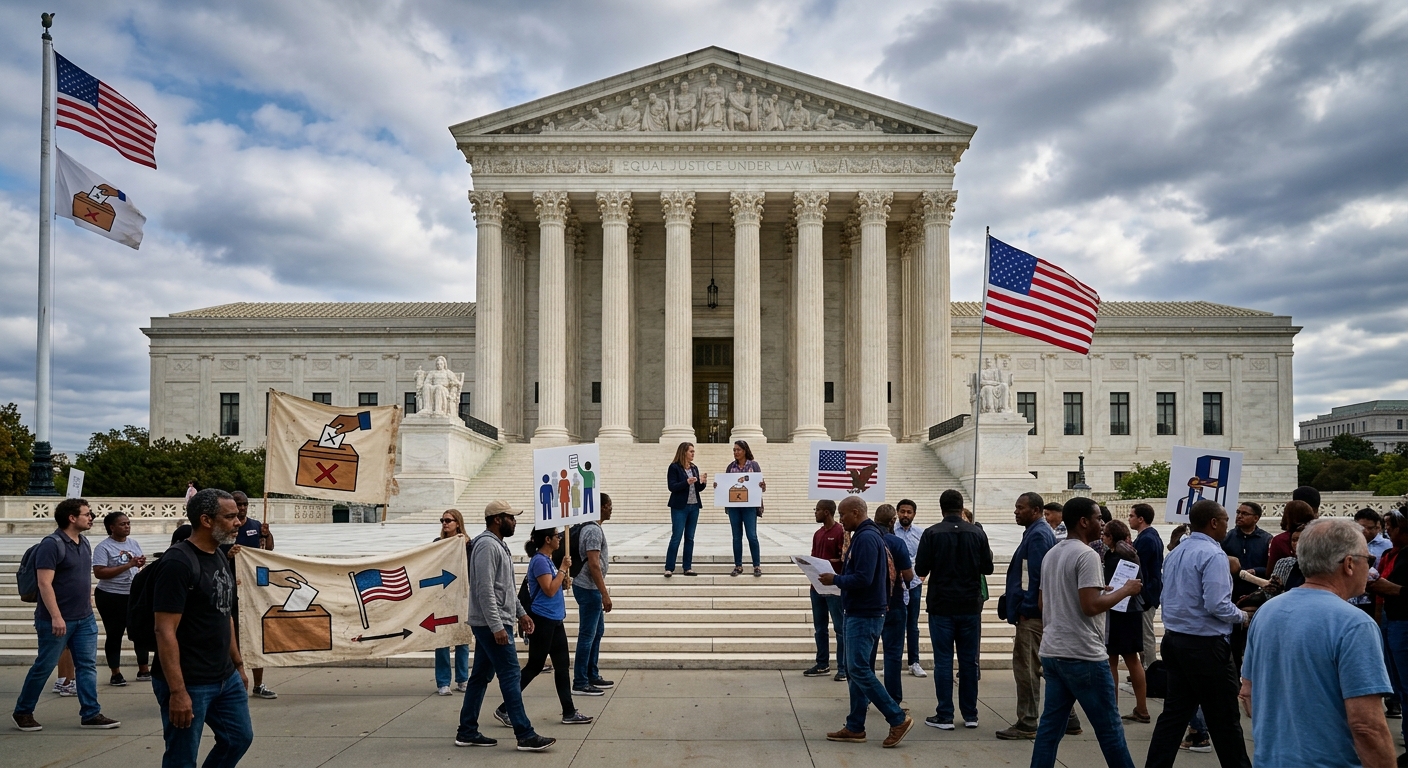
The Judicial Battlefield: How the Supreme Court Dictates Election Integrity
In the modern era of American jurisprudence, the United States Supreme Court has emerged as the ultimate arbiter of election law and democratic integrity. The foundation of the American electoral system rests upon the guarantee that every eligible citizen possesses an equal and unhindered right to cast a ballot. However, the translation of this democratic ideal into practical application is frequently contested in federal courtrooms. Over the past decade, civil rights organizations, state legislatures, and political operatives have engaged in intense legal battles to define the boundaries of voter access, redistricting protocols, and legislative authority.
At the center of these disputes is the delicate balance between state sovereignty and federal oversight. The Constitution grants states significant leeway in managing their elections, yet federal statutes and constitutional amendments serve as critical guardrails against discriminatory practices. When state legislatures pass sweeping election overhauls or draw highly partisan congressional maps, the legality of these actions inevitably spirals upward through the federal appellate system, culminating in profound, precedent-setting decisions by the nine justices of the Supreme Court. Understanding these legal frameworks is essential for comprehending how modern political power is distributed and maintained.
The Erosion and Defense of the Voting Rights Act
To grasp the significance of contemporary legal battles, one must first look at the historical context of the Voting Rights Act of 1965 (VRA). Enacted to enforce the Fifteenth Amendment, the VRA historically mandated that jurisdictions with documented histories of racial discrimination seek federal “preclearance” before altering their election laws. This preventative measure, housed in Section 5 of the VRA, was functionally dismantled by the Supreme Court’s 2013 ruling in Shelby County v. Holder. The Court concluded that the coverage formula determining which states were subject to preclearance was unconstitutional and outdated .
With preclearance eliminated, the burden shifted entirely to Section 2 of the VRA, which allows plaintiffs to sue states after discriminatory laws or maps have been implemented. The reliance on Section 2 has transformed the legal landscape, forcing civil rights advocates to engage in costly, retroactive litigation. Consequently, recent Supreme Court terms have been closely watched by legal scholars and voters alike, as the Court’s interpretation of Section 2 effectively dictates the survival of federal protections against racial gerrymandering and vote dilution.
Redistricting and Racial Gerrymandering: The Legal Precedents
One of the most consequential issues routinely brought before the Supreme Court is the practice of redistricting. Following the decennial census, state legislatures are tasked with redrawing congressional and state legislative districts to reflect population changes. However, this process is frequently manipulated to secure political dominance—a tactic known as gerrymandering. While partisan gerrymandering (drawing maps to favor a specific political party) was deemed beyond the reach of federal courts in Rucho v. Common Cause (2019), racial gerrymandering remains strictly prohibited under the Constitution and the Voting Rights Act.
Racial gerrymandering typically occurs through two distinct mechanisms: “packing” and “cracking.” Packing involves concentrating minority voters into a single district to minimize their influence in surrounding areas. Cracking, conversely, splinters minority populations across multiple districts, ensuring they never constitute a majority capable of electing their preferred candidates. Identifying and dismantling these tactics is a mathematically and legally complex endeavor, heavily reliant on established legal precedents that the Supreme Court constantly refines.
Understanding Section 2 and the Gingles Preconditions
When assessing claims of minority vote dilution under Section 2 of the VRA, federal courts rely on a legal framework established in the 1986 Supreme Court case Thornburg v. Gingles. To successfully challenge a redistricting map, plaintiffs must satisfy three stringent preconditions . First, they must demonstrate that the minority group in question is sufficiently large and geographically compact to constitute a majority in a reasonably drawn district. Second, the minority group must be shown to be politically cohesive, generally voting for the same candidates. Third, plaintiffs must prove that the majority demographic votes as a bloc to consistently defeat the minority’s preferred candidates.
If these three preconditions are met, the court then looks at the “totality of the circumstances” to determine whether the political process is equally open to minority voters. In recent years, conservative lawmakers have urged the Supreme Court to narrow the application of the Gingles test, arguing that it places an undue emphasis on race in the redistricting process. The survival of this standard is absolutely paramount to the enforcement of the Voting Rights Act in the twenty-first century.
The Ruling That Defied Expectations
The fragility of Section 2 protections was put to the ultimate test during the Supreme Court’s 2022-2023 term in the landmark case of Allen v. Milligan . The dispute originated in Alabama, where the Republican-controlled legislature drew a congressional map featuring only one majority-Black district out of seven, despite Black residents making up more than a quarter of the state’s population. Civil rights groups sued, arguing that the map illegally diluted Black voting power and that a second majority-Black district could be reasonably configured.
A lower federal court agreed with the plaintiffs, ordering Alabama to redraw the map. The state aggressively appealed to the Supreme Court, urging the justices to adopt a “race-neutral” approach to redistricting that would effectively gut the Gingles framework and render Section 2 virtually unenforceable in gerrymandering cases. Given the Court’s conservative supermajority and its history of skepticism toward race-conscious remedies, many legal analysts predicted the imminent demise of Section 2.
However, in a surprising 5-4 decision authored by Chief Justice John Roberts, the Supreme Court upheld the lower court’s ruling and reaffirmed the traditional Gingles test . The Court meticulously detailed how Alabama’s map violated the VRA, reinforcing the statutory requirement that states cannot draw districts that minimize the electoral power of minority communities. This ruling sent immediate shockwaves through the political landscape, triggering the redrawing of discriminatory maps not just in Alabama, but in surrounding states facing similar litigation, thereby reshaping the congressional battlefield.
The Independent State Legislature Theory: A Constitutional Close Call
While Section 2 of the Voting Rights Act addresses the protection of minority voters, another existential threat to democratic norms emerged in the form of the “Independent State Legislature” (ISL) theory. This fringe legal doctrine surfaced prominently in the Supreme Court case Moore v. Harper , threatening to radically alter the system of checks and balances governing federal elections.
The ISL theory centers on a hyper-literal interpretation of the Elections Clause in Article I of the U.S. Constitution, which states that the “Times, Places and Manner of holding Elections for Senators and Representatives, shall be prescribed in each State by the Legislature thereof.” Proponents of the maximalist ISL theory argued that the word “Legislature” meant only the state legislature, acting completely independent of state constitutions, state supreme courts, or gubernatorial vetoes.
Implications for Checks and Balances in State Governments
Had the Supreme Court fully embraced the ISL theory, the consequences for election administration would have been catastrophic. State legislatures would have been granted unchecked authority to draw excessively gerrymandered congressional maps, implement severe voter identification laws, and dictate election procedures without any oversight from state judicial branches. Even if a state legislature passed an election law that blatantly violated its own state constitution, state courts would have been powerless to strike it down.
The case originated in North Carolina, where the state supreme court struck down a heavily gerrymandered congressional map for violating the free and fair election clause of the state constitution. The state’s legislative leaders appealed to the U.S. Supreme Court, asserting the ISL theory to bypass the state court’s ruling. In a decisive 6-3 ruling, the Supreme Court rejected the maximalist ISL theory . The majority opinion clarified that while state legislatures possess the primary authority to set federal election rules, they remain bound by the ordinary constraints of their state constitutions and are subject to judicial review by state courts. This decision preserved a crucial layer of accountability, ensuring that state-level politicians cannot operate above the law when managing federal elections.
The Ripple Effect: How Judicial Rulings Alter the Electoral Landscape
The jurisprudence emerging from the Supreme Court does not exist in a vacuum; it dictates the immediate operational realities of state legislatures, advocacy groups, and millions of voters. When the Court issues a ruling affirming civil rights protections, such as in Allen v. Milligan, it empowers lower courts across the nation to aggressively strike down similar violations. It forces state legislatures to act with greater caution during the redistricting process, knowing that federal oversight remains a viable threat to discriminatory maps.
Conversely, when the Court scales back protections—as it has done with other provisions of the VRA—it signals a green light to partisan operatives seeking to exploit legal ambiguities. This dynamic creates a highly volatile electoral landscape where voting rights are not universally static but are instead geographically dependent on the latest federal court injunctions. Consequently, voter advocacy organizations must continuously pivot their strategies, investing massive resources into complex litigation, grassroots voter education, and monitoring legislative sessions to preemptively counter disenfranchisement efforts.
As the nation looks toward future election cycles, the legal frameworks established by these recent Supreme Court terms will serve as the battleground for dozens of localized disputes. From mail-in ballot deadlines and drop-box accessibility to voter registration purges and district boundaries, the boundaries of democracy will continue to be litigated in the shadow of the High Court’s precedents.
Frequently Asked Questions (FAQs)
- What is the Voting Rights Act of 1965?
The Voting Rights Act (VRA) is a landmark piece of federal legislation enacted to enforce the Fifteenth Amendment of the U.S. Constitution. It prohibits racial discrimination in voting practices, outlawing historical barriers such as literacy tests, and provides legal mechanisms for citizens to challenge discriminatory election laws and redistricting maps in federal court. - What is the difference between Section 2 and Section 5 of the VRA?
Section 5 required jurisdictions with a history of discrimination to obtain federal “preclearance” before making any changes to their election laws, acting as a preventative measure. Section 2 applies nationwide and allows individuals to sue states after a discriminatory law or map has been enacted. Following the Supreme Court’s 2013 ruling that disabled Section 5, Section 2 became the primary tool for combating voter discrimination. - What are “packing” and “cracking” in redistricting?
Packing and cracking are two primary methods of gerrymandering. “Packing” involves placing as many voters of a specific demographic or political party into a single district to reduce their influence in other districts. “Cracking” involves dividing a concentrated group of voters across several districts so that they remain a minority in each, preventing them from electing their preferred candidates. - What was the Independent State Legislature (ISL) theory?
The ISL theory was a controversial legal argument suggesting that state legislatures have sole and absolute authority to regulate federal elections within their states, free from the oversight of state courts or state constitutions. The Supreme Court rejected this maximalist theory in the 2023 case Moore v. Harper, affirming that state lawmakers remain subject to standard judicial review. - Why was the Allen v. Milligan case so important?
The case was critical because it challenged the established legal test for proving minority vote dilution under Section 2 of the VRA. By ruling against the state of Alabama, the Supreme Court unexpectedly preserved this vital enforcement mechanism, ensuring that federal courts can continue to strike down racially discriminatory congressional maps.
References
- Allen v. Milligan, 599 U.S. 1 — Supreme Court of the United States. 2023-06-08. https://www.supremecourt.gov/opinions/22pdf/21-1086_1co6.pdf
- Moore v. Harper, 600 U.S. 1 — Supreme Court of the United States. 2023-06-27. https://www.supremecourt.gov/opinions/22pdf/21-1271_3f14.pdf
- History of Federal Voting Rights Laws — U.S. Department of Justice. 2024-05-15. https://www.justice.gov/crt/history-federal-voting-rights-laws
- Thornburg v. Gingles, 478 U.S. 30 — Supreme Court of the United States. 1986-06-30. https://supreme.justia.com/cases/federal/us/478/30/
Similar Articles








Read full bio of Sneha Tete


