
Supreme Court Passes on Major Protest Rights Case
Understanding the impact of the Supreme Court's refusal to hear Mckesson v. Doe.
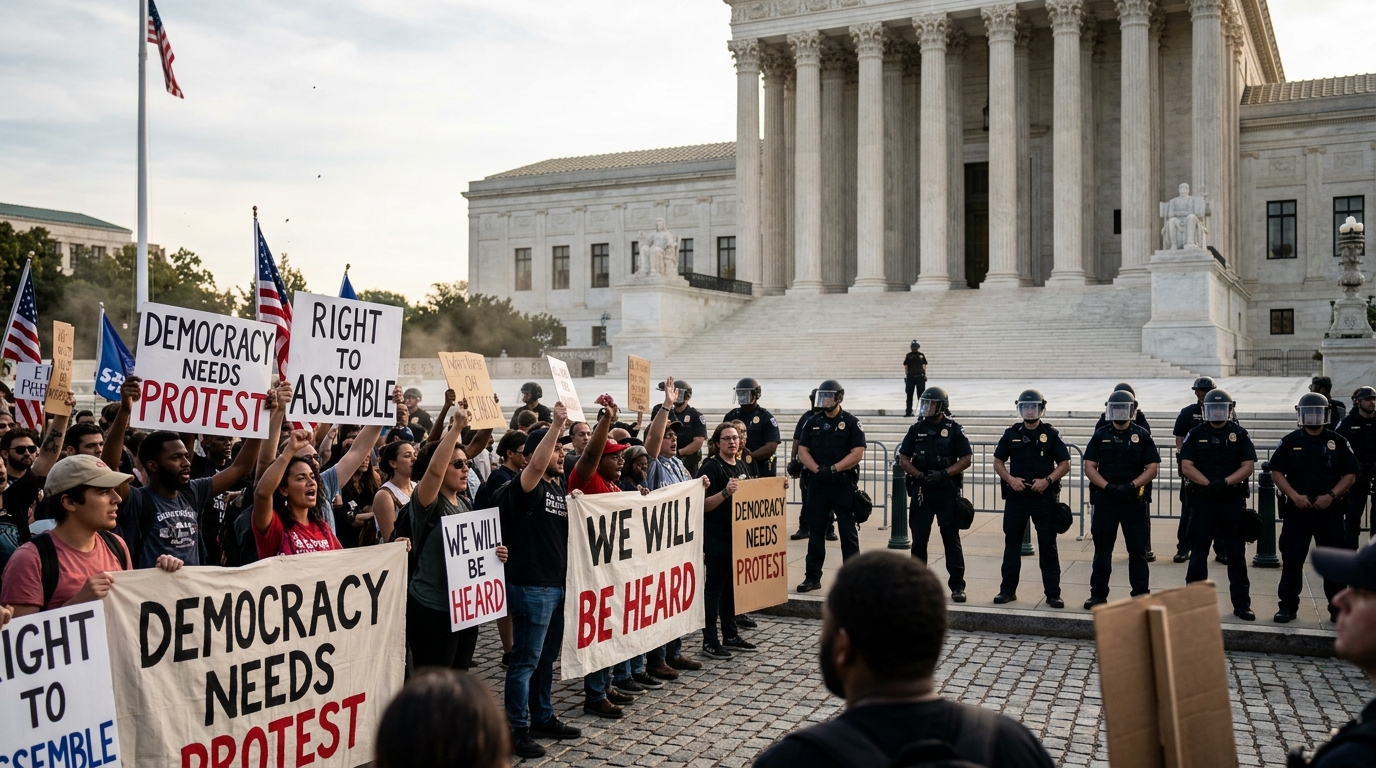
The Core Conflict: Civil Liability in Mass Movements
The First Amendment of the United States Constitution explicitly guarantees the right of the people to peaceably assemble and petition the government for a redress of grievances. For generations, this constitutional bedrock has served as the ultimate shield for mass movements, civil rights campaigns, and political demonstrations. However, the modern legal landscape is increasingly testing the boundaries of this protection. A recent development at the United States Supreme Court regarding a high-profile protest case has sent ripples through the civil liberties community, raising profound questions about the future of organized dissent in America.
When the Supreme Court declined to grant certiorari (a formal review) in the case of a prominent civil rights organizer sued by an injured police officer, it chose not to intervene in a contentious legal debate. By stepping aside, the high court allowed a controversial lower court ruling to stand for the time being—a ruling that introduces a novel “negligence” standard into the realm of First Amendment protections. To truly understand the gravity of this moment, we must unpack the origins of the dispute, the historical precedents at stake, and the subtle legal mechanisms that could inadvertently silence lawful assembly.
The Origins of the Legal Dispute in Baton Rouge
The catalyst for this extensive legal battle traces back to July 2016 in Baton Rouge, Louisiana. Following a tragic and highly publicized police shooting, community members and activists organized a demonstration to protest police brutality. The gathering eventually spilled onto a public highway, momentarily blocking traffic—a common occurrence in large-scale spontaneous protests, albeit one that violates local traffic ordinances.
During the confrontation between protesters and heavily armored law enforcement officers, a still-unidentified individual threw a hard object, which struck and severely injured a Baton Rouge police officer, identified in court documents under the pseudonym “Officer John Doe.” The individual who threw the projectile was never apprehended.
Unable to sue the anonymous assailant, the injured officer filed a civil lawsuit against the most visible organizer of the protest. The lawsuit did not claim that the organizer threw the object, nor did it claim that the organizer explicitly directed anyone to commit an act of violence. Instead, the legal argument hinged on a theory of “negligent protest.” The plaintiff argued that by organizing an event that illegally blocked a highway, the organizer created a volatile environment where violence was a foreseeable outcome, and therefore, the organizer should be held personally liable for the financial damages resulting from the officer’s injuries.
The Fifth Circuit’s Introduction of “Negligent Protest”
The case eventually found its way to the United States Court of Appeals for the Fifth Circuit, which holds jurisdiction over Louisiana, Texas, and Mississippi. In a decision that alarmed legal scholars and constitutional advocates across the political spectrum, the Fifth Circuit allowed the lawsuit to proceed. The court ruled that the organizer could potentially be held liable under a standard tort law theory of negligence.
Tort law generally dictates that individuals have a duty of care to act reasonably and avoid causing foreseeable harm to others. If a person breaches that duty, they can be held financially responsible. By applying standard negligence principles to a political protest, the Fifth Circuit effectively bypassed the stringent protections usually afforded by the First Amendment. The court reasoned that organizing a protest that violates the law (such as obstructing a public roadway) inherently carries the foreseeable risk of clashes with police, thus making the organizer liable for the rogue actions of a third party.
Negligence vs. Intent in First Amendment Law
To grasp why the Fifth Circuit’s ruling is considered radical by free speech advocates, one must understand the traditional difference between negligence and intent in constitutional law. Below is a breakdown of how these two standards apply to speech and assembly.
| Legal Standard | Definition | Application to Protest Rights |
|---|---|---|
| Ordinary Negligence | Failing to exercise the level of care that a reasonable person would under similar circumstances, resulting in unintended harm. | If applied, an organizer could be bankrupted because a random attendee committed a crime that the organizer should have “foreseen.” |
| Specific Intent (Incitement) | Purposefully acting with the goal of causing a specific unlawful outcome. | The traditional standard. An organizer is only liable if they directly ordered, encouraged, or intended for the specific act of violence to occur. |
The Ghost of Claiborne Hardware: A Historical Perspective
The Fifth Circuit’s embrace of the negligence standard seemingly conflicts with a landmark Supreme Court decision that has safeguarded protest rights for over four decades: NAACP v. Claiborne Hardware Co. (1982).
In the 1960s, the NAACP organized a massive boycott of white-owned businesses in Claiborne County, Mississippi, to protest racial segregation. During the multi-year boycott, a small number of participants engaged in acts of violence and intimidation against individuals who refused to honor the boycott. The targeted merchants sued the NAACP and its local leaders, seeking massive financial damages for their lost revenue and the isolated acts of violence.
When the case reached the Supreme Court in 1982, the justices ruled unanimously in favor of the NAACP. The Court declared that the First Amendment protects nonviolent political boycotts and demonstrations. Crucially, the Court established that organizations and leaders cannot be held financially liable for the violent acts of rogue individuals unless there is clear proof that the leaders specifically intended to incite or direct that violence. Mere association with a mass movement, or the failure to prevent unauthorized violence, is not enough to strip away First Amendment protections.
Civil liberties advocates argue that the Fifth Circuit’s recent “negligent protest” theory creates a dangerous loophole around the Claiborne precedent. By framing the issue as a matter of state-level tort negligence rather than constitutional incitement, lower courts can effectively penalize organizers without ever having to prove that they intended to cause harm.
Why Did the Supreme Court Decline the Case?
Given the apparent conflict between the Fifth Circuit’s ruling and the Claiborne precedent, many expected the Supreme Court to accept the Baton Rouge case and decisively strike down the “negligent protest” theory. Instead, in April 2024, the Supreme Court issued a brief order denying the petition for a writ of certiorari, meaning they refused to hear the appeal.
However, a denial of certiorari does not mean the Supreme Court agrees with the lower court’s decision. It simply means the Court chose not to review it at this specific moment. In a highly unusual move, Justice Sonia Sotomayor attached a statement to the denial, offering critical context. She emphasized that the Court’s refusal to hear the case should not be interpreted as an endorsement of the Fifth Circuit’s logic.
The Counterman Factor and “True Threats”
Justice Sotomayor pointed out that since the Fifth Circuit issued its ruling, the Supreme Court handed down a separate, vital First Amendment decision in 2023: Counterman v. Colorado.
While Counterman was a case about online stalking and “true threats” rather than physical protests, it established a crucial threshold for punishing speech. The Supreme Court ruled in Counterman that an objective standard of negligence (i.e., whether a “reasonable person” would view a statement as a threat) is insufficient to bypass the First Amendment. Instead, the government must prove a subjective standard of “recklessness”—meaning the speaker consciously disregarded a substantial risk of causing harm.
Justice Sotomayor’s statement signaled to the lower courts that they must re-evaluate the Baton Rouge protest case through the lens of Counterman. If negligence is insufficient to punish online threats, it is likely insufficient to punish the organizers of a political protest. The Supreme Court essentially opted to let the lower courts clean up their own jurisprudence using this newly clarified standard, rather than stepping in immediately.
The Chilling Effect on the Freedom of Assembly
Despite the Supreme Court’s underlying rationale, the immediate reality is that the Fifth Circuit’s ruling remains on the books for now. This creates a severe “chilling effect” on the freedom of assembly in Texas, Louisiana, and Mississippi.
Mass protests, by their very nature, are unpredictable. They involve hundreds or thousands of passionate individuals, counter-protesters, and heavy law enforcement presences. If the organizers of these events know that they could face personal financial ruin—including the loss of their homes and savings—because a single anonymous attendee throws a water bottle or breaks a window, the overwhelming majority will simply stop organizing.
This legal threat disproportionately affects marginalized communities and grassroots organizations that lack the resources to fight protracted legal battles or purchase exorbitant liability insurance policies. The mere threat of a lawsuit becomes a weapon. Opponents of a political movement can use the court system to bankrupt organizers, effectively silencing political dissent without ever having to pass a law outlawing the protest itself.
Future Implications for Activists and Organizers
As this legal saga continues to unfold in the lower courts, organizers across the country are being forced to adapt to a hostile legal environment. In the states governed by the Fifth Circuit, the risks of leading a march are currently at a historic high.
To mitigate these risks, civil rights groups are advising organizers to take extraordinary precautions. This includes rigorously documenting their commitments to nonviolence, verbally instructing crowds against illegal acts, and strictly adhering to local permitting processes, even though spontaneous demonstrations have historically been a vital part of American political expression.
Ultimately, the health of a democracy is measured by its tolerance for dissent. The ongoing legal battles over “negligent protest” are not just about the financial liability of one individual; they are a stress test for the First Amendment itself. Until the Supreme Court issues a definitive ruling reaffirming the principles of Claiborne Hardware in the modern era, the right to peaceably assemble remains under a precarious legal cloud.
Frequently Asked Questions (FAQs)
- Did the Supreme Court make protesting illegal?
No. The Supreme Court simply declined to review a lower court case regarding civil liability for protest organizers. Protesting remains a constitutionally protected right, but organizers in certain states currently face a higher risk of civil lawsuits if violence occurs at their events.
- What is “negligent protest” liability?
It is a legal theory asserting that if an organizer plans an event that violates laws (such as blocking a highway), they can be held financially responsible for the violent acts of third parties, because violence in such scenarios is considered a “foreseeable” outcome of the initial legal violation.
- How does this affect people outside of Texas, Louisiana, and Mississippi?
Technically, the Fifth Circuit’s ruling only applies to those three states. However, legal theories often migrate. If this negligence standard goes unchallenged, plaintiffs and politicians in other jurisdictions may attempt to file similar lawsuits against protest organizers nationwide.
- Why is the Counterman v. Colorado case important here?
The Counterman ruling established that the First Amendment requires at least a “recklessness” standard (a conscious disregard of risk) rather than mere “negligence” when punishing unprotected speech. Justice Sotomayor indicated that this standard should protect protest organizers from being sued purely on negligence grounds.
References
- 23-373 Mckesson v. Doe, Statement of Justice Sotomayor respecting the denial of certiorari (04/15/2024) — Supreme Court of the United States. 2024-04-15. https://www.supremecourt.gov/orders/courtorders/041524zor_q8l1.pdf
- Counterman v. Colorado, 600 U.S. 66 (2023) — Supreme Court of the United States. 2023-06-27. https://www.supremecourt.gov/opinions/22pdf/22-138_4g15.pdf
- NAACP v. Claiborne Hardware Co., 458 U.S. 886 (1982) — U.S. Supreme Court via Justia. 1982-07-02. https://supreme.justia.com/cases/federal/us/458/886/
- Ford v. Mckesson, No. 17-30864 — United States Court of Appeals for the Fifth Circuit. 2023-06-16. https://www.ca5.uscourts.gov/opinions/pub/17/17-30864-CV2.pdf
Similar Articles








Read full bio of Sneha Tete


