
Why the Supreme Court Cares How You Capitalize “Internet”
How one Supreme Court opinion revived an old style debate and what it reveals about language, law, and the evolving internet.
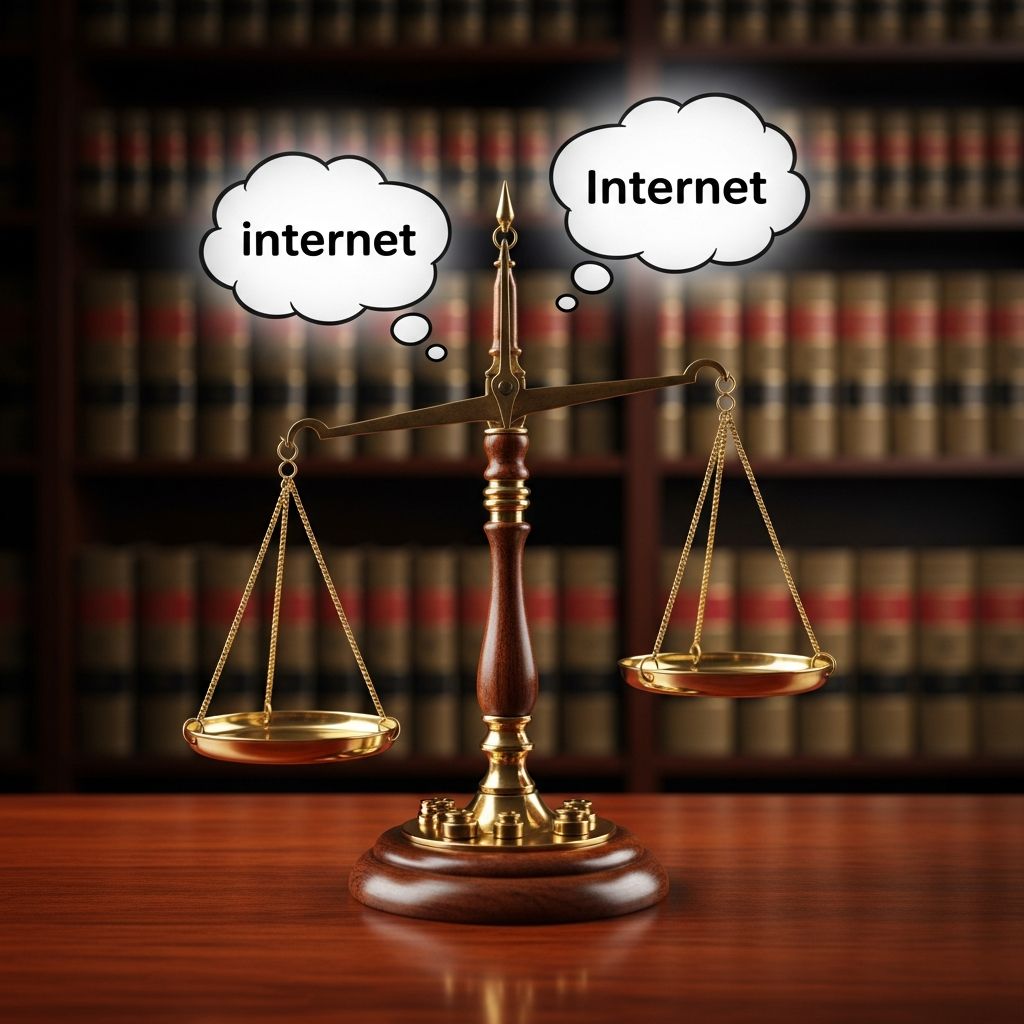
For most lawyers, judges, and legal editors, battles over commas, hyphens, and capitalization are the quiet background noise of daily work. Yet a recent U.S. Supreme Court opinion unexpectedly thrust one such debate into public view: should we write “Internet” with a capital “I,” or has the time come to treat it as ordinary and write “internet” in lowercase?
That seemingly small choice reflects a much broader story about how language evolves, how courts present themselves to the public, and how legal institutions respond when technology reshapes everyday life. This article uses the Court’s opinion as a jumping-off point to explore the capitalization controversy, the history of the term, and the implications for legal writing and public perception.
The Capitalization Question in Plain Terms
At its core, the debate centers on a simple question: is the global network we use daily a proper noun (like the Pacific Ocean) or a generic technology (like electricity)? For years, many courts, newspapers, and style guides treated the term as a unique entity and wrote it as “Internet”. Over time, however, usage has shifted in favor of the lowercase spelling as the technology has become ubiquitous and less exotic.
When a Supreme Court majority opinion adopts one form and a concurrence or dissent uses another, it does more than spark stylistic chatter. It raises real questions:
- How closely should courts follow modern linguistic conventions?
- Do word choices signal a particular view of technology or law?
- Should legal writers prioritize tradition, clarity, or alignment with mainstream usage?
A Brief History of “The Internet” as a Proper Noun
When the network that became today’s internet first emerged from U.S. government research projects such as ARPANET, it was often described in technical and legal materials as a distinct system, sometimes capitalized as “the Internet” to denote this specific internetwork of networks. The capitalization helped distinguish that single, global network from smaller or hypothetical internets (generic interconnected networks).
In the early commercial era, official and quasi-official documents, including laws and regulatory materials, routinely used the capitalized form. For example:
- Federal agencies discussing consumer protection and privacy online.
- Congressional reports addressing broadband policy and online speech.
- Court opinions grappling with copyright, defamation, or jurisdiction in online disputes.
Capitalization signaled that the “Internet” was seen as a defined, almost place-like infrastructure—an identifiable destination where people went to browse, email, or transact.
Style Guides Move On: From Proper Noun to Everyday Utility
As internet access spread and online activity became part of everyday life, major style authorities began revisiting this special treatment.
| Style Guide | Earlier Treatment | Later Change | Rationale |
|---|---|---|---|
| Associated Press Stylebook | Capitalized “Internet” and “Web” | Shifted to lowercase “internet” and “web” in 2016 | Reflected common usage and treated the term as generic technology |
| Chicago Manual of Style | Originally promoted “Internet” | Later acknowledged emerging preference for lowercase | Aimed to align with readers’ expectations in general writing |
| Government & legal drafting guidance | Longstanding preference for “Internet” | Gradual move toward lowercase in some newer documents | Part of broader “plain language” reforms in public communication |
These changes were not instantaneous, and many courts and agencies kept the capitalized form even as newspapers and technology writers moved on. But the overall trajectory has been clear: as the internet became as familiar as electricity or radio, capitalization began to look increasingly old-fashioned to some readers.
Why the Supreme Court’s Word Choice Caught Attention
Supreme Court opinions are meticulously edited, not only for legal reasoning but also for style. When an opinion in a high-profile technology or communications case switches (or declines to switch) the capitalization of “internet,” legal commentators and linguists naturally notice. The Court’s choice can be read in several ways:
- As a signal of institutional conservatism – maintaining historical capitalization to preserve internal consistency with past opinions.
- As a reflection of authorship – particular Justices and their clerks may have distinct stylistic preferences, visible across multiple opinions.
- As a missed or intentional divergence – the Court may diverge from modern style guides either because it has not updated its conventions, or because it sees a legal reason to preserve the older form.
Observers are quick to notice when the majority opinion uses one form and a concurrence or dissent uses the other. That kind of internal split suggests that the Court, like the broader legal community, has not reached consensus on how to treat the word.
Language Change vs. Legal Continuity
Courts operate in a world where both precision and stability matter. Once a statutory term, regulatory phrase, or doctrinal label takes hold, courts are naturally hesitant to alter it in ways that might generate uncertainty. At the same time, language in official documents must remain intelligible and credible to contemporary readers.
Several tensions arise here:
- Stability of precedent – Lawyers and judges rely on consistent terminology across decades of opinions.
- Public legitimacy – Legal texts that appear linguistically out of step may seem disconnected from modern life.
- Technological evolution – Terms born in niche technical circles (like “cyberspace” or “World Wide Web”) may age poorly, forcing courts to revisit how they describe online environments.
In that context, deciding whether to capitalize “Internet” is less about grammar than about how the Court conceptualizes the technology itself. Keeping the capital letter subtly emphasizes uniqueness and infrastructure; dropping it implies that the network is now simply part of the ambient environment, alongside phones, electricity, and other utilities.
How Other Institutions Handle the Term
To understand the Court’s position, it helps to compare how other public bodies and major organizations treat the term today:
- Federal agencies – Many modern federal communication initiatives, including those promoting access to broadband and digital services, have moved toward lowercase “internet” in public-facing materials, especially when written under plain-language policies designed to improve readability.
- International organizations – Entities like the International Telecommunication Union (ITU) and the Organisation for Economic Co-operation and Development (OECD) often use the lowercase form in recent reports analyzing digital infrastructure and online services.
- Academic and technical communities – Research papers may vary, but many contemporary technology law and policy journals now follow their house style, which usually prefers lowercase unless quoting older sources.
The Supreme Court, bound less by any single house style and more by precedent plus its own internal traditions, sometimes lags behind these shifts—or, depending on one’s view, deliberately resists them.
Why Capitalization Matters in Legal Writing
Some may view the entire debate as trivial. Yet in law, capitalization often carries serious consequences. Consider these patterns:
- Defined terms – Contracts, statutes, and regulations often capitalize terms that carry a specific defined meaning, such as “Service,” “Person,” or “Covered Entity.”
- Institutional titles – Courts distinguish between the Court (as the specific tribunal) and other “courts” in general, using capitalization to mark status and role.
- Jurisdictional labels – Phrases like “State,” “Nation,” or “United States” may be capitalized in particular contexts to denote specific legal entities.
Against this backdrop, treating the Internet as a proper noun can subtly invoke the idea that it is more than a generic communication tool; it is a legally and conceptually distinct space. Lowercasing the word, by contrast, encourages courts and lawyers to focus on concrete activities—messages, data, platforms, and networks—rather than on a quasi-mystical “place” separate from the physical world.
Practical Guidance for Lawyers and Legal Editors
Regardless of what the Supreme Court ultimately settles on, practitioners must make day-to-day choices in briefs, memos, and client-facing materials. A consistent approach helps avoid distracting the reader and reduces editing disputes. The following considerations can guide those decisions.
1. Know Your Audience and Governing Style
- Check any court-specific rules or local formatting orders that might dictate certain capitalization practices.
- When writing for general readers or the media, align with common usage and major style guides, which now favor lowercase.
- Within a law firm or agency, adopt an internal style sheet specifying your preference and stick to it across documents.
2. Align with Defined Terms and Statutory Language
- If a statute or regulation explicitly uses “Internet,” consider mirroring that spelling when quoting or closely tracking the text.
- When drafting legislation or contracts, decide whether “Internet” will be a defined term; if not, treating it as lowercase supports standardization.
3. Focus on Clarity, Not Trendiness
- Avoid switching between “Internet” and “internet” within the same document absent a good reason, such as quoting older language.
- When in doubt, prioritize readability and avoid choices that might look inconsistent or produce confusion about whether you are referring to a specific defined term.
What the Debate Reveals About Courts and Technology
The Supreme Court’s treatment of “internet” forms part of a broader pattern in which courts gradually adapt their language to new technologies. Earlier generations saw similar transitions:
- The shift from speaking of the “telephone system” as a novel network to treating phone service as mundane infrastructure.
- The normalization of “radio” and “television” in everyday language, even while specific regulatory frameworks treated them as specialized services.
- More recently, the move from exotic terms like “cyberspace” to more grounded references to specific platforms, apps, or services.
In modern communications law disputes—such as those concerning universal service funds, rural broadband, or online copyright liability—courts increasingly confront not just abstract questions of jurisdiction and statutory interpretation, but also the real-world functioning of networks, providers, and users. How they describe these systems can influence how the public perceives both the technology and the fairness of regulatory choices.
Common Questions About “Internet” vs. “internet”
Q: Is one spelling “legally correct” and the other wrong?
No. Both forms appear in authoritative legal texts, and no U.S. statute or Supreme Court rule universally mandates one spelling. The choice is largely a matter of style and institutional preference.
Q: Does using lowercase “internet” change the meaning in a contract or statute?
Standing alone, capitalization rarely changes the underlying concept. What matters more is whether the term is expressly defined. If a document defines “Internet” as a specific service or system, that definition will control regardless of broader linguistic trends.
Q: Which form do modern style guides recommend?
Major general-audience style guides, such as the Associated Press Stylebook, now recommend lowercase “internet,” reflecting mainstream usage and the view that it is a generic technology rather than a unique proper noun.
Q: Why might a court continue to use “Internet” with a capital “I”?
A court may follow its internal conventions, maintain consistency with prior opinions, mirror statutory language, or simply give deference to decades of earlier legal writing that treated the term as a proper noun.
Q: As a legal writer, how should I decide which form to use?
Start with any controlling style rules (court, firm, or publication). If none exist, consider aligning with contemporary usage and major style guides, and—most importantly—use your chosen form consistently throughout the document.
References
- FCC v. Consumers’ Research, 606 U.S. ___ (2025) — Supreme Court of the United States. 2025-06-27. https://www.supremecourt.gov/opinions/24pdf/24-354_0861.pdf
- AP changes style to lowercase internet and web — Associated Press Stylebook. 2016-03-18. https://www.apstylebook.com/blog_posts/18
- Federal Plain Language Guidelines — Plain Language.gov. 2011-03-01 (periodically updated). https://www.plainlanguage.gov/guidelines/
- Broadband Policies for Latin America and the Caribbean: A Digital Agenda for the Digital Age — OECD. 2016-02-15. https://www.oecd.org/publications/broadband-policies-for-latin-america-and-the-caribbean-9789264251823-en.htm
- Universal service in a competitive telecommunications environment — Federal Communications Commission (Universal Service Order, FCC 97-157). 1997-05-08. https://transition.fcc.gov/Bureaus/Common_Carrier/Orders/1997/fcc97157.pdf
Similar Articles








Read full bio of Sneha Tete


