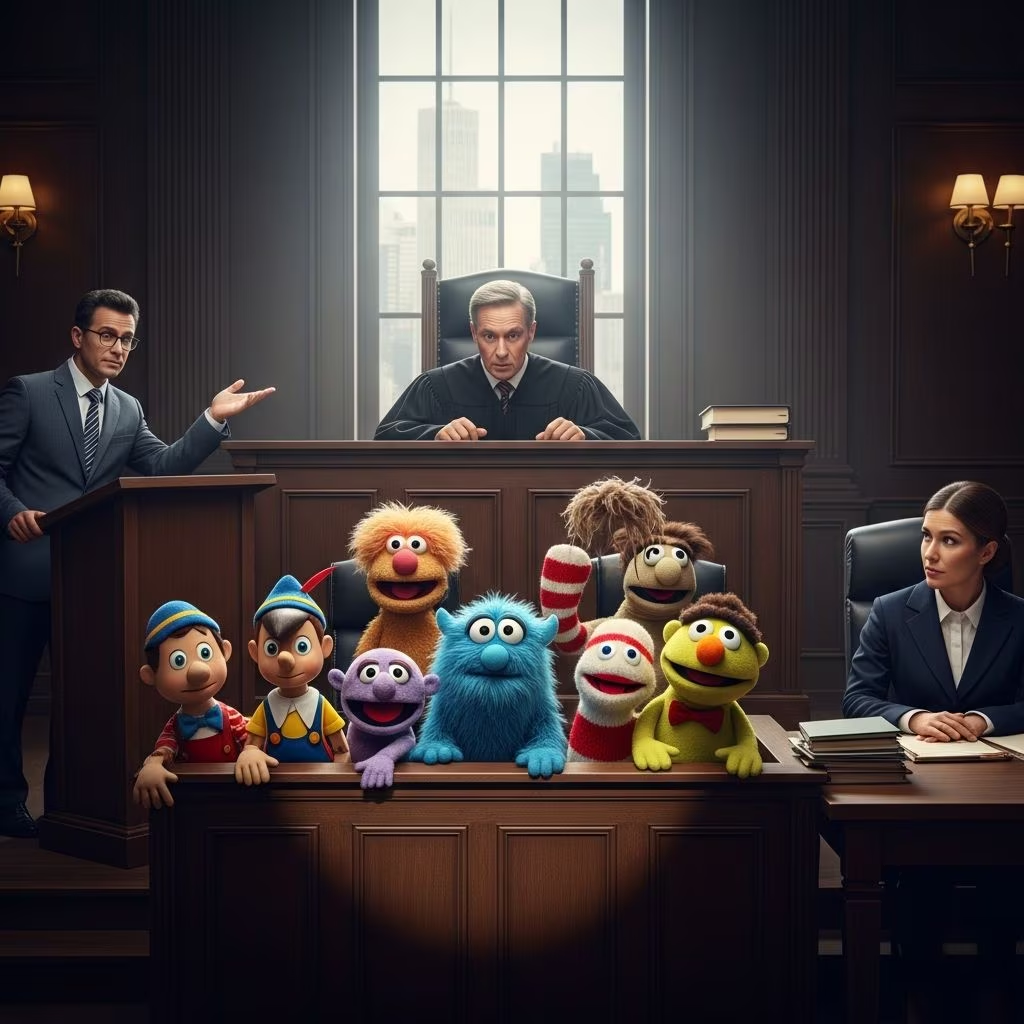
In the vibrant world of entertainment, where creativity meets commerce, questions arise about accountability for discriminatory practices. Can a beloved puppet like Elmo become the target of a racial discrimination lawsuit? This provocative idea highlights deeper tensions between anti-discrimination laws and artistic freedoms in casting decisions.
The Clash Between Creativity and Civil Rights
Entertainment productions, from Broadway musicals to television shows, often make casting choices that reflect narrative needs, audience appeal, or artistic vision. These decisions, however, can intersect with federal laws like Title VII of the Civil Rights Act of 1964, which prohibits employment discrimination based on race, color, religion, sex, or national origin, and Section 1981, which ensures equal contract rights regardless of race.
Consider a scenario where a performer behind a puppet character faces replacement due to racial considerations tied to the story’s message. Courts have grappled with whether such moves constitute unlawful discrimination or protected expression. In expressive mediums, producers argue that race-based casting is essential to the artwork’s integrity, invoking First Amendment shields.
Key Court Rulings Shaping the Debate
Recent judicial decisions provide clarity on these issues. In a notable Broadway case, a Black actress in a chorus role claimed race discrimination after being replaced by a white performer. The production aimed to diversify its cast to avoid a perceived ‘white savior’ narrative in its mythological retelling. The U.S. District Court for the Southern District of New York dismissed the claims, ruling that the casting directly influenced the story’s conveyance and thus merited First Amendment protection.
This ruling echoes precedents in reality television. Producers of shows like ‘The Bachelor’ faced suits alleging intentional exclusion of nonwhite contestants to sidestep interracial romance controversies. Even assuming discriminatory intent, courts upheld the defendants’ rights, deeming casting ‘part and parcel of the creative process’ safeguarded by free speech.
In California, anti-SLAPP laws have further insulated entertainment employers. These statutes target lawsuits meant to suppress speech, allowing early dismissal of claims impeding artistic choices, including in music and reality programming.
| Case | Allegation | Ruling Basis | Outcome |
|---|---|---|---|
| Moore v. Hadestown Broadway LLC | Race discrimination in casting replacement | First Amendment protection for story expression | Claims dismissed |
| Claybrooks v. ABC (Bachelor cases) | Exclusion of nonwhite contestants | Casting as creative process | First Amendment defense upheld |
| She’s Got Game (Viacom) | Discriminatory casting in reality TV | California anti-SLAPP law | Lawsuit stricken |
Understanding ‘Color’ Discrimination in Entertainment
Beyond overt race claims, ‘colorism’—preferential treatment based on skin tone—poses unique challenges. Anti-Black colorism disadvantages those with darker skin and Afrocentric features, rooted in historical biases favoring Eurocentric traits. In Hollywood, this manifests as lighter-skinned Black actors securing lead roles while darker-skinned counterparts are typecast into stereotypes or sidelined.
Federal laws address ‘color’ under Title VII, but courts struggle with its application in artistic contexts. Defendants often raise bona fide occupational qualification (BFOQ) defenses, arguing race or color is reasonably necessary for the job’s essence, like authentic representation in a biopic. First Amendment arguments compound this, prioritizing expressive content over equity mandates.
Historical Roots and Industry Patterns
Colorism traces to colonial eras, perpetuated by media hierarchies that undervalue darker complexions. Studies reveal persistent underrepresentation: darker-skinned Black performers face pay gaps and fewer opportunities in prominent roles. The Academy Awards controversies underscore off-screen biases too, with hiring disparities affecting women, minorities, and LGBTQ+ individuals.
- Underrepresentation: Darker-skinned actors often relegated to supporting or villainous parts.
- Pay Disparities: Lighter-skinned peers command higher compensation for similar work.
- Stereotyping: Limited roles reinforce harmful tropes.
- Behind-the-Scenes Bias: Few minorities in executive positions influencing casts.
Legal Hurdles for Plaintiffs
Claimants face steep barriers. Proving disparate treatment requires showing adverse action due to protected characteristics, but artistic defenses often prevail. Disparate impact claims—where neutral policies disproportionately harm groups—fare poorly against business necessity or BFOQ.
Section 1981 claims, focusing on contract interference, similarly falter in expressive works. Courts view casting as integral to the ‘message,’ even if controversial, protecting producers’ control. Implicit bias evidence is rarely admitted, leaving subtle colorism unaddressed.
Potential Reforms and Solutions
Scholars advocate clarifying ‘color’ in Title VII for consistent rulings and tailored BFOQs prioritizing underrepresented groups in entertainment. Industry solidarity—hiring diverse creatives—could organically reduce biases without legal coercion.
Broader reforms include implicit bias training and transparency in casting data. While the Civil Rights Act transformed workplaces, its limits in creative fields highlight needs for targeted updates.[10]
Frequently Asked Questions
Can artistic expression override anti-discrimination laws?
Yes, courts often protect casting tied to a story’s expressive content under the First Amendment, as in Broadway and TV cases.
What is colorism under employment law?
Discrimination based on skin tone or features within the same racial group, actionable under Title VII’s ‘color’ provision.
Does the BFOQ defense apply to actors?
It can, if race/color is essential to the role’s authenticity, like historical accuracy, though narrowly construed.
Are reality TV casting choices lawsuit-proof?
Largely yes, via First Amendment and anti-SLAPP protections, even if race influences selections.
How can the industry combat bias without lawsuits?
Through diverse hiring, bias training, and inclusive storytelling led by underrepresented voices.
Implications for Puppeteers and Performers
Extending to puppets, suits against characters like Elmo would fail; liability targets employers, not fictional entities. Performers behind masks or puppets are employees, but casting rationales mirroring human stories invoke identical defenses. This underscores entertainment’s unique status: creativity trumps uniformity where expression is core.
As debates rage, balancing rights remains key. Plaintiffs must navigate fortified legal shields, while producers wield constitutional armor. Future legislation may refine this equilibrium, ensuring fairness without stifling art.
References
- Redefining the Scope of Anti-discrimination Law — Brooklyn Law Review, BrooklynWorks. 2024. https://brooklynworks.brooklaw.edu/blr/vol90/iss4/4/
- Broadway Ruling Puts Discrimination Claims In The Limelight — Proskauer. 2024-03-07. https://www.proskauer.com/pub/broadway-ruling-puts-discrimination-claims-in-the-limelight
- Race Discrimination Claims by Broadway Actor Sent Back to the Underworld — Law and the Workplace. 2024-03. https://www.lawandtheworkplace.com/2024/03/race-discrimination-claims-by-broadway-actor-sent-back-to-the-underworld-in-the-face-of-producers-first-amendment-rights/
- Rampant Discrimination in the Entertainment Industry — Georgia Employment Rights. 2016-03-11. https://gaemploymentrights.com/lawyer/2016/03/11/Employment-Law/Rampant-Discrimination-in-the-Entertainment-Industry_bl23910.htm
- Discrimination is Still Part of the Entertainment Industry — The MK Law Group. 2020-06. https://themklaw.com/2020/06/discrimination-is-still-part-of-the-entertainment-industry/
- The Failure of the Civil Rights Act in Media and Entertainment — Auburn Law Review. 2021-03. https://aublr.org/2021/03/the-failure-of-the-civil-rights-act-in-media-and-entertainment/