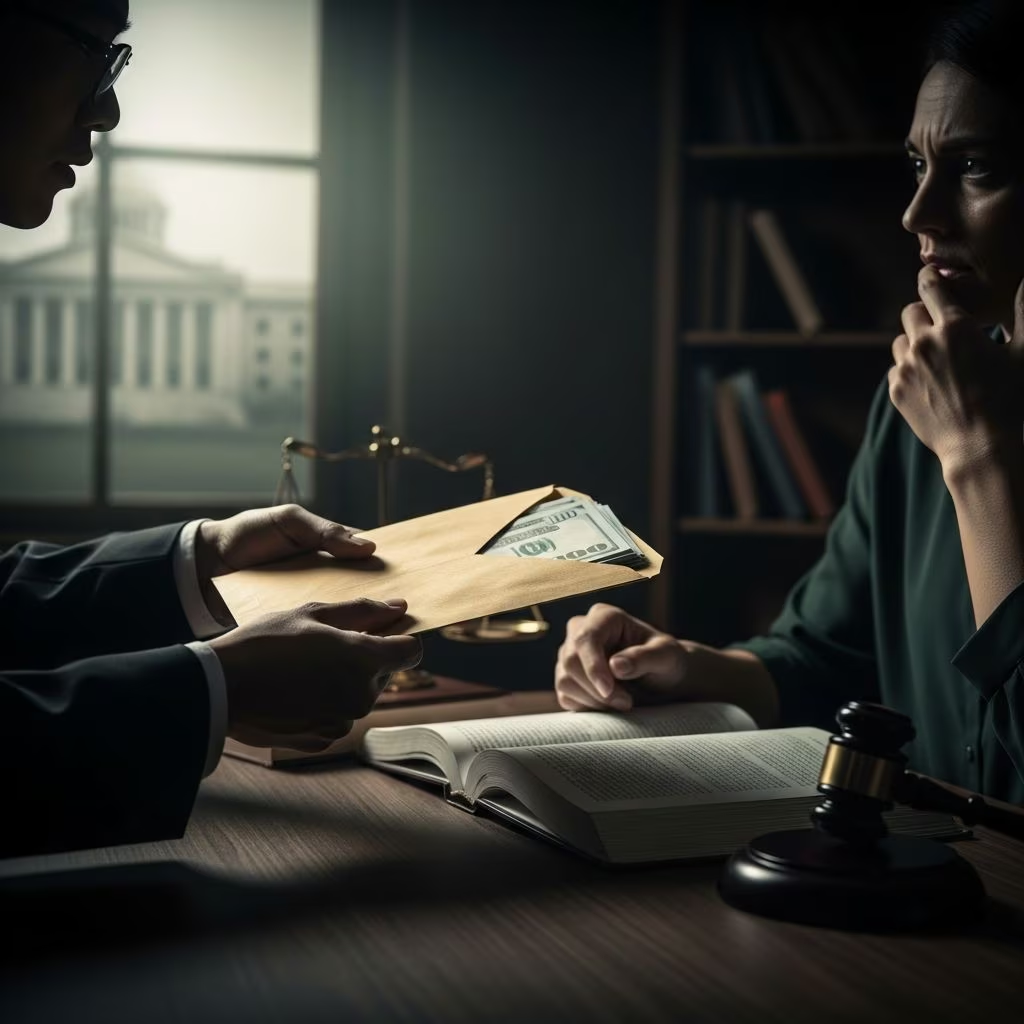
The integrity of the justice system hinges on truthful testimony under oath. When someone deliberately induces another to provide false statements in legal proceedings, they commit subornation of perjury, a serious felony that undermines trials and investigations. This offense targets those who corruptly procure lies, distinguishing it from perjury itself, where the liar faces direct consequences.
Defining the Offense: Core Legal Meaning
Subornation of perjury occurs when an individual persuades, induces, or procures another person to knowingly deliver false testimony under oath. Federal statute 18 U.S.C. § 1622 explicitly states: “Whoever procures another to commit any perjury is guilty of subornation of perjury,” punishable by fines or up to five years imprisonment, or both. This law, rooted in common law traditions, emphasizes the procurer’s intent and knowledge that the induced statement is false.
Unlike simple perjury, which requires the witness to lie, subornation demands proof that the instigator actively caused the falsehood. The term ‘suborn’ derives from inducing wrongful acts secretly, particularly procuring perjured testimony. Prosecutors must show the suborner knew or believed the testimony was false and that the witness also knew its falsity.
Key Elements Prosecutors Must Prove
To secure a conviction, the government bears a heavy burden, proving every element beyond a reasonable doubt. Here’s a breakdown:
- Perjury Actually Occurred: The witness must have given false testimony under oath in a material matter. No perjury means no subornation, even if inducement attempts failed.
- Defendant Procured the Perjury: Evidence of persuasion, bribery, threats, or other corrupt means to induce the lie.
- Knowledge of Falsity: The suborner must know, believe, or have reason to believe the testimony is false, rising above mere suspicion.
- Witness’s Knowledge: The perjurer must also know the statement is untrue.
In federal cases, this aligns with Department of Justice guidelines, requiring corrupt procurement. State variations exist; for example, Oklahoma law includes offering bribes to influence testimony, treating it as a felony equivalent to perjury.
Federal vs. State Frameworks
Federal Law (18 U.S.C. § 1622): Uniformly punishes procurement of perjury with up to five years in prison. Applies in federal courts, grand juries, or proceedings where false oaths are sworn. Reviewed as current through 2025.
States mirror this but vary in penalties and specifics:
| Jurisdiction | Key Statute/Definition | Penalty |
|---|---|---|
| Federal | 18 U.S.C. § 1622: Procures perjury | Up to 5 years prison, fines |
| Oklahoma | Okla. Stat. tit. 21 § 456: Bribe or induce false testimony | Punished as perjury (felony) |
| California | Matches perjury penalties | 2-4 years prison |
| North Carolina | Class I felony | Up to 2 years prison |
| Virginia | Class 5 felony | Matches perjury |
. These differences highlight why jurisdiction matters in prosecutions.
Penalties and Collateral Consequences
Conviction carries severe repercussions beyond prison. Federal penalties include fines and up to five years incarceration. States often align, with felonies leading to:
- Prison terms (2-5 years typically)
- Substantial fines
- Probation with supervision
- Criminal record impacting employment, voting, and housing
Attorneys face disbarment or disciplinary action for knowingly presenting false evidence. Additional charges like obstruction of justice or accessory after the fact may apply if linked to concealing crimes.
Real-World Examples and Case Insights
High-profile cases illustrate application. Consider scenarios where defendants coach witnesses to fabricate alibis in trials, bribing them for silence on incriminating facts. In one federal context, prosecutors targeted individuals corruptly inducing lies in grand jury testimony, proving knowledge via recorded inducements.
Another example: A party in civil litigation urges a witness to exaggerate damages under oath, believing the inflation false. If the witness complies, subornation charges follow. These cases underscore that subornation protects not just criminal trials but any sworn proceeding.
Common Defenses and Challenges
Defendants often challenge the elements:
- No Actual Perjury: If the witness tells the truth or doesn’t testify, no crime.
- Lack of Knowledge: Claiming reasonable belief in truthfulness, e.g., honest mistake in facts.
- No Inducement: Mere encouragement to recall events isn’t criminal; only corrupt persuasion qualifies.
- Two-Witness Rule: Some jurisdictions require corroboration, though not always for conspiracy variants.
Willful blindness by attorneys—ignoring red flags—can still lead to liability if a reasonable professional would recognize falsity.
Distinctions from Related Offenses
| Offense | Key Difference | Example |
|---|---|---|
| Perjury | Liar under oath; no need for inducement | Witness lies directly |
| Witness Tampering | Threats or intimidation; no oath required | Coercing silence pre-trial |
| Obstruction of Justice | Broader; includes solicitation without perjury | Attempted inducement failing |
| Accessory After Fact | Helping conceal crime via false testimony | Inducing alibi for accomplice |
. Subornation specifically requires successful perjury.
Role in Modern Legal Proceedings
In an era of digital evidence, subornation prosecutions leverage texts, emails, and recordings proving inducement. Grand juries and trials remain hotspots, as false oaths erode public trust. Ethical rules bind attorneys: presenting known false testimony violates professional conduct, risking bar sanctions.
Prevention emphasizes witness preparation limits—refreshing memory without scripting falsehoods. Courts instruct on perjury risks, deterring subornation.
Frequently Asked Questions (FAQs)
What if the witness doesn’t lie after inducement?
No subornation; perjury must occur. Attempts may trigger obstruction charges.
Can attorneys be charged?
Yes, if knowingly presenting false testimony, facing criminal and disciplinary penalties.
Is subornation always a felony?
Federal and most states treat it as such, with 2-5 year sentences.
Does bribery define it?
No, but it’s a common method; any corrupt inducement suffices.
How recent are these laws?
18 U.S.C. § 1622 dates to 1948, updated 1994; Wex reviewed November 2025.
Protecting Judicial Integrity
Subornation laws safeguard oaths, ensuring justice relies on truth. Awareness deters manipulation, preserving fair proceedings for all.
References
- Subornation of perjury – Wikipedia — Wikipedia. Accessed 2026. https://en.wikipedia.org/wiki/Subornation_of_perjury
- Subornation of Perjury is Soliciting a Sworn Lie — Wirth Law Office. Accessed 2026. https://www.wirthlawoffice.com/oklahoma-criminal-law/subornation-of-perjury.html
- subornation of perjury | Wex | US Law — Legal Information Institute, Cornell Law School. 2025-11. https://www.law.cornell.edu/wex/subornation_of_perjury
- 18 U.S. Code § 1622 – Subornation of perjury — U.S. Code, Cornell Law School. 1994-09-13. https://www.law.cornell.edu/uscode/text/18/1622
- “Subornation of Perjury” — Maine Law Review, University of Maine School of Law. Accessed 2026. https://digitalcommons.mainelaw.maine.edu/mlr/vol26/iss2/5/
- How Is Suborning Perjury Punished? — CriminalDefenseLawyer.com. 2024. https://www.criminaldefenselawyer.com/resources/suborning-perjury.htm
- 1752. Subornation Of Perjury — United States Department of Justice. Accessed 2026. https://www.justice.gov/archives/jm/criminal-resource-manual-1752-subornation-perjury