
Student Expression: First Amendment Rights in Public Schools
Exploring free speech and constitutional rights for public school students.
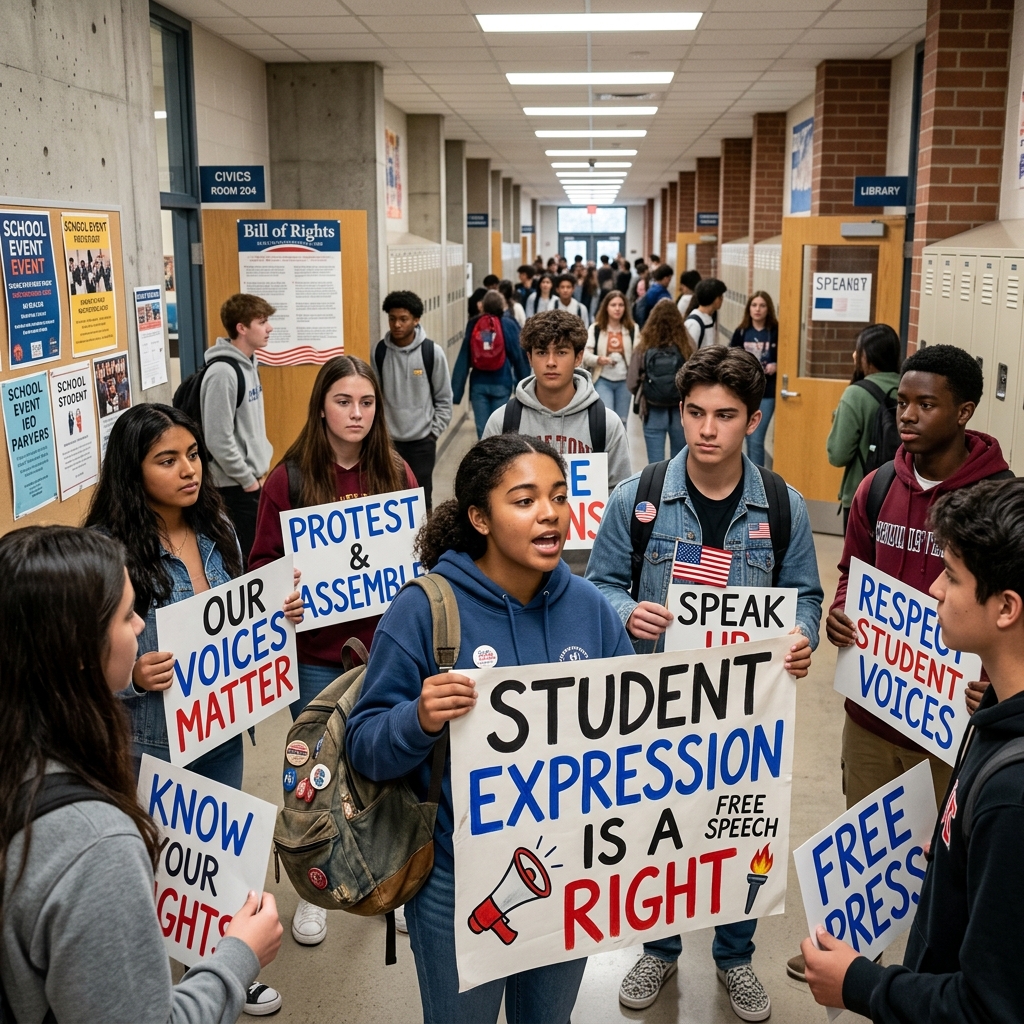
The Intersection of Constitutional Liberties and Public Education
The concept of constitutional rights within the context of public education presents a fascinating legal balancing act. On one hand, public schools are government institutions tasked with providing a safe, orderly, and effective learning environment. On the other, they are the very incubators of democracy, where young citizens first learn to exercise their civic rights and participate in a free society. The First Amendment of the United States Constitution guarantees the freedom of speech, religion, and the press, as well as the right to assemble peacefully. However, how these freedoms translate into a high school classroom, a cafeteria, or a school-sanctioned extracurricular activity has been the subject of fierce legal debate for decades .
Unlike adults in a public square, students operate within a highly regulated environment. Educators must maintain discipline and protect the well-being of a captive audience of minors. Yet, the courts have consistently ruled that stripping students of their fundamental rights simply because they are in an educational setting would be fundamentally undemocratic. Navigating this complex terrain requires a deep understanding of historical precedents, the evolving nature of communication in the digital age, and the precise boundaries of what constitutes protected expression versus unacceptable disruption.
The Bedrock Precedent: Crossing the Schoolhouse Gate
To understand the current landscape of student liberties, one must look back to the defining legal precedent of the 20th century. In 1969, at the height of the Vietnam War, the United States Supreme Court delivered a landmark ruling that would become the cornerstone of student free speech rights .
The Substantial Disruption Standard
The case centered around a group of students in Iowa who decided to wear black armbands to school as a silent, peaceful protest against the Vietnam War. Anticipating the protest, school administrators hastily passed a policy banning the armbands and subsequently suspended the students who refused to remove them. The students, aided by their parents, sued the school district, leading to a legal battle that reached the highest court in the land .
In a resounding 7-2 decision, the Supreme Court ruled in favor of the students. The majority opinion famously declared that neither students nor teachers “shed their constitutional rights to freedom of speech or expression at the schoolhouse gate.” This powerful phrase solidified the notion that public school students are, in fact, protected by the First Amendment .
However, the Court also established a crucial caveat known as the “substantial disruption” test. The ruling clarified that schools can limit student speech, but only if administrators can reasonably forecast that the expression would cause a “material and substantial disruption” to the educational process or impinge upon the rights of others . Simply being uncomfortable with a viewpoint, or fearing a hypothetical disturbance, is not enough to justify censorship.
Navigating the Modern Frontier: Off-Campus and Digital Speech
While the armband protest defined physical expression on school grounds, the advent of the internet and social media has drastically blurred the lines of the “schoolhouse gate.” Today, students carry a global broadcasting platform in their pockets, raising difficult questions about when a school has the authority to discipline a student for something said off-campus, on a weekend, or over the internet.
The Limits of School Authority Outside School Hours
For years, lower courts struggled to apply 20th-century legal frameworks to 21st-century digital realities. If a student tweets a harsh criticism of a teacher on a Saturday, can they be suspended on Monday? The Supreme Court finally provided modern clarity in 2021 with another landmark decision involving a frustrated high school cheerleader .
After failing to make the varsity cheerleading squad, a student posted a profane, fleeting message on the social media platform Snapchat while off-campus at a local convenience store. The school discovered the post and suspended her from the junior varsity team for a year, claiming her speech violated team rules regarding respect and good conduct. The Supreme Court ruled in favor of the student, emphatically stating that schools have significantly less leeway to regulate off-campus speech than on-campus speech .
The Court outlined three specific features of off-campus speech that limit school intervention:
- Parental Domain: When students are off-campus, they are generally under the jurisdiction and care of their parents, not the school .
- 24/7 Surveillance: Permitting schools to regulate all off-campus speech would mean a student is never truly free to express themselves outside of the school’s watchful eye .
- The Marketplace of Ideas: Schools have an affirmative duty to protect unpopular ideas and foster a student’s ability to participate in the “marketplace of ideas,” especially outside of the classroom .
While the Court acknowledged that schools might still intervene in cases of severe off-campus bullying, harassment, or threats directly targeting the school ecosystem, everyday digital venting and profanity outside of school hours remain largely protected .
Everyday Battlegrounds: Dress Codes and Personal Appearance
Beyond explicit political protests and social media posts, one of the most common friction points between student rights and administrative authority is the enforcement of dress codes. Clothing and personal grooming are inherently expressive, often reflecting a student’s identity, culture, and personal beliefs.
Symbolic Speech vs. Neutral Regulation
Courts generally allow public schools to enforce dress codes, provided the policies are viewpoint-neutral and designed to promote a safe learning environment . A school can legally ban clothing that is objectively distracting, promotes illegal drug use, or contains explicit profanity. For example, a policy prohibiting all tank tops or requiring skirts to be a certain length is generally considered a neutral regulation aimed at maintaining focus in the classroom .
However, a dress code crosses the line into constitutional violation when it engages in “viewpoint discrimination.” A school cannot enforce a dress code selectively to silence specific political or social messages. If a school allows a student to wear a t-shirt supporting one political candidate, it cannot force another student to remove a t-shirt supporting an opposing candidate . Similarly, clothing that bears messages related to social movements is heavily protected as “symbolic speech” as long as it does not trigger the substantial disruption threshold.
Furthermore, modern legal scrutiny is increasingly applied to dress codes that disproportionately target specific demographics. Policies that heavily police natural hair textures, target cultural headwear, or unfairly focus on the attire of female students over male students are frequently challenged not just under the First Amendment, but under equal protection and anti-discrimination laws.
The Right to Receive Information: Libraries and Curriculum
The First Amendment does not merely protect the right to speak; it inherently protects the right to receive information and ideas. In the context of public schools, this principle frequently clashes with curriculum design and the management of school libraries.
The Controversy Over Book Bans
School boards possess significant discretion in determining the standard academic curriculum and selecting assigned reading materials. Because the curriculum represents “school-sponsored speech,” administrators can curate these materials to align with community values and pedagogical goals. However, the school library occupies a unique constitutional space. A library is considered a place of voluntary inquiry, where students go to explore ideas beyond the mandatory curriculum .
When school boards attempt to remove books from library shelves, they walk a fine constitutional line. The Supreme Court has indicated that local school boards may not remove books from school library shelves simply because they dislike the ideas contained within those books. If the motivation behind a book ban is strictly partisan or intended to suppress a specific political viewpoint, it likely violates the students’ First Amendment rights to access information. Conversely, if a book is removed because it is deemed genuinely “pervasively vulgar” or educationally unsuitable for a specific age group, the courts may uphold the removal. This subjective distinction makes library censorship one of the most highly contested areas of student rights today.
Student Activism, Walkouts, and Peaceful Protest
The tradition of student activism is deeply woven into the fabric of American history. From the civil rights movement to contemporary rallies concerning climate change and gun violence, students have consistently used collective action to make their voices heard. But how does a school balance a student’s right to protest with the legal obligation to compel attendance?
When students organize walkouts during school hours, they are engaging in a form of civil disobedience. Because a walkout inherently disrupts the educational process—by emptying classrooms—schools are legally permitted to enforce standard attendance policies. This means a school can issue unexcused absences, detentions, or other standard disciplinary measures for skipping class.
The critical First Amendment protection here is that the school cannot issue disproportionate punishments based on the *reason* for the walkout. If the standard penalty for leaving school unexcused is a single detention, the school cannot suspend a student for a week simply because they left to attend a political protest. The discipline must remain content-neutral. Additionally, students are generally free to distribute flyers, gather in common areas during non-instructional times, and express their views, provided they do not block hallways or shout down opposing viewpoints in a manner that creates chaos.
A Summary of Key Legal Standards
To navigate the complexities of student rights, legal professionals and educators often refer to a handful of core Supreme Court decisions that dictate specific standards based on the context of the speech. Below is an overview of how the courts categorize and handle different types of student expression:
| Context of Speech | Legal Standard / Precedent | General Rule for Administrators |
|---|---|---|
| Independent On-Campus Speech (e.g., clothing, personal conversations, armbands) | Tinker v. Des Moines (1969) | Protected unless it causes a “material and substantial disruption” to the educational process or invades the rights of others. |
| Lewd or Vulgar Speech (e.g., explicit language at school assemblies) | Bethel v. Fraser (1986) | Schools can restrict and punish sexually explicit, indecent, or deeply vulgar speech on campus, as it undermines the school’s basic educational mission. |
| School-Sponsored Speech (e.g., official school newspapers, theatrical productions) | Hazelwood v. Kuhlmeier (1988) | Schools have broad authority to censor expression that is part of the curriculum or appears to bear the school’s official endorsement, provided there are legitimate pedagogical concerns. |
| Off-Campus & Digital Speech (e.g., weekend social media posts) | Mahanoy Area School District v. B.L. (2021) | Highly protected. Schools bear a heavy burden to justify punishing off-campus speech, typically limited to severe bullying, threats, or direct cheating. |
Conclusion: Cultivating Citizens, Not Subjects
The public school system is uniquely positioned as the training ground for civic participation. While the primary function of a school is to educate, the courts have continually recognized that learning how to responsibly exercise one’s constitutional rights is, in itself, a crucial part of education. Attempting to sanitize the school environment of all controversy or differing opinions does a disservice to students who will soon enter a diverse and often divided adult society. By protecting student expression—even when it is inconvenient, frustrating, or challenging—schools uphold the truest spirit of the First Amendment, ensuring that the next generation understands the value and responsibility of free speech.
Frequently Asked Questions (FAQ)
1. Does the First Amendment apply to students in private schools?
Generally, no. The First Amendment protects individuals from government overreach. Because public schools are funded and operated by the government, they must abide by the Constitution. Private schools are non-governmental entities and typically require students to sign contracts (or agree to handbooks) that can legally waive certain speech and expression rights.
2. Can a school censor a student-run newspaper?
It depends on the nature of the newspaper. If the publication is part of a journalism class, uses school funds, and is overseen by a faculty advisor, it is considered “school-sponsored speech.” Administrators have broad authority to censor these publications for legitimate educational reasons. However, if the publication is entirely independent, produced off-campus, and distributed by students independently, it enjoys much higher First Amendment protections.
3. What exactly qualifies as a “substantial disruption”?
There is no strict formula, but courts generally look for concrete evidence of chaos. A substantial disruption involves incidents like classes being completely halted, severe physical altercations, or a coordinated inability of the school to carry out its daily schedule. Minor murmuring, a few distracted students, or administrators feeling uncomfortable do not meet the legal threshold for a substantial disruption .
4. Can I be forced to stand for the Pledge of Allegiance?
No. Long-standing Supreme Court precedent dictates that public schools cannot compel students to recite the Pledge of Allegiance or salute the flag. Students have the absolute right to sit silently or decline to participate based on their personal, religious, or political beliefs.
References
- Facts and Case Summary – Tinker v. Des Moines — United States Courts. https://www.uscourts.gov/educational-resources/educational-activities/facts-and-case-summary-tinker-v-des-moines
- Mahanoy Area School Dist. v. B. L. (20-255) — Supreme Court of the United States. 2021-06-23. https://www.supremecourt.gov/opinions/20pdf/20-255_g3bi.pdf
- Rights of Students — The First Amendment Encyclopedia, Middle Tennessee State University. 2023-08-11. https://firstamendment.mtsu.edu/article/rights-of-students/
- Do dress codes generally violate the First Amendment? — The McLellan, Michigan State University. https://mclellan.law.msu.edu/questions/dress-codes-first-amendment
Similar Articles








Read full bio of Sneha Tete


