
The Strategic Architecture of Civil Rights Movements
Explore the grassroots mechanics and unsung strategies that drove civil rights.
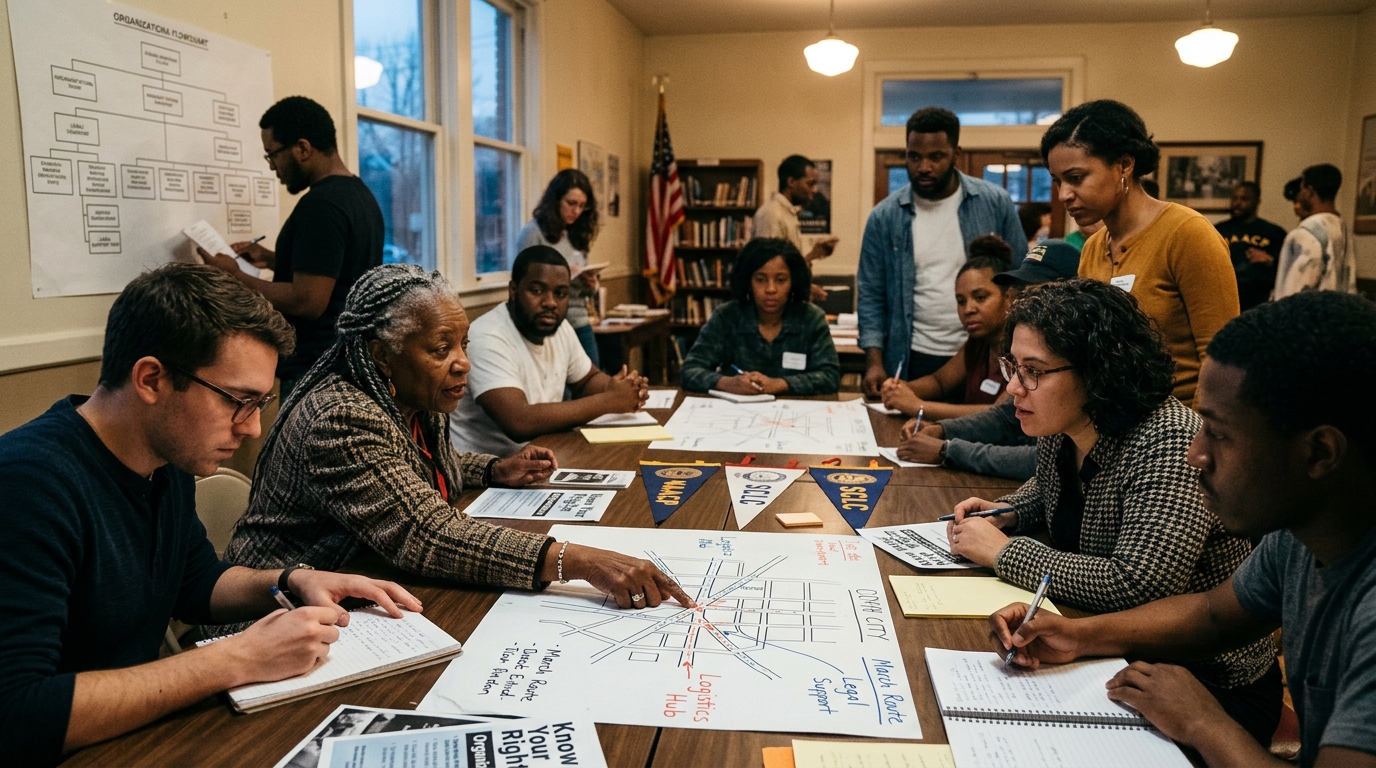
When modern history looks back at the mid-century American struggle for racial equality, the popular narrative is often distilled into soaring oratory, sweeping marches, and individual heroism. While monumental speeches and charismatic leaders were indeed vital to the spiritual endurance of the fight, they represent only the visible crest of a much deeper wave. Beneath the surface lay the true engine of social change: relentless, meticulous, and unglamorous grassroots organizing. The success of the civil rights movement was not an accidental byproduct of spontaneous protests; rather, it was a carefully constructed architecture of political strategy, community mobilization, and tactical direct action. By looking beyond the podium, we can understand how communities turned moral outrage into codified legislative reform. Too often, history classes and mainstream retellings compress a decade of painstaking coordination into a highlight reel of triumphant moments, obscuring the incredibly difficult, slow, and dangerous work that made those moments possible.
The Misconception of the Solitary Savior
A pervasive issue in historical retrospection is the “great man” theory—the idea that history is driven exclusively by a handful of extraordinary individuals. In the context of American civil rights, this tendency often reduces a sprawling, multifaceted movement into a simplified timeline of singular leaders who seemingly materialized to guide the masses. However, the true strength of the era’s progress lay in thousands of unknown organizers, local block captains, student activists, and dedicated citizens who built the foundation for national change.
Movements are fundamentally constructed on the backs of localized networks. Before any national figure stepped up to a microphone, everyday people were risking their livelihoods and lives to organize voter registration drives in rural counties, distribute informational leaflets in urban centers, and conduct workshops on nonviolent resistance in church basements. The infrastructure relied on deeply embedded community ties. Organizations such as the Southern Christian Leadership Conference (SCLC) and the Student Nonviolent Coordinating Committee (SNCC) operated in tandem. As chronicled by Stanford University’s Martin Luther King, Jr. Research and Education Institute, the evolution of these organizations reflected a highly sophisticated timeline of localized, relentless actions across the country . This decentralized cooperative framework ensured that if a prominent leader was jailed, the momentum of the movement did not fracture; the local leadership simply continued to execute the established strategy.
Foundational Elements of Grassroots Mobilization
Organizing for social justice required more than just impassioned ideals; it demanded a rigorously practical approach to community engagement. The infrastructure of the movement was built on a series of foundational elements that empowered disenfranchised populations to assert their rights collectively.
The Role of Community Education
One of the most effective, yet frequently overlooked, tools for grassroots mobilization was adult community education. Organizers established “Citizenship Schools” across the violently segregated South, which were ostensibly designed to teach basic adult literacy skills. In reality, these schools were subversive incubators for political empowerment. By teaching adults to read, organizers helped them pass the arbitrary and discriminatory literacy tests that were specifically designed by white supremacists to prevent Black citizens from voting. Furthermore, these classrooms fostered a sense of collective identity and civic responsibility. They transformed isolated individuals into a unified, educated political bloc capable of demanding systemic reform and understanding the specific constitutional rights being denied to them.
Coalition Building Across Divides
Another pillar of civil rights organizing was the profound ability to forge coalitions among disparate groups. Strategists understood that confronting deeply entrenched systemic racism required a broad-based alliance that transcended racial, economic, and geographic boundaries. Labor unions, progressive religious institutions, student organizations, and sympathetic political groups were actively courted and brought together to amplify the movement’s demands. This intersectional approach recognized that the struggle for racial equality was inherently linked to broader issues of economic fairness and basic human rights. By aligning with labor leaders, civil rights organizers multiplied their financial and organizational resources, proving that unity across different societal sectors was a prerequisite for toppling entrenched institutional power.
The Logistics of Direct, Nonviolent Action
The public face of the civil rights movement was characterized by powerful displays of nonviolent direct action. However, executing events like boycotts, sit-ins, and large-scale mass marches required an astonishing level of logistical coordination that rivaled military operations.
The March on Washington for Jobs and Freedom in August 1963 stands as a definitive masterclass in organizational execution. Spearheaded by seasoned strategist Bayard Rustin and veteran labor leader A. Philip Randolph, the march required organizers to coordinate transportation for over 250,000 attendees from across the country. According to primary records maintained by the Library of Congress, planning documents meticulously outlined every imaginable detail. The comprehensive final plan included political goals, talking points for media interactions, the logistical provision of 80,000 boxed lunches, and the strategic placement of portable sanitation facilities . The success of the march was not a spontaneous, organic uprising but the result of two months of exhaustive, relentless planning in a Harlem headquarters, where volunteers worked around the clock to distribute manuals, raise funds, and mobilize participants from every corner of the nation.
Nonviolent direct action was a highly calculated strategy designed to expose the brutal, unvarnished realities of segregation to a national television audience. By remaining entirely peaceful in the face of violent provocation, organizers created a stark moral contrast that captured the attention of the media and the conscience of the broader public. This tactical discipline required intensive, emotionally grueling training; volunteers participated in role-playing exercises where they were subjected to simulated verbal and physical abuse to learn how to protect themselves and maintain their composure during actual assaults.
Navigating Institutional Pushback and Securing Legislative Change
The primary objective of grassroots organizing was to generate enough localized pressure to force systemic, national legislative change. This meant navigating severe, often lethal, institutional pushback from local governments, heavily armed law enforcement agencies, and domestic terrorist organizations. Organizers faced various forms of extreme pushback, including:
- Illegal surveillance: Monitoring by local and federal agencies aiming to disrupt strategic communication and smear leaders.
- Economic intimidation: Immediate loss of employment, loan denials, and eviction for those who dared to register to vote.
- Arbitrary arrests: Law enforcement repeatedly using fabricated charges to drain organizational bail funds and demoralize activists.
- Physical violence: Bombings, beatings, and murders perpetrated by white supremacist organizations acting with state impunity.
Despite these immense, terrifying challenges, the organizational structure held firm, brilliantly translating street-level activism and public suffering into undeniable political leverage. The relentless pressure applied by boycotts that crippled local economies, sit-ins that disrupted daily commerce, and marches that halted city traffic forced the federal government to intervene.
This organizing culminated in monumental legislative victories, most notably the Civil Rights Act of 1964. As documented by the National Archives, this landmark legislation, heavily influenced by the undeniable momentum and lobbying of civil rights organizations, formally outlawed segregation in businesses and public places, and banned discriminatory practices in employment . The passage of this act demonstrated the undeniable efficacy of combining grassroots agitation with strategic, sophisticated political lobbying.
Economic Justice as a Pillar of Equality
As the movement secured crucial, foundational victories in desegregation and voting rights, organizers rapidly recognized that legal equality was vastly insufficient without corresponding economic justice. A desegregated restaurant meant little to a family that could not afford to buy a meal there. Consequently, the later years of the movement saw a pronounced, strategic shift toward addressing the systemic economic disparities that disproportionately suffocated marginalized communities.
This strategic pivot was most famously epitomized by the Poor People’s Campaign of 1968. Visionary organizers conceived a massive, multiracial coalition of poor Americans—bringing together Black urban residents, white Appalachian coal miners, Chicano agricultural workers, and Native American citizens—to converge on the nation’s capital and demand an economic bill of rights. As noted by the National Park Service, this campaign aimed to unequivocally highlight the realities of economic inequality by constructing “Resurrection City,” a sprawling temporary settlement of plywood A-frame shelters erected directly on the National Mall . This ambitious direct-action campaign sought to compel the federal government to commit to radical economic reforms, including full employment, a guaranteed annual income, and an abundance of affordable housing. While the campaign faced significant internal leadership transitions and devastating weather-related challenges, it profoundly underscored the organizers’ deep, enduring understanding that true human liberation required actively dismantling both racial and economic barriers simultaneously.
The Evolution of Civil Rights Tactics
To better understand the profound sophistication of these grassroots movements, it is helpful to analyze how organizing strategies rapidly evolved to meet different historical challenges across three distinct phases of the struggle.
| Strategic Phase | Primary Objective | Core Organizing Tactics | Key Legislative/Social Outcomes |
|---|---|---|---|
| Legal & Judicial Strategy (1940s-1950s) | Dismantle the state-sponsored legal framework of segregation. | Test cases, appellate litigation, constitutional challenges by legal scholars. | Desegregation of public schools, shifting the legal precedent on “separate but equal.” |
| Nonviolent Direct Action (1950s-1960s) | Expose systemic brutality and force federal intervention. | Sit-ins, economic boycotts, freedom rides, highly coordinated mass marches. | Civil Rights Act of 1964, Voting Rights Act of 1965, end of legal public segregation. |
| Economic & Intersectional Advocacy (Late 1960s) | Address systemic poverty, housing discrimination, and wealth disparity. | Multiracial coalitions, sustained encampments, tenant strikes, labor organizing. | Heightened national focus on poverty, Fair Housing Act of 1968, expansion of welfare. |
Translating Mid-Century Tactics to Modern Advocacy
The profound legacy of mid-century civil rights organizing continues to actively inform and inspire contemporary social justice movements across the globe. While the tools of mass mobilization have undoubtedly evolved—with digital platforms, encrypted messaging, and social media algorithms largely replacing mimeograph machines and localized phone trees—the fundamental, core principles of effective organizing remain remarkably unchanged.
Modern movements still rely heavily on the tedious, largely invisible, behind-the-scenes work of building durable coalitions, systematically educating communities on their rights, and meticulously coordinating the logistics of public dissent. The ability to harness raw public outrage and channel it constructively into sustained, strategic, and disciplined action is just as vital today as it was in the turbulent 1960s. Contemporary organizers actively study the logistical successes and structural failures of past campaigns, skillfully adapting historical strategies to confront modern iterations of systemic inequality, from mass incarceration and criminal justice reform to climate change and environmental justice.
The most enduring, powerful lesson of civil rights organizing is that monumental, societal-level change is never the spontaneous result of a single brilliant speech or the arrival of a lone political savior. It is, and always has been, the deliberate product of ordinary people engaging in the extraordinary, exhausting, and essential daily work of building an unstoppable movement from the ground up.
Frequently Asked Questions (FAQs)
What was the role of local grassroots organizers in the civil rights movement?
Local organizers were the absolute backbone of the entire movement. They handled the critical, day-to-day operations required to build power, such as running local voter registration drives, organizing community-wide economic boycotts, and managing the intricate logistics of local protests. Their unglamorous work ensured that the movement sustained its momentum even when prominent national leaders were entirely unavailable.
Why is the 1963 March on Washington considered such a monumental logistical feat?
Coordinating the March on Washington required mobilizing, transporting, and managing over 250,000 people from all across the United States before the advent of the internet or modern cellular communication technology. Organizers had to meticulously arrange transportation via thousands of chartered buses, provide mass sanitation and emergency medical facilities, distribute 80,000 boxed meals, and ensure a completely peaceful environment.
What was the primary goal of the Poor People’s Campaign?
Launched in 1968, the Poor People’s Campaign was a strategic effort to address the deep intersection of racial and economic injustice in America. It sought to build a massive, multiracial coalition of impoverished Americans to demand comprehensive federal anti-poverty legislation, a guaranteed income, and full employment. This effort culminated in a highly publicized occupation of the National Mall in Washington, D.C., known as “Resurrection City.”
References
- Exploring the Ideas and Logistics Behind the March on Washington Using a Planning Document — Library of Congress. 2023-02-02. https://blogs.loc.gov/teachers/2023/02/exploring-the-ideas-and-logistics-behind-the-march-on-washington-using-a-planning-document/
- Congress and the Civil Rights Act of 1964 — National Archives. 2020-10-10. https://www.archives.gov/legislative/features/1964-civil-rights
- Resurrection City — U.S. National Park Service. 2020-09-01. https://www.nps.gov/articles/000/resurrection-city.htm
- Major King Events Chronology: 1929-1968 — The Martin Luther King, Jr. Research and Education Institute, Stanford University. 2023-01-01. https://kinginstitute.stanford.edu/king-resources/major-king-events-chronology-1929-1968
Similar Articles








Read full bio of medha deb


