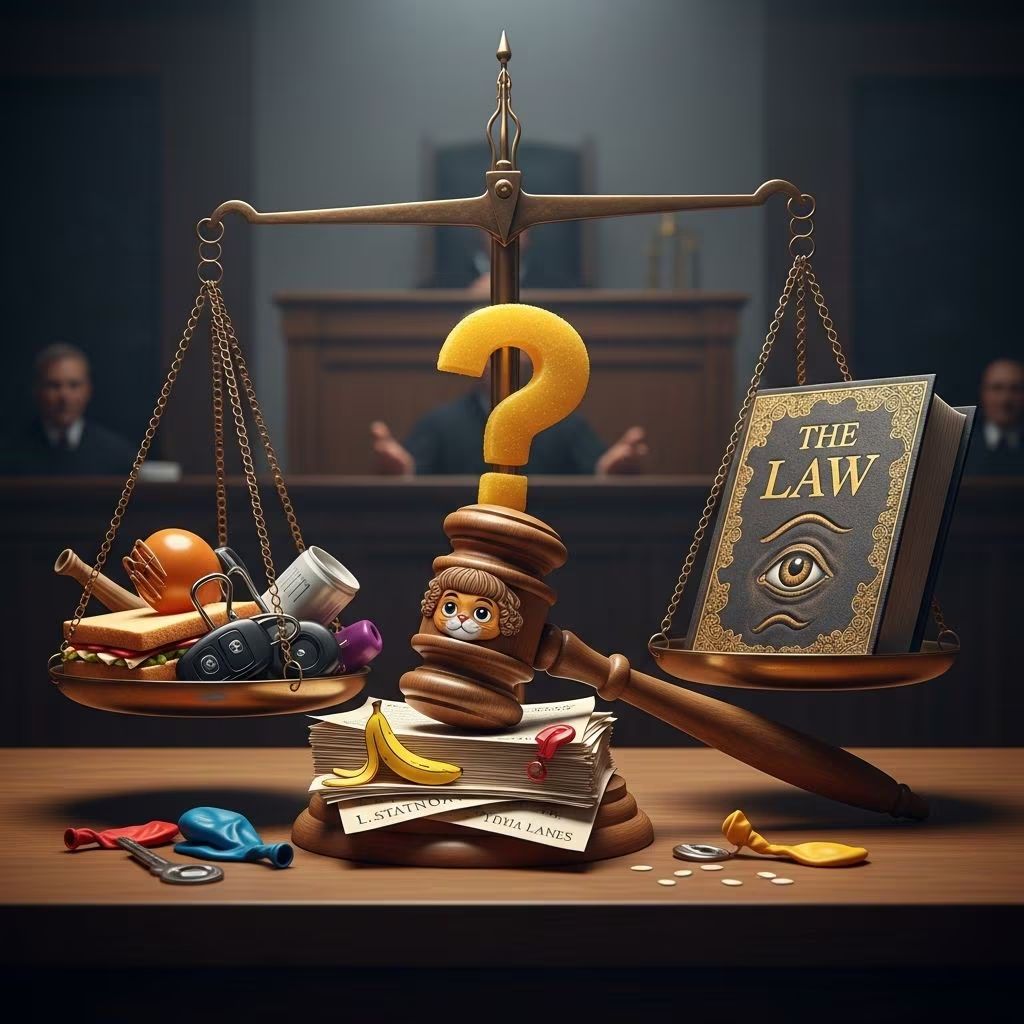
Modern life produces strange conflicts, and some of the strangest end up in court. Stories about wild lawsuits — blaming cereal for fake fruit, suing over hurt feelings, or demanding millions for minor slights — spread quickly and often leave people wondering: Can you really sue for that?
This guide looks at odd and surprising situations people have sued over, explains the legal concepts behind them, and clarifies when a lawsuit is possible, when it is pointless, and when it can backfire on the person filing it.
What It Means to “Be Able to Sue”
In everyday conversation, people say “I’ll sue you” to mean they are angry. Legally, the idea is more precise.
- You can file a lawsuit over almost anything if you pay the filing fee and meet procedural rules.
- Winning is different — you must meet specific legal requirements for your claim.
- Judges can dismiss lawsuits that lack any legal basis, sometimes quickly, and in extreme cases can penalize the filer.
Civil courts typically require at least these basics:
- A duty owed to you by another person or business (for example, the duty to drive safely, or a contractual promise).
- A breach of that duty (carelessness, deception, refusal to honor a deal, etc.).
- Causation: the breach must be a factual and legal cause of your harm.
- Damages: real, measurable harm — physical, emotional, or financial.
If one of those elements is clearly missing, a judge may treat the case as frivolous and dismiss it early.
Weird but Real: Odd Lawsuits That Had a Legal Footing
Some lawsuits sound ridiculous in headlines but are legally serious once you know the facts.
Dangerous Products and Unexpected Injuries
Product-liability law allows people to sue when a product is defectively designed, poorly manufactured, or sold without adequate warnings.
- Products that explode or break: Shattering bottles, exploding cans, or defective household devices can cause serious eye, face, or burn injuries, even during ordinary use.
- Misleading labels or hidden risks: Companies can be sued when advertising or labels misrepresent what a product is, how to use it safely, or where it comes from.
These cases may look odd because the accident occurs in a mundane setting — like a grocery checkout line — but courts often treat them as straightforward personal-injury or consumer-protection claims.
Entertainment That Is “Too Scary” (or Too Dangerous)
Haunted houses, theme parks, and adventure attractions make people sign waivers, but those waivers are not a free pass for unsafe conditions.
- Normal fear vs. unreasonable risk: Fright is expected; hidden puddles, unlit hazards, or poorly controlled crowds may be negligence.
- Foreseeable panic: If an attraction intentionally startles guests, it should reasonably anticipate that some will run, fall, or collide with objects or other people.
Courts often examine whether the risk that caused the injury was part of what a reasonable customer would expect, or whether the operator failed basic safety duties.
Odd Consumer Expectations and “No Reasonable Person” Lawsuits
Some consumer lawsuits are thrown out because a judge decides no reasonable person would have believed what the plaintiff claims.
- Fictional ingredients, like “crunchberries” presented as fruit, have led to lawsuits alleging false advertising; courts have dismissed some on the grounds that the claim is too implausible.
- Exaggerated ads, such as humorous commercials promising absurd rewards, are often treated as “puffery,” not serious contract offers.
Advertising law distinguishes between factual representations (which must be truthful) and obvious exaggerations (which the law assumes consumers will not take literally).
Surprisingly Common Odd Disputes
Many everyday annoyances never become news, but they frequently motivate people to ask lawyers, “Can I sue?”
Neighbor Headaches and Property-Related Annoyances
Law recognizes that you have a right to reasonable enjoyment of your property, but not a guarantee of a perfectly quiet, drama-free life.
| Situation | Possible Legal Theory | When It Might Work |
|---|---|---|
| Constant late-night parties | Private nuisance | When noise is frequent, substantial, and documented. |
| Overgrown tree damaging fence | Negligence / trespass to property | If you gave notice, and the owner refused to address known damage risks. |
| Smells from nearby business | Nuisance | When smells or fumes materially interfere with use of your home. |
Cities often have local ordinances addressing noise, odors, and trash; using those enforcement channels is usually faster and cheaper than suing.
Hurt Feelings, Embarrassment, and Social Misconduct
Most social friction is not a lawsuit. Courts are cautious about turning all bad manners into legal claims, but some extreme cases cross the line.
- Defamation: You may sue if someone publishes false statements of fact about you that harm your reputation (for example, accusing you of a crime you did not commit), subject to free-speech protections.
- Intentional infliction of emotional distress: The law sometimes allows claims for conduct that is so outrageous and extreme that it goes beyond all bounds of decency, causing serious psychological harm.
- Invasion of privacy: Secret recordings in private spaces, doxxing, or disclosing medical information can support lawsuits in many states.
Run-of-the-mill rudeness, breakups, or simple insults almost never qualify — even if they feel deeply unfair.
What Makes a Lawsuit “Frivolous”?
The term “frivolous lawsuit” is often used loosely in conversation, but courts and ethics rules give it a more concrete meaning.
- No arguable legal basis: The claim contradicts well-established law, with no reasonable argument to change or extend that law.
- No factual basis: The allegations are unsupported by evidence and sometimes clearly invented.
- Improper purpose: Suing only to harass, intimidate, or burden the other side, rather than to resolve a real dispute.
Under court rules, lawyers may be disciplined and parties may be ordered to pay fees or monetary penalties for filing truly frivolous cases.
Costly Lessons From Over-the-Top Lawsuits
Highly publicized suits over trivial harms — like demanding enormous sums for minor losses — illustrate how judges police the boundary between creative legal arguments and abuse of the system.
- Courts may dismiss cases early on motions to dismiss or for summary judgment.
- Repeat or extreme abuse can lead to a litigant being labeled “vexatious,” limiting their future access to courts.
- Fee-shifting or sanctions can leave the filer owing the other side’s legal bills.
In practice, most frivolous cases fail long before a jury has any say.
Five Questions to Ask Before You Sue Over Something Strange
If you are tempted to sue over a bizarre incident — whether it involves a strange product label, an awkward social situation, or a one-in-a-million accident — carefully consider these questions.
1. Did You Suffer Measurable Harm?
Civil cases are about remedies, usually money. Ask yourself:
- Did you have medical bills, lost wages, or property damage?
- Can you document emotional distress, such as through therapy records or long-term impact?
- Is the harm more than minor inconvenience or irritation?
Court systems are not designed to address mere annoyance, and judges expect tangible losses.
2. Did Someone Clearly Do Something Wrong?
Not every bad outcome has a villain. For a negligence claim, you generally must show:
- The other party had a recognizable duty (for example, to keep premises reasonably safe).
- They failed to act reasonably under the circumstances.
- That failure directly led to your injury.
If the event was truly a freak accident that no reasonable person could foresee or prevent, courts are unlikely to impose liability.
3. Can You Prove the Key Facts?
Unusual stories often hinge on disputed facts. Strengthen your position by gathering:
- Photos or video of the scene.
- Witness names and contact information.
- Receipts, contracts, warranties, or product packaging.
- Medical records and repair estimates.
Without evidence, even a legitimate grievance may be impossible to win.
4. Are There Simpler Options Than a Lawsuit?
Before heading to court, consider:
- Insurance claims (homeowners, auto, business, or product warranties).
- Small claims court for low-dollar disputes, where procedures are streamlined and lawyers might not be required.
- Regulatory complaints to consumer-protection agencies, licensing boards, or local code enforcement.
- Mediation or informal negotiation to reach a compromise.
These routes are often less expensive, faster, and less stressful than full-scale litigation.
5. What Will It Cost — Financially and Emotionally?
Even if your claim is not frivolous, pursuing it may not be worth the time and expense.
- Attorney fees, expert witnesses, and court costs can quickly outstrip the value of small disputes.
- Lawsuits are public; embarrassing facts may become part of the record.
- Cases can take months or years, with uncertain outcomes.
Many personal-injury lawyers use contingency fees (they are paid only if you win), but they usually decline very weak or low-value cases because the economics do not work.
How Judges Handle Bizarre Claims
Court systems are constantly balancing open access with protection against abuse. Judges have several tools for dealing with odd or extreme cases.
- Early screening: Judges can dismiss suits that plainly fail to state a legal claim, sometimes before the defendant even responds.
- Summary judgment: After some evidence is collected, a court may decide there is no genuine dispute for a jury and rule for one side.
- Sanctions: Under procedural rules such as Federal Rule of Civil Procedure 11, courts may order penalties when parties or lawyers present claims without any legal or factual support.
- Vexatious litigant orders: In extreme cases, courts can require a person to get permission before filing new lawsuits, especially if they repeatedly file meritless claims.
These safeguards are meant to keep the courthouse doors open to genuine grievances while filtering out cases brought mainly for shock value, publicity, or harassment.
Practical Tips Before You Sue Over Something Unusual
- Write everything down: As soon as the incident happens, record dates, times, conversations, and names.
- Preserve evidence: Do not throw away defective products, packaging, or damaged items.
- Get medical care: If you are hurt, see a doctor promptly — both for your health and for documentation.
- Stay off social media: Jokes, exaggerations, or inconsistent statements online can hurt your credibility if the case proceeds.
- Talk to a lawyer early: A brief consultation can help you understand whether your strange story has real legal potential in your jurisdiction.
Frequently Asked Questions (FAQs)
Q: Can I sue just because I am offended or embarrassed?
Feeling insulted or embarrassed, by itself, rarely creates a valid lawsuit. To have a case, you usually need either a specific legal wrong — such as defamation, invasion of privacy, or discrimination — or conduct so extreme and outrageous that it causes serious emotional distress supported by evidence.
Q: Are “ridiculous” lawsuits really as common as they appear in the news?
Highly unusual lawsuits attract headlines, but research on civil justice systems indicates that most cases involve routine matters such as motor-vehicle accidents, contract disputes, and employment claims, not outlandish stories. Many extreme cases are dismissed early and never reach a jury.
Q: Can I be punished for filing a frivolous lawsuit?
Yes. Courts can impose sanctions, including ordering you to pay the other side’s legal fees, if they find that you filed a claim with no reasonable basis in fact or law, or for an improper purpose such as harassment.
Q: What if a company’s ad or packaging tricked me in a silly way?
Consumer-protection and advertising laws may help if a business made concrete, misleading claims that would deceive a reasonable consumer, especially about price, safety, or core features. However, obvious jokes, fantasy images, or exaggerated marketing are usually treated as non-actionable “puffery.”
Q: Should I talk to a lawyer if my situation sounds weird?
If you suffered real harm — physical, financial, or reputational — it is often worth at least a brief consultation, even if the facts are unusual. Personal-injury, consumer, or civil-litigation attorneys can quickly tell you whether your case is legally plausible in your state.
References
- Leonard v. Pepsico, Inc., 88 F. Supp. 2d 116 — U.S. District Court, S.D.N.Y. 1999. https://law.justia.com/cases/federal/district-courts/FSupp2/88/116/2338213/
- Restatement (Third) of Torts: Products Liability — American Law Institute. 1998. https://www.ali.org/publications/show/products-liability/
- Federal Rules of Civil Procedure, Rule 11 — Legal Information Institute, Cornell Law School. 2023-12-01. https://www.law.cornell.edu/rules/frcp/rule_11
- Understanding the Civil Justice System — U.S. Courts, Administrative Office of the U.S. Courts. 2022-09-15. https://www.uscourts.gov/about-federal-courts/types-cases/civil-cases
- Consumer Protection: Fair and Accurate Advertising — U.S. Federal Trade Commission. 2022-05-05. https://www.ftc.gov/business-guidance/advertising-and-marketing
- Products Liability: A Legal Overview — Congressional Research Service. 2021-09-20. https://crsreports.congress.gov/product/pdf/LSB/LSB10553
- State Courts, Civil Caseloads, and Litigant Types — National Center for State Courts. 2023-01-10. https://www.ncsc.org/topics/court-statistics
- Guides for Businesses: Advertising and Marketing on the Internet — U.S. Federal Trade Commission. 2023-03-01. https://www.ftc.gov/business-guidance/resources/advertising-and-marketing-internet-rules-road
- Restatement (Second) of Torts — American Law Institute. 1979. https://www.ali.org/publications/show/torts/