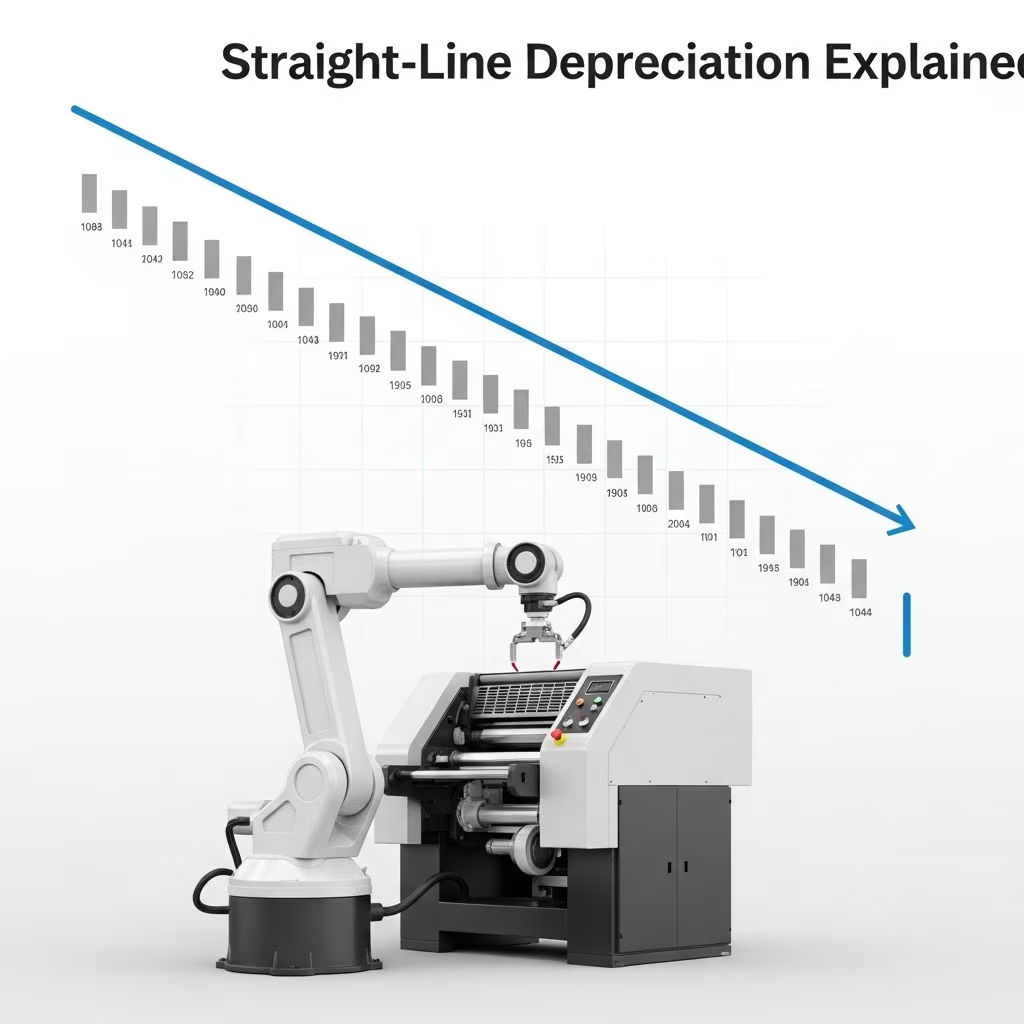
Straight-line depreciation represents the most straightforward approach to distributing the cost of a tangible asset across its productive years, ensuring consistent expense recognition in financial statements.
Understanding the Fundamentals of Asset Depreciation
Depreciation accounts for the gradual wear and tear or obsolescence of long-term assets like machinery, vehicles, or buildings. Businesses use it to match asset costs with the revenue they help generate, adhering to core accounting principles. This method prevents overstating profits in early years by systematically reducing an asset’s book value over time.
The core idea is that assets lose value predictably due to usage or time passage. Unlike inventory, which is expensed upon sale, fixed assets contribute value over multiple periods, necessitating a prorated cost allocation.
Core Components in Straight-Line Calculations
To apply this method, three key elements are essential:
- Acquisition Cost: The full initial outlay, encompassing purchase price, shipping, installation, and related taxes or fees.
- Residual Value: The projected market worth at the end of the asset’s service period, often called salvage value.
- Service Duration: The anticipated operational lifespan in years, derived from manufacturer guidelines, industry norms, or internal estimates.
These inputs form the foundation for precise depreciation scheduling, enabling accurate balance sheet representation.
The Essential Formula for Straight-Line Depreciation
The calculation boils down to a simple equation that yields uniform annual charges:
Annual Depreciation = (Acquisition Cost – Residual Value) / Service Duration
This formula ensures the depreciable amount—the net cost after subtracting residual value—is evenly spread. For instance, consider a delivery truck bought for $50,000 with a $5,000 residual value and 5-year life. The depreciable base is $45,000, divided by 5 yields $9,000 yearly expense.
| Year | Beginning Book Value | Depreciation Expense | Ending Book Value |
|---|---|---|---|
| 1 | $50,000 | $9,000 | $41,000 |
| 2 | $41,000 | $9,000 | $32,000 |
| 3 | $32,000 | $9,000 | $23,000 |
| 4 | $23,000 | $9,000 | $14,000 |
| 5 | $14,000 | $9,000 | $5,000 |
This table illustrates how the asset’s value declines linearly to its residual amount.
Step-by-Step Process to Compute Depreciation
- Document the total acquisition cost, including ancillary expenses.
- Estimate residual value based on resale data or expert appraisal.
- Determine service life using IRS tables or business projections.
- Subtract residual from cost to get depreciable base.
- Divide by years of life for the annual figure.
- Apply monthly if needed: Annual / 12.
Journal entries debit depreciation expense and credit accumulated depreciation, a contra-asset account that nets against the asset on the balance sheet.
Ideal Scenarios for Using Straight-Line Method
This approach suits assets with steady utility decline, such as office fixtures, structures, or furniture. It’s GAAP-compliant and tax-deductible under Section 168 of the Internal Revenue Code for most tangible property. Small enterprises favor it for its predictability in cash flow planning.
For assets like computers or cars that depreciate faster initially, alternatives may better reflect economic reality, but straight-line remains versatile for stable items.
Key Benefits Driving Its Popularity
- Simplicity: Minimal computational effort suits non-experts and small teams.
- Consistency: Predictable expenses aid budgeting and forecasting.
- Compliance: Universally accepted under GAAP and IRS rules.
- Transparency: Easy audit trails with uniform charges.
Financial statements benefit from stable net income patterns, avoiding volatility from accelerated methods.
Potential Limitations to Consider
Despite advantages, it assumes constant value loss, which mismatches assets front-loading wear, like heavy equipment. Overstating early-year value can distort profitability metrics. Tax strategies might prefer accelerated options for quicker deductions.
Revising estimates mid-life requires prospective adjustments, complicating records.
Comparing with Accelerated Depreciation Techniques
| Method | Description | Best For | Expense Pattern |
|---|---|---|---|
| Straight-Line | Even allocation over time | Stable assets like buildings | Constant |
| Double-Declining Balance | Twice the straight-line rate on book value | Tech, vehicles | High early, tapers |
| Units of Production | Based on output or usage | Machinery tied to production | Variable by use |
| Sum-of-Years Digits | Fractional decline | Moderate acceleration needed | Declining but less aggressive |
Straight-line prioritizes time-based simplicity, while others emphasize usage or early deductions.
Tax Rules and Straight-Line Application
Under MACRS, straight-line is optional for certain property, offering 100% bonus depreciation alternatives post-2026 changes. For books, it aligns expenses with revenue per matching principle. State variations exist, so consult tax pros.
Real-World Applications Across Industries
Manufacturing depreciates tools uniformly; real estate firms apply it to properties; retailers to shelving. A bakery purchasing a $30,000 oven with 10-year life and $3,000 salvage computes $2,700 annual expense, smoothing cost against bread sales.
Software like QuickBooks automates schedules, integrating with ledgers for real-time insights.
Handling Partial Years and Changes
For mid-year acquisitions, prorate: (Months Owned / 12) x Annual Amount. IRS conventions like half-year simplify. If life or value estimates shift, adjust forward without retroactive changes.
Best Practices for Implementation
- Maintain detailed asset registers with costs and dates.
- Review estimates annually for accuracy.
- Use accounting software for automation.
- Train staff on entries to ensure consistency.
- Consult CPAs for hybrid method selections.
Frequently Asked Questions
What distinguishes straight-line from other depreciation methods?
Straight-line spreads costs evenly by time, unlike accelerated methods that front-load expenses or usage-based ones tied to output.
Can all assets use straight-line depreciation?
Yes for GAAP, but tax rules favor MACRS hybrids; ideal for non-decelerating assets.
How does it affect cash flow?
Non-cash expense reduces taxable income, deferring taxes without outflow.
What if an asset is sold early?
Compute gain/loss: Sale price minus book value (cost less accumulated depreciation).
Is residual value always included?
Typically yes, but some tax rules assume zero for simplicity.
Advanced Tips for Optimizing Depreciation
Combine with Section 179 for immediate expensing of qualifying purchases. For fleets, segment by acquisition date. International ops may follow IFRS, mirroring GAAP closely. Monitor inflation impacts on residual estimates.
Depreciation schedules enhance investor reports by revealing asset efficiency. Analytics tools visualize trends, aiding replacement decisions.
References
- Straight Line Depreciation Formula, Meaning, and Examples — Career Principles. 2023-05-15. https://www.careerprinciples.com/resources/straight-line-depreciation-definition-formula-and-examples
- Straight-line depreciation: Definition, formula & examples — Netgain Tech. 2024-08-20. https://www.netgain.tech/accounting-finance-glossary/straight-line-depreciation
- Straight-Line Depreciation Method Definition — Becker. 2024-02-10. https://www.becker.com/accounting-terms/straight-line-depreciation-method
- What Is Straight Line Depreciation, and Why Does It Matter? — UpKeep. 2023-11-05. https://upkeep.com/learning/straight-line-depreciation/
- What Is Straight-Line Depreciation? Guide & Formula — NetSuite. 2024-09-12. https://www.netsuite.com/portal/resource/articles/accounting/straight-line-depreciation.shtml
- Straight-Line Depreciation Explained — Xero US. 2024-03-22. https://www.xero.com/us/guides/straight-line-depreciation-explained/