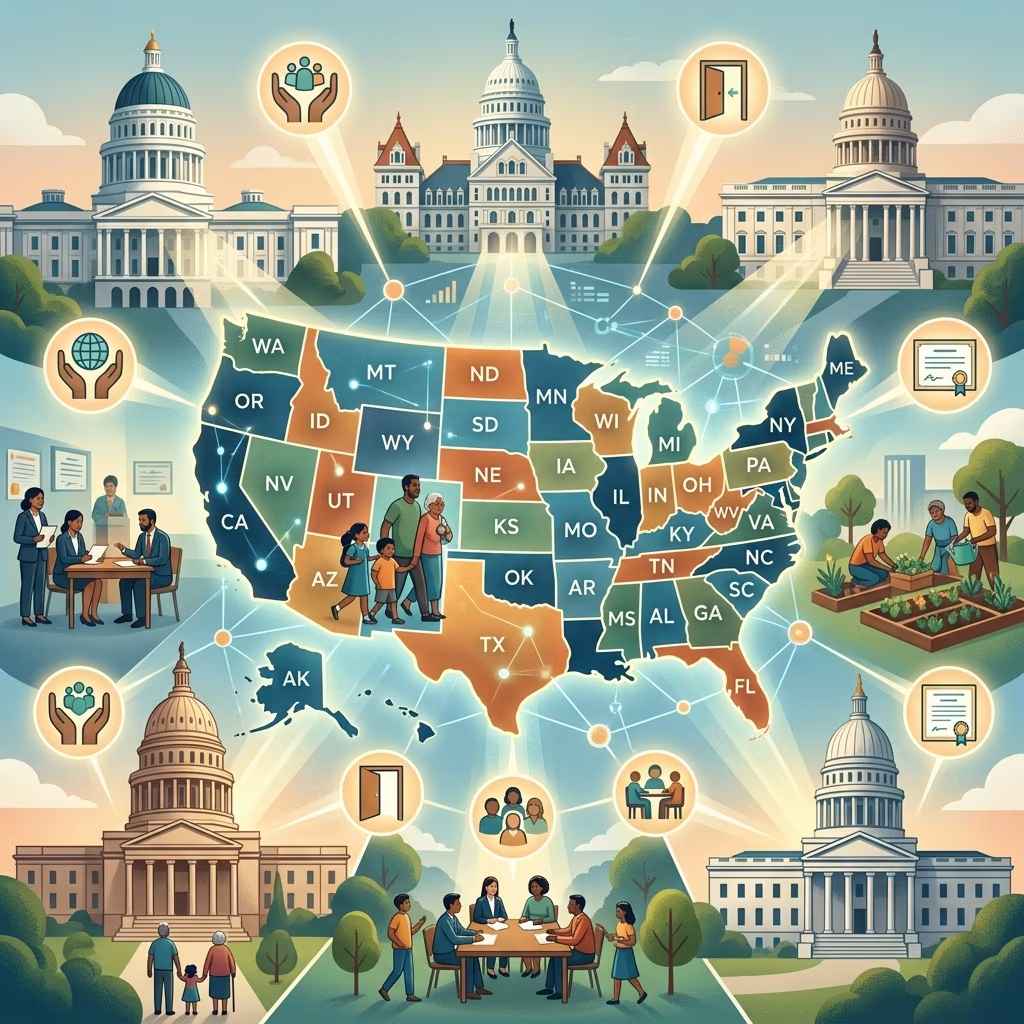
In recent years, the United States has witnessed a profound divergence in how immigration policy is approached at different levels of government. While federal policies have frequently fluctuated—often embracing restrictive and punitive measures against undocumented immigrants—a contrasting movement has steadily gained momentum at the state and local levels. Across the country, state legislatures, county commissions, and city councils have recognized the necessity of integrating and protecting immigrant communities, regardless of their legal status. This localized approach to immigrant justice represents a paradigm shift, moving the primary battlefield for immigrant rights from federal halls of power to state capitols and municipal buildings.
The decentralization of immigrant protections is not merely a political statement; it is a highly pragmatic response to the realities of local governance. Mayors, governors, and local law enforcement agencies understand that public safety, economic vitality, and community well-being are intrinsically linked to the inclusion of all residents. When a significant portion of the population lives in the shadows, fearful of interacting with basic government institutions, the entire community suffers from underreported crime, economic suppression, and public health vulnerabilities. Recognizing this intricate dynamic, numerous states have spearheaded initiatives aimed at expanding mobility rights, ensuring legal representation, and fiercely protecting the privacy of their immigrant residents.
This grassroots evolution underscores a critical reality: comprehensive reform does not solely dictate the immigrant experience from Washington, D.C. Instead, the day-to-day lived realities of immigrants are increasingly shaped by state-level bills and local ordinances. From the issuance of standardized driver’s licenses to the funding of universal legal representation, states are actively constructing a framework of inclusion that serves as a powerful counter-narrative to federal enforcement paradigms.
Expanding Mobility: The Push for Inclusive Driver’s License Policies
One of the most tangible and impactful ways states have advanced immigrant justice is through the aggressive expansion of driver’s license eligibility. Historically, lacking a driver’s license has been a severe barrier to upward mobility, lawful employment, and family stability for undocumented immigrants. Without the legal right to operate a motor vehicle, simple and essential tasks—such as commuting to work, dropping children off at school, purchasing groceries, or attending routine medical appointments—become fraught with the risk of traffic stops, which can rapidly escalate into civil deportation proceedings.
To mitigate this systemic risk and acknowledge the practical realities of everyday life, a growing coalition of states has successfully passed legislation allowing undocumented immigrants to obtain legal driving privileges. According to the National Conference of State Legislatures (NCSL), more than a dozen states, along with the District of Columbia, have implemented comprehensive laws that provide driver’s licenses to applicants who can present alternative documentation, such as foreign passports or consular identification cards, along with verifiable proof of state residency . These legislative victories are the result of years of tireless advocacy by community organizers who emphasized that the right to drive is a fundamental component of participating in modern American life.
The socioeconomic benefits of these inclusive policies extend far beyond the undocumented individuals themselves, providing a massive boon to state infrastructure and public safety. By requiring all drivers to pass written and practical driving tests, obtain proper auto insurance, and formally register their vehicles, states drastically enhance overall road safety. Furthermore, these policies generate significant state revenue through standard licensing and vehicle registration fees. Economically, these measures also lead to lower auto insurance premiums for all drivers across the state by effectively reducing the number of uninsured motorists on the road, creating a universally beneficial regulatory environment.
Decoupling Local Police from Federal Immigration Enforcement
Another central pillar of the state-level immigrant justice movement is the concerted effort to disentangle local law enforcement agencies from federal civil immigration enforcement. Often colloquially and politically referred to as “sanctuary policies,” these measures are meticulously designed to ensure that local police and sheriff’s departments focus entirely on their primary mandate: maintaining community safety and investigating local crimes, rather than acting as a force multiplier or extended arm of U.S. Immigration and Customs Enforcement (ICE).
When local police officers act as de facto immigration agents, the foundational trust between immigrant communities and local law enforcement rapidly and disastrously deteriorates. If victims or crucial witnesses of violent crime fear that interacting with the police could lead to their or their family members’ immediate deportation, they are statistically far less likely to report criminal activity. This dangerous dynamic creates an environment where predators can exploit vulnerable and silenced populations with near impunity, ultimately making cities and neighborhoods less safe for all residents, regardless of their citizenship status.
To combat this chilling effect, jurisdictions across the United States have implemented robust policies that strictly limit cooperation with ICE. The Immigrant Legal Resource Center (ILRC) notes that these disentanglement policies take various strategic forms, ranging from refusing to honor non-binding ICE detainer requests (administrative requests asking local county jails to hold individuals beyond their scheduled release time) to explicitly prohibiting the use of local municipal funds, personnel, and resources for federal immigration operations . By drawing a bright, uncrossable line between criminal justice functions and civil immigration enforcement, local governments foster deep trust, encouraging immigrants to participate fully in civic life and cooperate with local authorities without the paralyzing fear of reprisal or family separation.
Guaranteeing Due Process: Expanding Access to Legal Representation
The United States immigration court system is notoriously complex, highly adversarial, and severely backlogged. However, unlike the criminal justice system, where indigent defendants are constitutionally guaranteed the right to a public defender, immigrants facing deportation proceedings are not provided government-appointed counsel. This systemic inequity leaves tens of thousands of vulnerable individuals—including asylum seekers fleeing persecution, long-time lawful permanent residents, and even unaccompanied young children—to navigate the labyrinthine immigration courts entirely alone against highly trained federal prosecutors.
The consequences of appearing in immigration court without competent legal representation are extraordinarily stark. Extensive research and data analysis highlight that individuals with legal representation are vastly more likely to secure the right to remain in the United States and avoid deportation compared to those who go unrepresented . Recognizing this glaring and inhumane gap in due process, state and local governments have boldly stepped up to fund and organize deportation defense programs independently of the federal government.
Initiatives established in major metropolitan hubs and progressive states serve as pioneering models of universal representation. These local programs operate on the foundational legal principle that everyone, regardless of their immigration status, background, or the specific particulars of their case, deserves a fair hearing and a competent legal defense. By strategically allocating local public funds to non-profit legal service providers and public defender offices, municipalities ensure that families are not arbitrarily torn apart simply because they lack the disposable financial resources to hire a private immigration attorney. This not only upholds the fundamental American judicial value of due process but also drastically improves the operational efficiency of the heavily burdened immigration courts.
Safeguarding Data Privacy in the Digital Era
As state governments implement highly progressive and inclusive policies, such as issuing municipal identification cards and driver’s licenses to undocumented immigrants, they inadvertently collect vast amounts of sensitive, personally identifiable data. In a modern digital era where information sharing between distinct government databases is increasingly seamless and automated, this centralized data can easily become a potent and dangerous tool for federal immigration enforcement if not properly and legally shielded.
To prevent state agencies from becoming unwitting conduits and intelligence gatherers for ICE, forward-thinking legislatures have enacted robust data privacy laws. These legislative measures strictly limit or outright prohibit state departments, particularly Departments of Motor Vehicles (DMVs) and public health departments, from sharing personal information—such as home addresses, facial recognition photographs, and state tax records—with federal immigration authorities absent a legally binding judicial warrant signed by a judge.
This protective legislative firewall is absolutely crucial for the survival of state-led immigrant rights programs. Without it, the very policies designed to integrate and protect immigrants could be effectively weaponized against them, turning beneficial state services into traps. By enacting uncompromising data sharing restrictions, states confidently assure their residents that it is safe to interact with government institutions, register for essential services, and participate in local community programs without the looming, existential threat of their personal information being utilized to initiate federal deportation proceedings.
Conclusion: A Blueprint for National Reform
While the decentralized patchwork of state and local policies is certainly not a permanent substitute for comprehensive, humane federal immigration reform, it serves as a critical and life-saving lifeline for millions of individuals in the interim. The innovative laws, robust legal programs, and privacy shields developed in state capitols across the country conclusively demonstrate that a pragmatic, legally sound, and highly inclusive approach to immigration is both possible and mutually beneficial for society.
As states continue to test, refine, and expand these progressive policies, they provide a highly visible and heavily researched blueprint for what a functional, just national immigration system could ultimately look like. Until federal policymakers manage to bridge their deep partisan divides and overhaul the broken federal apparatus, the true vanguard of immigrant justice and human rights will remain firmly at the local and state level, proving every day that communities fundamentally thrive when they choose integration and protection over exclusion and fear.
Frequently Asked Questions (FAQs)
- What exactly is a “sanctuary policy”?
A sanctuary policy is a local or state law, ordinance, or internal law enforcement practice that explicitly limits cooperation with federal civil immigration enforcement agencies like ICE. These policies are carefully designed to separate local policing duties from federal immigration enforcement, ensuring that local police forces focus their resources on public safety, investigating local crimes, and building community trust rather than assisting in civil deportations. - Why do state governments issue driver’s licenses to undocumented immigrants?
States issue driver’s licenses to undocumented residents primarily to improve public safety on the state’s roadways, lower auto insurance premiums for the entire driving public, and allow individuals to commute to work and care for their families legally. This policy ensures that a significantly larger percentage of drivers are properly tested, licensed, and adequately insured. - Do immigrants have the constitutional right to a free lawyer in immigration court?
No. Unlike the American criminal justice system, individuals placed in civil immigration removal proceedings are not constitutionally guaranteed a government-appointed attorney if they cannot afford one. However, to bridge this justice gap, several progressive states and cities have created publicly funded legal defense programs to provide representation for those facing deportation. - How do state data privacy laws actually protect immigrant populations?
State data privacy laws legally prevent local government agencies, such as the DMV or public health boards, from sharing sensitive personal information (such as home addresses, contact information, and license photos) with federal immigration authorities without a specific court-ordered warrant. This prevents state-collected data from being easily utilized for civil deportation tracking.
References
- Brief: States Offering Driver’s Licenses to Immigrants — National Conference of State Legislatures. 2026-01-01. https://www.ncsl.org/immigration/brief-states-offering-drivers-licenses-to-immigrants
- Evaluating the Impact of the Midwest Immigrant Defenders Alliance — Vera Institute of Justice. 2025-01-01. https://www.vera.org/publications/evaluating-the-impact-of-the-midwest-immigrant-defenders-alliance
- Sanctuary Report Final — Immigrant Legal Resource Center. 2023-01-01. https://www.ilrc.org/sites/default/files/2024-03/Sanctuary%20Report%20Final.pdf