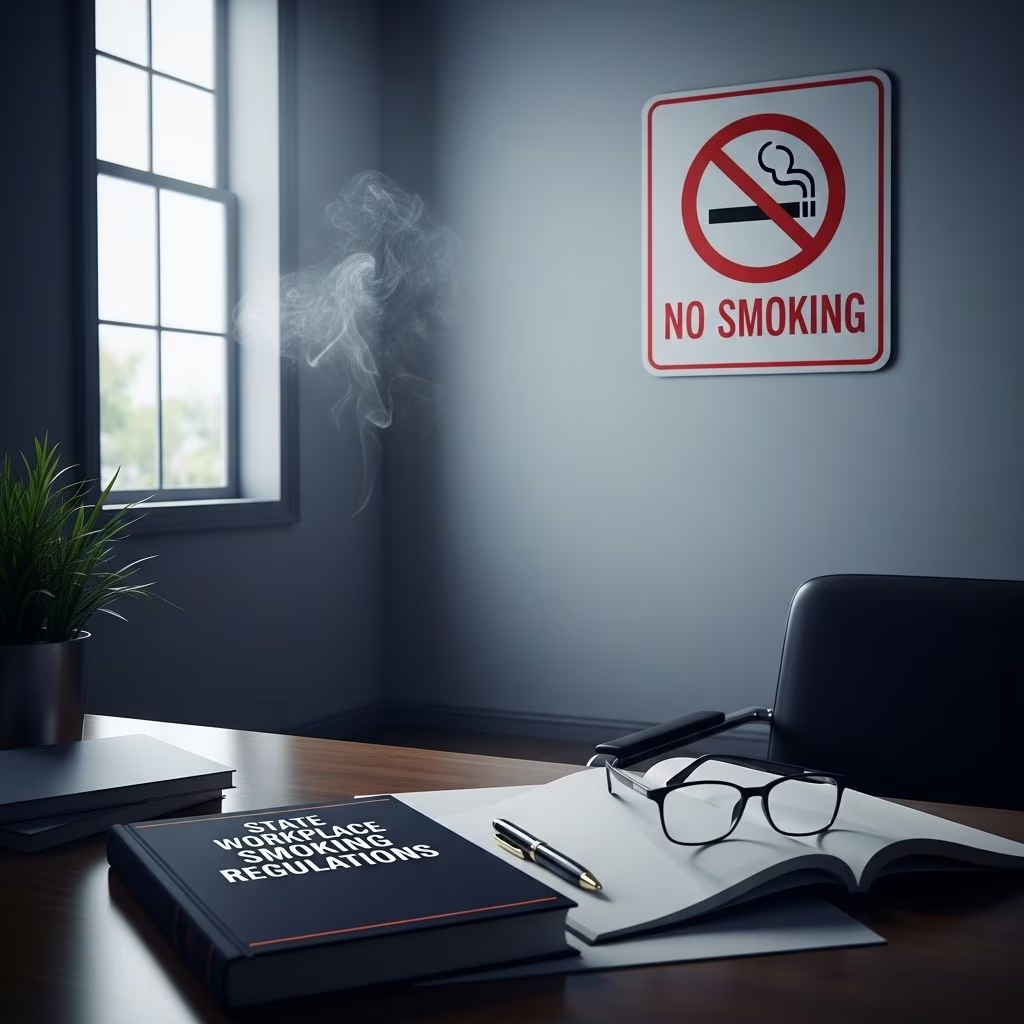
Workplace smoking rules in the United States differ widely across states, as no comprehensive federal law mandates uniform standards for private employers. These regulations aim to protect nonsmokers from secondhand smoke while balancing employee rights, with many states enforcing smoke-free policies in indoor areas.
Overview of Federal vs. State Authority
No overarching federal statute directly controls smoking in private workplaces, leaving regulation primarily to states exercising their police powers. Federal protections exist for specific venues like airplanes and government buildings, but private sector rules depend on state legislation. Employers often supplement state laws with internal policies prohibiting smoking entirely or confining it to outdoor areas.
Local ordinances can impose stricter limits than state laws, creating a patchwork of compliance requirements. For instance, cities may ban smoking in areas where state law permits designated zones. OSHA standards address indoor air quality but rarely intervene in tobacco smoke cases unless combined with other contaminants exceeding safe limits.
Comprehensive Smoke-Free States
Twenty-eight states, plus Washington D.C., Puerto Rico, and the U.S. Virgin Islands, have enacted broad smoke-free laws covering workplaces, restaurants, and bars. These jurisdictions include Arizona, California, Colorado, Connecticut, Delaware, Hawaii, Illinois, Iowa, Kansas, Maine, Maryland, Massachusetts, Michigan, Minnesota, Montana, Nebraska, New Jersey, New Mexico, New York, North Dakota, Ohio, Oregon, Rhode Island, South Dakota, Utah, Vermont, Washington, and Wisconsin.
In these areas, smoking is prohibited in all indoor public places and workplaces, with no exceptions for ventilation or separate sections, as studies show such measures fail to eliminate secondhand smoke exposure. Public health experts emphasize that completely smoke-free environments are the only effective protection against diseases linked to secondhand smoke.
| State | Coverage | Key Features |
|---|---|---|
| California | Workplaces, bars, restaurants | 100% indoor ban; e-cigarettes included |
| New York | All indoor areas | No designated smoking rooms allowed |
| Ohio | Comprehensive | Extends to private offices open to public |
| Washington | Workplaces fully | Bars and casinos covered |
This table highlights select states; full lists confirm uniform indoor prohibitions.
States with Partial or Weaker Restrictions
In 22 states lacking comprehensive laws, protections vary: some permit designated smoking areas separated from main workspaces, others allow employer discretion without mandates. A few states have no restrictions, relying solely on company policies. People in these areas often lack guaranteed safeguards against secondhand smoke exposure during work hours.
- States may authorize ventilated smoking lounges, but evidence indicates these do not fully protect air quality.
- Employers can voluntarily adopt smoke-free rules, benefiting health and productivity by reducing absenteeism and healthcare costs.
- Progress toward nationwide comprehensive laws has stalled, with no new adoptions in over a decade.
Protections Against Smoker Discrimination
Employers generally have freedom to set hiring and firing criteria, but 29 states plus D.C. prohibit discrimination based on lawful off-duty tobacco use. These ‘smoker protection’ laws prevent retaliation for smoking outside work hours unless it directly impacts job performance.
Protected jurisdictions include California, Colorado, Connecticut, D.C., Illinois, Indiana, Kentucky, Louisiana, Maine, Minnesota, Mississippi, Missouri, Montana, Nevada, New Hampshire, New Jersey, New Mexico, New York, North Carolina, North Dakota, Oklahoma, Oregon, Rhode Island, South Carolina, South Dakota, Tennessee, Virginia, West Virginia, Wisconsin, and Wyoming.
In non-protected states, companies may refuse to hire or terminate smokers, even for personal habits unrelated to work. Exceptions apply if smoking violates bona fide occupational qualifications, such as safety-sensitive roles.
E-Cigarettes and Vaping in Workplaces
Electronic cigarettes, often viewed as less harmful alternatives, face increasing scrutiny due to aerosol containing nicotine and chemicals. Nineteen states plus D.C. explicitly include e-cigarettes in smoke-free laws, banning them indoors alongside traditional tobacco.
States with statewide e-cig bans: California, Connecticut, Delaware, Maine, New Jersey, New York, North Dakota, Oregon, Utah, Vermont. Others defer to local rules or employer policies, creating uncertainty. Recent laws, like those in Minnesota and South Dakota, specifically prohibit vaping devices in workplaces.
- U.S. Surgeon General reports confirm e-cigarette emissions pose health risks, supporting inclusion in bans.
- Employers should clarify policies, as state silence often defaults to prohibiting indoor use.
- Assess state and local laws for minimum requirements.
- Consult legal experts to draft enforceable rules.
- Communicate policies via handbooks, signage, and training.
- Monitor compliance and handle violations consistently.
- Consider incentives for cessation programs to support employees.
- Smoking and the Workplace — The Stephens Law Firm PLLC. Accessed 2026. https://www.stephenslawny.com/employee-rights/smoking-rights-workplace/
- Smokefree Air Laws — American Lung Association. Accessed 2026. https://www.lung.org/policy-advocacy/tobacco/smokefree-environments/smokefree-air-laws
- U.S. State and Local Issues: Smoke-Free Laws — Campaign for Tobacco-Free Kids. 2025-07-07. https://www.tobaccofreekids.org/what-we-do/us/smoke-free-laws
- Workplaces — Americans for Nonsmokers’ Rights Foundation (no-smoke.org). Accessed 2026. https://no-smoke.org/at-risk-places/workplaces/
- Smoking Policy Guidelines for 2026 — SixFifty. 2026-01-07. https://www.sixfifty.com/blog/smoking-policy/
- S.2171 – 119th Congress: A bill to amend title 38… — Congress.gov. Accessed 2026. https://www.congress.gov/bill/119-congress/senate-bill/2171
Employer Best Practices for Compliance
Even absent strict laws, businesses benefit from proactive smoking policies. A clear policy outlines permitted locations (e.g., designated outdoor areas), break times, and enforcement. Updated for 2026, effective policies promote wellness, reduce liability, and enhance recruitment.
Smoke-free workplaces correlate with lower insurance premiums, fewer sick days, and higher morale, making them sound business decisions.
Health Impacts Driving Regulations
Secondhand smoke exposure causes serious illnesses, including lung cancer, heart disease, and respiratory issues among nonsmokers. Workplaces, where adults spend significant time, amplify risks. Smoke-free laws protect all employees, yielding public health gains without harming hospitality revenues, per extensive studies.
Adopting voluntary policies empowers employers to foster safer environments, especially in unregulated areas.
Frequently Asked Questions
Is smoking allowed in workplaces without state bans?
In states without laws, employers decide; many prohibit it indoors to protect health.
Can employers fire me for smoking at home?
No, in 29 states plus D.C., off-duty tobacco use is protected unless job-related.
Are e-cigarettes banned like cigarettes?
In 19 states plus D.C., yes; check local policies elsewhere.
What if local laws are stricter than state?
Locals prevail; always verify city/county rules.
Does OSHA regulate workplace smoke?
Rarely, only if air quality standards are exceeded.
Navigating Changes in 2026
As of 2026, smokefree advocacy continues, with model policies emphasizing total bans. Employers must stay updated, particularly on e-cig expansions and potential federal shifts like VA facility prohibitions.
This guide equips workers and managers to understand rights and obligations amid evolving regulations.