
Unveiling the Silent Arbiters: State Supreme Court Transparency
State supreme courts wield immense power over our civil liberties. It is time we pull back the curtain and demand true judicial transparency.
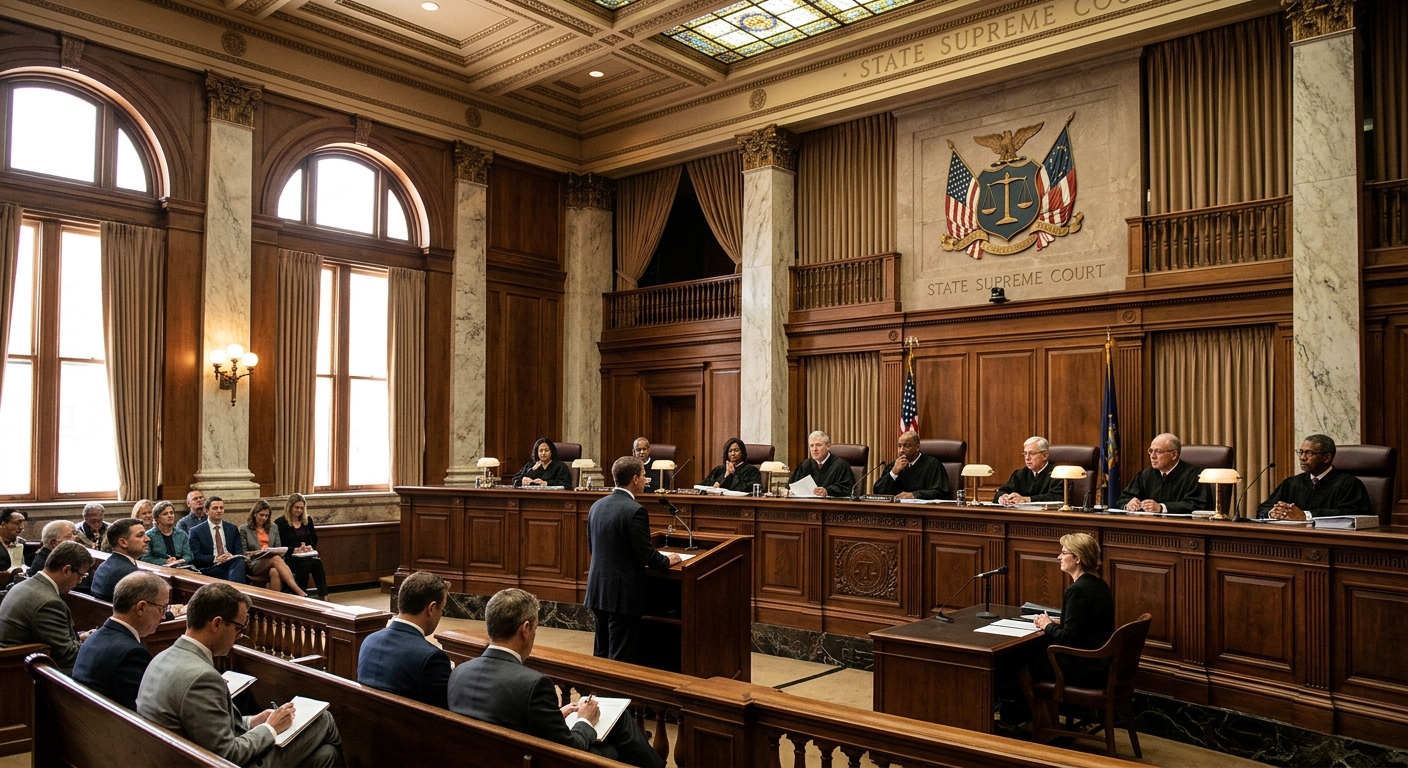
The Hidden Engines of American Jurisprudence
The U.S. Supreme Court commands the lion’s share of public attention. Whenever a major constitutional question arises, cameras flock to the steps of the highest court in the land, and legal analysts dissect every word of the resulting opinions. Yet, for all the media fanfare surrounding federal jurisprudence, a profound misunderstanding of American legal power persists. The reality is that the vast majority of our civil liberties are shaped, secured, or stripped away not in Washington, D.C., but within the walls of the fifty state supreme courts.
Despite their monumental influence over the daily lives of millions, these state-level judicial bodies operate in relative obscurity. This systemic lack of transparency, coupled with an alarming absence of standardized data, leaves the public largely in the dark about how our fundamental rights are being interpreted. From voting rights to bodily autonomy, state supreme courts are at the center of some of our most important debates. It is time we bridge this gap and demand a clearer window into the workings of state high courts.
Independent State Grounds: A Double-Edged Sword
To comprehend the urgency of this issue, one must first understand the legal doctrine of ‘independent and adequate state grounds.’ State constitutions are unique, foundational documents that frequently predate the federal Constitution. Because of this, state supreme courts have the authority to interpret their own constitutions to grant rights that are broader or more expansive than those recognized under the U.S. Constitution. For example, while the U.S. Supreme Court has recently retreated from federally protected rights in areas such as reproductive autonomy and partisan gerrymandering, litigants are increasingly turning to state courts for relief.
When a state supreme court roots its decision firmly and explicitly in its own state constitution, that ruling is generally shielded from federal appellate review. This makes state supreme court justices the ultimate, final arbiters of civil rights within their borders. They are currently shaping the future of environmental protections, voting rights, housing equity, and criminal justice reform. However, immense power requires commensurate accountability. When state courts rule on these critical issues, the legal reasoning, the procedural maneuvers, and the demographic data of the cases should be highly visible to the electorate. Unfortunately, as researchers and advocates have repeatedly discovered, this information is often locked behind archaic systems and opaque administrative practices.
The Crippling ‘Data Deficit’ in State Courts
The legal research community frequently describes the current state of judicial information as a severe ‘civil justice data deficit’. Unlike the federal court system, which relies on a unified—albeit flawed—electronic access system, state courts are a decentralized patchwork. There are fifty different states, and within those states, thousands of counties that often use completely different, non-communicative case management software systems.
This data deficit is not merely an inconvenience for statisticians; it is a profound barrier to civil rights advocacy. To evaluate whether a state supreme court is acting equitably, we need empirical data. We need to know who is filing appeals, what types of civil liberties cases are being granted certiorari (the court’s agreement to hear a case), and whether certain marginalized groups face systemic disadvantages. Without robust, standardized data collection, civil rights organizations cannot accurately map trends or hold elected judges accountable. The absence of data creates an environment where structural biases can thrive without detection, shielded by the sheer complexity and fragmentation of state-level record-keeping.
Invisible Adjudication and State Shadow Dockets
Beyond the lack of statistical data, there is a growing concern over how state supreme courts actually process their cases. In recent years, scholars and journalists have heavily scrutinized the U.S. Supreme Court’s ‘shadow docket’—the use of emergency orders and summary decisions to alter policies without full oral arguments or detailed majority opinions. Yet, legal scholars note that state supreme courts possess their own shadow dockets, which are often broader, more powerful, and vastly less transparent than the federal equivalent.
Referred to in contemporary legal literature as ‘invisible adjudication,’ state supreme courts frequently utilize procedural tools unique to state law. Many state high courts have superintending control over lower courts, allowing them to bypass normal appellate procedures, stay lower court rulings, or issue sweeping administrative directives that effectively decide civil liberties disputes before a trial is even finished. Unlike the federal shadow docket, state supreme court procedural orders are rarely covered by the media. The dockets are often difficult to navigate, and the public can easily miss monumental decisions that arrive as brief, unexplained orders. When a state supreme court quietly halts a progressive local ordinance or pauses a crucial voting rights injunction without offering a written rationale, democracy suffers in the dark.
The Threat to Democratic Accountability
Unlike the federal system, where federal judges and Supreme Court Justices are appointed for life, the vast majority of state supreme court justices are subject to some form of democratic selection or retention. Across the country, justices are chosen through partisan elections, non-partisan elections, or gubernatorial appointments followed by periodic retention elections. This structural difference fundamentally alters the relationship between the bench and the public. In a system where the electorate holds the ultimate power to retain or remove a judge, information is the vital currency of democracy.
However, the severe lack of transparency surrounding state supreme court dockets functionally short-circuits this democratic process. When voters head to the ballot box to vote in a judicial election, they are routinely faced with names they do not recognize, presiding over cases they have never heard of. Because court data is inaccessible and procedural orders are hidden within shadow dockets, advocacy groups cannot easily compile comprehensive voting records or judicial philosophies for these candidates.
How can a citizen evaluate a justice’s commitment to civil liberties if the court’s case management system makes it impossible to query all the search-and-seizure cases that justice has ruled on? How can voters assess a judge’s stance on reproductive rights or environmental regulations if the majority of their impactful rulings are issued via unexplained procedural stays? The data deficit deprives voters of the basic information necessary to cast an informed ballot, reducing judicial elections to partisan guessing games. The electorate has a fundamental right to know how their judges are interpreting the law before they grant them another term on the bench.
The Impact on Marginalized Communities
The consequences of this opacity fall most heavily on those who are already marginalized. The civil justice system is increasingly populated by unrepresented litigants—individuals attempting to navigate complex family, housing, and debt collection disputes without professional legal representation. As these disputes bubble up to the appellate level, the rules and procedural hurdles become even more insurmountable.
When state supreme courts operate without transparency, they create a body of informal law that is inaccessible to the average citizen. If advocates cannot access comprehensive docket information, they cannot intervene in crucial cases through amicus curiae (friend of the court) briefs. Amicus briefs are vital tools used by civil liberties organizations to provide justices with broader social contexts, historical data, and systemic perspectives that individual litigants might not possess.
By obscuring which cases are on the docket and rushing consequential decisions through invisible adjudication, courts effectively shut out public interest groups. This isolation deprives the judiciary of vital perspectives on how their rulings will impact minority communities, low-income renters, and marginalized voters. Transparency is therefore not just an academic concern; it is a vital safeguard for equal protection under the law.
A Roadmap for Judicial Transparency
The path toward judicial accountability requires a multifaceted approach, blending technological modernization with policy reform and media investment. Reforming the state courts is entirely possible if state governments and advocacy groups collaborate on the following priorities:
- Unified Electronic Access: State legislatures must allocate funding to construct centralized, easily searchable, and entirely free databases for all appellate filings, orders, and opinions. Citizens should not have to pay exorbitant fees to read the legal arguments shaping their constitutional rights.
- Standardized Data Reporting: Courts must commit to universal coding standards for civil and criminal cases. If researchers can accurately measure the demographics of appellants and the specific claims being raised, they can better assess whether courts are dispensing equal justice. Government initiatives like the State Supreme Court Initiative have attempted to begin this process, but broader adoption is needed.
- Transparency Scorecards: Civil liberties organizations must continue to publish and promote transparency scorecards. By grading state supreme courts on metrics such as the public accessibility of their dockets and the clarity of their procedural rules, advocates can create actionable public pressure.
- Media and Academic Investment: There must be a revitalization of legal journalism and academic research focused specifically on state judiciaries. Funding fellowships for reporters to cover state supreme courts would ensure that invisible adjudication is dragged into the public square.
Frequently Asked Questions (FAQs)
What does ‘independent state grounds’ mean?
The adequate and independent state grounds doctrine refers to the power of state supreme courts to base their legal decisions entirely on their own state constitutions. When they do this, their rulings generally cannot be overturned by the U.S. Supreme Court, allowing states to grant broader civil liberties than the federal government.
What is the ‘civil justice data deficit’?
This term describes the severe lack of standardized, easily accessible data regarding civil court cases in the United States. Because state and county courts use hundreds of different, incompatible software systems, it is incredibly difficult to track case outcomes, demographic impacts, and judicial trends.
What is a state supreme court shadow docket?
A shadow docket refers to cases that are resolved outside of the court’s regular, transparent procedures. In state supreme courts, this often involves emergency orders, stays, or administrative directives that decide the outcome of a dispute without full written briefs, oral arguments, or detailed majority opinions.
Conclusion
State supreme courts are the hidden engines of American jurisprudence. They hold the ultimate authority to interpret state constitutions and act as the final backstop for our most cherished civil liberties. Yet, the persistent data deficit and the rise of invisible adjudication threaten to separate these vital institutions from the democratic accountability they require. Until we modernize court records, standardize judicial data, and demand total transparency, the true scope of state judicial power will remain in the shadows. It is time to pull back the curtain and ensure that the courts protecting our rights are visible to the people they serve.
References
- Invisible Adjudication in State Supreme Courts — Adam B. Sopko, Carolina Law Scholarship Repository. 2024-09-01. https://scholarship.law.unc.edu/cgi/viewcontent.cgi?article=7056&context=nclr
- Paying Down the Civil Justice Data Deficit: Leveraging Existing National Data Collection — Rebecca L. Sandefur, South Carolina Law Review. 2016-01-01. https://scholarcommons.sc.edu/sclr/vol68/iss2/5/
- Update on the State Supreme Court Initiative (SSCI) — State Justice Institute. 2011-09-01. https://www.sji.gov/news/update-on-the-state-supreme-court-initiative-ssci/
- Cultivating State Constitutional Law — Brennan Center for Justice. 2018-01-01. https://www.brennancenter.org/our-work/research-reports/cultivating-state-constitutional-law-form-more-perfect-union-indianas
- Certiorari Transparency — Washington and Lee University School of Law. 2026-03-16. https://scholarlycommons.law.wlu.edu/wlulr/vol80/iss1/5/
Similar Articles








Read full bio of Sneha Tete


