
Understanding Standards of Care and the Reasonable Person in Negligence Law
Learn how the reasonable person standard and varying duties of care shape negligence claims and personal injury cases.
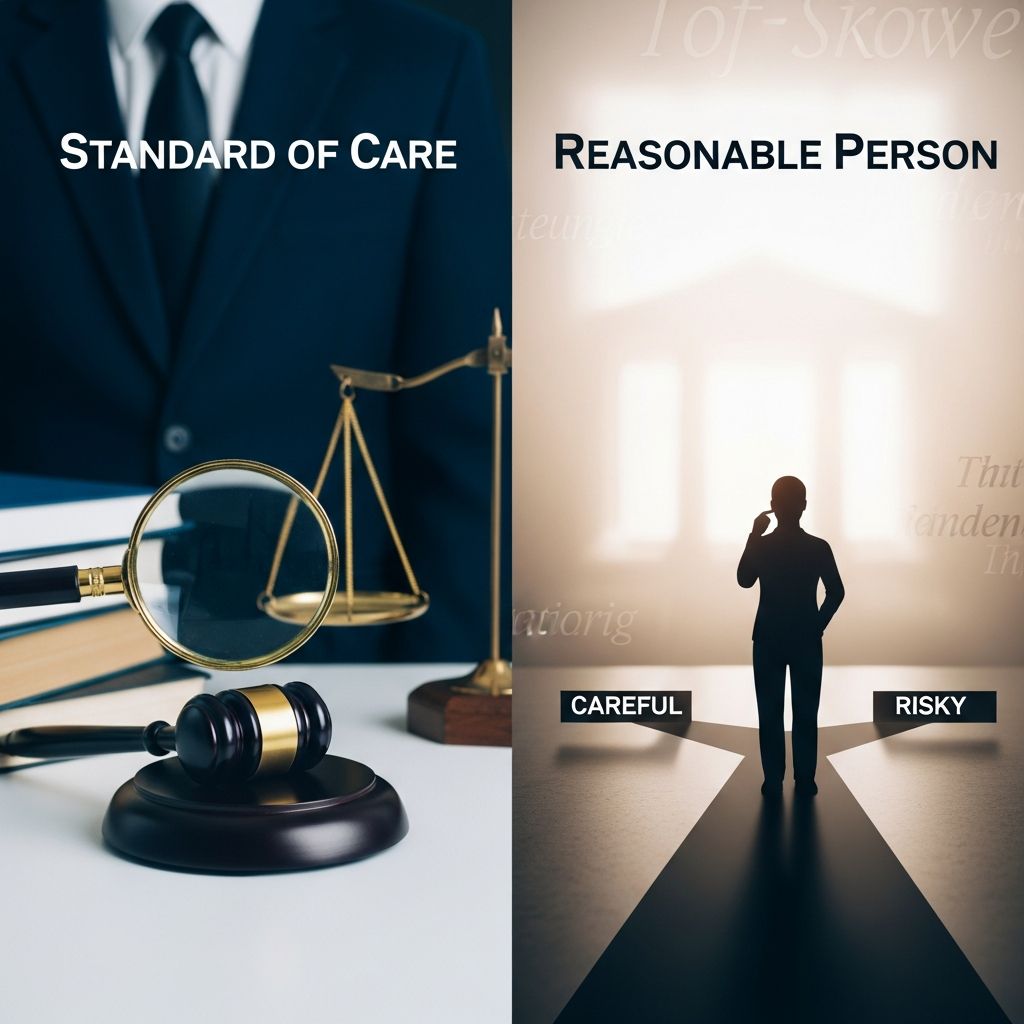
In personal injury and accident cases, courts often decide liability by asking a deceptively simple question: Did the defendant act as a reasonable person would have acted in the same situation? That question reflects the core of negligence law and the concept known as the standard of care.Understanding how the reasonable person standard works is essential for anyone involved in a claim after a crash, a fall, or another injury-causing event.
What Is a “Standard of Care”?
The standard of care is the level of caution and attention the law expects a person to exercise to avoid causing foreseeable harm to others. In negligence law, it is closely tied to the idea of a duty of care—the legal obligation to act carefully when your conduct creates a risk to someone else.
In most everyday situations, the standard of care asks whether a person acted as an ordinarily prudent and reasonable person would act under similar circumstances.
Key features of the standard of care
- Context-dependent: The required level of care changes with the situation—the same person may owe different levels of care when driving, walking, or performing surgery.
- Objective: Courts look at what a hypothetical reasonable person would have done, not what this particular defendant thought was acceptable.
- Forward-looking: The focus is on foreseeable risks, based on facts known or knowable at the time of the conduct, not on hindsight after an accident occurs.
The Reasonable Person: A Legal Benchmark
The reasonable person (sometimes called the “reasonably prudent person”) is a legal fiction—a hypothetical individual used to evaluate behavior in negligence cases. This figure represents the community’s minimum expectations for safe conduct in everyday life.
Core characteristics of the reasonable person
- Ordinary judgment: Uses typical common sense and caution for an average adult in society.
- Objective standard: Personal traits, such as being impulsive, inexperienced, or particularly nervous, generally do not lower the standard.
- Awareness of obvious risks: Understands everyday dangers, such as the risk of running a red light or driving too fast in heavy rain.
- Balances risk and utility: Considers the likelihood and seriousness of harm against the social value and burden of taking precautions.
Why law uses an objective standard
Legal systems rely on an objective reasonable person standard so that liability does not depend on each defendant’s personal habits or moral outlook. Using a single benchmark helps keep negligence rules more predictable and uniform for everyone.
| Aspect | Objective (Reasonable Person) | Subjective (Defendant’s Own View) |
|---|---|---|
| Whose conduct is measured? | Hypothetical reasonable person | Actual defendant’s personal beliefs and traits |
| Consistency across cases | High: same external standard for all adults | Low: would vary with each person |
| Fairness to injured parties | Prevents careless people from escaping responsibility | May excuse unreasonable risk-taking as “normal” for that person |
| Main use in negligence law | General rule for adults in civil cases | Limited, often only for certain mental states in criminal law |
How Standards of Care Fit into Negligence Claims
Negligence is a civil wrong that arises when a person fails to use reasonable care and that failure causes compensable harm. In a typical personal injury case, the injured person (plaintiff) must prove four elements:
- Duty: The defendant owed a duty of care.
- Breach: The defendant failed to meet the applicable standard of care (did not act as a reasonable person).
- Causation: The breach actually and legally caused the plaintiff’s injuries.
- Damages: The plaintiff suffered legally recognizable harm (medical bills, pain, lost income, etc.).
The reasonable person standard is most central to the breach element—did the defendant’s conduct fall below the level of care society requires?
Different Types of Standards of Care
Although the reasonable person is the default rule, the law recognizes that not all situations or actors are the same. Some people must meet higher or sometimes adjusted standards of care.
1. Ordinary adult in everyday life
For most adults in routine activities—such as driving, shopping, or walking—the applicable standard is that of a reasonably prudent person under similar circumstances.
- Drivers must follow traffic laws and adjust speed to road and weather conditions.
- Property occupants must take reasonable steps to keep walkways safe from foreseeable hazards.
- Individuals must avoid conduct that unreasonably risks harm, such as throwing heavy objects in crowded spaces.
2. People with specialized skills or professions
Where defendants hold themselves out as trained professionals, the law compares them not to ordinary laypeople, but to a reasonable professional in that field.
- Doctors are judged by the standard of a reasonably competent physician in that specialty, following accepted medical practices.
- Engineers, architects, and other licensed professionals are measured against professional norms and regulations.
- Lawyers are evaluated based on the skill and knowledge of reasonably prudent attorneys.
These elevated standards reflect the greater expertise, training, and control over risk that professionals possess.
3. Children and minors
Courts often apply a modified standard of care to children, taking into account age, experience, and maturity. Many jurisdictions compare a child’s conduct to that of a reasonable child of similar age, intelligence, and experience, rather than to an adult.
However, when children engage in distinctly adult or inherently dangerous activities (such as operating a motor vehicle), they may be held to the adult standard, because the risks to the public are comparable.
4. Individuals with physical disabilities
For physical disabilities, some courts adjust the standard to ask what a reasonable person with the same disability would have done, while still requiring reasonable precautions based on abilities and limitations. The goal is to be fair to both injured parties and those with disabilities.
5. Persons performing hazardous activities
In inherently dangerous activities—handling explosives, transporting hazardous chemicals, or operating heavy construction equipment—courts expect heightened vigilance. What counts as reasonable care rises along with the gravity of potential harm.
Who Decides What Is “Reasonable”?
In negligence lawsuits, the question of whether the standard of care was met is usually a question of fact for the jury (or judge in a bench trial). The judge explains the law and the general standard, but the fact-finder decides how that standard applies to the evidence presented.
Role of the judge
- Determines whether a legal duty of care exists between the parties under the circumstances.
- Instructs the jury on the general standard of care, including any special rules for professionals or children.
- May take the issue away from the jury only when no reasonable fact-finder could disagree (for example, when conduct was clearly reasonable or clearly unreasonable).
Role of the jury or fact-finder
- Identifies what the defendant actually did or failed to do, based on testimony, documents, and other evidence.
- Decides whether those actions match what a reasonable person would have done in the same situation.
- Resolves disputes about credibility and contested facts.
Because juries reflect community values, the reasonable person standard is partly shaped by shared expectations about safety and responsibility.
Evidence Used to Prove (or Disprove) Breach of the Standard
To persuade a jury that someone failed to act as a reasonable person, both sides present evidence on what happened and what precautions were available.
Common types of evidence
- Witness testimony: Drivers, pedestrians, employees, or bystanders describing the events before and during the accident.
- Physical and documentary evidence: Photographs, surveillance video, accident reports, maintenance logs, and repair records.
- Expert testimony: Specialists explaining accepted safety practices, industry customs, medical standards, or engineering principles.
- Statutes and regulations: Traffic laws, building codes, and workplace safety rules, which may help define reasonable care.
- Company policies and industry standards: Internal safety procedures or widely followed standards within a trade.
How Statutes and Regulations Affect the Standard of Care
In many cases, legislatures and agencies have already articulated specific rules—speed limits, safety guard requirements, or workplace safety regulations. Violation of such a rule may strongly suggest that the defendant did not meet the reasonable person standard.
Negligence per se (by statute)
Some jurisdictions apply a doctrine known as negligence per se. Under this doctrine, if:
- a safety statute or regulation establishes a clear standard of conduct,
- the defendant violates it,
- the plaintiff is among the class of people the rule was designed to protect, and
- the harm is the type the rule sought to prevent,
then the violation itself may automatically count as a breach of the standard of care, leaving the plaintiff to prove only causation and damages.
Limits and Critiques of the Reasonable Person Standard
Although widely accepted, the reasonable person standard is not free from criticism. Some scholars and advocates argue that the concept can hide biases or ignore important individual differences.
Common concerns
- Cultural and social assumptions: The idea of a “reasonable” response may quietly reflect the views of dominant groups, potentially overlooking different lived experiences.
- Limited sensitivity to psychological traits: Mental health conditions or cognitive impairments rarely alter the standard, which some see as unfair in certain cases.
- Risk–benefit weighting: Economic-style analyses of risk and cost can appear to prioritize cost savings over safety.
Despite these critiques, courts continue to rely on the reasonable person as the central measure of civil responsibility because it provides a workable, neutral-sounding framework for evaluating conduct.
Practical Implications for Personal Injury Claims
Anyone pursuing or defending a negligence claim should understand how the standard of care and reasonable person test shape outcomes.
For injured people (plaintiffs)
- Gather detailed evidence about the defendant’s conduct (photos, witnesses, records).
- Identify any statutes, regulations, or safety rules that were violated.
- Consider expert evaluations to explain how the conduct deviated from accepted safety practices.
- Be prepared for the defense to argue that you also failed to act reasonably, which may reduce or bar recovery under comparative or contributory negligence rules.
For defendants and insurers
- Document compliance with laws, regulations, and company policies.
- Highlight steps taken to assess and reduce foreseeable risks.
- Show that any remaining risk was minor, not reasonably avoidable, or caused primarily by the plaintiff or a third party.
Frequently Asked Questions (FAQs)
Q: What does “reasonable” mean in negligence law?
In negligence law, “reasonable” refers to the conduct of an ordinary, prudent person under similar circumstances, not to a perfect or superhuman actor. The law asks whether an average member of the community, aware of the same facts, would have taken more precautions or acted differently.
Q: Is the reasonable person standard the same as the average person?
Not exactly. The “average” person may behave carelessly, but the reasonable person standard reflects how a person ought to behave when aware of foreseeable risks. It is a normative benchmark rather than a statistical average.
Q: Who decides if someone acted as a reasonable person?
In most negligence cases, the jury or trial judge decides whether the defendant’s actions were reasonable, based on all the evidence. The judge explains the legal standard, but the fact-finder applies it to the facts.
Q: Do professionals have a higher standard of care?
Yes. Professionals such as doctors, lawyers, and engineers are usually held to the standard of a reasonably competent professional in that field, considering accepted practices and guidelines. The law expects them to use the training and expertise they have claimed to possess.
Q: Can breaking a law automatically prove negligence?
In some jurisdictions, violating a safety statute or regulation that was designed to prevent the type of harm that occurred can constitute negligence per se. In others, the violation is strong evidence of negligence but does not automatically decide the issue.
References
- reasonable person | Wex — Legal Information Institute, Cornell Law School. 2023-05-01. https://www.law.cornell.edu/wex/reasonable_person
- Reasonable Person Definition — Justia Legal Dictionary. 2022-09-15. https://dictionary.justia.com/reasonable-person
- What Is a Reasonable Person? — Bachus & Schanker, LLC. 2021-11-10. https://www.coloradolaw.net/law-101/reasonable-person/
- What is the Reasonable Person Standard? — Serrano Law. 2024-04-24. https://mikeserranolaw.com/2024/04/24/what-is-the-reasonable-person-standard/
- Reasonable person — John Gardner, in Oxford Journal of Legal Studies (archived working paper). 2019-01-01. https://johngardnerathome.info/pdfs/reasonableperson-iee.pdf
- Reasonable person — Legal overview drawing on comparative case law. 2020-06-01. https://en.wikipedia.org/wiki/Reasonable_person
Similar Articles








Read full bio of medha deb


