
Staff Accountant vs Accountant: Key Role Differences
Uncover the essential distinctions between staff accountants and general accountants in responsibilities, skills, salaries, and career progression.
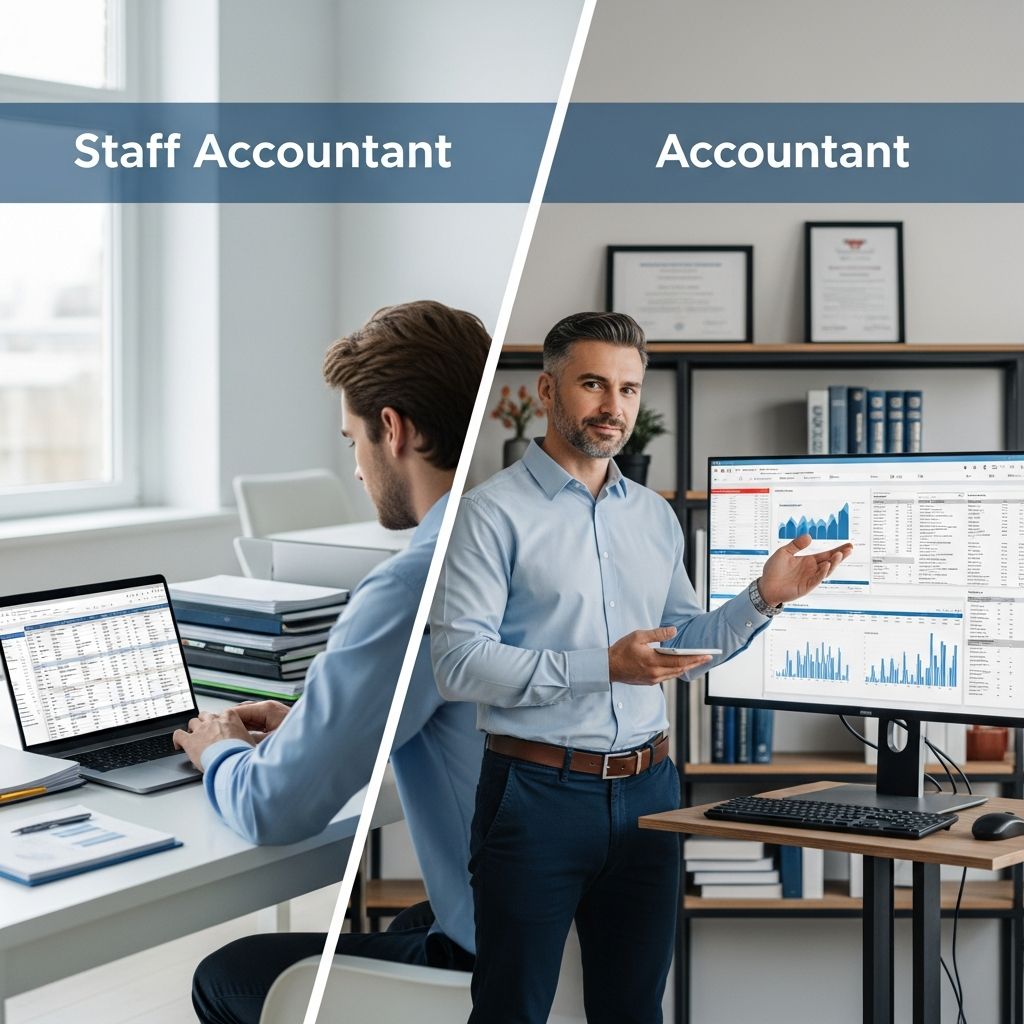
Accountants and staff accountants both play crucial roles in maintaining an organization’s financial health, but they differ significantly in scope, responsibilities, and career positioning. While general accountants often take a broad, strategic view of finances, staff accountants focus on operational execution and detailed record-keeping.
Defining the Core Roles in Accounting
The accounting profession encompasses various positions tailored to different organizational needs. A
general accountant
, sometimes called an accountant, handles overarching financial management tasks. They prepare comprehensive financial statements, ensure regulatory compliance, and contribute to high-level decision-making. These professionals analyze trends, forecast future performance, and advise on tax strategies and investments.In contrast, a
staff accountant
occupies a mid-level operational role. They support the accounting team by managing day-to-day transactions, maintaining ledgers, and ensuring accurate record-keeping. Staff accountants typically report to senior accountants or controllers, executing specific tasks that feed into broader financial reporting.Daily Responsibilities and Task Breakdown
Understanding the day-to-day work highlights the primary divergence between these roles.
- General Accountant Duties: Oversee full-cycle accounting, including financial statement preparation, tax filings, and audit coordination. They interpret data for strategic insights, such as profitability analysis or cost optimization recommendations.
- Staff Accountant Duties: Focus on transactional accounting, like processing invoices, payroll, accounts payable/receivable, and bank reconciliations. They assist in month-end closings and prepare preliminary reports for review.
General accountants engage in planning and advisory functions, while staff accountants ensure the accuracy of foundational data. For example, a staff accountant might reconcile vendor payments daily, whereas a general accountant reviews those reconciliations quarterly to assess vendor contract efficiencies.
Skills and Qualifications Required
Both roles demand strong numerical aptitude and knowledge of accounting principles, but qualifications vary by level.
| Aspect | General Accountant | Staff Accountant |
|---|---|---|
| Education | Bachelor’s in Accounting/Finance; often CPA or advanced certs | Bachelor’s in Accounting/Finance; entry-mid level certs like QuickBooks |
| Experience | 5+ years; strategic exposure | 2-5 years; operational focus |
| Key Skills | Analytical forecasting, compliance, leadership | Detail-oriented processing, software proficiency, reconciliation |
| Tools | ERP systems (SAP, Oracle), advanced Excel | QuickBooks, Xero, basic ERP modules |
Staff accountants prioritize precision in routine tasks, requiring proficiency in bookkeeping software. General accountants need broader analytical skills for interpreting complex data sets. According to the U.S. Bureau of Labor Statistics, accountants and auditors typically hold bachelor’s degrees, with many pursuing certifications to advance.
Compensation Comparison Across Levels
Salary reflects experience and responsibility scope. Staff accountants earn an average of $54,459 annually, slightly above entry-level accountants at $54,067, due to specialized training. General accountants, with strategic duties, command higher pay, often exceeding $70,000 depending on location and firm size.
- Entry-level factors: Geographic location, firm size, and certifications boost base pay.
- Mid-career growth: Staff roles offer steady increases, while general accountants see jumps with promotions to managerial positions.
In public accounting firms, staff accountants may earn bonuses tied to audit season performance, whereas corporate general accountants benefit from profit-sharing.
Career Progression Pathways
Entry often begins as a junior accountant or clerk, progressing to staff accountant after 2-3 years. From there, paths diverge:
- Staff Accountant Track: Advances to senior staff accountant, then controller or finance manager. Ideal for those preferring operational stability.
- General Accountant Track: Moves to senior accountant, then CFO or partner in firms. Suited for strategic thinkers.
Professional certifications like CPA accelerate advancement for both, opening doors to consulting or executive roles.
Work Environments and Organizational Fit
Staff accountants thrive in structured settings like corporate accounting departments or mid-sized firms, handling high-volume transactions. General accountants fit diverse environments, from startups needing versatile finance leads to large enterprises requiring compliance experts.
Public vs. private sector differences: Public firm staff accountants focus on client audits, while corporate ones manage internal ledgers. General accountants in public practice handle multiple clients strategically.
Choosing the Right Role for Your Career Goals
Aspiring professionals should assess preferences: detail-oriented execution suits staff roles; big-picture strategy favors general accounting. Hybrid paths exist, with staff experience building toward generalist positions.
Job market trends show demand for both, with remote opportunities growing post-pandemic. Staff roles offer quicker entry, while general positions provide long-term leadership potential.
Frequently Asked Questions (FAQs)
Can a staff accountant become a general accountant?
Yes, with experience and certifications like CPA, staff accountants often transition to broader general accounting roles handling strategy and oversight.
What is the typical salary difference?
Staff accountants average $54,000-$60,000; general accountants $70,000+, varying by experience and location.
Do both roles require a bachelor’s degree?
Yes, a degree in accounting or finance is standard, though staff roles may accept related fields with certifications.
How do responsibilities differ in small businesses?
In small firms, roles overlap more; staff accountants may handle general tasks, while general accountants lead compliance and planning.
Which role offers better work-life balance?
Staff roles often have predictable hours; general accountants face seasonal peaks like tax time.
References
- Accountant vs. Staff Accountant: Differences and How To … — Indeed Career Advice. 2023-2024. https://www.indeed.com/career-advice/finding-a-job/accountant-vs-staff-accountant
- General Accountant vs Staff Accountant — Finance Strategists. 2024. https://www.financestrategists.com/financial-advisor/accountant/general-accountant-vs-staff-accountant/
- What Are the Different Types of Accountants? — Pepperdine Seaver College. 2023. https://seaver.pepperdine.edu/blog/posts/types-of-accountants.htm
- Accounting Hierarchy Explained: Which Accountant? — The ASP Team. 2024. https://www.theaspteam.com/blog/accounting-hierarchy-explained-which-kind-of-accountant-do-you-need
- Accountants and Auditors: Occupational Outlook Handbook — U.S. Bureau of Labor Statistics. 2025-05-08. https://www.bls.gov/ooh/business-and-financial/accountants-and-auditors.htm
Similar Articles








Read full bio of Sneha Tete


