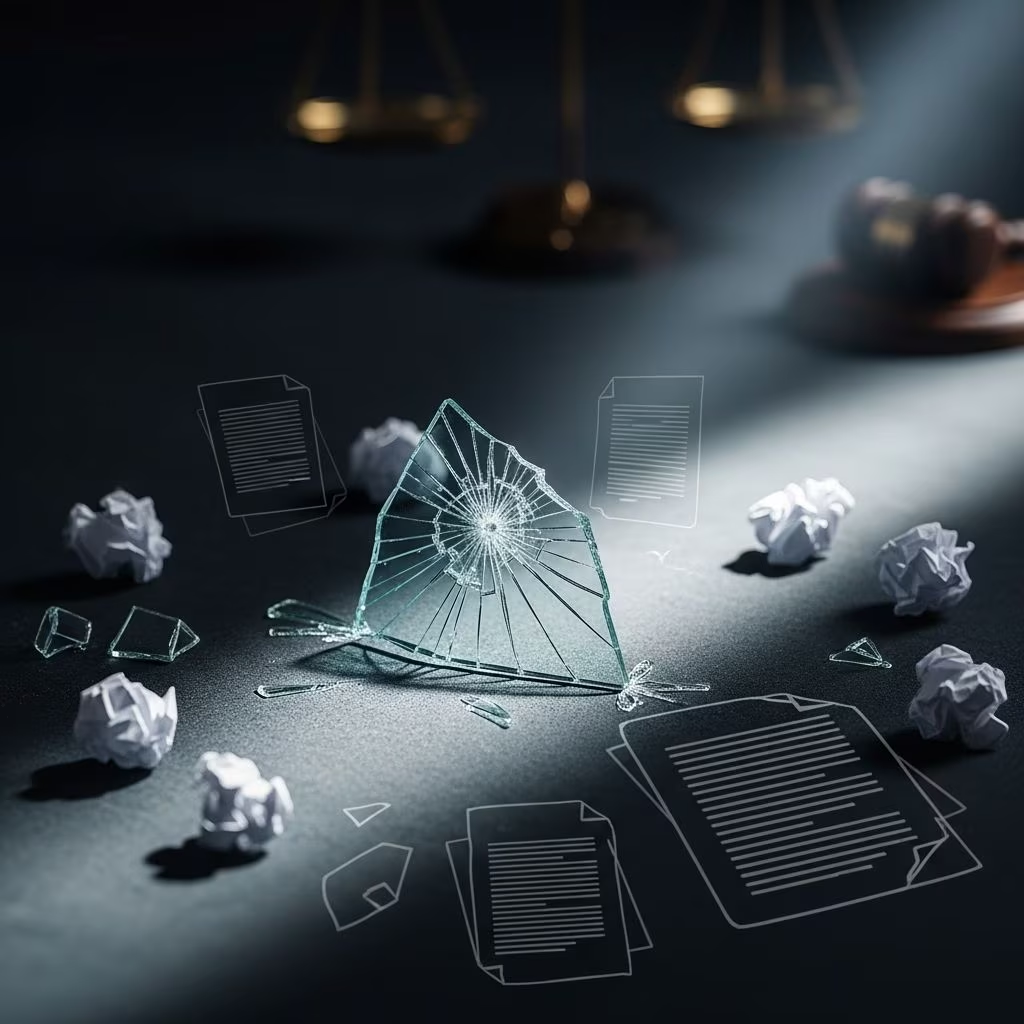
In personal injury litigation, the integrity of evidence is paramount. When key materials are lost, altered, or destroyed, it can fundamentally alter the course of a case. This phenomenon, known as spoliation, carries severe legal repercussions that can sway outcomes in favor of the prejudiced party. Courts view such actions as threats to the pursuit of justice, often imposing penalties to deter misconduct and restore balance.
Defining Spoliation in Legal Contexts
Spoliation occurs when a party with control over potentially relevant evidence intentionally or negligently destroys, alters, conceals, or fails to preserve it for use in litigation. This definition encompasses physical objects, documents, digital files, and even crime scenes or accident sites. The core harm lies in depriving the opposing side of materials crucial to proving or disproving claims, thereby undermining fair adjudication.
Legal systems recognize two primary forms: intentional spoliation, where bad faith motivates the act, and negligent spoliation, stemming from carelessness. Intentional acts trigger harsher responses, as they imply a desire to hide damaging facts. For instance, deleting surveillance footage after a slip-and-fall incident or discarding a faulty product involved in an injury could qualify.
When Does a Duty to Preserve Evidence Arise?
The obligation to safeguard evidence activates when litigation becomes reasonably foreseeable. This trigger point varies by jurisdiction but generally includes moments like an accident report, injury claim notice, or preservation letter from attorneys. Parties must act promptly to identify and protect all relevant items, from medical records to vehicle parts.
Key factors courts evaluate include:
- The timing of destruction relative to the incident and potential lawsuit.
- Whether the spoliator knew or should have known the materials’ relevance.
- Availability of substitutes from other sources.
Failure to meet this duty, especially post-notice, heightens culpability. In personal injury cases, common examples involve premises owners discarding security tapes or manufacturers failing to retain defective components.
Common Scenarios in Personal Injury Disputes
Personal injury claims frequently encounter spoliation issues. Consider a car crash where the at-fault driver’s mechanic scraps the vehicle without inspection—plaintiffs lose vital crash data. Or a workplace injury where employer surveillance vanishes, obscuring negligence proof.
Product liability suits see spoliation when consumers discard malfunctioning goods before expert analysis. Premises liability often involves cleaned-up spill sites or removed hazard-causing mats. Digital spoliation surges with emails, texts, or app data deletions amid injury claims.
| Case Type | Typical Evidence at Risk | Spoliation Risk Level |
|---|---|---|
| Auto Accidents | Vehicle parts, dashcam footage | High |
| Slip-and-Fall | Security videos, floor samples | High |
| Product Liability | Defective items, purchase records | Medium |
| Medical Malpractice | Patient charts, device logs | Medium |
Proving Spoliation: What Courts Require
To succeed on a spoliation claim, the aggrieved party must demonstrate specific elements. First, control over the evidence by the accused. Second, a preservation duty at the time of loss. Third, a culpable state of mind—willful, reckless, or negligent. Finally, prejudice, meaning the absence impairs claim or defense.
Courts apply a two-part test in many venues: foreseeability of litigation and relevance of destroyed items. Specificity matters; vague allegations fail. If negligence suffices for sanctions, intentional acts invite adverse inferences presuming the evidence harmed the spoliator.
Court Remedies and Sanctions Overview
Judges wield broad tools to address spoliation, tailored to severity and prejudice degree. Mild cases prompt lesser measures; egregious ones yield draconian penalties.
Primary Remedies:
- Adverse Inference: Jury instruction allowing presumption that lost evidence favored the opponent. This ‘spoliation inference’ levels the field without direct proof.
- Evidence Preclusion: Barring the spoliator from using related evidence or testimony.
- Monetary Fines: Costs for prejudice, including expert fees or investigation expenses.
- Issue Sanctions: Deeming facts admitted against the spoliator.
- Terminating Sanctions: Default judgment or dismissal in extreme bad faith cases.
Pretrial discovery sanctions dominate, promoting efficiency. Juries may hear tailored instructions, like Wisconsin’s model, emphasizing potential unfavorable content in destroyed records.
State Variations in Spoliation Rules
Approaches differ across jurisdictions. California emphasizes discovery misuse penalties under its Code of Civil Procedure, rejecting standalone torts post-litigation start. New York demands culpability and relevance, with striking pleadings for gross negligence. Federal courts under FRCP 37(e) distinguish negligence from intent, limiting severe sanctions to bad faith.
Some states recognize independent spoliation torts pre-litigation, allowing damages for evidence destruction. Trend favors integrated sanctions over separate suits, streamlining justice.
Strategies to Prevent Spoliation Accusations
Proactive steps mitigate risks. Upon incident awareness:
- Issue litigation hold notices to custodians.
- Document the scene thoroughly with photos, videos, measurements.
- Secure physical items; avoid routine disposal.
- For digital data, suspend auto-deletes and use forensic tools.
- Notify insurers and counsel immediately.
Self-collections demand care to avoid tainting validity. Train staff on preservation duties.
Impact on Personal Injury Case Outcomes
Spoliation transforms dynamics. Plaintiffs gain leverage via inferences supporting causation or liability. Defendants face credibility erosion, jury skepticism. Settlements often accelerate as risks mount. Quantifying prejudice proves challenging sans the evidence, but courts infer from context.
In subrogation, insurers pursue spoliators for recovery obstruction. Long-term, repeated spoliation invites ethical scrutiny for attorneys under professional rules.
Frequently Asked Questions (FAQs)
What triggers a duty to preserve evidence?
A duty arises when litigation is reasonably foreseeable, such as after an accident report or claim notice. Parties must then halt destruction and implement holds.
Can negligent destruction lead to sanctions?
Yes, though milder than intentional acts. Courts require proof of prejudice and relevance for negligence-based remedies.
Does spoliation always result in adverse inferences?
No; courts assess intent, timing, and alternatives. Inferences apply mainly to willful spoliation.
How do you prove evidence was relevant if destroyed?
Circumstantial evidence like incident logs, witness statements, or patterns suffices to establish likely relevance.
Are there defenses against spoliation claims?
Yes: lack of control, no preservation duty, absence of prejudice, or routine disposal unrelated to litigation.
Navigating Spoliation as Plaintiff or Defendant
Plaintiffs should send prompt preservation demands and monitor compliance. Defendants must audit holdings rigorously. Both benefit from early legal advice to document chains of custody. Technology aids with secure repositories and audit trails.
Ethical imperatives bind attorneys: ABA Model Rule 3.4 prohibits unlawful evidence destruction. Violations risk bar discipline alongside civil penalties.
In sum, spoliation undermines trust in the legal process. Awareness and diligence preserve not just evidence, but case viability. Litigants ignoring these risks court disaster, while vigilant parties uphold justice’s foundations.
References
- Spoliation: Understanding Its Legal Definition and Implications — US Legal Forms. Accessed 2026. https://legal-resources.uslegalforms.com/s/spoliation
- 400 Wis JI-Civil — Wisconsin State Law Library. 1990 (updated). https://wilawlibrary.gov/jury/files/civil/0400.pdf
- Understanding Spoliation of Evidence — Control Risks. Accessed 2026. https://www.controlrisks.com/our-thinking/insights/spoliation-of-evidence
- Spoliation of Evidence: Ethical and Legal Ramifications — San Francisco Bar Association. Accessed 2026. https://www.sfbar.org/blog/spoliation-of-evidence-ethical-and-legal-ramifications/
- Spoliation of Evidence — NIST Glossary. Accessed 2026. https://www.nist.gov/glossary-term/40646
- Spoliation of Evidence – Subrogation and Recovery — Cozen O’Connor. Accessed 2026. https://www.cozen.com/subrogation/resources/publications/spoliation-of-evidence-subrogation-and-recovery—articles-and-papers
- 4.18.1 Spoliation — New York State Unified Court System. Accessed 2026. https://www.nycourts.gov/judges/evidence/4-RELEVANCE/4.18.1_Spoliation.pdf