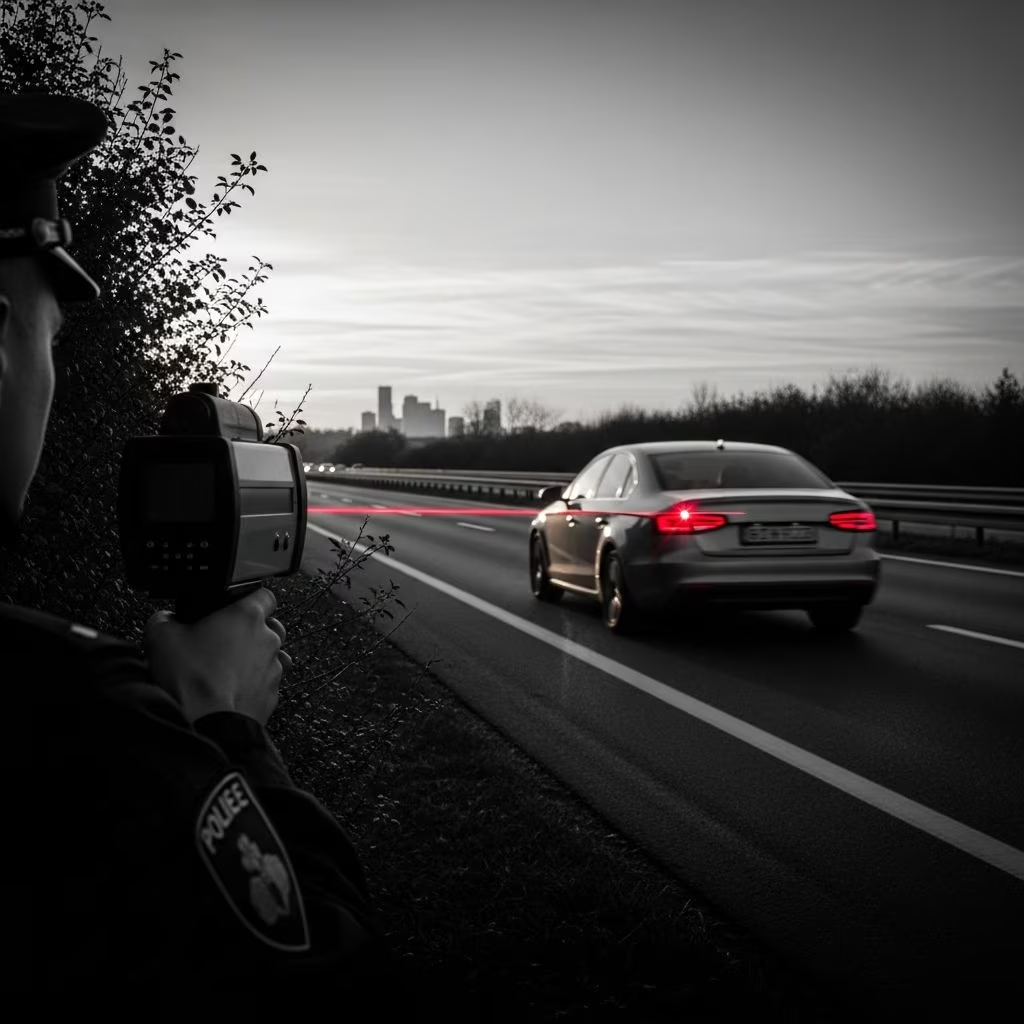
Speed traps represent one of the most debated aspects of traffic enforcement in the United States. Drivers often encounter sudden reductions in speed limits or hidden patrol positions that lead to citations, sparking questions about fairness and legality. This article delves into the definitions, regulations, and practical implications of speed traps, empowering motorists with knowledge to navigate these scenarios confidently.
Defining Speed Traps in Modern Traffic Enforcement
The term speed trap evokes images of concealed officers timing vehicles or abrupt speed limit drops designed to catch unaware drivers. Legally, definitions vary by jurisdiction, but a core concept emerges: a speed trap involves measuring speed through timing travel between fixed points without proper signage or surveys, or enforcing unjustified low speed limits with radar.
In precise terms, many states prohibit setups where police calculate speed by stopwatch between markers, as this lacks calibration accuracy. Broader interpretations include revenue-focused enforcement rather than safety-driven policing, particularly targeting out-of-state motorists less likely to contest fines. For instance, a classic setup features a highway abruptly slowing from 70 mph to 35 mph through a small town, with officers positioned just after the sign change.
- Timing-based traps: Officers use pre-marked points to measure time and compute speed.
- Radar with unjustified limits: Enforced below traffic flow without engineering justification.
- Hidden enforcement zones: Police concealed behind signage or foliage, surprising drivers.
These methods raise concerns about entrapment, but courts consistently rule that mere concealment or sudden limits do not constitute entrapment, as officers do not induce the violation. Entrapment requires active inducement, like challenging a driver to race, which rarely occurs.
State-Specific Regulations on Speed Traps
While no uniform federal law governs speed traps, states enact statutes to regulate them. California provides a stringent model under Vehicle Code § 40801, banning speed traps for arrests or evidence collection. There, a speed trap includes timing between points or radar enforcement of limits not backed by a five-year-old engineering and traffic survey (with exceptions for local streets and school zones).
Evidence from such traps is inadmissible in court per Vehicle Code § 40803, covering both direct and circumstantial proof. This forces prosecutors to rely on officer testimony alone, often weakening cases. Other states like Illinois and Oregon have similar ‘speed trap laws’ requiring surveys for limits below the 85th percentile speed—the pace at which 85% of traffic flows safely.
| State | Key Prohibition | Exceptions | Source |
|---|---|---|---|
| California | Timing traps; radar without survey | Local streets, school zones | VC §40801-40803 |
| General U.S. | Revenue over safety focus | N/A | NMA Definition |
| Many States | Unjustified low limits | Safety zones justified | Nolo Overview |
Nationwide, over 20 states have anti-speed trap laws mandating traffic studies. Without them, tickets may be dismissed if drivers request survey proof, which departments often lack.
Technology Behind Speed Detection: Radar, Lidar, and More
Police employ advanced tools to monitor speeds accurately. Radar guns emit radio waves bouncing off vehicles to gauge velocity, while lidar (laser) provides pinpoint precision. These devices are legal statewide, even in potential trap areas, provided limits are justified.
Officers strategically place units in low-expectation zones: residential areas, post-curve highways, or construction sites. Calibration is crucial; unmaintained radar can err by 5-10 mph, offering a defense avenue. Drivers can challenge readings via device logs or cross-examination on training.
- Radar: Doppler effect measures speed; effective up to 1,000 feet.
- Lidar: Laser pulses for targeted accuracy; harder to contest.
- Pacing: Officer matches speed over distance; subjective but common.
- Aircraft: Rare, used on freeways with ground confirmation.
Despite tech, speed trap laws limit evidence use if surveys are outdated.
Revenue Generation vs. Public Safety: The Ongoing Debate
Critics label speed traps as ‘revenue rackets,’ where towns set artificially low limits to fund budgets via fines. The Institute for Justice documents cases of small municipalities deriving 20-50% of income from tickets, often from transients. Common citations include minor issues like tinted windows or dangling air fresheners alongside speeding.
Proponents argue enforcement deters reckless driving, reducing accidents. Data shows speed-related crashes comprise 29% of fatalities (NHTSA), justifying vigilance. Yet, when limits ignore prevailing traffic flow—e.g., 45 mph where 85% drive 60 mph—enforcement prioritizes fines over safety.
Reforms include ‘speed trap transparency’ bills requiring fine usage reports and limit justifications.
Fines, Penalties, and Long-Term Consequences
Speeding penalties escalate with excess speed. In California, base fines are:
- 1-15 mph over: $35
- 16-25 mph over: $70
- 26+ mph over: $100
Total costs, including fees and assessments, often quadruple bases. Multiple offenses trigger points, license suspension, or insurance hikes (20-50% premiums rise). Extreme speeds (100+ mph) incur reckless driving charges with jail time.
Strategies to Challenge and Fight Speed Trap Tickets
Do not ignore tickets; contest them strategically. Steps include:
- Request Discovery: Demand officer notes, radar calibration, and traffic survey.
- Motion to Suppress: Argue speed trap illegality if survey absent or outdated.
- Challenge Radar: Question device accuracy, officer training, or visual estimation.
- Trial by Written Declaration: Submit affidavit without court appearance (CA option).
- Trial Stipulation: Officers often no-show for out-of-towners.
Success rates exceed 50% with preparation. Consult attorneys specializing in traffic law for complex cases.
Frequently Asked Questions About Speed Traps
Are speed traps legal everywhere in the U.S.?
No, many states regulate or ban improper speed traps, especially those lacking traffic surveys. California strictly prohibits certain types.
Can I fight a ticket from a hidden officer?
Concealment alone is not a defense, but combine with speed trap violations or radar errors for strong cases.
What if I’m from out of state?
Out-of-staters are prime targets but can request dismissals or pay remotely. Fight via mail to avoid warrants.
Do speed cameras count as speed traps?
Automated systems face separate rules; many states limit them, but they bypass traditional trap definitions.
How recent must a traffic survey be?
Typically 3-5 years; California mandates within five years for radar enforcement.
Preventing Speed Trap Encounters: Driver Best Practices
Proactive habits minimize risks:
- Monitor speedometer, not flow.
- Slow immediately at limit signs.
- Use apps like Waze for alerts.
- Avoid peak ticket times (holidays, month-end).
- Maintain vehicle compliance.
Understanding local laws enhances safety and rights protection.
References
- Vehicle Code § 40801 VC – California Law re “Speed Traps” — Shouse Law Group. Accessed 2026. https://www.shouselaw.com/ca/defense/vehicle-code/40801/
- Speed Traps and Impound Rackets — Institute for Justice. Accessed 2026. https://ij.org/issues/private-property/fines-and-fees/speed-traps-and-impound-rackets/
- What Is A Speed Trap? — National Motorists Association. Accessed 2026. https://ww2.motorists.org/issues/speed-traps/definition/
- Are Speed Traps Legal? How Do I Fight a Speed Trap Ticket? — Nolo. Accessed 2026. https://www.nolo.com/legal-encyclopedia/are-speed-traps-legal-how-do-i-fight-a-speed-trap-ticket.html
- What Is A Speed Trap? – Law Enforcement Insider — YouTube (Law Enforcement Insider). 2025-03-18. https://www.youtube.com/watch?v=5QxqwDtDUT8
- ARE SPEED TRAPS ENTRAPMENT? — Traffic Ticket Team. Accessed 2026. https://www.trafficticketteam.com/speeding-ticket/are-speed-traps-entrapment/