The Hidden Crisis: Educational Deprivation Behind Bars
When a young person enters the adult criminal justice system, they forfeit many fundamental liberties, but their legal right to an education is not supposed to be one of them. For decades, a hidden crisis has persisted within the walls of state penitentiaries across the nation: the systematic denial of special education services to incarcerated youth with disabilities. While federal laws strictly mandate the provision of appropriate educational services regardless of a student’s environment, the carceral system frequently prioritizes punitive measures and security over pedagogical needs and rehabilitation. The result is a profound civil rights violation that disproportionately impacts vulnerable youth, leaving them to navigate the harsh realities of adult prisons without the academic support or transition services they are federally guaranteed.
The denial of educational rights in prison is not merely an administrative oversight; it is a systemic failure that perpetuates cycles of poverty, marginalization, and recidivism. Educational programming is one of the most effective tools for reducing re-incarceration rates, yet the students who require the most specialized instruction are often the ones completely excluded from these opportunities. This educational deprivation effectively ensures that young people with disabilities return to society further behind than when they entered the system.
The Intersection of Disability and Mass Incarceration
To understand the gravity of educational deprivation in adult correctional facilities, one must first examine the systemic pathways that funnel young people with disabilities into the justice system. The phenomenon known as the school-to-prison pipeline disproportionately captures students with learning disabilities, emotional disturbances, and neurodevelopmental conditions. Research indicates that neurodivergent students and those with behavioral needs are frequently subjected to exclusionary disciplinary practices in public schools—such as suspensions, expulsions, and isolation—rather than receiving the necessary academic interventions.
Without adequate academic accommodations and behavioral support, these students are pushed out of the traditional educational environment and criminalized for behaviors that are often direct manifestations of their disabilities. Consequently, the percentage of youth in the criminal justice system who qualify for special education services is astronomically higher than in the general public school population. Some estimates suggest that over a third of incarcerated youth possess a qualifying learning or emotional disability. By the time these individuals are sentenced to adult prisons, they have typically experienced years of educational failure and systemic neglect.
Upon incarceration, their pre-existing academic and emotional vulnerabilities are compounded by an isolating environment that is entirely ill-equipped to identify, evaluate, or serve their complex educational needs. The transition from a struggling public school student to an incarcerated individual cements a trajectory of disenfranchisement that is incredibly difficult to break without targeted legal and educational interventions.
The Federal Mandate: The Individuals with Disabilities Education Act (IDEA)
The core of this legal battle centers around the Individuals with Disabilities Education Act (IDEA), a comprehensive federal law that guarantees a Free Appropriate Public Education (FAPE) to eligible children and young adults with disabilities. Under IDEA, school districts and responsible state agencies are required to develop and implement an Individualized Education Program (IEP) for every qualifying student. Crucially, the federal mandate for FAPE does not terminate at the prison gates.
Federal and state legislation specifically dictates that young adults with disabilities—typically up to their 21st or 22nd birthday, depending on regional statutory interpretations—retain their right to special education services even when incarcerated in county jails or adult correctional facilities. State Departments of Corrections, often operating in collaboration with State Departments of Education, bear the explicit legal obligation to ensure that incarcerated students are identified and provided with the individualized instruction, related behavioral services, and transition planning stipulated in their IEPs.
In a properly functioning carceral educational setting, an IEP is meant to encompass adapted learning materials, access to qualified special education teachers, and specialized accommodations that address the individual’s unique cognitive profile. Furthermore, the law requires that these students receive transition services designed to facilitate their successful reintegration into society, whether through further academic schooling, vocational training, or independent living preparation.
Bridging the Gap: Legal Mandates vs. Carceral Realities
| IDEA Federal Mandate | Common Reality in Adult Prisons |
|---|---|
| Individualized Education Programs (IEP) with tailored, measurable academic and behavioral goals. | Generic, unadapted worksheets slid under cell doors without any substantive verbal instruction. |
| Instruction delivered by highly qualified, certified special education professionals. | Reliance on untrained peer prisoner tutors, correctional officers, or complete self-study protocols. |
| Education provided in the Least Restrictive Environment (LRE) possible for the student. | Educational isolation, particularly for youth placed in long-term administrative segregation. |
| Comprehensive transition planning and vocational preparation for post-release success. | Abrupt release at the end of a sentence with zero transition planning or vocational skill-building. |
Systemic Failures: When Security Eclipses Rehabilitation
Despite the clear, unambiguous directives established by the federal government under IDEA, compliance within adult prisons remains notoriously abysmal. The architecture and administrative culture of maximum-security and state penitentiaries are inherently antithetical to the foundational principles of special education. Wardens and correctional officers are trained extensively to prioritize institutional security, containment, and order. In this high-stakes environment, educational programming is frequently viewed as an inconvenient secondary concern, or worse, a security risk.
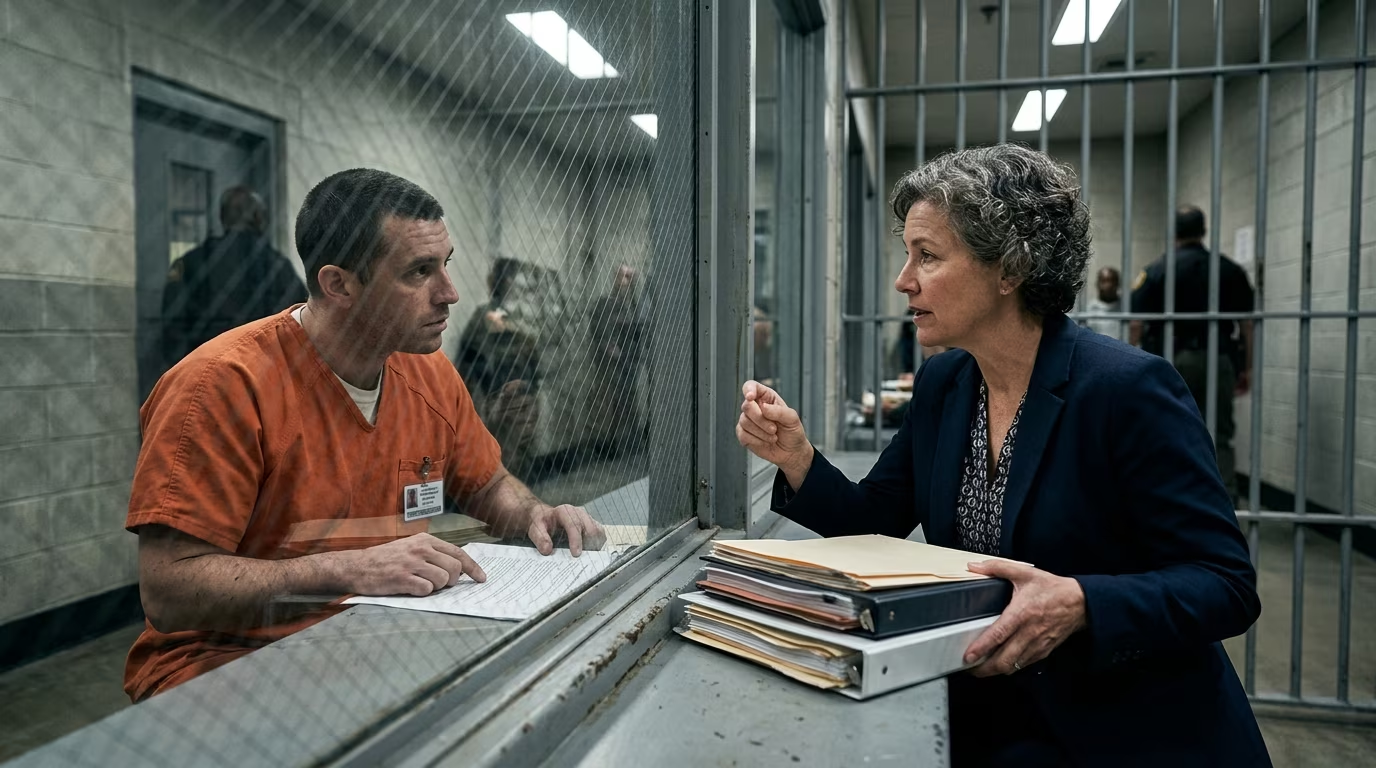
One of the most egregious violations of incarcerated students’ rights occurs through the use of solitary confinement, often rebranded administratively as “segregation.” Young adults with unmanaged emotional or behavioral disabilities are particularly susceptible to rule infractions in a high-stress, traumatizing prison environment. As a result, they are disproportionately subjected to extended periods of isolation. Once placed in segregation, whatever minimal educational access a student might have had is usually severed entirely. Instructors are often prohibited from entering high-security tiers, leaving vulnerable students with nothing but standardized packets of paper that fundamentally fail to accommodate reading deficits, cognitive impairments, or severe attentional disorders.
Furthermore, adult correctional facilities face severe and chronic staffing shortages. Recruiting licensed, highly qualified special education teachers to work inside a state prison—an environment fraught with safety concerns and completely lacking standard educational resources like internet access, interactive whiteboards, or digital technological aids—is a monumental logistical challenge. Consequently, many facilities attempt to bypass their federal legal obligations by utilizing a “jail mindset” approach to learning, effectively babysitting students in a holding room rather than engaging them in meaningful academic progress.
Landmark Litigation: Challenging the Status Quo
The systemic, nationwide refusal to accommodate disabled youth in adult prisons has sparked a massive wave of legal pushback, driven directly by the incarcerated students themselves working alongside dedicated civil liberties advocates. Frustrated by years of stolen opportunities and blatant disregard for their federal rights, a growing coalition of young plaintiffs has begun leveraging the federal judicial system to demand structural reform. Through massive class-action lawsuits, these individuals have forcefully exposed the profound gaps between the legal requirements of the IDEA and the grim, daily realities of prison classrooms.
A paradigm-shifting example of this advocacy materialized in recent federal litigation targeting state departments of corrections and education for their joint, systemic failure to provide FAPE to eligible inmates. In comprehensive legal filings, plaintiffs successfully argued that state agencies entirely neglected to track which incoming prisoners had pre-existing IEPs, failed to evaluate individuals demonstrating clear learning disabilities upon intake, and explicitly denied access to qualified educators. The overarching legal strategy emphasized that by denying these vulnerable students their educational rights, the state was effectively issuing an “educational death sentence,” guaranteeing that these youth would leave the prison system far behind their peers and utterly unprepared for the rigors of independent adulthood.
Civil rights organizations and prominent disability advocates united to meticulously document these systemic failures over several years. During extensive legal discovery phases, court-appointed neutral experts corroborated the plaintiffs’ harrowing claims, revealing a profound lack of administrative oversight and a deeply entrenched institutional apathy toward special education. The resulting legal pressure forced state agencies to the negotiating table, ultimately culminating in landmark class-action settlements that dictate sweeping, mandatory overhauls of special education policies within carceral systems.
Meaningful Remedies: Compensatory Education and External Oversight
Securing a policy change on paper is only the very first step in dismantling decades of systemic educational neglect; the second, and arguably much more critical phase, involves direct restitution and strict enforcement. In recent landmark prison education settlements, federal courts have heavily emphasized the absolute necessity of “compensatory education.” Compensatory education is an equitable legal remedy designed to put a student in the exact position they would have been in had the educational deprivation not occurred in the first place.
For incarcerated and formerly incarcerated youth whose foundational educational years were unlawfully squandered by the state, compensatory education translates into tangible, life-altering financial support. Settlement funds are meticulously established to provide affected class members with thousands of dollars designated specifically for their educational and vocational advancement. For instance, landmark rulings have enabled eligible individuals to receive up to $8,000 per year in compensatory education benefits. These vital funds empower individuals to pursue post-secondary college degrees, enroll in specialized trade schools, or access intensive reentry and transition services that the state prison system previously denied them.
Additionally, civil rights attorneys and advocates understand that adult prisons cannot be blindly trusted to self-police their compliance with newly drafted special education policies. Therefore, these monumental legal victories heavily feature the appointment of independent, external monitors. These court-appointed educational experts are officially tasked with conducting rigorous, multi-year audits of the prison’s educational programs, tracking the timely development of new IEPs, and ensuring that compensatory funds are properly and transparently allocated to the victims of this neglect.
The Ripple Effect: Why Prison Education Matters to Society
The arduous fight for special education rights behind bars extends far beyond the individual plaintiffs listed on the court dockets; it represents a critical, overarching societal imperative. Well over 90 percent of currently incarcerated individuals will eventually complete their sentences and return to their home communities. When the state blatantly neglects its statutory duty to educate young people while they are in prison, it actively contributes to a devastating cycle of poverty, civic disenfranchisement, and predictably high recidivism rates.
Conversely, providing robust special education and comprehensive transition planning drastically alters this trajectory. It equips returning citizens with the foundational literacy, vocational skills, and behavioral coping mechanisms necessary to secure stable employment, navigate complex social challenges, and lead independent, law-abiding lives post-release. By strictly enforcing the mandates of the Individuals with Disabilities Education Act within the confines of adult prisons, legal advocates are not merely correcting a bureaucratic oversight—they are actively championing a rehabilitative justice model. This model fundamentally recognizes the inherent dignity, constitutional rights, and future potential of every individual, regardless of their zip code, disability status, or carceral history.
Frequently Asked Questions (FAQs)
What is the Individuals with Disabilities Education Act (IDEA)?
The IDEA is a comprehensive federal law ensuring that tailored educational services are provided to children and youth with disabilities throughout the nation. It strictly governs how states and public agencies provide early intervention, special education, and related auxiliary services to eligible infants, toddlers, children, and young adults with disabilities, ensuring they receive a Free Appropriate Public Education (FAPE).
Do individuals in adult prisons actually have a right to special education?
Yes. Under the federal guidelines of the IDEA, eligible individuals—typically up to the age of 21 or 22, depending on specific state statutes—retain their full right to a Free Appropriate Public Education. They must receive the specialized services outlined in their Individualized Education Program (IEP), even if they are tried as adults and incarcerated in a maximum-security adult prison.
What does compensatory education mean in a legal context?
Compensatory education is an equitable legal remedy awarded by courts to students who were unlawfully denied their federal right to FAPE. In the context of prison litigation, it provides direct services or financial trusts to make up for the specific educational progress the student lost due to the correctional institution’s failure to comply with federal law.
How does the school-to-prison pipeline specifically affect students with disabilities?
Students with learning and behavioral disabilities are significantly disproportionately affected by exclusionary public school discipline policies, such as out-of-school suspensions and expulsions. This severe lack of adequate in-school support often marginalizes them, exponentially increasing the likelihood of early juvenile justice involvement and eventual long-term adult incarceration.
References
- IDEA and the Juvenile Justice System: A Factsheet — U.S. Department of Education (NDTAC). 2005-04-15. https://www2.ed.gov/policy/speced/leg/idea/brief4.html
- N.J. adopts sweeping new policies on special education in state prisons, following settlement — WHYY. 2022-03-15. https://whyy.org/articles/n-j-adopts-sweeping-new-policies-on-special-education-in-state-prisons-following-settlement/
- The School-to-Prison Pipeline for Probation Youth with Special Education Needs — PubMed Central (PMC). 2020-01-01. https://www.ncbi.nlm.nih.gov/pmc/articles/PMC8147814/
- Special Education in County Jails — Colorado Department of Education. 2022-10-01. https://www.cde.state.co.us/cdesped/speced_in_countyjails