Understanding Small Claims Court: An Accessible Path to Justice
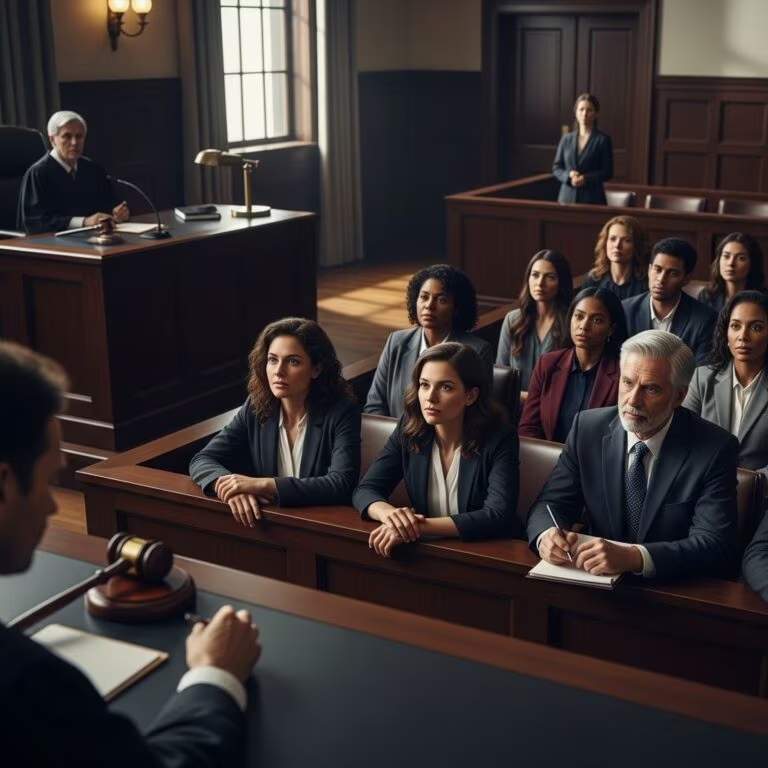
Small claims court represents a specialized judicial forum designed to resolve monetary disputes in an efficient and cost-effective manner. Unlike traditional civil litigation, which often requires substantial financial investment and extensive legal expertise, small claims court operates on the principle that ordinary citizens should have access to justice without incurring excessive legal fees. The court’s primary purpose is to provide a streamlined mechanism for settling disagreements over money, making it accessible to individuals, small business owners, and landlords alike.
This judicial system emerged from the recognition that many legitimate disputes fall below the threshold that justifies hiring an attorney. The court acknowledges that not every financial conflict requires complex legal proceedings, lengthy discovery processes, or courtroom drama. Instead, small claims court offers a pragmatic alternative where parties can present their cases directly to a judge who will evaluate the evidence and render a decision based on the merits of the dispute.
Monetary Limits and Jurisdictional Boundaries
One of the defining characteristics of small claims court is its monetary jurisdiction limit, which establishes the maximum amount a claimant can recover. These limits vary significantly depending on your location, reflecting different state and local policies. The typical range extends from approximately $2,500 to $25,000, with some jurisdictions setting their thresholds at $10,000 or $12,500. For example, California permits claims up to $12,500 for most plaintiffs, while other states maintain different ceiling amounts.
Understanding your local jurisdiction’s limit is critical before initiating a claim. If your dispute exceeds the monetary threshold, you cannot pursue it in small claims court and must instead file in a higher court, such as district or superior court. Conversely, if your claim falls well within the limits, small claims court offers a significantly more efficient pathway to resolution.
Beyond monetary jurisdiction, small claims courts also have territorial jurisdiction requirements. Generally, you must file your claim in the county or judicial district where the defendant resides, conducts business, or where the cause of action arose. This ensures that defendants receive proper notice and have the opportunity to participate in the proceedings in their local area.
The Filing Process: Initiating Your Claim
Beginning a small claims action requires completing specific paperwork and following procedural requirements established by your local court system. The initial step involves preparing and filing a complaint or petition, which is a formal document that outlines the nature of your dispute, identifies the defendant, and specifies the amount you are seeking. This document must clearly explain why you believe the defendant owes you money and provide factual basis for your claim.
The complaint must include essential information such as:
- The plaintiff’s (your) name and contact information
- The defendant’s full legal name and address
- A detailed description of the dispute and relevant dates
- The specific amount of money being claimed
- The legal basis for your claim, whether breach of contract, property damage, unpaid debt, or another cause
- Any supporting documentation or evidence references
Many courts provide standardized forms and templates to simplify this process, allowing individuals without legal training to prepare compliant documents. These forms typically guide you through necessary sections and ensure you include all required information. After completing your complaint, you must file it with the court clerk, pay the associated filing fee, and receive a case number that will identify your matter throughout the proceedings.
Service of Process: Notifying the Defendant
A critical procedural requirement that many litigants overlook involves properly serving the defendant with notice of the lawsuit. You cannot simply hand papers to the defendant yourself or mail them informally. Instead, small claims court rules mandate that a neutral third party, known as a process server, deliver the documents according to specific procedural requirements. This ensures that the defendant receives actual notice and the court can verify that service was executed properly.
Service methods vary by jurisdiction but typically include:
- Personal service, where the process server hands documents directly to the defendant
- Service at the defendant’s residence or workplace by leaving documents with an adult household member or employee
- Certified mail with signature confirmation for certain types of claims
- Service by publication in local newspapers when the defendant cannot be located through other means
After successfully serving the defendant, the process server provides a proof of service document (also called an affidavit or return of service) that confirms the service was completed in compliance with court rules. This proof must be filed with the court before your case can proceed. Improper service is one of the most common reasons cases are dismissed, as it violates the defendant’s constitutional right to receive notice of legal proceedings.
Costs and Fees Associated with Small Claims
One significant advantage of small claims court is the substantially lower cost compared to traditional litigation. Filing fees typically range from $50 to $300, depending on your jurisdiction and the amount claimed. Many courts implement a sliding scale where larger claims incur higher filing fees. Beyond the initial filing fee, you may incur expenses for service of process, which professionals charge between $50 and $200 depending on the difficulty of locating and serving the defendant.
Additional potential expenses include:
- Costs for obtaining certified copies of documents or evidence
- Travel expenses to attend court hearings
- Fees for expert witnesses if needed to support your claim
- Costs for notarizing documents or obtaining official records
If you prevail in your case, many jurisdictions allow you to recover reasonable costs as part of your judgment, meaning the defendant must reimburse you for filing fees and service of process expenses. However, attorney fees are generally not recoverable in small claims court, which reinforces the principle that parties should represent themselves.
Preparing Your Case and Gathering Evidence
Success in small claims court depends significantly on thorough preparation and effective presentation of evidence. Unlike formal litigation where extensive discovery occurs, small claims trials operate on a more compressed timeline. You should begin organizing your case by collecting all relevant documentation that supports your claim, including contracts, written agreements, payment records, receipts, photographs, emails, and correspondence with the defendant.
Evidence organization strategies include:
- Creating a chronological timeline of events leading to the dispute
- Labeling and numbering documents for easy reference during trial
- Preparing copies of key evidence for the judge and defendant
- Taking clear photographs or videos if your claim involves property damage
- Identifying witnesses who can testify about relevant facts
- Calculating damages carefully with supporting documentation
Judges appreciate organized presentations where evidence is logical and easy to follow. Rather than overwhelming the court with voluminous documentation, focus on the most compelling and directly relevant materials that clearly establish your entitlement to damages.
The Hearing and Trial Process
Small claims trials are notably informal compared to traditional court proceedings. The judge will hear from both the plaintiff and defendant, review submitted evidence, and ask questions to clarify disputed facts. The plaintiff typically presents their case first, explaining the circumstances and presenting supporting evidence. The defendant then has the opportunity to respond, provide contrary evidence, and present their own witnesses.
During the trial, you should:
- Speak clearly and directly to the judge, not to the defendant
- Stick to the facts and avoid emotional arguments or character attacks
- Present evidence in a logical sequence that tells your story
- Allow the judge to ask questions without interrupting
- Remain respectful and professional throughout the proceedings
- Avoid discussing settlement or offers to compromise made before trial
Most small claims courts do not use juries; instead, a judge determines both liability and damages. This can actually be advantageous since judges understand legal concepts and can focus on the factual merits without emotional appeals influencing their decision.
Judgment and Collection of Awards
After hearing both sides, the judge will render a decision either immediately or within a short period. If the judge rules in your favor, you receive a judgment stating the amount the defendant must pay. However, obtaining a judgment is only the first step in securing actual payment. Many defendants do not voluntarily pay judgments, requiring the prevailing plaintiff to take additional collection action.
Collection methods include:
- Wage garnishment, where a portion of the defendant’s paychecks is directed to you
- Bank account levies that freeze funds to satisfy the judgment
- Property liens that attach to real estate owned by the defendant
- Debtor’s examinations where the defendant must provide information about assets
- Selling property seized through writs of execution
The specific remedies available depend on your jurisdiction and the defendant’s financial circumstances. Some defendants may claim inability to pay, which does not eliminate the judgment but may delay collection efforts. Interest typically accrues on unpaid judgments, and if the defendant’s financial situation improves, you can pursue collection years after the initial judgment.
Frequently Asked Questions About Small Claims Court
Q: Can I have a lawyer represent me in small claims court?
A: While rules vary by jurisdiction, most small claims courts prohibit attorney representation, with some exceptions for specific circumstances. This restriction keeps costs low and emphasizes self-representation. However, some jurisdictions allow attorneys in cases exceeding certain monetary thresholds.
Q: What types of disputes can be filed in small claims court?
A: Small claims jurisdiction typically covers breach of contract disputes, property damage claims, unpaid debt, security deposit disagreements, negligence claims resulting in monetary losses, and other civil matters where monetary compensation is the primary remedy.
Q: How long does the small claims process typically take?
A: The timeline varies by jurisdiction but typically ranges from two to six months from filing to trial. Some cases resolve through settlement or default judgments more quickly, while others may require longer if continuances are granted or appeal processes are pursued.
Q: Can I appeal a small claims court decision?
A: Most jurisdictions permit limited appeals in small claims cases. Either party may appeal on grounds that the court made a legal error or procedural violation, though appeal options are more restricted than in traditional litigation. Some jurisdictions impose short timeframes for filing appeals.
Q: What happens if the defendant doesn’t show up for trial?
A: If the defendant fails to appear after proper service of the complaint, the court typically grants a default judgment in favor of the plaintiff for the full amount claimed. However, the defendant may later request to have the default judgment set aside under certain circumstances.
Q: Can I file a counterclaim in small claims court?
A: Yes, the defendant can file a counterclaim if they believe the plaintiff owes them money related to the same dispute. The counterclaim must fall within the court’s monetary jurisdiction and is heard alongside the original claim during trial.
Advantages of Choosing Small Claims Court
Small claims court offers distinct advantages that make it attractive for resolving moderate disputes. The accessible nature of the process eliminates barriers created by complex legal rules and expensive attorney fees. Individuals can represent themselves effectively without extensive legal knowledge, as judges expect self-represented litigants and accommodate their lack of legal training. The expedited timeline means disputes resolve faster than in traditional courts, reducing the emotional and financial burden of prolonged litigation. Additionally, the informal atmosphere creates a less intimidating environment compared to formal courtrooms, making justice more achievable for ordinary people.
Limitations and When to Consider Alternatives
While small claims court is ideal for many disputes, certain situations warrant pursuing different legal remedies. If your claim exceeds the monetary jurisdiction limit, you must file in a higher court or accept the jurisdiction cap as a partial recovery. Some disputes, such as those requiring complex legal analysis, multiple witnesses, or substantial discovery, may be better suited to traditional litigation despite higher costs. Additionally, if you believe an attorney’s expertise would significantly improve your outcome, the prohibition against representation in small claims court may be disadvantageous. Disputes involving equitable relief (such as injunctions or specific performance) rather than monetary damages also fall outside small claims court’s scope.
References
- Understanding Small Claims Court — National Center for State Courts (NCSC). 2024. https://www.ncsc.org/resources-courts/understanding-small-claims-court
- Small Claims Court Definition — Legal Information Institute (Cornell Law School). 2021. https://www.law.cornell.edu/wex/small_claims_court
- The Small Claims Process — California Courts Self Help Guide. 2025. https://selfhelp.courts.ca.gov/small-claims
- Small Claims Court: Legal Requirements and Process — Justia Legal Resources. 2024. https://www.justia.com/trials-litigation/lawsuits-and-the-court-process/small-claims-court/
- How Small Claims Court Works — ABC Legal. 2025. https://www.abclegal.com/pro-blog/how-does-small-claims-court-work
- Small Claims Court in California: Process and Guidelines — San Benito County Courts. 2024. https://www.sanbenito.courts.ca.gov/system/files/general/dca-small-claims-court-guide.pdf