
Qualifying Reasons For FMLA Leave: 6 Key Scenarios
Understand which family, medical, and military situations are covered under the Family and Medical Leave Act and how to use your rights effectively.
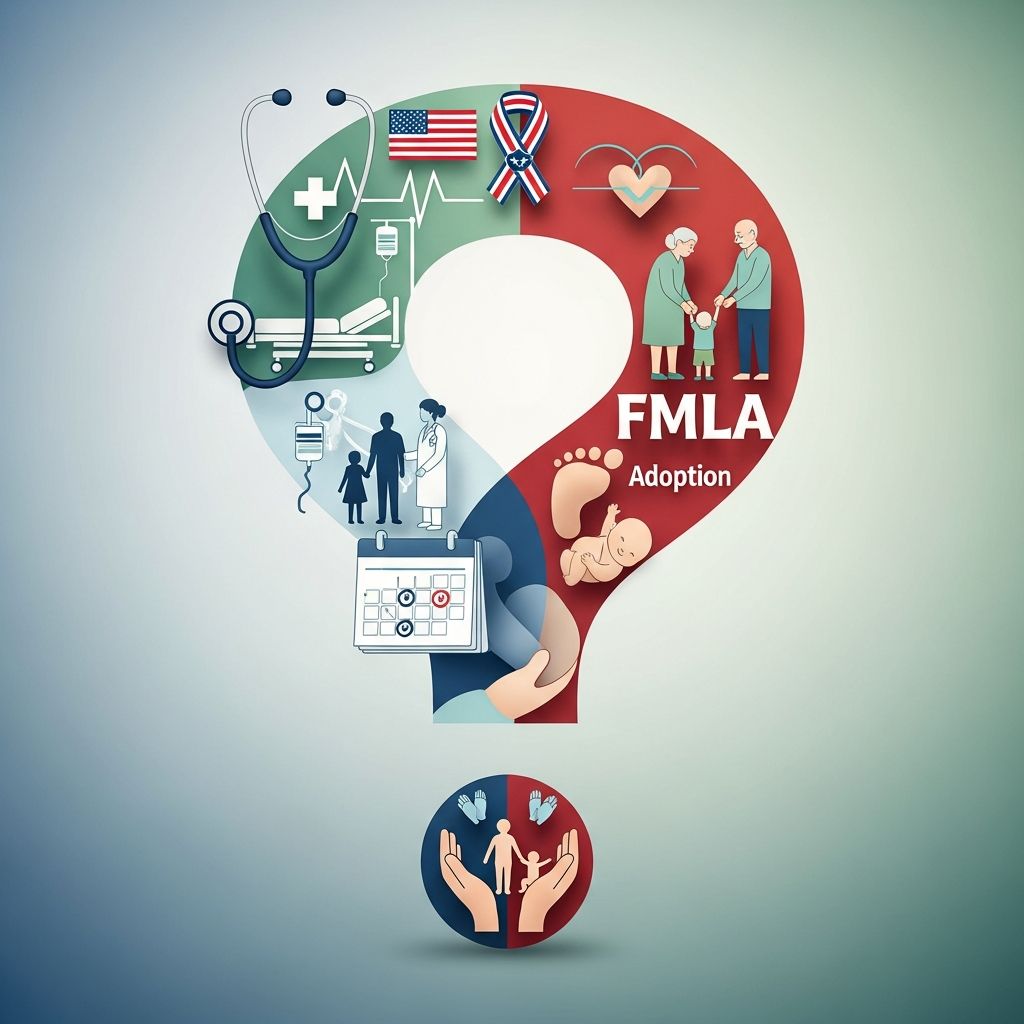
The federal Family and Medical Leave Act (FMLA) allows eligible employees of covered employers to take unpaid, job-protected leave for specific family and medical reasons. Knowing which situations qualify is essential so you can plan time away from work without risking your job or health insurance.
This guide explains the major qualifying reasons for FMLA leave, how they work in practice, and what limits or conditions may apply.
FMLA Basics in One Glance
| Key Feature | Standard FMLA Leave |
|---|---|
| Maximum duration | Up to 12 workweeks of unpaid leave in a 12-month period for most reasons; up to 26 weeks to care for a covered service member with a serious injury or illness. |
| Job protection | Right to return to the same or an equivalent position at the end of leave. |
| Health insurance | Group health coverage must be maintained under the same terms as if you had continued working. |
| Pay | FMLA leave is unpaid, but you may choose or be required to use certain paid leave during FMLA. |
| Eligibility (core test) | Work for a covered employer, have at least 12 months of service, and at least 1,250 hours worked in the 12 months before leave starts. |
What Counts as a Qualifying Reason?
Under federal law, eligible employees may use FMLA leave for these broad categories of reasons:
- Birth and bonding with a newborn child
- Placement of a child for adoption or foster care and bonding
- Caring for a spouse, child, or parent with a serious health condition
- Dealing with your own serious health condition when it prevents you from performing your job
- Specific military-related needs (qualifying exigencies)
- Military caregiver leave for a seriously injured or ill covered service member
Each category has its own rules about timing, documentation, and how much leave you can use. The sections below walk through each type in more detail.
1. Birth, Pregnancy, and Bonding With a Newborn
FMLA covers time off both for childbirth and for bonding with a new baby. This includes situations where pregnancy or childbirth causes a serious health condition.
Pregnancy and Childbirth as a Serious Health Condition
Pregnancy and childbirth can be serious health conditions when they require continuing treatment by a health care provider or cause a period of incapacity. Under FMLA, a serious health condition generally involves inpatient care or continuing treatment, such as:
- Inpatient hospital care related to pregnancy or delivery
- Ongoing prenatal visits and medically necessary bed rest
- Illnesses or complications requiring multiple medical visits or prescription treatment
A pregnant employee may use FMLA leave for:
- Prenatal medical appointments
- Incapacity due to morning sickness or pregnancy complications
- Recovery from childbirth when the condition makes working impossible
Bonding Time After Birth
FMLA also allows parents to take leave to bond with a newborn, even if neither parent has a serious health condition. Key points include:
- Bonding leave must be completed within 12 months of the child’s birth.
- Both parents working for different employers generally each have their own 12-week entitlement, subject to normal eligibility rules.
- Employers may require that bonding leave be taken in a single continuous block or may allow intermittent/reduced schedule leave, depending on policy and applicable rules.
2. Adoption or Foster Care Placement
Employees can take FMLA leave when a child is placed with them for adoption or foster care, as well as for bonding with the new child.
Covered Situations
Qualifying reasons related to adoption or foster care can include:
- Time needed for legal and administrative procedures for adoption
- Travel to meet the child or attend required meetings
- Initial adjustment period after the child joins the household
Similar to birth-related bonding leave:
- Adoption and foster care bonding leave must be used within 12 months of placement.
- Leave may be continuous or intermittent, depending on the employer’s policy and the circumstances.
3. Caring for a Family Member With a Serious Health Condition
Employees can use FMLA leave to care for a spouse, child, or parent who has a serious health condition. This is one of the most commonly used provisions of the law.
Who Counts as a Family Member?
Under federal FMLA, covered family members are:
- Spouse – generally a husband or wife as defined by state law, including same-sex spouses recognized under state law.
- Child – a biological, adopted, or foster child, stepchild, legal ward, or a child for whom the employee stands in loco parentis (in the place of a parent), generally under age 18, or over 18 if incapable of self-care due to a disability.
- Parent – a biological, adoptive, step, or foster parent, or someone who stood in loco parentis to the employee when the employee was a child; it does not include parents-in-law.
What Is a “Serious Health Condition”?
The FMLA uses a specific legal definition of a serious health condition. In general, it means an illness, injury, impairment, or physical or mental condition that involves:
- Inpatient care (an overnight stay) in a hospital, hospice, or residential medical care facility; or
- Continuing treatment by a health care provider, such as:
- A period of incapacity of more than three consecutive full calendar days with at least two visits to a health care provider, or one visit plus a regimen of continuing treatment (for example, prescription medication)
- Chronic conditions requiring periodic visits (at least twice a year) for treatment and causing episodic incapacity, such as asthma or diabetes
- Permanent or long-term conditions where treatment may not be effective, such as Alzheimer’s disease
- Conditions requiring multiple treatments or recovery, such as chemotherapy or physical therapy after surgery
Examples of Caregiving Activities
When caring for a covered family member, FMLA leave can be used for tasks such as:
- Taking the family member to medical appointments
- Providing assistance with activities of daily living (eating, bathing, dressing, transportation)
- Providing psychological comfort or reassurance during a serious health condition
Leave can be taken continuously, intermittently, or on a reduced schedule when medically necessary and properly certified.
4. Your Own Serious Health Condition
Employees may use FMLA leave for their own serious health condition when that condition makes them unable to perform the essential functions of their job.
When Your Condition Qualifies
Examples of situations that commonly qualify include:
- Hospitalization for surgery or serious illness and the related recovery period
- Chronic conditions like epilepsy, migraines, or severe asthma that periodically prevent you from working
- Serious mental health conditions such as major depression or post-traumatic stress disorder requiring inpatient care or ongoing therapy
- Cancer treatment, including chemotherapy and radiation
The key issue is whether you are unable to perform one or more essential job functions because of the health condition or its treatment. Employers may ask for a medical certification that describes the need for leave and the expected duration, but not your detailed diagnosis.
Intermittent or Reduced Schedule Leave
For your own serious health condition, FMLA leave can often be used:
- Intermittently (for example, a few hours or days at a time for flares of a chronic illness)
- On a reduced schedule (for example, working half-days during a treatment period)
When leave is foreseeable based on planned medical treatment, you are expected to work with your employer to schedule treatment in a way that does not unduly disrupt operations, when possible and consistent with your provider’s advice.
5. Military-Related Qualifying Exigency Leave
FMLA recognizes that a family member’s military service can create urgent needs at home. Employees may take up to 12 workweeks of FMLA leave in a 12-month period for certain qualifying exigencies arising from the fact that a spouse, child, or parent is on covered active duty (or has been notified of an impending call or order to such duty) in the Armed Forces.
Examples of Qualifying Exigencies
Qualifying exigency leave may be available for purposes such as:
- Short-notice deployment issues
- Military events and related activities (ceremonies, briefings)
- Childcare and school activities when the military member’s deployment creates the need
- Making or updating financial, legal, or childcare arrangements
- Counseling related to the deployment for the employee or certain family members
- Rest and recuperation visits with the service member during deployment (limited to a set number of days per leave period under regulations)
- Post-deployment activities such as attendances at ceremonies or addressing issues arising from a death on active duty
Employers may request documentation, such as deployment orders, to support exigency leave.
6. Military Caregiver Leave
Separate from exigency leave, FMLA provides a special entitlement called military caregiver leave. Eligible employees may take up to 26 workweeks of unpaid leave in a single 12-month period to care for a covered service member with a serious injury or illness.
Who Is a Covered Service Member?
Covered service members include:
- Current members of the Armed Forces (including National Guard and Reserve) undergoing medical treatment, recuperation, or therapy, or on outpatient status or the temporary disability retired list, for a serious injury or illness incurred in the line of duty
- Certain veterans who are undergoing treatment, recuperation, or therapy for a qualifying serious injury or illness and who were members of the Armed Forces during a specified time period before treatment began
Who May Take Military Caregiver Leave?
The employee must be the service member’s:
- Spouse
- Parent
- Child
- Next of kin (closest blood relative, as defined in the regulations)
Unlike the 12-week entitlement that can renew each FMLA year, the 26-week military caregiver leave is a one-time limit per service member, per injury in a single 12-month period, though employees may qualify again for a different injury or different service member.
How Eligibility and Coverage Affect Qualifying Reasons
Even if your reason clearly fits one of the categories described above, you must still satisfy FMLA eligibility and coverage rules.
Covered Employers
Under federal law, FMLA applies to:
- Private employers with 50 or more employees in 20 or more workweeks in the current or preceding calendar year
- All public agencies (federal, state, and local government)
- Public and private elementary and secondary schools, regardless of the number of employees
Employee Eligibility Requirements
To use FMLA leave with a qualifying reason, an employee must generally:
- Have worked for the employer for at least 12 months (not necessarily consecutively)
- Have at least 1,250 hours of service for the employer during the 12 months before the leave begins
- Work at a location where the employer has at least 50 employees within 75 miles (for most private-sector employees)
Certain categories of employees, such as some temporary or intermittent status federal workers, may be excluded under specific rules.
Notice, Certification, and Employer Rights
Even when your reason qualifies, FMLA is not automatic. Both employees and employers have responsibilities in the process.
Employee Notice
- When the need for leave is foreseeable (for example, scheduled surgery or expected birth), you generally must provide 30 days’ notice if practicable.
- When the need is not foreseeable, you must give notice as soon as reasonably possible under the circumstances.
Medical Certification
Employers may require a medical certification to support leave for a serious health condition (yours or a family member’s) or for military caregiver leave. The certification usually needs to include:
- Contact information and specialty of the health care provider
- Appropriate medical facts about the condition
- The need for leave and its likely duration
- Whether intermittent or reduced schedule leave is medically necessary
For qualifying exigency leave, employers may request documentation of the military member’s covered active duty status and a description of the exigency.
Common Misunderstandings About Qualifying Reasons
Some situations frequently cause confusion about FMLA coverage:
- Routine illnesses such as colds or minor flu typically do not qualify unless they meet the serious health condition standards (for example, complications requiring extended treatment).
- Childcare without a serious health condition is generally not covered, unless related to a military qualifying exigency.
- Paid vacation or personal time for non-medical reasons does not count as FMLA unless it is designated for a qualifying reason under the law.
However, employers and employees may agree to use accrued paid leave at the same time as FMLA when a qualifying reason exists, effectively providing income replacement during some or all of the FMLA period.
Frequently Asked Questions (FAQs)
Q1: Does every medical problem qualify for FMLA leave?
No. The condition must meet the legal definition of a serious health condition, which usually involves inpatient care or continuing treatment by a health care provider, such as multiple visits, prescription medication, or chronic conditions that cause periodic incapacity.
Q2: Can I take FMLA leave to care for a sibling or grandparent?
Under federal FMLA, siblings and grandparents are not covered family members unless they stood in loco parentis when you were a child or you are next of kin to a covered service member for military caregiver leave. Some state laws may provide broader family definitions.
Q3: If I adopt a child, is my leave different from birth-related leave?
Both birth and adoption/foster care placement can qualify you for up to 12 workweeks of FMLA leave within 12 months of the child’s arrival, primarily for bonding and to manage placement-related tasks. The entitlement amount is the same, though specific timing and employer policies on intermittent leave may differ.
Q4: Can my employer ask for proof of my family member’s serious health condition?
Yes. Employers may require a medical certification completed by the health care provider of you or your family member. They may also seek clarification or authentication under specific rules, but they generally cannot demand detailed diagnosis information beyond what the certification requires.
Q5: What if my state has its own family or medical leave law?
Many states have separate family and medical leave programs with different eligibility rules, broader family definitions, or paid benefits. When both federal FMLA and state law apply, employees usually receive the greater protection or benefit available under either law.
References
- Fact Sheet #28: The Family and Medical Leave Act — U.S. Department of Labor, Wage and Hour Division. 2023-02-01. https://www.dol.gov/agencies/whd/fact-sheets/28-fmla
- Fact Sheet #28F: Qualifying Reasons for Leave under the Family and Medical Leave Act — U.S. Department of Labor, Wage and Hour Division. 2013-02-01. https://www.dol.gov/agencies/whd/fact-sheets/28f-fmla-qualifying-reasons
- Family and Medical Leave Act (FMLA) 12-Week Entitlement — U.S. Office of Personnel Management. 2023-01-15. https://www.opm.gov/policy-data-oversight/pay-leave/leave-administration/fact-sheets/family-and-medical-leave/
- The Family and Medical Leave Act (FMLA) — USAGov. 2024-04-10. https://www.usa.gov/family-leave-act
- 29 CFR Part 825 – The Family and Medical Leave Act of 1993 — Electronic Code of Federal Regulations (eCFR), U.S. Government Publishing Office. 2024-01-01. https://www.ecfr.gov/current/title-29/part-825
- The Family and Medical Leave Act: An Overview of Title I — Congressional Research Service. 2015-11-19. https://crsreports.congress.gov/product/pdf/R/R44274
- Family and Medical Leave Act (FMLA) — Colorado Department of Personnel & Administration, Division of Human Resources. 2023-08-01. https://dhr.colorado.gov/state-employees/time-off-leave/family-medical-leave-act-fmla
Similar Articles








Read full bio of medha deb




