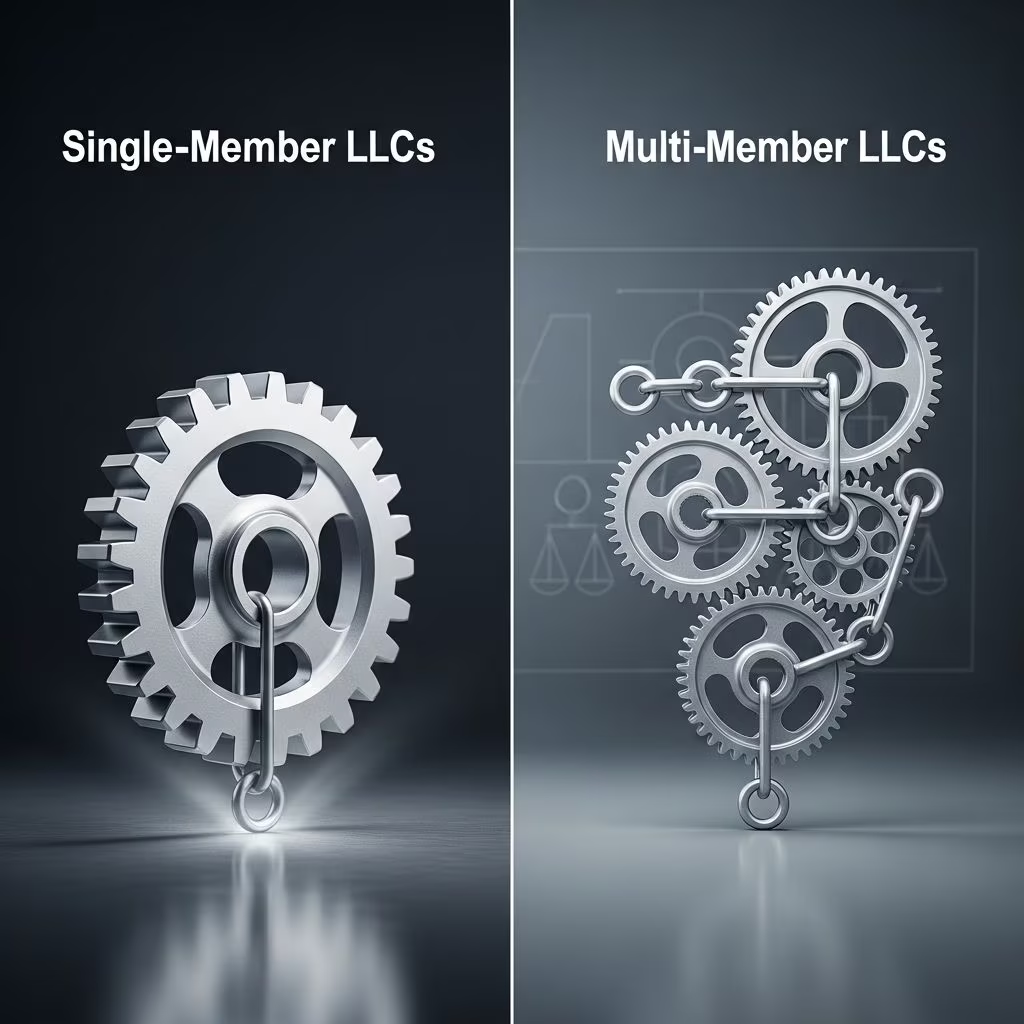
A Limited Liability Company (LLC) offers entrepreneurs a flexible way to protect personal assets while enjoying pass-through taxation. The primary distinction lies in ownership: a **single-member LLC** has one owner, providing simplicity and full control, whereas a **multi-member LLC** involves two or more owners, enabling shared resources but requiring more coordination.
Defining Ownership Structures in LLCs
Understanding the foundational differences starts with ownership. In a single-member LLC, one individual or entity holds complete ownership, making decisions swiftly without needing consensus. This setup suits solopreneurs, freelancers, and consultants who value autonomy. Conversely, multi-member LLCs distribute ownership among partners, family members, or investors, fostering collaboration and diverse input.
Owners in multi-member setups, known as members, can include people, corporations, or other LLCs, with no upper limit on numbers. This structure often appeals to startups needing pooled capital or expertise. Both types maintain the LLC’s core benefit: limited liability, shielding personal assets like homes and savings from business debts.
Taxation Breakdown: How Ownership Affects Your Returns
Tax rules vary significantly by member count, impacting filing requirements and strategies. Single-member LLCs are ‘disregarded entities’ by the IRS, meaning the owner reports all income and expenses on personal Form 1040 via Schedule C, akin to a sole proprietorship. This simplicity avoids separate business returns but exposes the owner to self-employment taxes on net earnings.
Multi-member LLCs default to partnership taxation, filing Form 1065 and issuing Schedule K-1s to each member, who then reports their share on personal returns via Schedule E. This pass-through avoids double taxation but demands meticulous profit allocation tracking. Both can elect S-corp or C-corp status for potential savings, such as deducting salaries before self-employment taxes.
| Aspect | Single-Member LLC | Multi-Member LLC |
|---|---|---|
| Default IRS Treatment | Disregarded Entity (Schedule C) | Partnership (Form 1065 + K-1s) |
| Filing Complexity | Low | Moderate to High |
| Self-Employment Taxes | On all net income | On guaranteed payments/salary |
| Election Options | S-Corp/C-Corp | S-Corp/C-Corp |
For married couples in community property states, a single-member LLC may suffice for joint ventures, treated as disregarded for federal taxes. Always consult IRS guidelines or a tax professional for state-specific nuances.
Managing Operations: Control and Decision-Making
Single-member LLCs grant the owner absolute authority over daily operations, strategic directions, and financial choices, minimizing bureaucracy. No need for voting protocols or member approvals accelerates growth for solo ventures.
In multi-member LLCs, management can be member-managed—all owners participate—or manager-managed, where designated managers (members or outsiders) handle operations. This requires a robust operating agreement outlining voting rights, major decision thresholds (e.g., 51% majority), and roles to avert conflicts.
- Member-Managed: Democratic input ideal for small teams with aligned visions.
- Manager-Managed: Efficient for larger groups or passive investors.
- Key Agreement Clauses: Profit/loss splits, capital contributions, dispute resolution, exit strategies.
Without clear governance, multi-member LLCs risk paralysis from disagreements, underscoring the need for detailed documentation.
Liability Safeguards: Protection Levels Examined
Both structures provide robust personal liability protection, isolating business obligations from owners’ private assets. Creditors can pursue LLC assets but generally not personal bank accounts or property, barring personal guarantees or fraud.
Multi-member LLCs may offer marginally stronger separation due to multiple owners and formal agreements, potentially deterring aggressive lawsuits. Single-member LLCs face occasional IRS or court scrutiny as ‘alter egos’ if commingling funds occurs, but proper maintenance mitigates this. Spousal LLCs add layers, especially in non-community property states.
Pros and Cons: Weighing Your Options
Each LLC type suits distinct scenarios. Here’s a balanced view:
| Single-Member LLC Pros | Single-Member LLC Cons | |||
|---|---|---|---|---|
| Multi-Member LLC Pros | Multi-Member LLC Cons | |||
| Simplicity & Control | ✓ Full autonomy, easy setup | ✗ All risks on one person | ||
| Collaboration | ✓ Shared expertise, capital | ✗ Disputes, complexity | ||
| Credibility | Less appealing to investors | ✓ Attracts partners/lenders | More paperwork |
Single-member suits bootstrapped operations; multi-member excels in scalable enterprises.
Building a Solid Operating Agreement
Single-member LLCs benefit from basic operating agreements for banking and clarity, though not mandatory in all states. Multi-member versions are essential, detailing:
- Ownership percentages and capital commitments.
- Voting procedures and deadlock resolutions.
- Profit distributions and loss allocations.
- Member addition/removal, buy-sell terms.
- Succession upon death or incapacity.
These documents prevent litigation and ensure smooth transitions.
Evolving Your LLC: Adding or Removing Members
Businesses change, and so can LLC structures. Adding a member to a single-member LLC shifts it to partnership taxation; update the operating agreement, file amendments with the state, and notify the IRS (often via EIN if needed). Removing members reverses this, potentially reverting to single-member status.
Spousal additions in community property states may not alter tax treatment. Multi-member to single-member conversions require buyouts or transfers, documented meticulously to avoid tax pitfalls. Professional legal advice is crucial during transitions.
Special Scenarios: Family and Spousal LLCs
Married couples often debate structures. A single-member LLC with one spouse as owner simplifies taxes in community property states (e.g., CA, TX), qualifying as disregarded. Multi-member lists both, treated as partnership elsewhere, offering clearer separation.
Family businesses thrive in multi-member formats, leveraging shared responsibilities while protecting assets.
Compliance Essentials: Filings and EINs
Single-member LLCs may operate without an EIN if no employees, using the owner’s SSN. Multi-member always require one for partnership filings, even sans payroll. Both need state Articles of Organization, annual reports, and licenses.
Strategic Selection: Matching Structure to Goals
Choose based on vision: solo control favors single-member; growth via partners suits multi-member. Factor taxes, complexity, and scalability. Consult attorneys and CPAs early.
Frequently Asked Questions
What’s the main difference between single-member and multi-member LLCs?
Single-member has one owner with full control; multi-member has two or more sharing ownership and decisions.
Do both provide equal liability protection?
Yes, both shield personal assets from business liabilities when properly maintained.
Can I convert a single-member LLC to multi-member?
Yes, by adding members, amending agreements, and updating tax status with IRS/state.
Which is simpler for taxes?
Single-member, via personal Schedule C; multi-member requires partnership returns and K-1s.
Is an operating agreement required for single-member LLCs?
Not always legally, but highly recommended for clarity and protection.
References
- Single vs Multi-Member LLC Differences Explained — UpCounsel. 2023. https://www.upcounsel.com/single-member-llc-vs-multi-member-llc
- Single-Member LLC vs. Multi-Member LLC — Tailor Brands. 2024-01-15. https://www.tailorbrands.com/blog/single-member-llc-vs-multi-member-llc
- Single-Member LLC vs. Multi Member LLC — LegalZoom. 2023-05-10. https://www.legalzoom.com/articles/single-member-or-multiple-member-llcs
- Single Member LLC — Northwest Registered Agent. 2024. https://www.northwestregisteredagent.com/llc/single-member
- Single Member vs Multi Member LLCs Key Differences Explained — YouTube (Transcript). 2023-08-20. https://www.youtube.com/watch?v=WTJOCFmlnrk
- LLC Ownership for Married Couples — Carolina Family Estate Planning. 2023. https://www.carolinafep.com/blog/llc-ownership-for-married-couples-should-you-choose-single-member-or-multi-member-.cfm
- Single member limited liability companies — Internal Revenue Service. 2025-02-01. https://www.irs.gov/businesses/small-businesses-self-employed/single-member-limited-liability-companies